


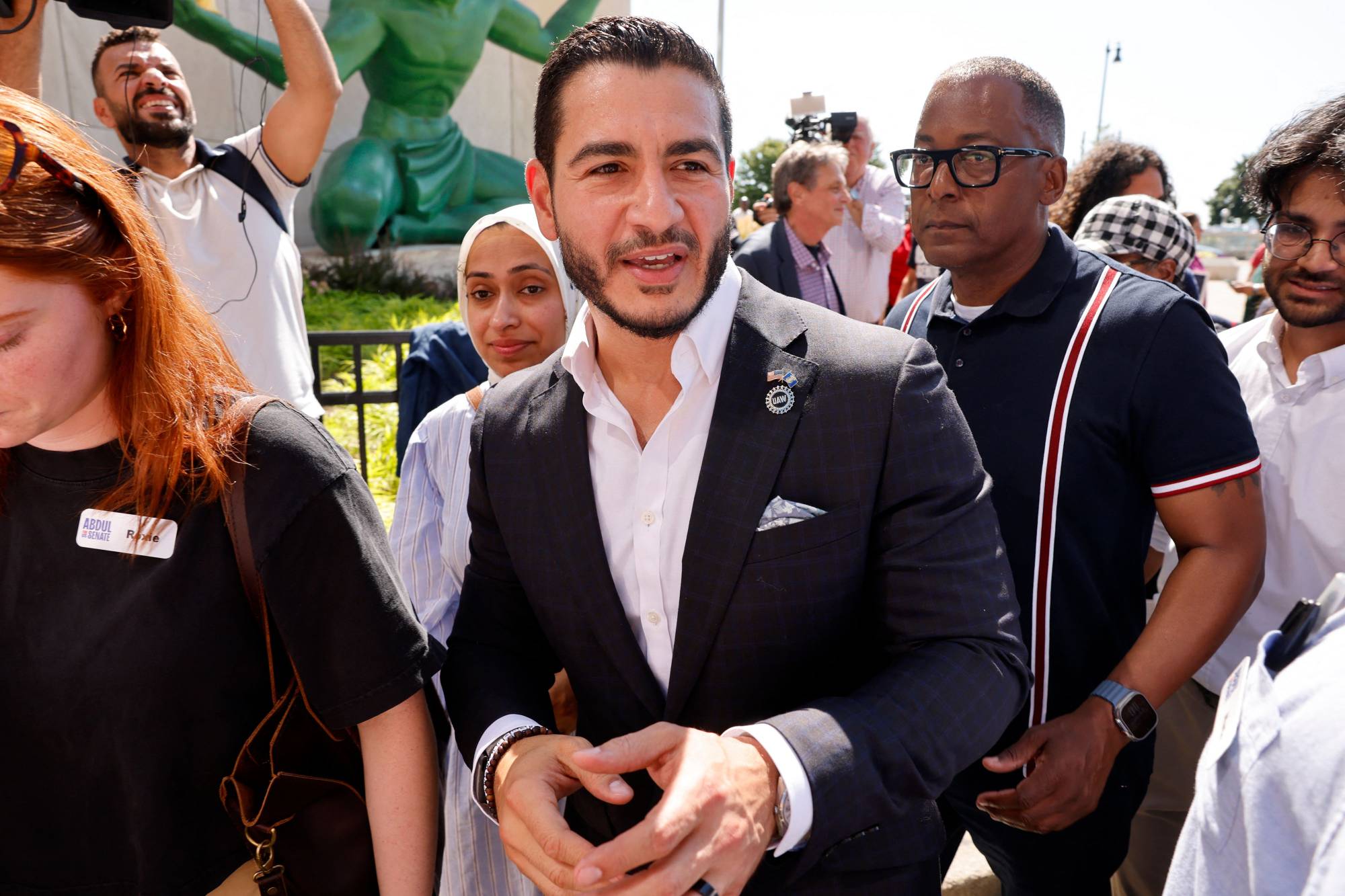
Abdul El-Sayed, 42, made history as the first Muslim elected to the US Senate after winning a crucial seat in Michigan in Tuesday's congressional midterm elections.
Born in Michigan on October 31, 1984, El-Sayed previously served as a public health official in Wayne County, in the battleground state. He has never held elected office, but he is no stranger to politics. In 2018, he ran for governor of Michigan, finishing second to Gretchen Whitmer in the Democratic primary.
El-Sayed grew up in the Detroit area with his father, Mohamed, an Egyptian immigrant who came to the United States to study at Wayne State University, and his stepmother, Jackie. His biological mother, Fatten Elkomy, is a psychiatric nurse in Missouri.
El-Sayed describes himself as "as Michigan as you get." He attended local schools, graduating from high school in 2003. During his school years, he captained the lacrosse, wrestling and football teams.
He went on to the University of Michigan, where he majored in biology and political science and played on the university's lacrosse team. He graduated in 2007 with highest distinction and was selected to deliver the student commencement address.
"We have the audacity to believe that we can change this world, and that each of us will," he told his fellow graduates, describing what made Michigan exceptional.
El-Sayed received a full-tuition scholarship to the University of Michigan Medical School. After completing two years of medical school, he was awarded a Rhodes Scholarship for 2009 to study at Oriel College, Oxford University, where he completed a doctorate in public health in 2011.
He was the University of Michigan's first Rhodes Scholar since 2004. At Oxford, he continued playing lacrosse and earned a Full Blue, the university's highest sporting honor, as team captain.
By 2014, El-Sayed had completed his medical education, earning his medical degree from Columbia University's College of Physicians and Surgeons.
He subsequently joined Columbia's faculty as an assistant professor of epidemiology. Months later, then-Detroit Mayor Mike Duggan appointed him health officer and executive director of the city's Health Department.
El-Sayed rebuilt Detroit's Health Department following the city's bankruptcy. He later restructured Wayne County's Department of Health, Human and Veterans Services, which serves 1.8 million residents in Michigan's largest and most diverse county.
As a public servant, El-Sayed secured free eyeglasses for children in need, challenged some of Michigan's biggest polluters and expanded access to the lifesaving overdose-reversal medication naloxone, commonly known by the brand name Narcan.
He also spearheaded a program to eliminate up to $700 million in medical debt for 300,000 Michigan residents over two years.
His work earned him recognition as Public Official of the Year from the Michigan League of Conservation Voters and a place on Crain's Detroit Business's 40 Under 40 list.
Nationally recognized for his expertise in improving the American healthcare system, El-Sayed is the author of Medicare for All: A Citizen's Guide.
He later returned to public service as director of Wayne County's Department of Health, Human and Veterans Services, serving from December 2022 until April 2025, when he resigned to seek elected office once again, this time in the US Senate.
El-Sayed has also made a name for himself as a podcast host, including through America Dissected.
His medical credentials have attracted controversy, largely because he has described himself as a physician despite not holding a license to practice medicine in Michigan.
Although he studied medicine, El-Sayed came to believe that a broken political system was what was making people sick. That conviction ultimately led him to run for the Senate.
According to his campaign website, he entered the race because he believes life in America should not be so difficult and wants to build a government that serves ordinary Americans rather than Elon Musk, Donald Trump and their billionaire allies.
Responding to questions about his medical credentials in July, El-Sayed said: "I did graduate from a school that's literally called Columbia College of Physicians and Surgeons. So, you know, you can go have that argument with Columbia University if you'd like."
In his only previous bid for elected office, El-Sayed finished second to Gretchen Whitmer in Michigan's 2018 Democratic gubernatorial primary, ahead of Shri Thanedar, who subsequently won a seat in the state legislature and later in the US House of Representatives.
Throughout his Senate campaign, El-Sayed distilled his platform into a three-part message: "Money out of politics, money in your pocket, Medicare for All."
He repeatedly emphasized that he was the only candidate running for the US Senate in Michigan who had never accepted a dime of corporate campaign money and never would.
El-Sayed lives in Ann Arbor with his wife, Sarah, and their two young daughters, Emmalee and Serene.


