


Houthi Summer Centers: A 'Mandatory' School Passage to the Front Lines

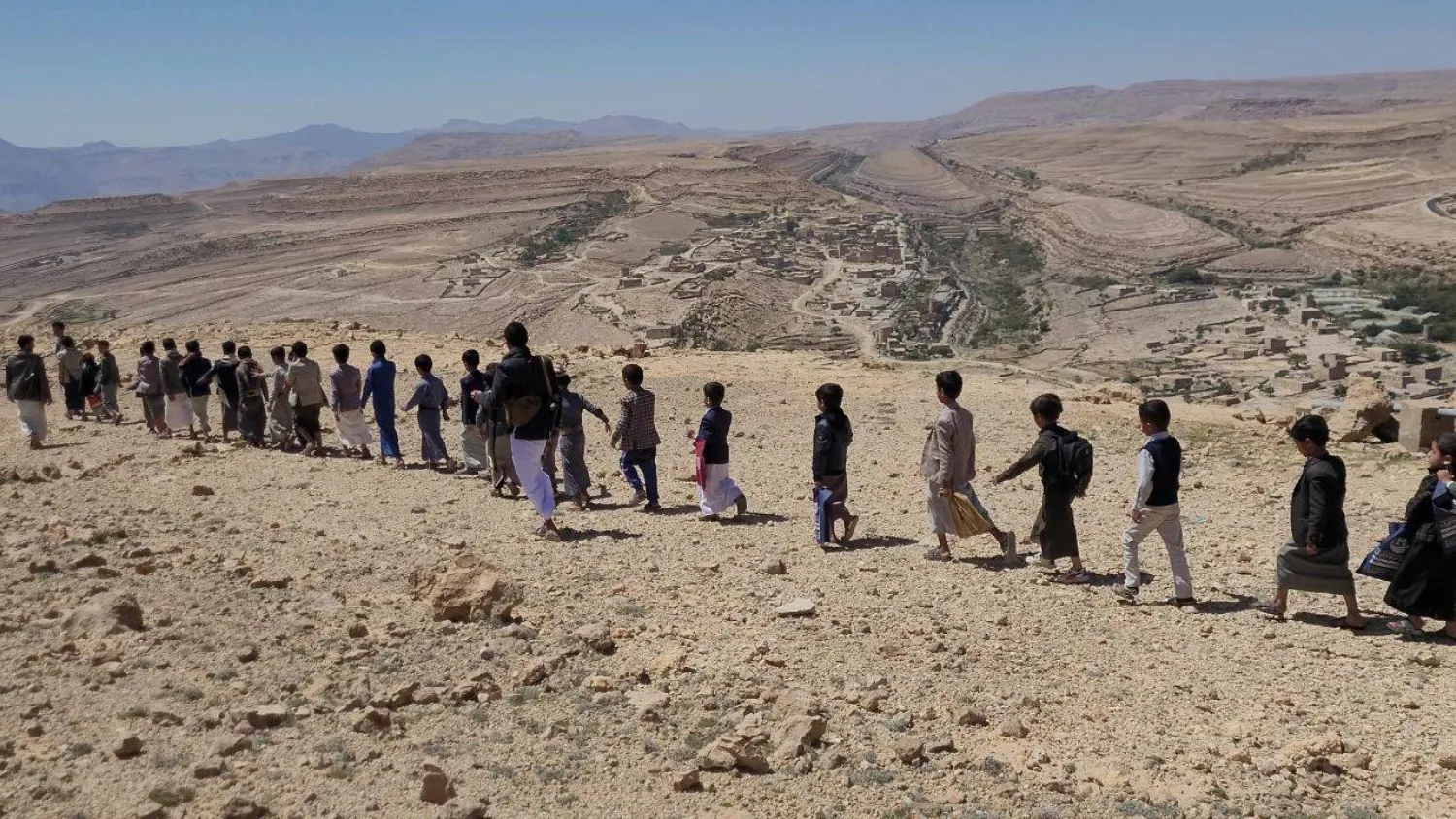
“School trip” for children at a Houthi-run summer camp in Amran (Asharq Al-Awsat)
TT

Houthi Summer Centers: A 'Mandatory' School Passage to the Front Lines

“School trip” for children at a Houthi-run summer camp in Amran (Asharq Al-Awsat)

In a corner of the courtyard of a public school in Sanaa, a woman dressed in black stands, once used to seeing her son in the morning assembly line. Today, she returns to the same place not as a mother, but as a cleaner trying to keep what remains of her life intact. She wipes the ground in heavy silence, as if whispering to the courtyard gravel: I had a son here. He left a child and came back a corpse.

She sees her son’s face in the student lines, hearing chants and slogans that were once unfamiliar. Quietly, she realizes many of them may follow the same path, but she says nothing. Two years ago, Umm Amer lost her only son. He was 17. He was returned to her a lifeless body, his image raised atop a coffin. They told her: “Ululate, he has attained martyrdom.”

She recalls how he began to change gradually after joining that summer camp. He became quieter, sometimes sharper, shouting and repeating phrases she had never known, about “jihad” and “victory,” as if they were his only path. She did not understand what was happening, but she saw in his eyes a look that was carrying him away from her.

Today, she does nothing but wipe her tears in secret and continue cleaning, in a job she obtained as the “mother of a martyr,” to support her three daughters after losing the family’s provider.

From Summer Activity to Mobilization Apparatus

The Houthi summer centers did not emerge with the group’s takeover of Sanaa in 2014. They are an extension of a historical trajectory tied to the group’s origins. Their beginnings date back to the early 1990s, specifically 1991, when activities were organized under what was known as the “Believing Youth” in Saada. These included youth programs and seasonal courses aimed at transmitting ideological messaging through study circles and summer camps, serving as early tools to build a social and organizational base by combining education with ideological formation.

With the outbreak of the Saada wars in 2004, these activities underwent a qualitative shift. They were no longer limited to religious or educational aspects but became tools of mobilization and recruitment, benefiting from public sympathy during the conflict and expanding their reach among youth.

By 2008, the group began spreading these activities beyond Saada using nontraditional means, including distributing digital materials on SD cards and USB drives. These contained Houthi doctrinal lectures and lessons tied to the summer centers, as well as what is known as the “Malazim” - Houthi doctrinal lectures delivered by the group’s founder, Hussein Badr al-Din al-Houthi, transcribed into booklets.

A supervisor in Sanaa said he received such memory devices in 2008, distributed among selected students. Upon reviewing their contents, he found recordings and Houthi doctrinal lectures by Hussein Badr al-Din al-Houthi, noting that these materials marked a turning point in his adoption of the group’s ideas and support for it.

He attended closed gatherings to listen to these Houthi doctrinal lectures in private meeting spaces with individuals close to the group in Sanaa and nearby areas such as Bani Hushaysh, Khawlan, and Sanhan.

Following the developments of 2011, particularly the February protests and sit-ins and the broader moment of political opening, these activities expanded to a number of provinces. More organized centers and courses appeared outside the group’s main stronghold, with clearer administrative oversight under the appealing slogan “regime change.” They moved beyond narrow circles to fill libraries and kiosks with the Malazim, establishing stalls in multiple locations to distribute booklets, posters, and slogans free of charge, and installing loudspeakers to continuously broadcast chants.

The most significant transformation came after the takeover of Sanaa in 2014, when summer centers shifted from limited activities into a wide-ranging program formally administered through state institutions, within an organizational structure that includes central, technical, and supervisory committees, with the involvement of multiple ministries.

A security source said the group had, in earlier stages, relied on what it called “cultural courses” and religious seminaries to attract youth, gain their sympathy, and integrate them into its project before the current model of summer centers emerged. The source added that these centers “are no longer limited, but have become an institutional program managed within an integrated organizational structure,” noting that they are used as a tool to influence youth orientations, ultimately pushing some toward the front lines.
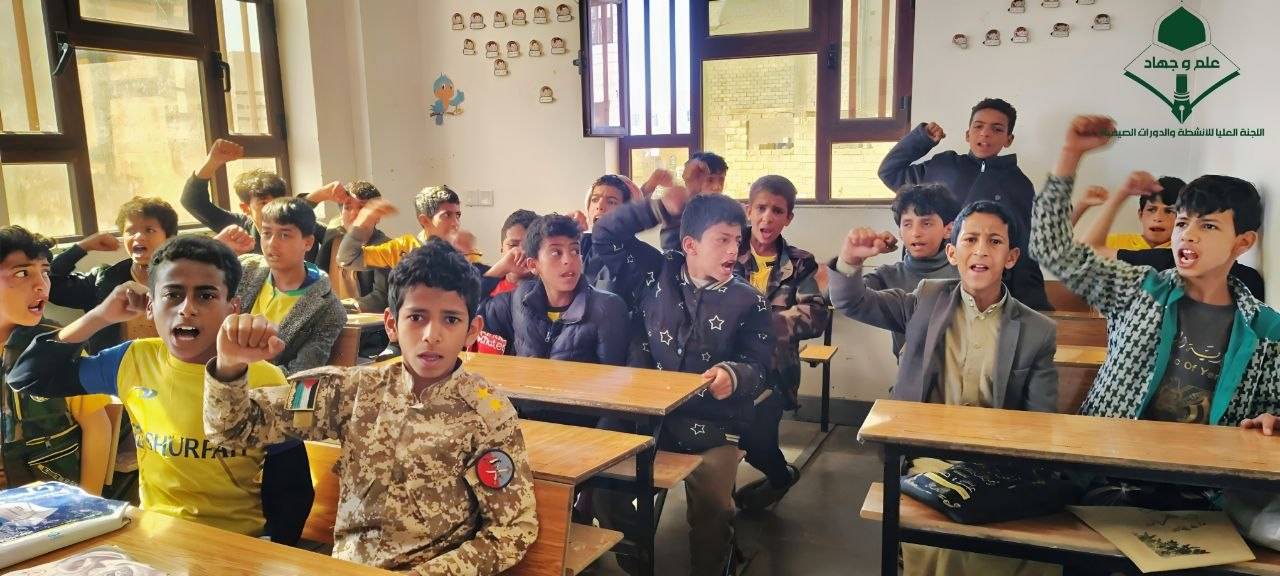
Students in a classroom perform a military salute and chant the Houthi slogan (al-sarkha) (Asharq Al-Awsat)

Types of Summer Camps

According to available information, the group divides these centers or camps into three types: closed, model, and open. Closed camps function as ideological military courses. They are held in military barracks and focus primarily on preparing participants to become fighters within the group. They are trained both militarily and ideologically for this purpose and are considered reserve forces. Once enrolled, their phones are confiscated, contact with their families is cut off, and they are transported at night between training camps that change periodically.

All participants are high school students who have completed weapons dismantling training in schools. Their trainers nominate them for military courses as a reward for excellence and distinction, in addition to some members of school scout groups whose activities have been shifted from scouting to military.

In these camps, participants are trained to use light and medium weapons, RPGs, mortars, grenades, and camouflage and concealment techniques.

Model camps, typically for those over the age of 10, are considered “specialized camps.” Top-performing students in various school activities are recruited to them. These are closed camps where students remain throughout the week, but they are allowed to communicate with their families and their phones are not confiscated. They may return home weekly or every two weeks.

These camps are usually held in provincial capitals, where students receive intensive ideological lectures from senior group leaders, watch films on “jihad,” and study the biographies of the group’s leaders, Hezbollah, and Iran’s Revolutionary Guard. They also receive limited training in dismantling and using certain types of weapons.

Open camps are for children aged 5 to 10. They begin in the morning and end at noon, appearing to the public as Quran memorization centers and summer activities. As a result, the group spreads them across schools and mosques to make them widely accessible. However, children in these camps are taught the “pledge of allegiance,” to chant the Houthi slogan (al-sarkha), and to obey the group’s leader.

Girls are not excluded. There are dedicated centers for females, managed by the General Women’s Cultural Authority, which designs and implements programs, recruits students through field networks, supervises female staff, and prepares unified guidance materials.

These centers are presented as educational and recreational spaces, but they also include intensive religious programs, mobilization-oriented lectures, and group activities that reinforce discipline and belonging.

Embedding a “Conspiracy Theory” Narrative

In its messaging, the group promotes the idea that the summer centers are a fortress against “conspiracies” targeting religion and the nation. They are presented as a means of instilling what it calls “Quranic culture” in younger generations and building a generation armed with knowledge and awareness.

The group also emphasizes that the “battle with the enemy” is not limited to the military dimension but extends to “targeting awareness.” These centers are framed as a safeguard against what is described as “soft war” and “cultural invasion,” and as part of a long intellectual struggle aimed at preparing a generation capable of confrontation.

Alongside this messaging, educational sources indicate that organizers rely on a set of material and moral incentives, such as providing meals, basic supplies, organizing trips, and offering activities, to attract as many students as possible each year.

According to one of the Malazim, a Houthi doctrinal lecture by founder Hussein Badr al-Din al-Houthi titled “Lessons in Knowing God,” delivered at the Believing Youth forum in Saada, the overarching objective is to “develop students’ knowledge of God and entrench doctrine within their souls and consciences, in a way that propels them toward fighting and confronting enemies.”

Lessons Outside the Official Curriculum

In this year’s season, which began on March 28, the group distributed its own curricula for the summer centers, printed in high quality with a distinct visual identity. This reflects the scale of resources allocated to these programs compared to formal education, which continues to suffer from declining support and capacity.

Students are often forced to purchase their official textbooks from the black market, while teachers struggle to obtain their salaries. Each year, as preparations for the summer centers begin, the group’s leader, Abdul-Malik al-Houthi, delivers an annual speech calling for enrollment, a call that has itself evolved significantly over time.

These materials carry no reference to the Republic of Yemen or the Ministry of Education. Instead, they are issued under the title “The Quranic March – General Administration of Summer Courses.”

This extends to the naming of the centers, which are not attributed to the schools hosting them but are instead given symbolic names such as “Al-Hadi,” “Al-Hussein,” “Fatima,” “Martyr Taha al-Madani,” and “Martyr Saleh al-Sammad.”
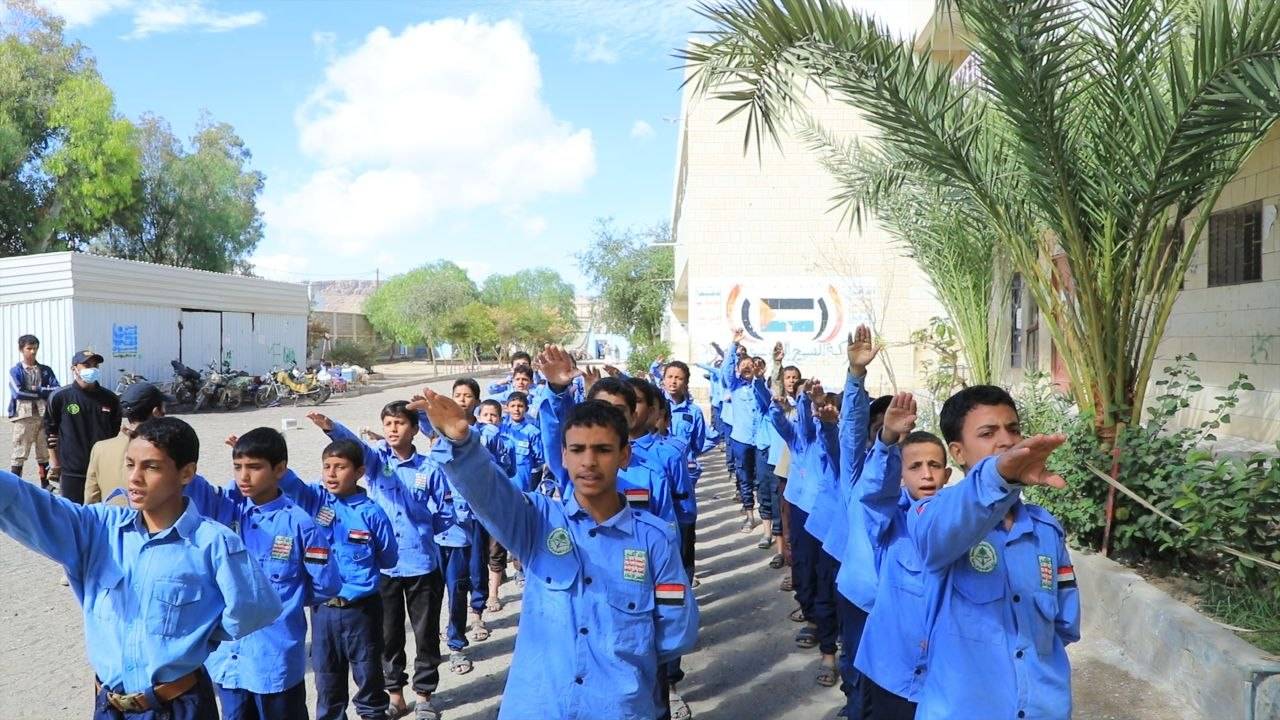
Morning assembly for children in uniform at Houthi summer camps (Asharq Al-Awsat)

Administrative Structure with a Ministerial Character

The administrative structure of the summer courses and activities in areas under Houthi control reflects a multi-level system, led by the Ministries of Education and Youth and Sports, alongside the General Mobilization Authority, which plays a central role in mobilization and guidance, and the Ministry of Endowments, responsible for religious content.

At the executive and technical levels, local authorities in Houthi-controlled provinces oversee field implementation and coordinate activities within districts and centers through education offices and supervisory committees. Daily activities are managed, staff are assigned, and program implementation is monitored, reflecting a system that extends from central leadership down to neighborhoods.

Other ministries participate as technical partners in sectoral programs: the Ministry of Interior runs “Aware Youth... Safe Society,” Agriculture oversees the “Green Army,” Health manages “Health Ambassadors,” the communications sector supervises “Awareness in the Age of Communications,” and Technical Education and Vocational Training oversees “My Profession is My Future.”

The Ministry of Information plays an ongoing supporting role through annual coordination ahead of the launch of the courses, setting the framework for media coverage, including promotion and field reporting, as part of a plan to strengthen the centers’ presence in society.

These centers are managed by the “Supreme Committee for Summer Courses and Activities,” chaired by the prime minister in the Houthi administration, with membership including the ministers of education and youth and sports, a representative of the Endowments Authority, and representatives from the group’s mobilization and cultural apparatus.

Subcommittees are headed by provincial governors, with mobilization officials as deputies, and include directors of education, youth and sports, and endowments offices.

A Turning Point in 2026

While expansion of the summer centers had occurred gradually in previous years, 2026 marks a decisive turning point. Summer schooling is no longer optional; the group has moved to a new phase in which attendance is effectively compulsory. According to testimonies from students, parents, and teachers, a network of direct and indirect pressures is being applied, at times reaching the level of threats, placing families before a stark equation: comply or risk their children’s future.

Although this shift has not been officially announced, it has become a daily reality. Multiple sources confirm that, with preparations for this year’s summer centers underway, the group has escalated practices linking school procedures to participation in these programs.

For example, student results and admission for the next academic year are tied to participation, alongside pressure on school administrations to push students into the camps under threat of penalties. If a student wants their academic record to remain free of marks that could affect their future, including university admission, they must register in these centers.

In some schools, the release of results or acceptance into the following year is tied to a certificate of attendance from the summer center. Messages circulated on communication groups include implicit warnings that absence may negatively affect academic progression.

One message sent by a school administrator to mothers in a WhatsApp group contains a veiled threat that any student who does not attend the summer centers will be denied enrollment next year: “Dear mothers, please be informed that registration will not be accepted without a certificate from the summer center. We ask that students who have not yet registered do so and join the center to benefit.”

In another group, a teacher urged students: “Come early tomorrow, those registered and those not yet registered should register. The administration will not accept them at the start of the school year without the summer center certificate.”

A message attributed to a school principal in northern Ibb indicated that attendance at the summer centers is a condition for receiving exam results, while failing students are enticed with additional marks if they join the courses.
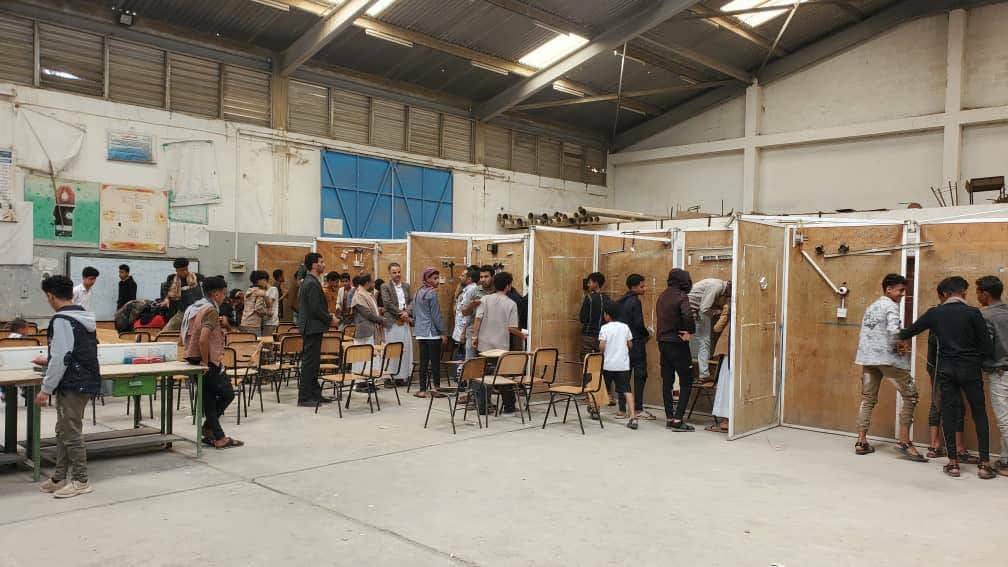
Extracurricular activities titled “My Profession is My Future” at a Houthi-run summer camp (Asharq Al-Awsat)

Declining Participation and Criminalization

According to sources, these measures were introduced out of concern that the summer centers might face declining turnout, as families are increasingly aware of their outcomes. Teacher A. Abdul Karim, who works in these centers, said that despite the group’s efforts to mobilize as many students as possible, participation has recently declined.

He noted that turnout has become very weak, and that recruiting students now requires significant time, sustained persuasion, and financial incentives.

The Yemeni Teachers’ Syndicate warned of the dangers posed by these centers, stating they have become organized tools for sectarian ideological mobilization and the recruitment of children and youth, as part of a systematic targeting of national identity and the education system in Yemen.

In a statement dated Sunday, April 12, 2026, the syndicate said the group has expanded these centers since taking control of Sanaa to attract the largest number of students, using them to instill doctrinal ideas based on concepts of lineage-based selection that conflict with national and religious values and serve a political project threatening Yemen’s security and stability.

Neglected Schools, Flourishing Centers

In its messaging, the group describes the summer centers as an “educational support channel” to compensate for gaps caused by war. However, according to many teachers, this is nothing more than a worse excuse than the offense itself. Schools themselves could serve that role if there were genuine intent to reform education.

Teachers argue that the group’s insistence on these centers reveals that the goal is not education, but the production of a generation prepared for early recruitment and ideological mobilization. They pose a central question: if the group holds full control over formal education and has successfully inserted its ideology into school curricula, why deliberately neglect schools, leaving them in a state of near collapse, without teachers, salaries, or basic educational resources?

This contradiction between stagnating schools during the academic year and their sudden revival in summer raises serious questions.

While significant attention, funding, and effort are directed toward summer centers that quickly turn into active and crowded spaces, formal education remains in a state of severe stagnation and resource deprivation, with thousands of schools lacking even the most basic requirements for learning.

Why Is a ‘Very Close’ Iran-US Deal Taking So Long?

A man walks past Iran's national flag at the Vanak Square in Tehran on June 10, 2026. (AFP)
TT

Why Is a ‘Very Close’ Iran-US Deal Taking So Long?

A man walks past Iran's national flag at the Vanak Square in Tehran on June 10, 2026. (AFP)

President Donald Trump has repeatedly declared Iran and the US are on the verge of agreeing a deal to end the Middle East war, but a litany of sticking points have delayed finalizing an accord and will complicate its implementation, analysts say.

Trump has been widely mocked in US and Iran for frequently insisting an end to the conflict was imminent even as negotiations dragged on for weeks, with US network CNN saying he had used phrases like "very close to a deal" or in the "final throes" of talks on 39 occasions.

In what has become a familiar pattern, Trump on Thursday withdrew a threat of renewed strikes on Iran and said a deal could be signed in the coming days, only for Iran's foreign ministry to respond by saying it "has not reached a final conclusion on the agreement".

Arash Azizi, lecturer at Yale University, told AFP that one reason the deal has taken so long is that the Iranian side believed "they could hold out to get better terms" after not capitulating during the conflict.

Trump, meanwhile, "could hardly stomach" releasing Iran's frozen assets -- a key demand of Tehran -- and also risked facing accusations the accord would be more favorable to Iran than the 2015 nuclear deal he pulled out of during his first term, he added.

Trump "had to accept that his initial gambit of causing an Iranian capitulation by sheer military force didn't work and he had to settle for something much less", said Azizi.

Both Iran and the United States would appear to have vested interests in ending a conflict that saw five weeks of all-out war, paused by an uneasy ceasefire on April 8.

The US-Israeli war has become increasingly unpopular in the US, even among the president's core supporters, with Trump mindful of the looming US midterm elections.

A deal could also see Tehran win the security guarantees and recognition it has long craved from the US and ensure the personal safety of its own leadership, after former supreme leader Ali Khamenei and several top officials were killed in the first phase of the war.

But any negotiation -- in this case mediated by Pakistan as well as Qatar -- between two foes who have been sworn enemies since shortly after the 1979 revolution was never going to be easy.

- 'Frozen war' with 'flare-ups' -

Iran's new leadership structure after the killing of Ali Khamenei has likely proved problematic, with the extent of the power wielded by his successor and son Mojtaba Khamenei still unclear. He is said by Iranian officials to have been wounded and has yet to appear in public.

Trump's own pronouncements have also changed with startling rapidity, most notably on Thursday when he threatened to hit Iran "very hard" before predicting that a "great settlement" was near.

Trump, in a Truth Social post Friday, appeared to again be losing patience, describing the Iranian side as "very dishonorable people to deal with".

"Trump has neither a clear strategic objective nor a credible exit strategy for extricating the United States from the war with Iran," said Ali Alfoneh, a senior fellow at the Arab Gulf States Institute (AGSI).

He said a key obstacle was Israeli Prime Minister Benjamin Netanyahu, who has opposed any Iran-US deal and on Friday again vowed "Iran will not have nuclear weapons".

The Iranian authorities, meanwhile, have "sensed Trump's reluctance to enter the midterm election season burdened by an unpopular war", and seek above all an enduring peace without US aggression, said Alfoneh.

"The conflict has already taken on the characteristics of a frozen war, punctuated by periodic flare-ups," he added.

- 'Tremendous leverage' -

Iran has always insisted that any deal include Lebanon, where Israel has been attacking the Tehran-backed group Hezbollah, which has been further weakened but not eradicated.

A White House official said on Friday that Iran had agreed to dismantle its nuclear program, which the West fears is aimed at making a nuclear weapon -- a commitment that has yet to be confirmed by Tehran.

Critical will be the reopening of the Strait of Hormuz shipping bottleneck, which Iran blockaded at the start of the war in a move that caused global energy prices to surge.

Iran "will not forget the tremendous leverage it gained by closing it," Thomas Juneau, professor at the University of Ottawa, wrote in a study for London-based think tank Chatham House.

"It will not hesitate to consider closing the Strait again if it perceives it to be necessary."


What to Know About the Growing Opposition to Trump Family-Linked Resort in Albania

A drone view shows people during a protest against a luxury resort, a plan by a company linked to Donald Trump's son-in-law, Jared Kushner, on an environmentally sensitive part of the Adriatic coast, in Zvernec near Vlora, Albania June 6, 2026. (Reuters)
TT

What to Know About the Growing Opposition to Trump Family-Linked Resort in Albania

A drone view shows people during a protest against a luxury resort, a plan by a company linked to Donald Trump's son-in-law, Jared Kushner, on an environmentally sensitive part of the Adriatic coast, in Zvernec near Vlora, Albania June 6, 2026. (Reuters)

A massive coastal development project linked to Jared Kushner, the son-in-law of US President Donald Trump, is facing growing resistance from protesters in Albania.

Thousands of protesters are taking to the streets in nightly protests, blowing whistles and holding up cardboard cut-outs of flamingos — one of the protected migratory bird species that could see their habitats threatened by the proposed luxury resort.

The government says the development on the Adriatic coast would be transformational for the former communist nation as it seeks to enter the high-end tourism market and pushes for European Union membership.

But the venture, spanning an abandoned island and a nearby stretch of seafront on Albania’s southern coast, has drawn opposition from environmental campaigners and critics of longtime Socialist Prime Minister Edi Rama.

Outside forces blamed for anger

In an interview with The Associated Press, Rama vowed not to “step back” from the development and defended his administration's environmental record. He insisted the protests were being encouraged by malicious cyber activists overseas.

“There is a lot of manipulation. There are a lot of half-truths that become bigger and bigger lies by the hour,” Rama said, accusing Iran of targeting his government.

The allegations, which Rama has made for several years, followed a dispute with Albania after it sheltered members of an Iranian opposition group in 2022. Iran has denied the claims.

Despite Rama's defense of the development, the protests have gathered pace, with supporters in Albanian communities in neighboring Greece and other European countries also holding rallies.

A drone view of protesters waving Albanian National flags during a protest against a luxury resort, a plan by a company linked to US President Donald Trump's son-in-law, Jared Kushner, on an environmentally sensitive part of the Adriatic coast, in Tirana, Albania, June 10, 2026. (Reuters)

Kushner and Ivanka Trump found the site on a barefoot hike

The luxury project has two components: a coastal development in the Narta Lagoon area, which is a wildlife reserve, and a smaller resort on the nearby uninhabited island of Sazan, a communist-era military base.

The planned development of hotels, apartments, villas and a marina is linked to Kushner and Trump’s daughter, Ivanka Trump. An investment firm linked to Kushner has been granted special investor status by Albanian authorities.

In an interview this week with US podcaster David Senra, Ivanka Trump said they discovered the site by accident.

“We were on a friend’s boat, and we stopped for a swim. Effectively, that’s how we found it,” she said. “We swam to the island. We went on a hike, barefoot all the way up to the top, and we were just captivated.”

Harsh communist rule and pristine beaches

Albania has 450 kilometers (280 miles) of coast that remained largely underdeveloped during decades of harsh communist rule.

Protest groups fear sections of that pristine coastline could be snapped up by powerful investors. And public anger grew after video showed an activist being dragged by a private security guard while demonstrating at the site.

The development is planned within a nature reserve and one of Albania’s most valuable biodiversity areas, a key stopover for migratory birds along the Adriatic coast.

Since late May, excavators and other heavy machinery have entered the area, opening access routes, digging into the sand, clearing land among pine trees and installing fencing.

Environmental groups from Albania and elsewhere in Europe condemned the work, with one prominent local group charging that long-protected habitats are being “irreversibly destroyed.”

Albanian Prime Minister Edi Rama speaks during an interview with The Associated Press in Tirana, Albania, Tuesday, June 9, 2026. (APi)

A multibillion-dollar bonanza?

Albania’s state anti-corruption agency has confirmed it opened an investigation related to the project but has not disclosed details.

The government says the land earmarked for the project is privately owned. But competing claims have emerged questioning the privatization.

Rama has committed to the venture, saying it would align with Albania’s ambition to become a major global tourism destination.

“Albania should not be a country that fears an extraordinary project like this one, where exceptional partners have come together to invest 4 billion euros ($4.6 billion),” Rama said.

He added: “There is no chance for this investment to stop as long as I am here.”

However, the demise of a similar project in Serbia offers a cautionary tale. In November, Serbia's Parliament passed a special law to enable the building of a luxury complex in the capital, Belgrade, to be financed by an investment company linked to Kushner.

The following month, Serbia's prosecutor for organized crime charged four people, including a government minister, with abuse of office and falsifying of documents to help pave the way for the development.

Kushner later withdrew from the planned multimillion investment that would have replaced a sprawling bombed-out military complex, a designated heritage zone whose legal protection was lifted by the former officials now on trial.


Kharg... A Pivotal Island for Iran

This handout image taken by the European Space Agency (ESA) captured by the Copernicus Sentinel-2 satellite shows a view of Iran's Kharg Island. (Photo by EUROPEAN SPACE AGENCY / AFP)
TT

Kharg... A Pivotal Island for Iran

This handout image taken by the European Space Agency (ESA) captured by the Copernicus Sentinel-2 satellite shows a view of Iran's Kharg Island. (Photo by EUROPEAN SPACE AGENCY / AFP)

Islands under Iran's control, spanning from the northern Arabian Gulf to the entrance of the Strait of Hormuz, have returned to the forefront of the war as part of direct military calculations.

These islands gain additional importance as potential points for engagement in a new phase of the war, shifting the battlefield to energy warfare and transit control.

At the heart of this map stands Kharg Island, which US President Donald Trump had threatened to seize, considering it the lifeline for Iranian oil exports. Meanwhile, other islands serve functions of controlling transit, military fortification, and advanced strategic positioning on one of the world's most sensitive maritime passages.

Kharg Island is an 8-kilometer-long coral island in the Arabian Gulf, located approximately 43 kilometers off the mainland and about 500 kilometers northwest of the Strait of Hormuz. It is the terminus for pipelines coming from Iran's oil fields in the central and western parts of the country. It was established by the giant American oil company Amoco and seized by Iran during the 1979 revolution.

Kharg Island occupies an exceptional position in Iran's strategic structure, serving as the lifeline for the majority of Iranian crude exports. It is located in the northern Gulf off the Iranian coast, making it close enough to the Iranian mainland to remain under the umbrella of its fires, missile, and drone capabilities.

Its importance stems primarily from its direct economic function. The island houses the terminal through which almost all of Iran's oil exports pass, securing the largest share of the state's crude revenues. During the ongoing war, it quickly became a prominent target in military discussions, as striking it would impact one of the state's most vital funding sources.

The Most Important Gateway

The island developed during Iran's oil boom in the 1960s and 1970s because large parts of the Iranian coast were too shallow to allow supertankers to dock. Hence, with its deep harbors and terminals, the island became the most important gateway for Iranian oil exports, especially to Asian markets, particularly China.

Theoretically, any American control could choke a vital financial artery for the regime and give Washington leverage to compel Tehran to keep the Strait of Hormuz open. Moreover, due to its location, the island could, in such a scenario, turn into an advanced platform for military pressure on the Iranian mainland. However, this temptation is met with significant obstacles.

Seizure would require stationing American forces on a small island very close to the Iranian coast, meaning within range of Iranian drones, missiles, and mobile artillery, and the potential use of mines and fast boats. Thus, an attacking force could quickly become a fixed target vulnerable to attrition.

Furthermore, retaining the island after forces enter it would require constant air cover, advanced air defense systems, and protected supply lines by sea and air. Tehran has increased its fortifications on Kharg in recent weeks, sending additional personnel and deploying air defense assets, alongside reports of mines around the island.

Significant Strategic Advantages

It also threatened to target American forces if they attempted to enter the island, and to strike the energy infrastructure of companies dealing with the United States if its oil facilities were targeted.

The island includes storage tanks, housing for thousands of workers, and has a clear civilian presence. It also contains an old Portuguese fortress and the ruins of an early Christian monastery in the Gulf.

The Washington Post said on Thursday that for the US, capturing the island would give the United States significant strategic advantages, including potentially choking off Tehran’s ability to pay its military.

Despite intensive strikes launched by the United States and Israel against targets inside Iran, Kharg Island, the most important center for Iranian oil exports, has remained off the list of these strikes so far; experts warn that striking it could cause a catastrophic collapse in global markets.

Threat to Strike the Island

Trump had repeatedly threatened to launch strikes on the island's oil infrastructure if Tehran did not stop its attacks on ships in the Strait of Hormuz, a warning observers said could heighten market tensions already suffering unprecedented supply disruptions.

Trump had stated during the bombing of Iran that the United States had completely destroyed military targets on the island. He added that the American strikes had not targeted the oil infrastructure on Kharg Island, but he wrote that if Iran or anyone else does anything to interfere with the free and safe passage of ships through the Strait of Hormuz, he will immediately reconsider this decision.

Centcom said US forces had struck more than 90 Iranian military targets on the island, “while preserving the oil infrastructure.”

The regional military command unit said it had destroyed naval mine storage facilities, missile storage bunkers and numerous other military sites.