Mojtaba Khamenei: Iran’s Unseen Leader Shadowed by Late Father

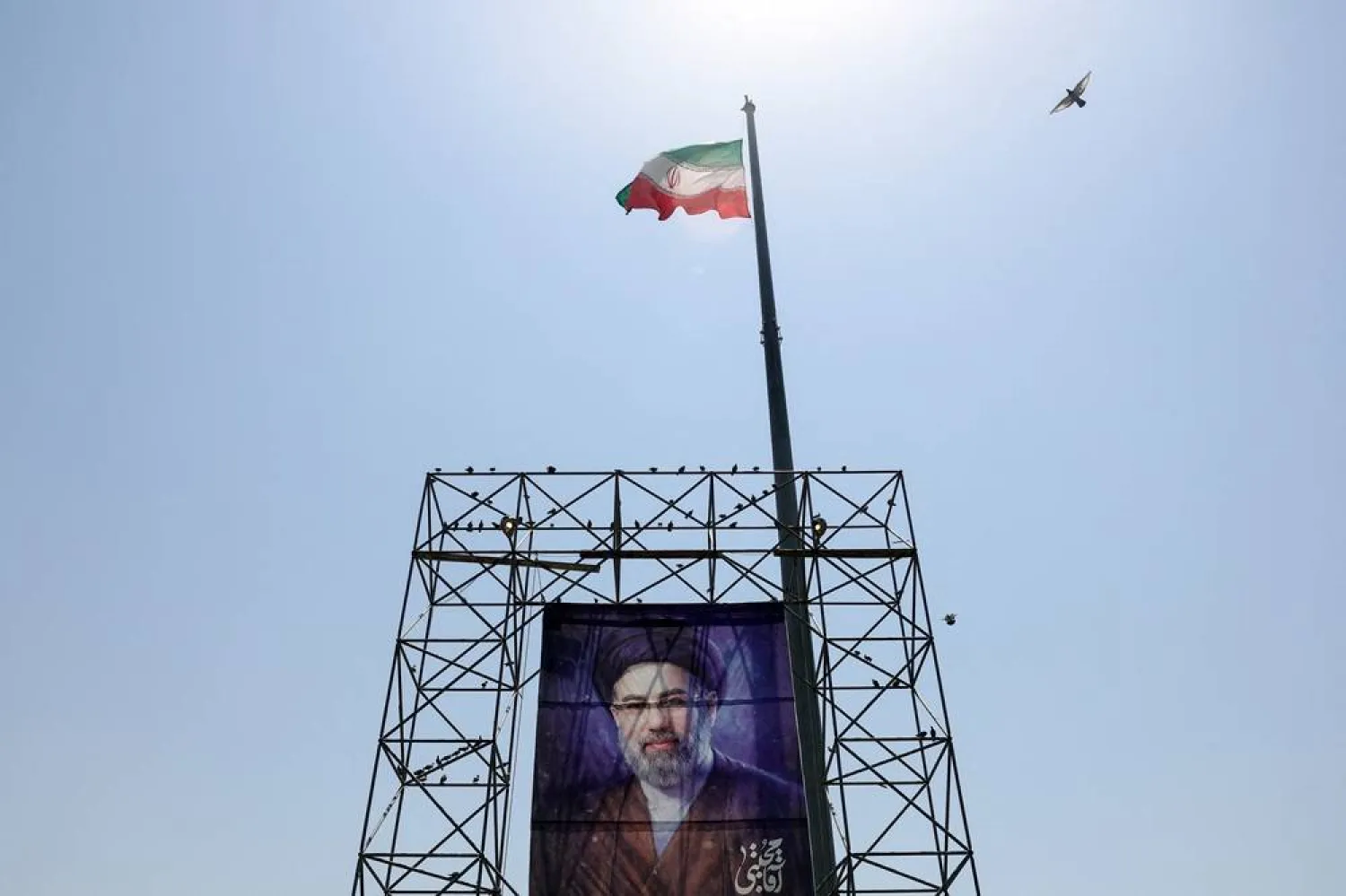
A bird flies near an Iranian flag and a banner with a picture of Iran's Supreme Leader Mojtaba Khamenei, in Tehran, Iran, June 28, 2026. Majid Asgaripour/WANA (West Asia News Agency) via Reuters
TT

Mojtaba Khamenei: Iran’s Unseen Leader Shadowed by Late Father

A bird flies near an Iranian flag and a banner with a picture of Iran's Supreme Leader Mojtaba Khamenei, in Tehran, Iran, June 28, 2026. Majid Asgaripour/WANA (West Asia News Agency) via Reuters

Mojtaba Khamenei, who has spent his career behind the scenes and is yet to appear in public as Iran's new supreme leader, faces the formidable challenge of occupying the role held by his father for most of the regime's existence.

Iranians knew little about the younger Khamenei when he was named to the lifetime post shortly after a US-Israeli airstrike killed his father Ali Khamenei, supreme leader since 1989, at the start of the Middle East war.

Said to have been wounded himself, Mojtaba Khamenei has issued over dozen written messages as leader that have carried on his father's confrontational ideology, taking aim at Israel and the United States.

In one of his most significant recent interventions, released on June 18, Mojtaba Khamenei said he had given his blessing to talks with the US to end the war despite having a "different view", likely an attempt to stay above the domestic political fray.

Despite the messages and activity on social media channels, there has been no concrete proof that Mojtaba Khamenei is even alive after the February 28 attack that also killed his wife Zahra Haddad Adel and other members of the Khamenei family.

But several Iranian officials have said he was wounded, sparking speculation he could be waiting to recover fully before appearing in public, as well as being mindful of his own security.

With Ali Khamenei's funeral starting Saturday, there will be intense scrutiny for signs of Mojtaba Khamenei emerging, and questions will mount if he fails to appear.

-'Radical' agenda -

Unlike Ali Khamenei, a prominent opponent of the shah who was president in the first decade of the republic from 1981-1989 before becoming supreme leader, Mojtaba Khamenei has never held a government position before.

But observers believe he was second-in-command at the office of the supreme leader under the veteran chief gatekeeper Mohammad Golpayegani.

He is also seen as close to the leadership of the powerful Revolutionary Guards, a connection that may have proved crucial in his selection by the Assembly of Experts clerical body.

One of the few official insights into the importance of Mojtaba Khamenei came in November 2019 when the US Treasury announced sanctions against him and other senior Iranian officials, including Golpayegani, on the grounds they were pushing Iran's "radical" agenda around the world.

The US said he was designated for representing Ali Khamenei "in an official capacity despite never being elected or appointed to a government position aside from work in the office of his father".

"The Supreme Leader has delegated a part of his leadership responsibilities to Mojtaba Khamenei," the US said, adding that he had "worked closely" with the commanders of the Quds Force -- the Guards branch responsible for operations outside Iran -- and the Basij militia "to advance his father's destabilizing regional ambitions and oppressive domestic objectives".

A sign of his potential sway came during the 2005 presidential elections when former parliament speaker Mehdi Karroubi wrote a letter to the supreme leader complaining that Mojtaba Khamenei had been intervening on behalf of his ultra-conservative rival Mahmoud Ahmadinejad.

Ahmadinejad went on to cause a sensation by defeating former president Hashemi Rafsanjani. Mojtaba was again seen by some commentators as coordinating the crackdown on protests that followed Ahmadinejad's disputed 2009 election victory.

A leaked US diplomatic cable from 2008 published by Wikileaks said that Mojtaba was "seen by many second only to Golpayegani within the office of the supreme leader".

- 'Unlikely' to have father's influence -

According to an investigation by Bloomberg, which cited anonymous sources and Western intelligence agency reports, Mojtaba Khamenei has amassed wealth estimated at more than $100 million.

It reported he has earned money from oil sales channeled into investments in luxury British real estate, hotels in Europe and property through shell companies in tax havens.

Born in his father's home city of Mashhad in northeastern Iran, Mojtaba Khamenei studied theology in the clerical hub of Qom where he also taught.

"The role of Mojtaba Khamenei is unclear," said Thomas Juneau, professor at the University of Ottawa.

"It is very unlikely at this point that he has the degree of influence that his father used to have."


Is the MAGA Era Over?

President Donald Trump gestures while boarding Air Force One at Morristown Airport, Monday, Sept. 7, 2026, in Morristown, N.J. (AP Photo/Julia Demaree Nikhinson)
TT

Is the MAGA Era Over?

President Donald Trump gestures while boarding Air Force One at Morristown Airport, Monday, Sept. 7, 2026, in Morristown, N.J. (AP Photo/Julia Demaree Nikhinson)

Has MAGA fever finally begun to fade? Will the American right abandon the Make America Great Again slogan and Donald Trump's populist ideology in favor of a more traditional brand of conservatism?

Following a crushing defeat in midterm elections that revolved almost entirely around one man, many Republicans have begun questioning the party's future and what role, if any, Trump should play in shaping it.

The Wall Street Journal, whose editorial pages have long represented the establishment right, called for "soul-searching" and urged Republicans to move away from the ultranationalist, identity-driven rhetoric that helped return the 80-year-old Trump to power.

In an editorial titled "The Trump Reckoning Arrives," the newspaper argued that tariffs and mass deportations were no substitute for higher real incomes.

It added: "Playing to the bro MAGA base is no substitute for persuading Hispanics, independents and suburban swing voters who abandoned the party on Tuesday."

"Still Your President"

The White House, however, appeared far less inclined toward introspection.

Its first post on X on Wednesday featured a stern-looking Trump accompanied by the words "Trump is still your president," a reminder that he will remain in office until January 2029.

But the American political calendar never stands still. Wednesday also effectively marked the beginning of the 2028 presidential campaign, which will culminate in the election of Trump's successor.

The US Constitution bars Trump from seeking a third term.

There was no realistic scenario in which Trump could have emerged from the midterm elections in a stronger political position.

The scale of the Republican defeat on Tuesday night, which exceeded even some of the Democrats' most optimistic expectations, has accelerated the erosion of his political influence.

Eyes on 2028

Vice President JD Vance, widely regarded as a potential contender for the White House in 2028, was careful not to confront his boss directly.

In a lengthy, essay-like post on X on Wednesday, Vance wrote: "The reason we lost is the war."

He immediately added: "The president himself said so last night."

That was not entirely accurate. Trump had attributed the defeat partly to the war in the Middle East, while also arguing that Republicans had fielded weak candidates.

Florida Governor Ron DeSantis described the outcome as an "extinction-level event" for the Republican Party, suggesting Republicans might have to wait until 2032 to regain control of Congress.

Republican lawmaker Don Bacon wrote on X that the party "needs to reclaim our Reagan principles."

He added: "Voters rejected populism, chaos, Putin and tariffs."

Former congresswoman Marjorie Taylor Greene, a far-right figure who has turned against Trump, went further.

"If the GOP wants any chance in the future, it will have to kick Donald Trump out of the party," she said.

Matthew Boyle, a prominent figure at the far-right news outlet Breitbart, wrote on X that "Republicans need to get back to basics."

"No more endless wars," he said.

On the economy, which he identified as the top issue, Boyle called for policies that benefit ordinary Americans rather than special interests.

He also urged Republicans to "be sane with immigration enforcement."

Criticism Without Naming Trump

For now, however, criticism remains relatively muted. Only a handful of conservative figures, whether moderates or hardliners, have been willing to attack Trump by name.

After all, the Republican Party has tied its political fortunes almost entirely to Trump since 2016.

"The big question is, are some of these Republican leaders in the House and Senate going to distance themselves from Trump?" Amy Dacey, a former Democratic official who is now an expert at American University, told AFP.

The same question applies to far-right influencers whose prominence and financial success have been closely linked to Trump's popularity.

Dacey said a devastating electoral defeat could diminish their influence, but it would by no means eliminate those associated with the MAGA movement.

Some of MAGA's online supporters have already attempted to shift the blame elsewhere.

"Great work, neocons," Jack Posobiec wrote sarcastically on X, referring to the neoconservative wing of the Republican Party, known for its interventionist foreign policy and hawkish stance toward Iran.

Nevertheless, it may only be a matter of time before the divisions become more pronounced.

Former congressman Bob Good wrote on the same platform: "Gotta start by acknowledging that Trump was and is the problem. Quietly whispering it won't do it."


From Gaza to Congress: Adam Hamawy Becomes First Muslim to Represent New Jersey in the House

Dr. Adam Hamawy (File photo/AFP)
TT

From Gaza to Congress: Adam Hamawy Becomes First Muslim to Represent New Jersey in the House

Dr. Adam Hamawy (File photo/AFP)

Adam Hamawy, a surgeon who previously volunteered in the Gaza Strip, won a seat in the US House of Representatives on Tuesday, defeating Republican Gregg Mele in New Jersey's 12th Congressional District.

The Associated Press called the race for Hamawy at 8:26 p.m. Eastern Time. At the time, he had secured 70.8% of the vote, with 80% of ballots counted.

With his victory, Hamawy becomes the first Muslim elected to Congress from New Jersey.

Hamawy was among 12 active candidates who competed in the crowded Democratic primary to succeed liberal Rep. Bonnie Watson Coleman, who is retiring after 12 years in office. A 13th candidate remained on the primary ballot despite withdrawing from the race.

The former US Army combat surgeon comfortably defeated Mele, an attorney, to succeed the Democratic congresswoman.

The result came as little surprise. Watson Coleman, an influential progressive voice in the House, won reelection in 2024 by a margin of nearly 25 percentage points.

Hamawy's victory keeps the reliably Democratic seat in the party's hands, according to The Hill.

Earlier this year, Hamawy secured the Democratic nomination after emerging from a competitive primary field.

Early Life and Humanitarian Work

Hamawy grew up in New Jersey after his family emigrated from Egypt when he was an infant.

He attended Rutgers University and its medical school before later earning a Master of Business Administration degree from the same university.

After completing his military service, he returned to New Jersey and established a private plastic surgery practice in Princeton.

According to his campaign website, Hamawy has also volunteered to treat patients in Syria, Lebanon, Sudan, Jordan, Turkey, Bosnia, Haiti, Belize and Colombia.

He served eight years as a surgeon in the US Army, including a nine-month deployment with the 31st Combat Support Hospital in Baghdad during the Iraq War.

His Journey to Gaza

Hamawy, who lives in South Brunswick and operates a plastic surgery practice in Princeton, entered the congressional race as a political newcomer.

His campaign quickly gained momentum amid growing frustration among progressives over Israel and its war against Hamas in the Gaza Strip.

Hamawy came to national attention in 2024 when he was among a group of doctors stranded in Gaza after Israel closed the Rafah border crossing.

Democratic Sen. Tammy Duckworth of Illinois, who credits Hamawy with saving her life after her helicopter was shot down in Iraq in 2004, intervened to help secure his departure from Gaza along with that of other medical workers.

Duckworth's intervention was widely viewed as an opportunity to repay the surgeon who had helped save her life, according to The Hill.

Hamawy's volunteer work at a Gaza hospital during the war helped strengthen support for his candidacy.

He also received endorsements from prominent progressive figures, including Sen. Bernie Sanders and Rep. Ro Khanna, according to Politico.

Opposition to War

New Jersey is home to a substantial Arab American community of approximately 179,000 people. The Egyptian American population, in particular, has grown rapidly.

Hamawy's congressional district includes approximately 11,000 residents of Arab descent, according to data from the Arab American Institute.

In a video posted on his official X account, Hamawy urged voters to support his campaign, saying: "Do you want to make Trump mad? Return your mail-in ballot today."

Hamawy has called for an end to US military aid to Israel. More broadly, he has expressed opposition to providing American military assistance to countries that commit human rights violations.

In a May interview with the New Jersey Monitor, Hamawy opposed the ongoing war against Iran, describing it as "an illegal and immoral war" that needed to end.

He also accused the United States of catering to the special interests of defense contractors and warmongers, as well as organizations such as the American Israel Public Affairs Committee (AIPAC) and Israel's own special interests.

On domestic policy, Hamawy has advocated expanding access to healthcare, increasing funding for public schools and reducing costs for working-class families.

The Democrats are poised to take control of Congress following the midterm elections, having secured majorities in both the Senate and the House of Representatives, turning Tuesday's vote into a stinging defeat for President Donald Trump and his Republican Party.


Abdul El-Sayed: 'As Michigan as You Get'

Michigan Democratic Senate candidate Abdul El-Sayed speaks at an election night event, early Wednesday, Nov. 4, 2026, in Detroit. (AP Photo/Julia Demaree Nikhinson)
TT

Abdul El-Sayed: 'As Michigan as You Get'

Michigan Democratic Senate candidate Abdul El-Sayed speaks at an election night event, early Wednesday, Nov. 4, 2026, in Detroit. (AP Photo/Julia Demaree Nikhinson)

Abdul El-Sayed, 42, made history as the first Muslim elected to the US Senate after winning a crucial seat in Michigan in Tuesday's congressional midterm elections.

Born in Michigan on October 31, 1984, El-Sayed previously served as a public health official in Wayne County, in the battleground state. He has never held elected office, but he is no stranger to politics. In 2018, he ran for governor of Michigan, finishing second to Gretchen Whitmer in the Democratic primary.

El-Sayed grew up in the Detroit area with his father, Mohamed, an Egyptian immigrant who came to the United States to study at Wayne State University, and his stepmother, Jackie. His biological mother, Fatten Elkomy, is a psychiatric nurse in Missouri.

El-Sayed describes himself as "as Michigan as you get." He attended local schools, graduating from high school in 2003. During his school years, he captained the lacrosse, wrestling and football teams.

He went on to the University of Michigan, where he majored in biology and political science and played on the university's lacrosse team. He graduated in 2007 with highest distinction and was selected to deliver the student commencement address.

"We have the audacity to believe that we can change this world, and that each of us will," he told his fellow graduates, describing what made Michigan exceptional.

El-Sayed received a full-tuition scholarship to the University of Michigan Medical School. After completing two years of medical school, he was awarded a Rhodes Scholarship for 2009 to study at Oriel College, Oxford University, where he completed a doctorate in public health in 2011.

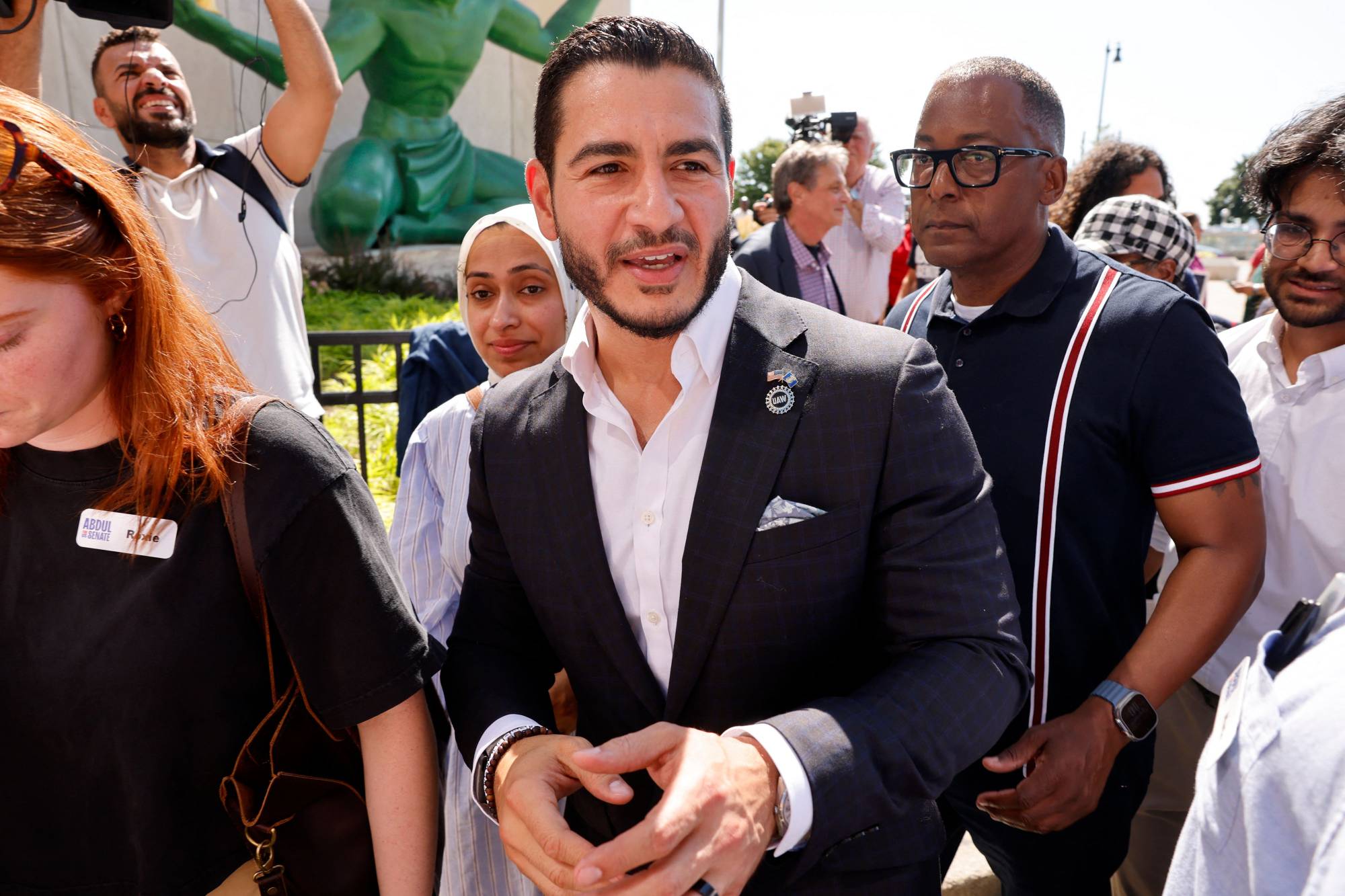
US Democratic Senate candidate from Michigan Abdul El-Sayed departs after a press conference declaring victory in the primary election in Detroit, Michigan, on August 5, 2026. (Photo by JEFF KOWALSKY / AFP)

He was the University of Michigan's first Rhodes Scholar since 2004. At Oxford, he continued playing lacrosse and earned a Full Blue, the university's highest sporting honor, as team captain.

By 2014, El-Sayed had completed his medical education, earning his medical degree from Columbia University's College of Physicians and Surgeons.

He subsequently joined Columbia's faculty as an assistant professor of epidemiology. Months later, then-Detroit Mayor Mike Duggan appointed him health officer and executive director of the city's Health Department.

El-Sayed rebuilt Detroit's Health Department following the city's bankruptcy. He later restructured Wayne County's Department of Health, Human and Veterans Services, which serves 1.8 million residents in Michigan's largest and most diverse county.

As a public servant, El-Sayed secured free eyeglasses for children in need, challenged some of Michigan's biggest polluters and expanded access to the lifesaving overdose-reversal medication naloxone, commonly known by the brand name Narcan.

He also spearheaded a program to eliminate up to $700 million in medical debt for 300,000 Michigan residents over two years.

His work earned him recognition as Public Official of the Year from the Michigan League of Conservation Voters and a place on Crain's Detroit Business's 40 Under 40 list.

Nationally recognized for his expertise in improving the American healthcare system, El-Sayed is the author of Medicare for All: A Citizen's Guide.

He later returned to public service as director of Wayne County's Department of Health, Human and Veterans Services, serving from December 2022 until April 2025, when he resigned to seek elected office once again, this time in the US Senate.

El-Sayed has also made a name for himself as a podcast host, including through America Dissected.

His medical credentials have attracted controversy, largely because he has described himself as a physician despite not holding a license to practice medicine in Michigan.

Although he studied medicine, El-Sayed came to believe that a broken political system was what was making people sick. That conviction ultimately led him to run for the Senate.

According to his campaign website, he entered the race because he believes life in America should not be so difficult and wants to build a government that serves ordinary Americans rather than Elon Musk, Donald Trump and their billionaire allies.

Responding to questions about his medical credentials in July, El-Sayed said: "I did graduate from a school that's literally called Columbia College of Physicians and Surgeons. So, you know, you can go have that argument with Columbia University if you'd like."

In his only previous bid for elected office, El-Sayed finished second to Gretchen Whitmer in Michigan's 2018 Democratic gubernatorial primary, ahead of Shri Thanedar, who subsequently won a seat in the state legislature and later in the US House of Representatives.

Throughout his Senate campaign, El-Sayed distilled his platform into a three-part message: "Money out of politics, money in your pocket, Medicare for All."

He repeatedly emphasized that he was the only candidate running for the US Senate in Michigan who had never accepted a dime of corporate campaign money and never would.

El-Sayed lives in Ann Arbor with his wife, Sarah, and their two young daughters, Emmalee and Serene.