
It was the summer of 2010. After hours of questioning, a suspect in an embezzlement case remained composed.
He sat with one leg crossed over the other, waiting for the interrogation to end so he could leave. Across the table, the investigator was running out of options.
“When will all this be over?” the suspect asked.
“When you answer all the questions,” the investigator replied.
A veteran financial auditor, the investigator believed he had enough evidence to convict a cornered embezzler. At the time, theft from the Iraqi state was spreading like water hyacinth — beginning as a small patch before covering an entire river.
The investigator pressed harder, placing evidence on the table.
“My dear, why are you tiring yourself?” the suspect said. “I have $1 million set aside to get me out of this room.”
“I do not take bribes,” the investigator replied.
“Who said it was for you?” the suspect said, appearing surprised.
Silence filled the room.
“Get some rest, my dear,” the suspect said.
The interrogation was over.
The investigator retired in 2012. The case, he said, remains open.
He now hopes a wave of arrests that began in mid-June and has swept up officials and political figures will produce a different outcome.
That interrogation offered only a narrow view into a sprawling, multibillion-dollar system. The $1 million was not merely intended to protect one suspect. It belonged to a broader protection structure built by shadow entities that have evolved into what one former official called “Iraq’s black book.”
For years, Iraqi political parties and Iran-aligned armed groups have operated what are locally known as “economic offices.” Their function is to capture part of the country’s oil wealth and channel it through government contracts and commissions into unofficial financial portfolios.
Criminalizing the system has proved difficult. Confronting it has carried a potentially high political price.
A state of economic offices
This investigation reveals how Iraq’s economic offices operate as an algorithmic system: carefully selected individuals sit at the center, surrounded by cells of government employees, contractors and businesspeople operating inside and outside Iraq.
Testimony from former investigators, officials, accountants, lawmakers and political advisers shows that the offices were designed in a way that allowed them to become self-sustaining.
Over time, they created new subsidiary offices, drawing power from armed groups and from elections — the same elections that determine who controls the state.
A rare account by an adviser familiar with government structures described how the system evolved from a primitive model that began taking shape around 2006 into a complex network that passed through three stages of growth and adaptation.
Iran benefits from the influence of these parallel financial entities, using some of the money to support the so-called Axis of Resistance, according to officials and political sources. That does not mean Tehran monopolizes the profits.
Its more important advantage, the sources said, is that the system helps conceal efforts to evade US sanctions.
The economic offices operate on two broad levels.
The first can be described as the VIP tier. It includes leaders of Shi’ite and Sunni political parties whose roles are largely confined to securing government contracts and collecting an agreed-upon share of the profits.
Implementation is left to the second, broader and more fragmented tier — the economy-class network.
Officials and political sources believe the suspects under investigation in recent weeks, along with the cash authorities say they have seized, belong mainly to this second tier.
It remains too early to say whether investigators are approaching the first’s inner circle.
On June 28, 2026, Iraqi authorities staged a dramatic show of force. Tanks and armored vehicles entered Baghdad’s fortified Green Zone as security forces raided the offices and homes of political figures and detained dozens of people.
Some Iraqi politicians described the operation as a coup.
It was given a name designed to convey both attack and spectacle: Operation Dawn Strike.
The raids that followed were quieter. Arrests continued without tanks, armored vehicles or public displays.
The investigation has centered partly on two senior officials in Iraq’s energy sector: Deputy Oil Minister for Refining Affairs Adnan al-Jumaili and Deputy Oil Minister for Distribution Affairs Ali Maarij.
Investigators and political sources believe one or both men may have served as key links in an Iranian program to smuggle oil and evade US sanctions, while also financing armed groups and election campaigns for competing political players.
When corruption carries no shame
Successive Iraqi governments have launched campaigns against the theft of public money. Journalists, former officials and politicians say none has produced lasting accountability.
The campaigns often begin with major announcements of arrests. They rarely end with convictions or reforms to the rules governing public administration.
That pattern has reinforced a widespread belief that anti-corruption drives are often designed to settle disputes among powerful factions or contain a political crisis.
A government official said the current campaign appeared different.
International actors, he said, had responded bluntly when Iraqi officials complained about the country’s financial crisis, US restrictions and the closure of the Strait of Hormuz.
“The money is around you. It is everywhere,” the official recalled them saying. “And it smells dirty.”
For nearly two decades, suspected corruption has carried little social stigma in Iraq.
Businesspeople surrounded by allegations are often treated like celebrities. Critics of Islamist political parties say the normalization of state theft has also been reinforced by religious opinions believed to permit the seizure of state or bank funds on the grounds that they have no known private owner.
Politicians routinely circulate wildly different estimates of how much has been stolen over the past two decades. The figures range from tens of billions to hundreds of billions of dollars.
Authorities frequently neither confirm nor challenge them.
Sadiq al-Rikabi, a London-based economist, estimates that the economic offices capture about $15.3 billion from the state budget each year.
He said dozens of intermediaries and companies have also controlled investments linked to state assets worth hundreds of billions of dollars.
The previous government of Mohammed Shia al-Sudani had operated since 2023 under a three-year budget worth about $450 billion.
Prime Minister Ali al-Zaidi says he took office to find only about $1 billion in the public treasury.
Ghosts inside the ministries
The basic idea behind the party offices is strikingly simple. That simplicity is also the source of their complexity.
A party selects trusted individuals it can control. They manage financial operations that require access and influence inside official institutions, while remaining ghosts who sign no government documents.
A former investigator who left public service about a decade ago after receiving threats said some members of the networks were easy to identify.
They might belong to a party leader’s immediate family circle.
Others were chosen precisely because nobody would think to look for them.
“The driver’s wife, the cousin of a bodyguard, or the reckless teenager who causes trouble in the neighborhood,” the former investigator said. “Someone selected because he can be tempted and controlled, not because he has influence.”
Over time, the political parties accumulated a workforce with specialized skills: negotiation, knowledge of bureaucratic procedures, an understanding of market needs, access to banks and currency exchanges, and an ability to evade oversight and sanctions.
Survival skills alone are not enough to lead an economic office.
Ziad al-Hashimi, a Baghdad-based economist, said the official in charge must have extensive political and government contacts, including links to companies, ministries and directors-general.
“He can knock on the door of powerful people at any time carrying a lucrative deal,” al-Hashimi said.
Political parties compete to secure the most effective operators.
“The head of the economic office is a name that grows in the shadows,” the political adviser said. “He becomes a force that cannot be ignored, but in most cases he remains under the party leader’s cloak. The relationship between them is extremely sensitive and obscure.”
An economic office has no official title, but its authority can exceed that of a minister.
“The minister may be their employee,” said two senior members of the Coordination Framework, the Shi’ite political alliance that has underpinned successive governments.
After every election, Iraq’s parties enter negotiations that appear to concern politics, ideology and cabinet formation.
At their core, however, the talks also redraw the borders of the economic offices and determine their shares for the next four years.
Under an informal points system, parliamentary seats are converted into bargaining power for distributing ministries and senior state positions.
“From the minister’s first week in office — or the deputy minister’s or director-general’s — a team from the party’s economic office begins negotiating the ministry’s contracts,” said a former official who requested anonymity.
“If everything goes according to plan, they tell the minister: ‘Sign here.’”
It is rare, the former official said, for a government institution to award major contracts beyond the reach of the offices.
Elections, therefore, do more than form governments. They redistribute the market among political parties.
The minister and hundreds of senior appointees become, in effect, bank guards who leave the key to the vault under the door.
Al-Rikabi describes the economic offices as the undeclared financial center of Iraq’s sectarian power-sharing system.
“Their danger does not lie only in stealing public money,” he said. “It lies in the fact that they shape the Iraqi state.”
He estimates that about 40 party-linked economic networks operate through roughly 200 influence cells inside ministries, provincial councils, municipalities, banks and other institutions.
Those cells, he said, have created more than 1,000 front companies or affiliated contractors.
Businesspeople who participated in this investigation said that companies connected to party offices often engage in genuine, legitimate trade.
But genuine business opportunities, they said, are difficult to obtain without dealing with the people who control the illicit side of the market.
“Some parties created their own businesspeople,” a former lawmaker said. “They turned members of the party entourage into influential merchants.”
Other party leaders forced existing businesspeople to accept them as partners, he said.
“In the early stages, business expanded through threats.”
Two categories of businesspeople emerged from years of party control.
The first are “the party leader’s people.” They enjoy tax exemptions, exceptional privileges and unusual access to state institutions.
In return, they finance election candidates, companies and television stations that provide political services.
The second category consists of private-sector contractors who struggle to receive payments owed by the government. According to the Iraqi Contractors Federation, those unpaid obligations had reached about $28 million by 2025.
Taken together, dozens of economic offices are estimated to seize about 10% of the state budget — roughly $15 billion a year — through contractors who steer government contracts and individuals who move between the state and political parties.
That estimate does not include revenue from smuggling or the seizure of private-sector assets.
The money cycle: From hunting to institutional control
Over two decades, the flow of money through the economic offices passed through three stages.
Each brought new methods, new risks and new forms of adaptation.
In the first stage, between 2004 and 2008, proceeds from embezzlement were smuggled abroad and used to buy property, land and hotels, al-Rikabi said.
In the second stage, between 2010 and 2014, the offices began establishing local banks where stolen money could be deposited, without ending the transfer of funds overseas.
The banks acted as safe containers. They allowed money to be withdrawn through transactions that appeared semi-official and provided profits from exchange-rate differences through the central bank’s foreign-currency auction.
The third stage began after the US Treasury exposed money-laundering and smuggling methods and restrictions were imposed on banks and outward transfers.
The offices responded by creating companies designed to meet real market demand, including property developers and shopping malls. More recently, they established small factories.
Government and political sources agree that the earliest economic offices emerged during Iraq’s sectarian conflict, when armed groups realized that control over revenue was essential to sustaining war.
A former US Army officer who served in Baghdad between 2004 and 2007 described the early system as a struggle for resources among warlords.
Groups seized goods to buy weapons and recruit fighters.
A soft-drink factory, he recalled, financed a Sunni faction. On the other side of the conflict, a Shi’ite militia traded in medicine.
The system later expanded into kidnapping for ransom.
The first clearly established model appeared under the short-lived government of Ibrahim al-Jaafari and the first government of Nouri al-Maliki between 2006 and 2010.
It was crude and improvised, resembling the work of an inexperienced trader entering a large market.
Under that model, a political party seized control of a ministry’s contracts and sold them directly to companies that carried out the work in return for a share of the profits, sometimes about 30%.
Before taking office, many party cadres had spent years opposing Saddam Hussein before the US-led invasion of 2003.
When they entered state institutions for the first time, they encountered administrative procedures they had never seen and joined meetings conducted in the language of international business and government bureaucracy.
A former official recalled one senior figure who held a central position in a prime minister’s office about two decades ago.
The official, who was also a leading member of the ruling party, was helping arrange foundational meetings for the new Iraqi state.
A representative of US oil company Exxon Mobil had an appointment with the prime minister.
An hour before the meeting, the official told his colleagues that the prime minister had already met the company’s representative the previous day. Why, he asked, did Exxon Mobil need another meeting?
Confusion spread through the prime minister’s office.
How could two representatives of the same company be inside the Green Zone? Was one an impostor?
Eventually, officials discovered that the prime minister had met a representative of a mobile-phone company.
The aide had confused “mobile” with Exxon Mobil and assumed the US oil producer was also a telecommunications company.
The primitive system appeared fractured and inexperienced. It nevertheless created rules for dividing the state.
A party that controlled the Health Ministry, for example, could not easily interfere with contracts controlled by the party holding the Electricity Ministry.
In later years, the boundaries between offices and political parties began to overlap.
The early system resembled hunting without knowing the value of the prey.
“The offices were naive in the beginning,” the former official said. “They sold contracts without understanding what was in them. Some were never implemented.”
An oversight official at the Planning Ministry recalled contracts for streetlights in Baghdad’s Shula district, electrical transformers in Sadr City, public parks in Hilla and sewer networks in Mosul.
The projects existed on paper.
The infrastructure did not.
As political parties learned to navigate the bureaucracy, a second model emerged and profits increased.
Party leaders concluded that selling contracts to outside companies deprived them of larger returns.
They began creating their own companies.
Experience accumulated. The party share rose from about 30% to 50% or 60%.
But when the new companies attempted to carry out the projects themselves, problems emerged involving audits, accounting, quality and technical capacity.
Contracts stalled or were left unfinished because of theft, failure or delay, according to the political adviser.
Open-source research found that about 6,000 projects stalled between 2008 and mid-2014, when ISIS seized large areas of Iraq.
That was the period in which the first two models of the economic offices matured.
After the fighting against ISIS ended and the influence of armed factions expanded, powerful groups recognized that contracts assigned to their own companies were creating new problems.
A state bureaucracy rooted in nearly a century of administrative practice was not easy to circumvent. Audits and oversight consumed time and money.
The parties needed another model.
The algorithm of profits and costs
The third system abandoned both the direct sale of contracts for a fixed percentage and the use of party-owned companies to carry out the work.
Instead, the parties created officially registered shell companies that acted as intermediaries.
A shell company receives the government contract and negotiates with genuine specialized companies to secure the best offer.
It effectively holds an auction, awarding the contract to the company willing to provide the most favorable return.
The system does not calculate the party’s share as a percentage of the total contract value.
It calculates the expected profit by measuring the difference between the estimated cost of the work and the company’s bid.
If the projected cost of a project is $6 million and a company submits a bid worth $16 million, the expected profit is $10 million.
The parties then negotiate over the final profit figure. It may be reduced from $10 million to $9 million or $8.5 million, depending on the agreement.
Once the final figure is set, the office determines the percentage it will take.
A 35% share of a $9 million profit would produce a payment of $3.15 million.
“Most corruption case files are clean on paper,” the former investigator said. “There is no trace connecting the contracts to members of the economic offices because the documents are completed according to official procedures and the people behind the offices leave no incriminating signature.”
The judiciary, he said, now needs specialists capable of deciphering the manipulation of estimated project costs.
This mechanism largely belongs to the VIP tier and the contract-award stage.
Another stream of money emerges during implementation, through commissions divided among contractors, government offices and intermediaries waiting to fatten what one source described as “hungry cats.”
One figure in the VIP tier often believes he has been cheated: the minister or deputy minister who signs the contracts without receiving a satisfactory share.
Around that official, networks of bankers and intermediaries begin to form. Their influence grows during the implementation stage.
The political adviser described detained Deputy Oil Minister Adnan al-Jumaili as initially a marginal figure in the VIP networks controlled by party leaders.
He later became a major hub for producing subsidiary offices within the second tier.
New players then emerged to demand shares from companies that had already bought contracts from the first-tier offices and now needed approval from second-tier officials to complete the work.
A minor intermediary might tell an official: “We will give you 1% or 2%, a fixed amount or one billion dinars, depending on the agreement, in return for completing the contract.”
The company deposits money or a check with a currency exchange office.
The payment is released to the official only after the contract is completed, often following multiple administrative stages and the disbursement of government advances.
The exchange office is instructed to release the deposit only when specified individuals are present.
Intermediaries said the deposits can also take the form of checks, Chevrolet Tahoe sport utility vehicles or apartments in luxury housing developments.
The intermediaries serve as a buffer between officials and companies.
They receive the money and hold it until the conditions of the bribe are fulfilled. In some cases, the intermediary also owns the exchange office.
By preventing direct contact between the government official and the company, they reduce the risk to both.
Over time, however, the intermediaries became powerful enough to create a new class of wealthy operators.
In recent years, financial players have emerged within the shadows of the second tier who can be described as “treasurers of bribes.”
Some became well known in the local market despite appearing to come from nowhere.
Cross-checked accounts identified two brothers, Hassan and Mohammed al-Kurdi, among the best known.
They are widely rumored to have left Iraq carrying about $500 million connected to the al-Jumaili case.
The Iraqi judiciary has made no public statement about the brothers.
Media outlets have circulated dramatic stories about them without producing evidence. Some reports said they traveled through Iraq with dozens of armed guards while distributing money.
Unconfirmed accounts now place them between Greece and France.
The “genetic mutation”
Government sources describe al-Jumaili and his extensive network as a “genetic mutation” in the evolution of the economic offices.
He began as an ordinary Oil Ministry employee and rose through the ranks at the Baiji refinery complex north of Baghdad, which later became the center of his influence.
In 2023, an influential Sunni party negotiated with Shi’ite allies in the Coordination Framework over the post of director of the Northern Refineries Company, which oversees Baiji.
The position went to al-Jumaili, who had already advanced under the protection of an influential Shi’ite faction, according to several sources.
Within a year, he became a deputy oil minister.
Within two years, he had received extensive authority over contracts.
From that point, the sources said, al-Jumaili found a financial mine in Baiji.
He was one of five officials who formed what a former official described as a board of directors for the refineries’ economic network. One of the five provided security protection for the others.
Led by al-Jumaili, the office became a distributor of services to multiple political parties.
Contracts were awarded to different factions. Money was disbursed without projects being completed. Much of the activity involved the Baiji refinery complex.
Al-Jumaili became useful to everyone — Shi’ite and Sunni political forces alike.
Then, a former oil official said, “unbelievable atrocities” occurred.
Baiji produces about 150,000 barrels of petroleum products a day, roughly half its capacity, because of damage sustained during ISIS’s occupation.
After the facility was recovered in 2017, it became a battleground among Shi’ite factions that said they had helped liberate it.
Local groups also emerged around the complex, taking part in fuel smuggling and competing for production contracts.
In one contract managed by al-Jumaili’s network, according to security personnel and former officials, the facility bought pumps and compressors from Romania for about $450 million.
The equipment was incompatible with the refinery’s infrastructure.
“It arrived in Baiji already out of service because of its age,” a former oil official said. “It was supposed to help produce white gasoline, which was later found not to meet specifications.”
Employees said the equipment was taken into a workshop, painted and presented as new.
“It was left on the side because it did not work,” one employee said.
As suspicions increased, drones struck the Baiji facility and destroyed the site containing the equipment.
Local authorities said the attack, believed to have occurred in July 2025, caused no casualties.
The Oil Ministry and refinery management did not confirm the Romanian contract or whether the drone strike destroyed the pumps.
Energy-sector officials who requested anonymity confirmed that the contract had been awarded.
One said the equipment had been purchased to replace production units that were smuggled out under unclear circumstances after the battles against ISIS and later taken to an unknown location.
Al-Jumaili’s blue notebook
A former oil official said al-Jumaili approved about $4 billion in contracts for the northern refineries from 2023 onward, including equipment that did not meet the specifications of Iraqi oil facilities.
The scale of the operation reflected a wider change in Iraq’s political balance.
The political adviser said al-Jumaili became an alternative economic office for a political alliance that was rising rapidly during the most recent elections.
The alliance had little previous experience managing economic offices before the formation of Mohammed Shia al-Sudani’s government.
Politicians said al-Jumaili received handwritten requests from the alliance’s leader to finance election campaigns for its candidates.
One political source said some requests reached 150 million Iraqi dinars. Other accounts placed individual requests at 200 million or 500 million dinars.
A source with direct knowledge said al-Jumaili recorded the requests in a blue notebook.
A judicial source said the notebook is now evidence that investigators are using to track money, names and networks.
Iraq’s whales in an oil pond
Iraq has only one sea: oil.
Its political groups learned to swim in it. As armed factions multiplied and state budgets rose into billions of dollars, the swimmers became crocodiles in a black pond.
“Iraq sells its oil twice officially,” a former minister said. “And once through smuggling networks.”
The smuggling of heavy fuel oil — known locally as black oil — is the shadow trade connecting overlapping networks of economic offices.
The fuel is used directly in power plants and industrial furnaces. It can also be refined or treated to produce petroleum products, particularly diesel.
The government allocates quantities of heavy fuel oil for sale in the domestic market, especially to asphalt plants.
Depending on the pricing policy adopted by successive administrations, the fuel has been sold for between $100 and $250 a metric ton.
Documented testimony indicates that a smuggling network overseen by an alliance of economic offices linked to factions and parties in the Coordination Framework, together with forces in the Sunni Political Council, diverts some of the fuel to regional ports through intermediaries.
Another portion is mixed with Iranian fuel oil and exported using Iraqi documents.
Two sources and a former Oil Ministry official estimated that this “double smuggling” generated about $2.6 billion a year for the economic offices between 2023 and 2025.
During that period, the number of licenses issued to asphalt plants increased as authorities reduced the price of a ton of fuel oil from $250 to $100.
Officials who held office during that period declined to comment before publication.
The offices carry out two operations simultaneously.
They exaggerate the fuel requirements of genuine asphalt plants to secure excess supplies.
They also buy state-subsidized fuel on behalf of fictitious plants that exist only on paper.
Three sources said the fuel that does not reach local plants is moved through intermediaries and companies to Iraqi ports for loading.
One source said a regional port had designated a refinery to receive smuggled Iraqi heavy fuel oil.
Successive governments have failed to stop the trade.
A handful of former ministers attempted to curb it by raising the state price.
The battle for the Oil Ministry
A politician in the Coordination Framework said the competing interests of the economic offices shape political negotiations after elections.
The parties engineer appointments connected to the oil sector, place intermediaries in strategic positions and rotate them through the ministry.
That, another Coordination Framework leader said, explains the “ferocious battle” for control of the institution.
The networks do not limit themselves to petroleum products such as fuel oil.
They also operate in the crude oil trade.
Sources familiar with the sector described business relationships between Iraqi officials and companies linked to Khatam al-Anbiya, the engineering arm of Iran’s Revolutionary Guards.
The relationships, the sources said, were used to facilitate the export of Iranian oil under official Iraqi documents.
In May 2026, the United States imposed sanctions on Deputy Oil Minister Ali Maarij, along with leaders of the Iran-aligned Asaib Ahl al-Haq movement.
US authorities accused Maarij of exploiting his position to redirect Iraqi oil and sell it for Iran’s benefit, enabling Iranian and Iraqi oil to be blended and providing documents that helped market the mixture.
Maarij was among the officials detained by Iraqi forces under an arrest warrant in June 2026.
Investigators believe he is one of the officials Iran relied upon to evade US sanctions.
How Iran ultimately receives the money generated by the sale of oil through Iraqi channels remains one of the investigation’s black holes.
A former investigator and a retired accountant who worked in the Planning and Finance ministries said they had spent years questioning apparently valid disbursement orders drawn from the state budget.
The documents appeared legal.
The money disappeared.
They suspect some of it was transferred secretly to Iran.
No evidence has emerged to prove that claim, and Iraqi officials said finding such evidence would be extremely difficult.
“Some resistance leaders behave like Americans”
The Revolutionary Guards are unlikely to exercise total control over the formation of Iraq’s economic offices.
But Iraqi politicians and former officials say Iran has exploited its influence and invested alongside them.
Two Shi’ite politicians said Iran operates economic offices of its own.
In recent years, businesspeople and companies affiliated with the Revolutionary Guards have entered the Iraqi market and secured contracts with significant privileges.
Lebanese businesspeople also operated in the hotel and healthcare sectors on behalf of Hezbollah, according to political sources.
A former member of the Shi’ite alliance said the Lebanese group determined which merchants were permitted to operate in Iraq based on loyalty and commissions.
Iran, he said, could trust that Hezbollah’s investments in Iraq would ultimately benefit the Axis of Resistance.
It could not, however, keep pace with the greed of some of its Iraqi allies.
Revolutionary Guards commanders, he said, compared Iraqi faction leaders who had accumulated sudden and enormous wealth to Americans in their habits.
Some Guards figures were nevertheless impressed by the Iraqi model.
They created financial networks and developed relationships with party offices, blurring the boundary between the work of the “resistance” and the commerce that flourished in its shadow.
Official Iran also benefits from its close economic relationship with Iraq.
Iranian exports to the country rose from about $4.5 billion in 2018 to $11.2 billion in 2025, according to customs data. The figure includes electricity and gas exports.
The shadow offices provide additional benefits.
A former lawmaker said Iranian officials collected money from Iraqi party leaders as though imposing a levy to finance members of the Axis of Resistance.
Revolutionary Guards officials would call Iraqi political leaders and ask them to prepare millions of dollars for representatives of Hamas or Yemen’s Houthis, the former lawmaker said.
“The call would come: ‘Hajji, prepare $5 million. Someone will come to your office to collect it.’”
The Revolutionary Guards also used its influence to improve the election prospects of allied Iraqi candidates.
By cross-checking sources and testimony, the investigation found that Iranian officers withdrew about $15 million from the economic offices between August and November 2025 to finance selected candidates.
Party leaders rarely rejected the requests, the former lawmaker said.
During the latest war between the United States and Iran, Iraqis began asking what would happen to their economy as the country entered a severe financial crisis.
The closure of the Strait of Hormuz was not the only cause.
Iranian influence and the economic offices had also played intertwined roles.
“It was like small whales eating from the belly of a larger whale,” said a former oversight official who left Iraq in 2018 after receiving threats.
“The large whale is now sick.”
“Operation Dawn Strike” to reassemble Iraq
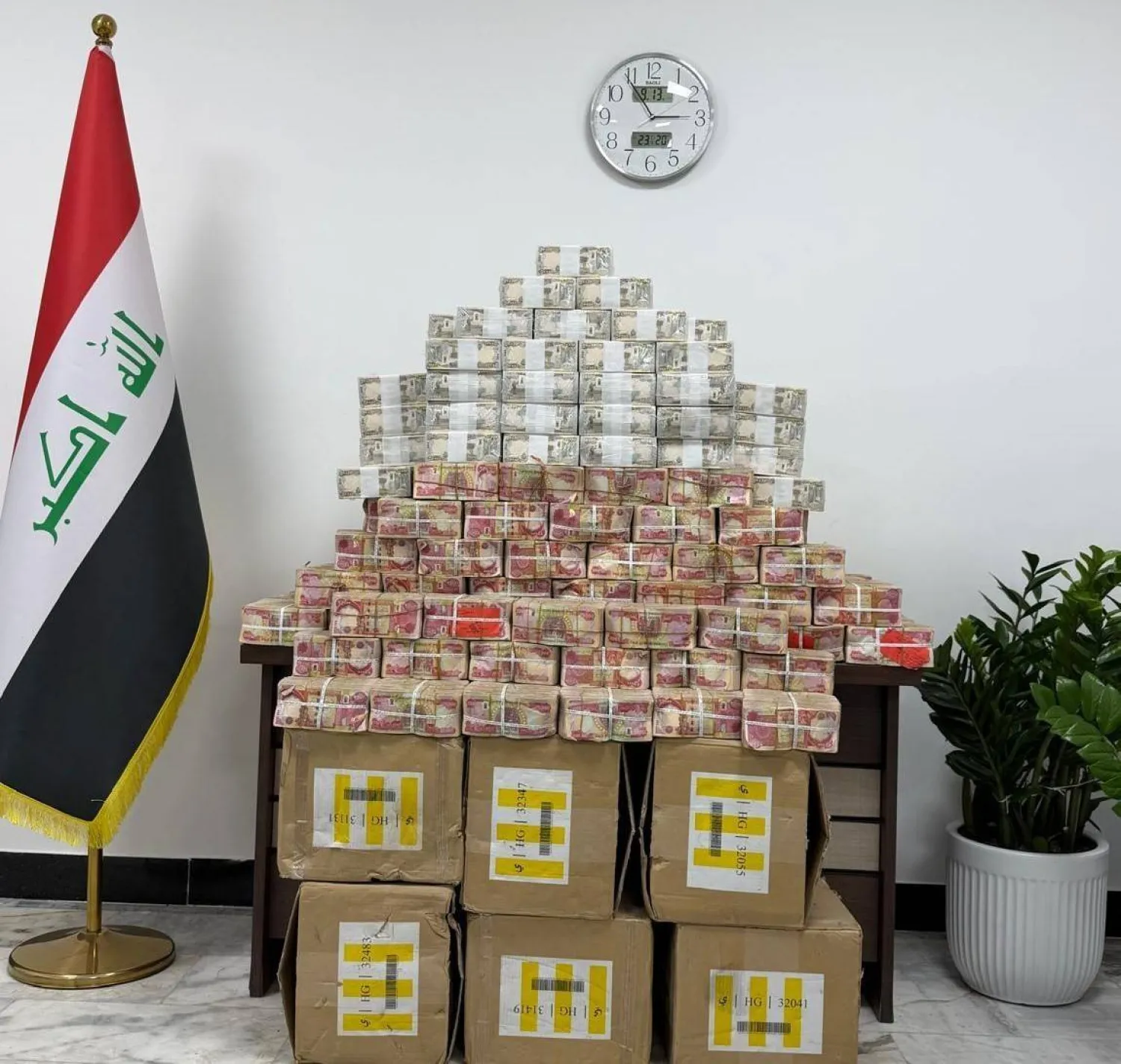
Iraqi media have been filled with images of cash discovered in homes, farms, underground hiding places and even drainage channels.
The former investigator said much of the money had little value to the suspects while it remained outside the formal economy.
It had failed to enter the market and had not been converted into assets.
“The money recovered its value when the state recovered it,” he said.
Al-Hashimi said the suspects likely kept large quantities of cash because the money was difficult to declare or move through official channels under increasing surveillance.
Without legitimate documents, it could not be laundered easily.
The most plausible explanation, he said, was that the economic offices needed liquidity to pay bribes, commissions and possibly protection money, while coordinating with local and regional actors and competing offices.
“Cash makes it far easier to complete tasks that require rapid, direct payments,” he said.
Despite the large sums authorities say they have recovered, former lawmaker Sajad, who spent years opposing the influence of armed factions, doubts that Operation Dawn Strike will reach the highest levels.
Many observers question whether detaining intermediaries will produce a lasting result given the size and complexity of the networks.
A former investigative judge said the economic offices had accumulated so many layers of adaptation and deception that some defendants did not understand their own position in the wider structure.
“They are individuals operating in a complex chain that ends with a party leader or a group of leaders,” he said.
Salem, another source familiar with the investigations, said the authorities were pursuing the tools of the economic offices, not dismantling the offices’ infrastructure.
A source who requested anonymity offered a more optimistic assessment.
The case is complex, he said, but it can be solved because the intermediaries — although not the final link — hold the keys to the upper layers of the network.
So far, the announced arrests have remained concentrated in the second tier.
They have not reached the most senior operators.
That has led some officials to believe the campaign is intended partly to reassemble a pool of cash to address the financial crisis and meet state obligations, including public-sector salaries.
There are signs, however, that the operation could move higher.
On July 12, 2026, local media reported that a security force raided the Baghdad home of former Labor and Social Affairs Minister Ahmed al-Asadi.
He was not present during the raid.
The Supreme Judicial Council made no public statement about al-Asadi.
Any attempt to detain him would bring the campaign closer to a higher tier of political influence.
Al-Asadi leads the Jund al-Imam faction within the Popular Mobilization Forces and is a member of the governing Coordination Framework.
Al-Rikabi said the focus should not remain confined to individual suspects.
Authorities must instead reform the financial and administrative system through which money flows and redesign the path of state revenue.
Even maximum pressure from the United States or another foreign power cannot directly destroy the economic offices, he said.
Prime Minister al-Zaidi made major commitments to Washington during his visit in mid-July.
The US administration’s objective, according to the Iraqi adviser, is to separate the economic offices from the state far enough to deprive Iran of Iraqi resources.
That helps answer a central question: Which corruption is the government targeting?
Al-Zaidi’s challenge is not simply how to begin the campaign, but how to end it.
The operation requires international support, which al-Rikabi said the prime minister has obtained.
It also requires judicial momentum, which he said is now present.
Destroying the structure, however, will require political courage and careful management to avoid confronting every powerful faction at once.
The economic offices have repeatedly adapted to Iraq’s changing conditions and needs.
For now, Operation Dawn Strike is moving through the network’s outer limbs without reaching the algorithm at its center.
Eliminating the entire system in a single assault would shock the foundations of Iraq’s political order.
The campaign instead appears to be pushing the country toward a new internal balance of power, driven by forces emerging from outside the Coordination Framework.
For Washington, the likely result would be greater room to redraw the limits of Iranian influence and clear a safer space for future investment.