


US Pulls Last Aircraft Carrier in Asia as Trump Focuses on Iran and the Western Hemisphere

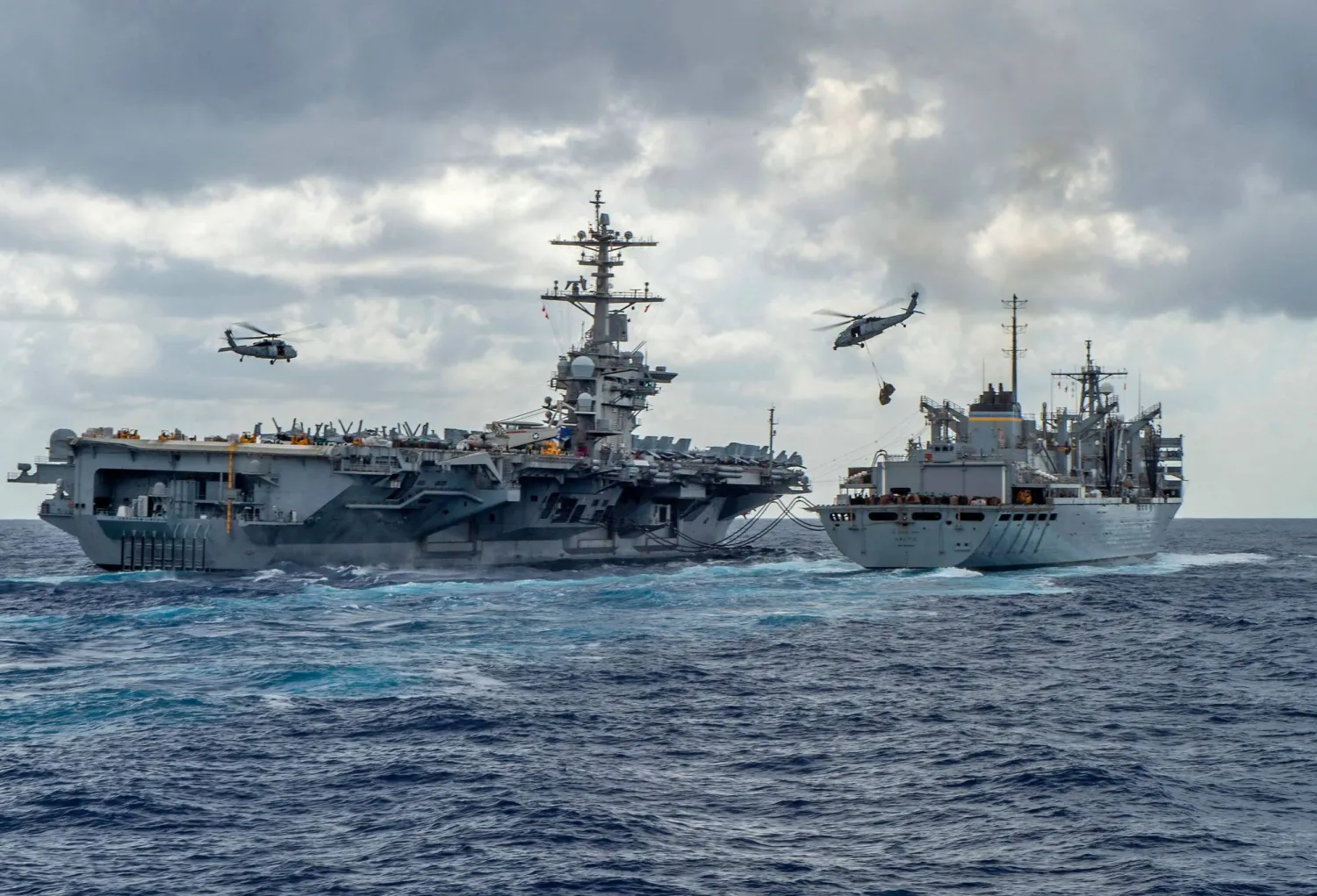
This handout picture released by the US Navy on May 8, 2019 shows the Nimitz-class aircraft carrier USS Abraham Lincoln (CVN 72) while conducting a replenishment-at-sea with the fast combat support ship USNS Arctic (T-AOE 9), while MH-60S Sea Hawk helicopters assigned to the "Nightdippers" of Helicopter Maritime Strike Squadron (HSM) 5, transfer stores between the ships. (Jason WAITE / Navy Office of Information / AFP)
TT

US Pulls Last Aircraft Carrier in Asia as Trump Focuses on Iran and the Western Hemisphere

This handout picture released by the US Navy on May 8, 2019 shows the Nimitz-class aircraft carrier USS Abraham Lincoln (CVN 72) while conducting a replenishment-at-sea with the fast combat support ship USNS Arctic (T-AOE 9), while MH-60S Sea Hawk helicopters assigned to the "Nightdippers" of Helicopter Maritime Strike Squadron (HSM) 5, transfer stores between the ships. (Jason WAITE / Navy Office of Information / AFP)

President Donald Trump's war against Iran is stretching the limits of US aircraft carriers and leaving the western Pacific without one of the key American warships as China shows more signs of aggression.

The USS George Washington is departing the Pacific and expected to replace the USS Abraham Lincoln in the Middle East amid growing concerns about mental health and supply issues aboard the long-deployed carrier. The Lincoln has had its time at sea extended from its original May return date to support operations against Iran.

The lack of a US carrier in the Pacific may be short-lived if the Navy deploys another in the next couple of months. But it shows how the open-ended operations with Iran are running some American sailors ragged, analysts say, while the Trump administration further retreats from the Asia-Pacific region and focuses on the Western Hemisphere.

“The administration says that the Pacific is supposed to be the most important behind the Western Hemisphere,” said Greg Poling, director of the Southeast Asia Program at the Center for Strategic and International Studies. Instead, the US is "doing the exact opposite" of its previously expressed goal of pulling out of the Middle East.

American allies in the Pacific are unsettled over the unpredictability of the Republican administration, Poling said, while Beijing “is quite happy with US distraction, with the frustration of US allies and partners."

China may take advantage of US carrier's absence

Beijing sees the US military presence in the region as a threat to China’s rise and an obstacle to its ambition to seize Taiwan, the self-governing island it claims as its own. But the United States has argued that the Pacific region is too important economically to lose.

No one expects China to invade Taiwan because an American aircraft carrier has left the region. But the carrier's absence gives the Chinese another opportunity to show its strength, said Bryan Clark, a former Navy submariner who is a defense analyst at the Hudson Institute.

“They’re using this as part of the narrative to demonstrate to the Philippines, to Japan, to Indonesia and others that the US is not the big dog in the western Pacific anymore,” Clark said. “They would just prefer that countries in the region decide that China is the bigger power and the US is not able to guarantee their security anymore.”

China conducted naval exercises this week with Indonesia and recently has shown signs of aggression toward Japan and the Philippines, two key US allies that also have territorial disputes with Beijing.

China carried out military drills this month near the Scarborough Shoal in the South China Sea. Both China and the Philippines have claims over the shoal. Last month, a Chinese guided-missile destroyer conducted a live-fire exercise off Japan’s southernmost island of Okinotori.

Adm. Frank Bradley, head of the US Special Operations Command, has been trying to reassure regional allies of Washington’s commitment. He was in Manila on Thursday, telling his Filipino counterparts that US special operations forces are ready to step up joint exercises to strengthen the countries' alliance. He also is expected to travel to Japan.

“We have the ability to project force, the United States, anywhere on the globe,” Bradley told The Associated Press. “And when the threat in the region of the Middle East has been attended to, we will redeploy and reorient and be able to project that force wherever else it might be required.”

“I also feel very confident in the Armed Forces of the Philippines’ ability to protect their sovereignty here and for us to remain close with them,” he said.

Evan Sankey, a policy analyst at the Cato Institute who focuses on US policy toward China, said aircraft carriers provide psychological assurance to US allies. The absence of carriers in the region, he said, “adds to the general sense that the US is distracted by events in the Middle East.”

Trump has relied on aircraft carriers for military actions

Trump has relied heavily on aircraft carriers to support military operations during his second term. For example, the USS Gerald R. Ford returned home in mid-May after an 11-month deployment, the longest since the Vietnam War, during which it supported the US fight against Iran and the capture of Venezuela's then-leader, Nicolás Maduro.

The Ford had experienced a fire in a laundry space that forced the carrier to turn around and return to the Mediterranean Sea for repairs and left hundreds of sailors without places to sleep. Meanwhile, the Lincoln has spent a record uninterrupted time at sea of more than 240 days. Democratic lawmakers have been calling for investigations and greater visibility into conditions aboard the ship.

Warships and their crews can only handle so much, said Robert Farley, who teaches national security and diplomacy at the University of Kentucky and often writes about aircraft carriers.

“People don’t get enough rest. It's psychologically exhausting. And R&R is part of keeping the crew healthy,” Farley said. “Sometimes it’s framed as, ‘These people haven’t had a vacation.’ But we are dealing with well-known limits on the capacity of a crew to operate at top efficiency over time. And that just declines."

Clark, of the Hudson Institute, said the squeeze on the nation's aircraft carriers stems from the lack of preparation and planning for the Iran war.

“If we were going to mobilize to do this kind of conflict, and we anticipated it might go this long, we might have done some changes to the carrier schedule to make sure more would be available,” Clark said.

Clark said the Navy has 11 aircraft carriers and typically deploys two or three at a time. But it could soon deploy four if the USS Theodore Roosevelt leaves San Diego for the Middle East, allowing the Washington to return to Pacific.

But the massive warships will need maintenance, likely causing a bottleneck at the nation's only two carrier shipyards.

“We’ll end up with a maintenance debt that needs to be paid for the next few years,” Clark said. “We’ll probably have less carrier presence than we’ve had in the previous years because carriers will be lined up to get into the shipyard.”

There are questions about the use of aircraft carriers in modern warfare

Michael Swaine, a senior research fellow in the Quincy Institute’s East Asia Program, questions the future need for aircraft carriers as warfare rapidly changes.

Carriers can be more easily targeted with drones and missiles, particularly by an adversary such as China, Swaine said, while smaller ships and submarines can be as effective in striking targets as the fighter jets that launch off a carrier.

Top Navy officials have indicated a desire to move away from a heavy reliance on carriers. Adm. Daryl Caudle, chief of naval operations, told The Associated Press in February that he wants to convince commanders to use smaller, newer ships and other assets instead of consistently turning to huge aircraft carriers.



Death of Al-Amin Khalifa Fhimah: The Libyan Who Escaped the Noose of the Lockerbie Case

A photo shows late Libyan President Muammar Gaddafi with Al-Amin Khalifa Fhimah (second from left) upon the latter's arrival in the capital Tripoli, a day after his definitive acquittal in the plane bombing case (Tripoli, February 1, 2001) (Getty Images)
TT

Death of Al-Amin Khalifa Fhimah: The Libyan Who Escaped the Noose of the Lockerbie Case

A photo shows late Libyan President Muammar Gaddafi with Al-Amin Khalifa Fhimah (second from left) upon the latter's arrival in the capital Tripoli, a day after his definitive acquittal in the plane bombing case (Tripoli, February 1, 2001) (Getty Images)

On August 25, 2026, in a quiet corner of the Libyan capital Tripoli, the life of Libyan citizen Al-Amin Khalifa Fhimah came quietly to an end at the age of nearly 70.

His death officially closes one of the most mysterious and compelling chapters in the history of the diplomatic and intelligence conflict between East and West. It also closes a living chapter in the case of the bombing of Pan Am Flight 103, which was traveling from Frankfurt to New York via London when it exploded over the Scottish town of Lockerbie in 1988, an incident that reshaped international politics for decades.

For an entire decade, the name of this man, who began his career as a low-ranking airline employee, echoed through the corridors of the United Nations Security Council. His photograph appeared on television screens around the world and in newspapers for years as the "second suspect" in the most horrific act of aerial terrorism of the 20th century.

Fhimah was an unwilling participant in a unique legal and political saga in which the details of his everyday life on the island of Malta became the basis of an international case that nearly brought an entire country to the brink. He later stood behind the glass of the historic Camp Zeist courtroom in the Netherlands and heard the word "acquitted" pronounced by Scottish justice at the dawn of the new millennium. He returned home carrying an acquittal that politics had been unable to grant him for years.

His death has reopened the memories of the era of crippling sanctions and international isolation, reminding the world of the story of a man who lived at the heart of the storm and died in complete seclusion, far from the political turmoil that had nearly consumed him.

Forgotten Beginnings: From Tripoli to Luqa Airport

Al-Amin Khalifa Fhimah was born in 1956 in the Souq al-Jumaa area on the outskirts of the Libyan capital, Tripoli. He progressed through his career until he joined Libyan Arab Airlines. In the mid-1980s, he was sent to work as an airline official, dispatcher, and station manager for the company at Luqa Airport in Malta.

The position appeared routine for the young employee, had it not intersected with the intense intelligence conflict unfolding across the Mediterranean between the former Libyan regime and the United States and its Western allies.

At the time, Fhimah did not know that his signature on cargo documents and the timing of his shifts at the Mediterranean airport would later become key evidence cited in the international indictment prepared by senior investigators in Washington and London.

The Night the Plane Fell and the International Storm Began

On December 21, 1988, the sky over the Scottish town of Lockerbie was torn apart when a Boeing 747 operated by Pan Am, Flight 103, exploded while traveling from Frankfurt to New York, killing 270 people.

After three years of complex joint investigations by the US Federal Bureau of Investigation (FBI) and Scottish police, two Libyan nationals were formally accused in November 1991: Abdelbaset al-Megrahi and Al-Amin Khalifa Fhimah.

At the time, Western investigators alleged that Fhimah had used his position and contacts at Malta's airport to facilitate the passage of a bomb-laden brown Samsonite suitcase. The suitcase contained a timed bomb concealed inside a cassette recorder and was allegedly placed aboard a Libyan Airlines flight bound for Frankfurt, from where it was transferred to the doomed Pan Am flight.

Historic Handover and Trial on Neutral Ground

Tripoli initially refused to hand over its citizens, placing Libya under severe international sanctions and an air and economic blockade imposed by the UN Security Council in 1992.

Libya endured a decade of deep isolation and economic paralysis until difficult diplomatic efforts led by Arab and African parties produced a unique legal and historic settlement.

Under the settlement, Libya agreed in 1999 to hand over the two suspects for trial before a special Scottish court, but on neutral ground at Camp Zeist, a former US military base near Utrecht in the Netherlands, under Scottish criminal law.

Camp Zeist Shock: Historic Acquittal and Return

On January 31, 2001, the world held its breath as Scottish judges delivered the verdict millions had been awaiting. While his associate Abdelbaset al-Megrahi was convicted and sentenced to life imprisonment, the court definitively acquitted Al-Amin Khalifa Fhimah of all charges and ordered his immediate release from behind the bulletproof glass enclosure.

The judges based his acquittal on insufficient evidence and major gaps in the witnesses' account, particularly that of Maltese clothing merchant Tony Gauci. The defense also conclusively established that Fhimah was not in Malta but was in Sweden on a business trip when the bomb-laden suitcase was checked in.

Voluntary Seclusion Until His Final Days

Following his acquittal, Fhimah returned immediately to Libya, where he received a hero's welcome in Tripoli from both officials and the public. He was portrayed as living proof that Western justice itself had established the innocence of the Libyan state from the full American account of events.

Yet the man, exhausted by years of fear, uncertainty, and detention, made a firm decision to stay completely out of the spotlight and politics. He lived the rest of his life as an ordinary citizen among his family in Tripoli, refusing to give press interviews that might reveal the secrets of that era.

The announcement of his death and the official mourning that followed brought a complete chapter of the bitter Libyan-Western conflict to a close.


Gaza’s Children Lose Simple Joy as Israel Warns Against Kite-Flying

Boys fly a kite against the backdrop of smoke rising from the Gath shelter, that houses displaced Palestinians, after an Israeli air strike in the west of Khan Younis, southern Gaza Strip on January 31, 2026. (AFP)
TT

Gaza’s Children Lose Simple Joy as Israel Warns Against Kite-Flying

Boys fly a kite against the backdrop of smoke rising from the Gath shelter, that houses displaced Palestinians, after an Israeli air strike in the west of Khan Younis, southern Gaza Strip on January 31, 2026. (AFP)

There are few joys left for 10-year-old Ahmed Hamdouna, whose childhood has already been scarred by years of war and displacement in Gaza.

Now, what little reprieve he found playing with scraps of plastic and sticks has also been torn away, as Israel warns it will step up military operations in the territory if kites continue to land on the Israeli side of the border.

"My father stopped me from flying my kites because of the occupation's threats," said Ahmed, who has been displaced to Deir el-Balah in the central Gaza Strip.

"I felt heartbroken after spending so much time collecting sticks and nylon, only for the occupation to prevent us from playing with them," he told AFP.

"We are just young children. They destroyed our home and our whole neighborhood -- what more do they want?"

Israel accuses Hamas of cynically using children and says the kites could pose a threat, years after a wave of incendiary kites and balloons sparked fires in Israeli farmland.

A series of kites have flown in recent days across the border into southern Israel, communities shaken by the Hamas-led attacks of October 7, 2023.

Hamas has denied responsibility. No explosives were detected, but at least one kite had a political message on it.

On Wednesday, an official of the US-led Board of Peace supervising the ceasefire plan in the territory said: "All militant activity in Gaza must stop, including the flying of kites."

"Israel, too, must comply with the ceasefire," a board official said.

Hamas spokesman Hazem Qassem said the popular committees in Gaza's displacement camps were trying to prevent children from flying kites, over fears they could be targeted by the Israeli military.

Ahmed said he was now scared of playing, but couldn't understand why the Israeli military was "afraid of kites when they are just paper and string".

"I don't want to hurt anyone. I just want to play like children everywhere else," he said.

- 'Sense of freedom' -

For Gaza's children, building kites was a simple way to find joy among the ruins of war.

"There are no toys here, no amusement parks, not even a football to play with. The kite is the only thing we can make with our own hands that makes us happy when we fly it in the sky," said 11-year-old Yamen al-Mubayyed, who has also been displaced to Deir el-Balah.

"My friends and I get together and make them using pieces of wood we collect from destroyed houses, along with paper and string. We glue them together using flour and water, then go to the sea to fly them," he told AFP.

Yamen said even the buzz of Israeli surveillance drones didn't put him off flying his kites.

"It is the only thing that makes us feel that we children are alive and gives us a sense of freedom," he said.

Israel has kept up attacks in Gaza, saying it is targeting gunmen, despite a US-backed ceasefire which came into effect in October.

Israeli army chief Lieutenant General Eyal Zamir on Tuesday vowed to push on with demilitarizing Gaza "using all necessary means".

- 'Kill the joy in their hearts' -

For parents in Gaza, the once-harmless activity now carries immense worries.

Akram Abu Shurkh, 30, said he had forbidden his children from making kites but felt he had "killed the joy in their eyes" in doing so.

"These are children who do not understand military calculations. They only see it as a game and a way to release their energy," he told AFP.

"But I see death in the touch of the string and the flying of the kite."

In southern Gaza, 34-year-old Umm Moaz Huwayla said her heart raced from worry every time her children went outside with their kites, but felt she couldn't stop them from playing.

"The occupation wants to kill the joy in their hearts," she told AFP.

"They are not asking for much, only to live their childhood, even with a piece of string and a sheet of paper."


From UNIFIL to Verification Committees... Will Int’l Force in Lebanon Have Expanded Powers?

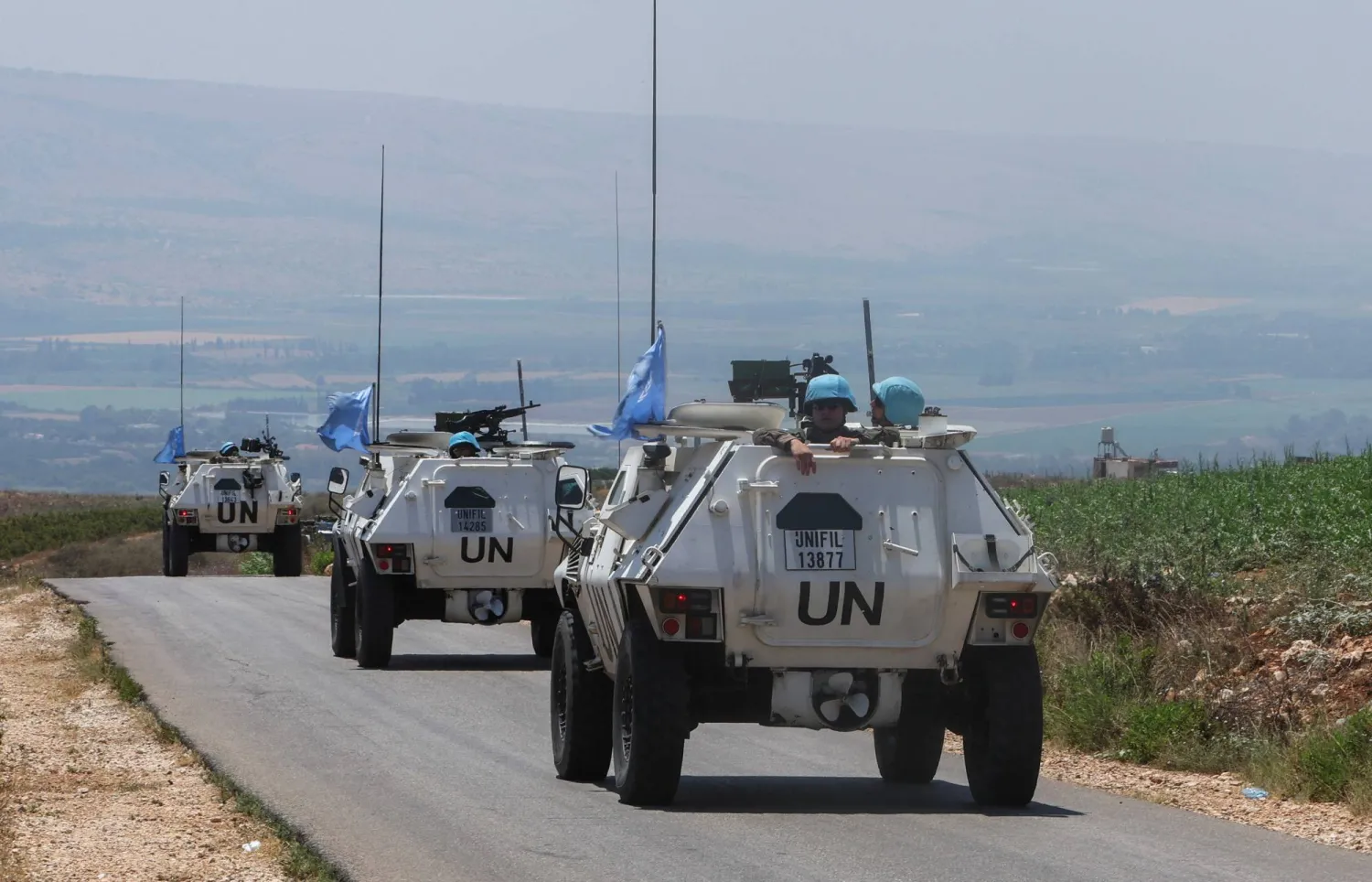
UN peacekeepers (UNIFIL) vehicles drive in the Lebanese village of Wazzani near the border with Israel, southern Lebanon, July 6, 2023. (Reuters)
TT

From UNIFIL to Verification Committees... Will Int’l Force in Lebanon Have Expanded Powers?

UN peacekeepers (UNIFIL) vehicles drive in the Lebanese village of Wazzani near the border with Israel, southern Lebanon, July 6, 2023. (Reuters)

With UNIFIL’s departure now all but certain, the question is no longer whether the UN force will remain in southern Lebanon, but who will replace it, and with what powers.

A European-led force and verification committees are under discussion, potentially expanding the international role from monitoring UN Security Council resolution 1701 to verifying exclusive state control over weapons south of the Litani River.

European-led force

Abbas Daher, director of the Center for Media Foresight, told Asharq Al-Awsat that a decision not to renew the UN Interim Force in Lebanon’s (UNIFIL) mandate was now “virtually certain,” despite recent attempts involving Italy to revive efforts for an extension.

“However, President Joseph Aoun’s visit to Italy and the current visit by Lebanese army Commander Gen. Rodolphe Haykal to continue discussions on implementation have effectively opened debate over the force that could succeed UNIFIL, whether in the form of verification committees or a force with a predominantly European composition,” Daher said.

“Discussions are now underway, and European countries, led by Italy, France and Spain, and perhaps Germany, are considering establishing a primarily European force to continue the mission,” he added.

“Efforts are also being made to gain international support for this arrangement.”

As for the verification committees, Daher said there was a proposal for the United States to play a role, particularly in verifying that weapons were under the state’s exclusive control and monitoring implementation. Discussions with Washington remain open, he added.

Italian proposal

Separately, local media reported having reviewed a four-page Italian proposal for the post-UNIFIL phase. The plan calls for a smaller, but more effective international presence focused on supporting the Lebanese army, protecting civilians and backing the mechanism monitoring the ceasefire.

The force could play a role in the disarmament measures, conditional on political approval.

Force’s mission

The debate over the force’s composition is closely tied to questions about its jurisdiction, mission and powers.

Asked how the new force would differ from UNIFIL, Daher said: “UNIFIL’s duties were defined by an international mandate and resolution 1701.”

“Lebanon will insist on replicating the experience or substance of the resolution in defining the nature of its work. The question, however, is whether that will succeed or whether amendments will be imposed, because Washington, under Israeli pressure, wants any committee to have greater executive powers.”

Retired Brig. Gen. Fadi Daoud agreed that the most important issue in the next phase was not limited to which party would replace UNIFIL. Rather, he said, it concerned a change in the nature of the international mission itself and the potential redefinition of the relationship between the new force and the Lebanese army.

“The process of ending UNIFIL’s mission has effectively become a reality, despite Lebanese efforts to secure an extension,” Daoud told Asharq Al-Awsat.

“The central question has therefore become: Who will replace it? The alternative arrangement will be the one that receives US approval,” he added.

“We are moving from peacekeeping forces to verification committees — from a mission linked to resolution 1701 to a different mechanism suited to a post-1701 phase, at least in the form in which we have known it over the past years.”

“Lebanon has no problem with any mechanism for verifying exclusive state control over weapons south of the Litani because it is committed to this issue,” Daher said.

“But the fundamental question is whether Israel will withdraw or remain an occupying force. If verification committees carry out their work, the army reaches certain areas and confirms that they are free of weapons, will Israel uphold its end of the arrangement and withdraw?”

“There must be a clear framework for an Israeli withdrawal, just as there is a clear framework for ensuring exclusive state control over weapons in the south.”

Powers of the verification committees

From a military perspective, Daoud said the scope of the committees’ powers lay at the heart of the debate. The distinction between verifying that the army had completed its mission and helping oversee its implementation could determine whether any new arrangement was viable.

“Will the verification committees’ role be limited to confirming that the Lebanese army has completed the task required of it, or will they take part in overseeing how it is carried out? There is a very significant difference between the two,” he stressed.

“For example, if information is received about a weapons depot at a particular location and the Lebanese army raids the site, will the committee merely receive a report confirming that the mission was completed and verify its outcome? Or will it accompany the military force and monitor the search on the ground using personnel, cameras and communications equipment?” he added.

“This is not a technical detail. It could be the most dangerous issue in any new arrangement because the Lebanese army cannot easily accept a foreign party or an entity outside its military chain of command exercising such close oversight over how it performs its duties or directing it during search operations,” he continued.

“An international body can verify that a mission has been carried out and confirm its results. But moving toward direct supervision of its implementation could create serious and sensitive problems,” Daoud said.