What Options Does Hezbollah Have in Dealing with Israeli Escalation?

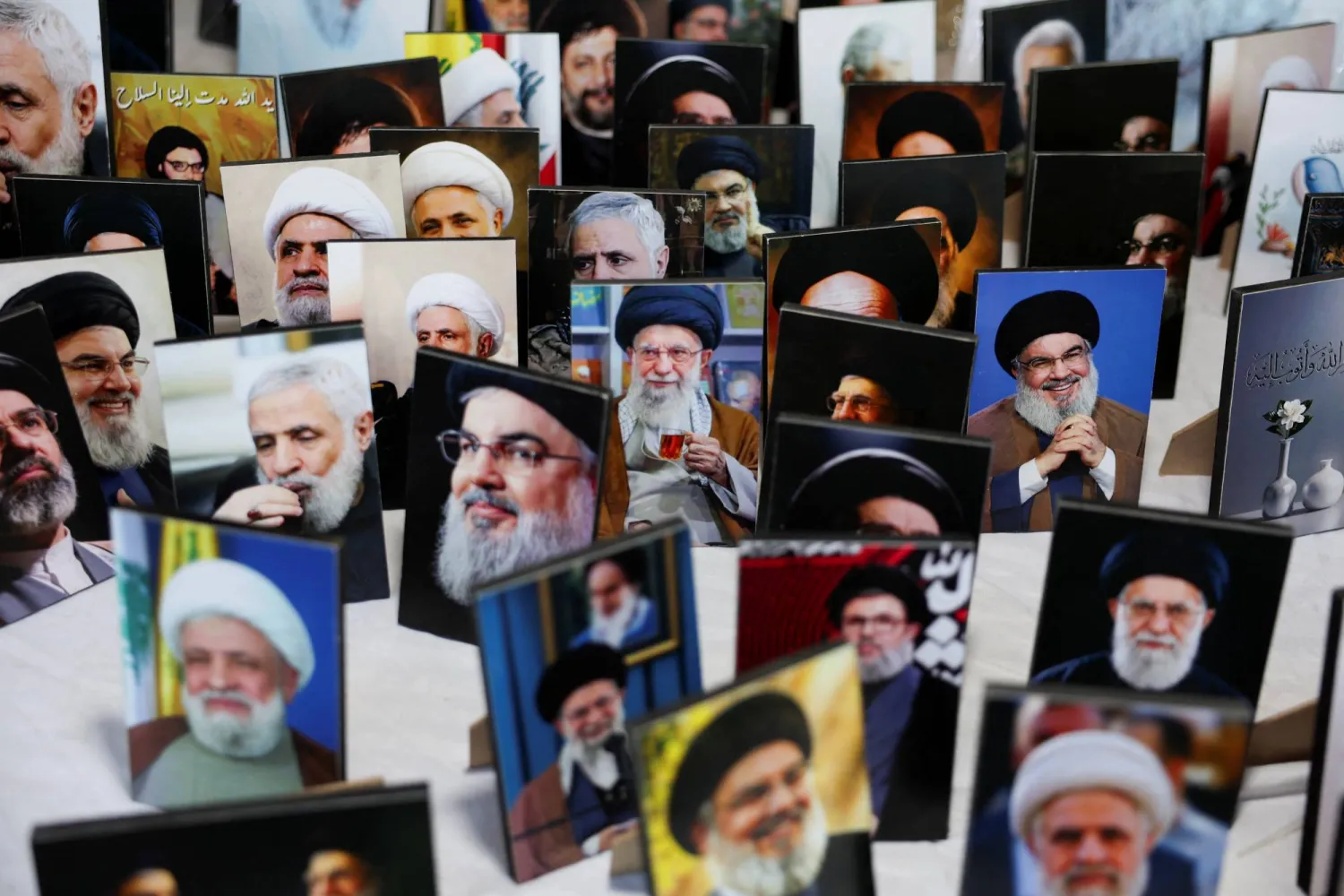
Portraits of current and former Iranian and Hezbollah leaders displayed at a rally, in the southern suburbs of Beirut, Lebanon, September 2, 2026. (Reuters)
TT

What Options Does Hezbollah Have in Dealing with Israeli Escalation?

Portraits of current and former Iranian and Hezbollah leaders displayed at a rally, in the southern suburbs of Beirut, Lebanon, September 2, 2026. (Reuters)

Hezbollah finds itself facing an increasingly difficult equation as Israeli escalation in South Lebanon has widened in recent days. How will the party respond to mounting Israeli strikes without being drawn into a broader confrontation that Israeli Prime Minister Benjamin Netanyahu may be seeking either to postpone Israel’s elections or improve his prospects in them.

At the same time, Hezbollah is facing growing pressure from its support base, which is bearing the brunt of the strikes and demanding a response capable of deterring Tel Aviv. Yet the group’s options appear largely constrained by regional developments, particularly the course of US-Iran negotiations, as well as domestic political calculations in Lebanon.

A response could benefit Netanyahu

Sources familiar with Hezbollah’s position said the Iran-backed party has largely avoided signaling whether it intends to retaliate or continue exercising restraint and adhering unilaterally to the ceasefire agreement.

They told Asharq Al-Awsat that Hezbollah is currently focusing on holding the Lebanese authorities responsible for addressing the situation, noting that the group had previously called on the government to engage in dialogue over the expanding Israeli offensive and the failure of negotiations.

The sources see no indication so far that Hezbollah may make a military response. They argue that one objective of Israel’s widening offensive is to provoke Hezbollah and Iran into retaliating and trigger a broader war, which could benefit Netanyahu electorally or help him postpone the polls.

Limited ability to confront Israel

Hilal Khashan, a professor of political science at the American University of Beirut, took a different view, saying Hezbollah has no options left because its military power has collapsed, particularly after its decision to hand over Ali al-Taher — “a symbol of its pride” — to Israel rather than surrender it to the Lebanese army.

“Hezbollah lacks the ability not only to fight Israel, but even to provoke it,” Khashan told Asharq Al-Awsat. “It sent two drones, and we saw the results.”

The academic believes the party’s current priority is to retain its weapons domestically after its military role in confronting Israel has effectively ended, although Hezbollah “insists on living in denial.”

He expects Israeli escalation to continue ahead of the heated elections, saying it will not be confined to Lebanon but could extend to the West Bank, Gaza and southern Syria, amid continued threats of strikes against Iran.

“As for America’s ability to pressure Israel, it appears limited,” Khashan noted, saying this means an expansion of Israeli operations into Lebanon's Bekaa Valley cannot be ruled out.

Three options for Hezbollah

Retired Lebanese army Brig. Gen. Mounir Shehadeh offered a different assessment, identifying three options available to Hezbollah.

“The first is a broad, direct military response,” he told Asharq Al-Awsat. “This is the option that could give Israel the pretext it is seeking to expand its target list, take the escalation deeper into Lebanon and perhaps strike Lebanese infrastructure. It is therefore a high-cost option.”

The second is to refrain entirely from responding. That also carries a price because Israel could interpret it as evidence that it can impose new realities without paying a cost, particularly following the escalation over Ali al-Taher and the continuing strikes, he explained.

The third option is a calibrated, limited response. “In my view, this is the most logical option if the group decides to respond,” Shehadeh said.

Such action would seek to establish the principle that “aggression carries a cost” without triggering an all-out confrontation, he went on to say. Hezbollah could simultaneously maintain a policy of ambiguity by declining to claim every operation, particularly if it wanted to preserve room for political maneuver.

Shehadeh said Hezbollah may be facing a more complicated calculation: whether to respond to Israel now or wait until the direction of US-Iran negotiations becomes clearer.

Waiting for the outcome of those talks would not necessarily mean surrendering or remaining passive, he noted. Instead, Hezbollah could defer a major response while keeping the option of limited retaliation open, since a broad confrontation at this stage could benefit Israel more than the party and give it an opportunity to widen the war before the regional picture becomes clearer.

Shehadeh expects Hezbollah to avoid, in the near term, initiating a major response that could trigger an all-out war. At the same time, the group cannot indefinitely tolerate continued Israeli escalation without responding.

He stressed that the most realistic scenario is to contain the escalation, monitor developments on the ground, take into account the US-Iran diplomatic track and keep open the option of a limited, carefully calibrated response if Israel crosses certain lines.



Xi-Trump-Putin Summit Evokes 1945 Yalta Carve-up

Signage for the upcoming Asia-Pacific Economic Cooperation (APEC) China 2026 summit is seen in Shenzhen, southern China's Guangdong province on November 3, 2026. Hector RETAMAL / AFP/File
TT

Xi-Trump-Putin Summit Evokes 1945 Yalta Carve-up

Signage for the upcoming Asia-Pacific Economic Cooperation (APEC) China 2026 summit is seen in Shenzhen, southern China's Guangdong province on November 3, 2026. Hector RETAMAL / AFP/File

A possible China-US-Russia summit has prompted alarm of a modern-day Yalta Conference, with three powerful men carving up the world -- with little regard for Ukraine, Europe and Taiwan or anyone else.

But apart from an historic photo opportunity, the meeting between Presidents Xi Jinping, Donald Trump and Vladimir Putin at the November 18-19 APEC summit in Shenzhen will likely achieve little, analysts say.

- Spheres of influence -

When then US president Franklin D. Roosevelt, Britain's Winston Churchill and Soviet leader Joseph Stalin met in Yalta in February 1945, they laid out the post-WWII settlement and new territorial boundaries in Europe.

That meeting in Yalta, then in the Soviet Union and now in a part of Ukraine annexed by Russia in 2014, laid out the foundations for the Soviet domination of Eastern Europe and the Cold War, AFP said.

Ukraine's President Volodymyr Zelensky has raised alarm that Shenzhen could be a Yalta-like "redistribution of spheres of influence" for the 21st century.

At talks in Abu Dhabi this week -- the first since February -- Russian negotiators rattled Ukraine and its European supporters by pushing a review of the continent's security architecture as part of any peace deal, with the US also floating a new framework.

Russia's delegation chief in Abu Dhabi, Vladimir Medinsky, fanned such fears by questioning the inclusion of Europe in further talks.

The trilateral rankles because it signals "the idea that a few great powers can decide the security and future of other countries over their heads", according to Tsiporah Fried at the Hudson Institute.

The format alone "would already send a message about who counts, and whose interests can be negotiated by others", she told AFP.

- Divergent interests -

Beyond the symbolism, however, divergent interests make the creation of a new world order in Shenzhen unlikely.

Even the agenda reportedly remains contentious: Russia has suggested the meeting focus on Ukraine, Trump has pushed for talks on nuclear weapons and the Iran war, and China has remained tight-lipped on both.

"The three parties have vastly different demands, making the management of expectations difficult. There is a high probability that talks could end without a breakthrough," according to Wang Wen, dean of the Chongyang Institute for Financial Studies at Renmin University in Beijing.

There are also few issues where input from all three leaders could bring progress.

The main points of contention between Beijing and Washington are trade and the AI technology race, for instance.

Beijing -- which presents itself as a champion of multilateralism -- has repeatedly said that Europe should be part of peace negotiations over Ukraine.

German President Frank-Walter Steinmeier said that in a recent meeting, Xi showed "irritation" when the idea of the trilateral talks covering Ukraine came up.

"He explicitly pointed out that this is a European conflict, in which the Europeans must also be at the table," Steinmeier told ARD.

On nuclear disarmament, China has long insisted that the US and Russia reduce their own giant nuclear arsenals before it agrees to talks on its own stockpile.

The summit therefore is more likely to produce minor outcomes such as crisis hotlines or some cooperation on counter-terrorism, public health, or climate change, Wang told AFP.

"There is no single enemy to unite all three great powers the way that the fight against Nazi Germany united Roosevelt, Churchill, and Stalin," said Wen-Ti Sung, a political scientist at Australian National University.

"It follows that piecemeal horse-trading is in; a grand bargain is out."

However, Taiwan -- which China claims -- will still be watching the meeting closely, Sung said.

"If the Trump administration is open to abandoning one partner (Ukraine) out of convenience, then it can abandon another," he said.

- A post-Shenzhen world -

The Trump administration has sought to reassert US dominance over the "Western hemisphere" -- including by capturing Venezuelan President Nicolas Maduro in January -- but splitting the world among great powers like it's 1945 may not guarantee security.

China has opposed the logic of Yalta -- the clandestine division of spheres of influence and major powers determining the fate of other nations -- "from the very beginning", according to Renmin University's Wang.

China could allay fears of a second Yalta by using the summit to "emphasize the defense of sovereignty and support for multilateral organizations", Wang said.

If Beijing uses the meeting to insist on European inclusion in talks regarding the continent's security, it "could, in fact, open a new window for communication between China and Europe", he said.

"The original Yalta opened the path to the Korean War and Indochina Wars in addition to various conflicts and insurgencies across Asia, Africa, and Latin America," said Chong Ja Ian at the National University of Singapore.

Any Yalta 2.0 agreement "will almost certainly run into the same kinds of issues", Chong said.


Alice Huang, Who Reportedly Had an Affair with Nvidia CEO, Is a Chinese Banker Turned Tech Exec

This screengrab from video footage by CTI obtained via AFPTV on November 9, 2026 shows Alice Huang (2nd R in pink), a Chinese executive linked to the data center company called Megaspeed, attending a dinner hosted by Nvidia's chief executive and co-founder Jensen Huang (2nd L in black back facing camera) at a restaurant in Taipei on May 22, 2025, during Computex, the island's top tech expo. (AFP photo / CTI via AFPTV)
TT

Alice Huang, Who Reportedly Had an Affair with Nvidia CEO, Is a Chinese Banker Turned Tech Exec

This screengrab from video footage by CTI obtained via AFPTV on November 9, 2026 shows Alice Huang (2nd R in pink), a Chinese executive linked to the data center company called Megaspeed, attending a dinner hosted by Nvidia's chief executive and co-founder Jensen Huang (2nd L in black back facing camera) at a restaurant in Taipei on May 22, 2025, during Computex, the island's top tech expo. (AFP photo / CTI via AFPTV)

She was building a career in Chinese finance before turning to tech with a leadership role at a data center company in Singapore. He is the high-profile CEO of Nvidia, the California-based company that makes computer chips relied upon by advanced artificial intelligence systems.

An affair between Nvidia's Jensen Huang and Alice Huang, who reportedly was suspected of working as a spy for Beijing, has rocked the tech and political worlds.

The Chinese businesswoman, also known as Huang Le, had a close relationship with Jensen Huang, according to reports over the past month by the New York Times. The newspaper also reported that top policymakers were informed in a memo that intelligence indicated she was a spy for China’s Ministry of State Security, recruited to influence Nvidia to make its most advanced chips more available in China.

In one widely shared photograph of the pair, Jensen Huang and people surrounding him are holding drinks in Taipei, while Alice Huang sits behind him, apparently watching him in conversation. The picture was posted in 2024 by software company NetThunder to its LinkedIn page.

It remains unclear how long the affair lasted, and when exactly the relationship might have ended. The Associated Press was unable to reach Alice Huang for comment.

Who is Alice Huang?

Publicly available information about Alice Huang is scant.

She was a Chinese finance executive before becoming involved in artificial intelligence, data centers and computer chips.

In 2023, she became a director at Singapore-based Megaspeed, which describes itself as an “NVIDIA cloud partner.” Last year, Megaspeed faced scrutiny from the US over its alleged skirting of US export restrictions and routing of a large amount of advanced Nvidia chips for Chinese users.

Megaspeed was incorporated in 2015 in Singapore with the name 7Road International, after being spun off as the overseas arm of a Chinese video game developer, according to corporate registration records.

Filings show that in March 2023, it renamed itself Megaspeed International, with all of the shares transferred to Huang Le Limited, a company registered in the British Virgin Islands.

That same month, Alice Huang became Megaspeed’s controlling shareholder, according to research by the C4ADS, a Washington-based nonprofit focused on global security.

But by November 2023, she was no longer listed as a director at Megaspeed, and all her shares were transferred to a Singaporean businessman, Tan Yong Pong, who also is known as James Tan.

While public records suggest Alice Huang left Megaspeed, short seller Culper Research issued a report in May this year that cited a Megaspeed employee saying Huang was “actually still our boss” and was still involved in the company’s daily operations.

Before Megaspeed, Alice Huang previously held senior positions at the Chinese firm Shanghai Hexi Investment Co. from around 2015 to 2017, according to social media posts and records from Simuwang, a Chinese private equity database.

Her roles at Hexi included deputy general manager, executive director and member of the investment committee, according to Hexi's social media posts, among possible other roles.

Hexi's founder Kang Wei, who appeared on some records alongside Alice Huang, was fined in 2018 by China's securities regulator 400,000 yuan ($60,000) over financial misconduct behaviors while Hexi was fined 17.7 million yuan ($2.7 million).

Before that, Alice Huang worked at HSBC’s Hong Kong private banking arm and at CITIC Securities, a Chinese investment bank.

HSBC and CITIC did not immediately respond to a request for comment on her employment history.

Taiwan’s Interior Minister Liu Shyh-fang told lawmakers and reporters this week when asked about Megaspeed and Alice Huang that authorities, including national security officials, are “actively” looking into the matter. She would be blocked from setting foot in Taiwan again, Liu said.

Beijing has rebutted claims that Alice Huang was a Chinese spy. Its Foreign Ministry said this week that the “Chinese spy allegation is unsubstantiated. It is nothing but smears against China.”

Why Megaspeed is at the center of the controversy

With the emergence of the latest scandal, Singapore-based AI computing company Megaspeed, where Alice Huang was a senior executive, is once again under the spotlight.

Megaspeed, an Nvidia customer, was originally incorporated in 2015 before changing its name to Megaspeed International in 2023. Nvidia lists Megaspeed as a partner on its website, while Megaspeed says on its website it's “a core business partner of NVIDIA’s computing power cloud business in the Asia-Pacific region.”

It was the overseas gaming arm of Shenzhen-based developer 7Road Holdings Ltd.

Late last year, Megaspeed denied accusations following reports that it was routing Nvidia chips to China, saying in a statement on its website that “there has been no evidence of any violations concerning the illicit transfer of chips or any illegal activities.”

Singapore’s government said in late October, after fresh reports that Alice Huang was accused of being a Chinese intelligence source, that authorities were investigating Megaspeed and that Singapore “does not condone businesses” circumventing or violating other countries’ export controls. However, it said, there were no investigations conducted in respect to Alice Huang.

Megaspeed did not immediately respond to a request for comment.


How Israel’s New Parliament Can Make Netanyahu’s Life Difficult

A combination picture shows Israeli Prime Minister Benjamin Netanyahu as he attends a memorial service held for Ran Gvili, an off-duty police officer who was killed fighting militants that had infiltrated Israel during the deadly October 7, 2023, attack by Hamas, and the last hostage recovered from Gaza, in Meitar, Israel, January 28, 2026, and Israeli opposition leader and former military chief, Gadi Eisenkot, as he launches an election campaign for Yashar, his new political party, at an event near Hod Hasharon, Israel, June 30, 2026. (Reuters)
TT

How Israel’s New Parliament Can Make Netanyahu’s Life Difficult

A combination picture shows Israeli Prime Minister Benjamin Netanyahu as he attends a memorial service held for Ran Gvili, an off-duty police officer who was killed fighting militants that had infiltrated Israel during the deadly October 7, 2023, attack by Hamas, and the last hostage recovered from Gaza, in Meitar, Israel, January 28, 2026, and Israeli opposition leader and former military chief, Gadi Eisenkot, as he launches an election campaign for Yashar, his new political party, at an event near Hod Hasharon, Israel, June 30, 2026. (Reuters)

Benjamin Netanyahu remains Israel's prime minister when the new parliament takes office Tuesday but its new, less friendly composition could make his life much more difficult.

Gadi Eisenkot, a former military chief seeking to move Israel to the center, was given the mandate Sunday by President Isaac Herzog to form a new government, a complicated task as neither he nor Netanyahu command a majority.

Until then Netanyahu, Israel's longest-serving leader, remains caretaker prime minister -- but the new 120-member parliament can still go to battle against him.

The lack of a new government "does not infringe upon the Knesset's prerogatives", said Assaf Shapira, a political expert at the Israel Democracy Institute.

Eisenkot has also warned military chiefs that Netanyahu does not have a mandate to resume war against Iran -- although the statement was more about politics than the law, with Netanyahu still in charge of national security.

Netanyahu's bloc slipped to 53 seats in the new parliament, down from the decisive 68 it commanded previously.

Eisenkot's core opposition bloc has fewer seats than Netanyahu at 48 but the new parliament also has a record 19 lawmakers from Arab-majority parties that are vehemently opposed to Netanyahu and his hard-right government -- although it remains unclear if Eisenkot will seek to work with Israeli-Arabs directly.

Here are ways in which the new parliament could turn on Netanyahu:

- Commission on October 7 attacks -

One of the opposition's main campaign promises has been to set up a commission of inquiry to probe failures in the famously high-security country that allowed Hamas's October 7, 2023, attack, the deadliest ever day for Israel.

While Netanyahu denies any wrongdoing on his part, his government has consistently opposed the creation of a national, independent commission of inquiry that would have broad investigative authority, with Netanyahu instead supporting a review by political appointees.

Even before a new government is formed, the incoming parliament could set up a special committee on the attack which would hand over its findings to an eventual commission of inquiry, Shapira said.

Eisenkot declared after the election that forming a commission would be an immediate priority.

- Repealing Netanyahu-era laws -

The new parliament could also move quickly to repeal some of the most controversial laws under Netanyahu, including his efforts to revamp the judiciary -- seen by the prime minister as an enemy after he was charged with corruption.

The judicial revamp triggered some of Israel's largest ever protests, with liberals worried about the future of democracy, although the Hamas attack and subsequent wars quickly shifted public attention.

The new parliament could aim to repeal the last coalition's laws that limited the powers of the Supreme Court and made it easier to remove the country's attorney general.

Lawmakers could also roll back exemptions for ultra-Orthodox Jews from serving in the military. The exemption has angered many Israelis at a time that the military is stretched thin, although the laws did not go far enough for ultra-Orthodox parties, who are being wooed by at least one opposition figure.

Shapira said repealing Netanyahu-era laws was as simple as calling a vote and reverting to previous policies. But the process to pass new laws could take weeks as the opposition coordinates its priorities.

- Electing new speaker -

The first political clash will concern electing a new parliament speaker. The incumbent is Amir Ohana, a Netanyahu loyalist from his Likud Party.

According to parliamentary rules, the vote for speaker can take place as early as during the inaugural session and must happen before a new government is sworn in.

An initial clash took place Thursday when three parties in the Eisenkot bloc sent letters to the outgoing speaker requesting that his successor be elected at the opening session -- a timing that Shapira agreed was more common.

Ohana responded that it was customary to elect the speaker on the day a new government is sworn in.

Naftali Bennett, a key opposition figure, vowed to act "urgently" on the bloc's priorities.

"We will take control of the Knesset as quickly as possible."