Policing of France's School Protests Clouds Macron's Final Months and Sparks Uproar

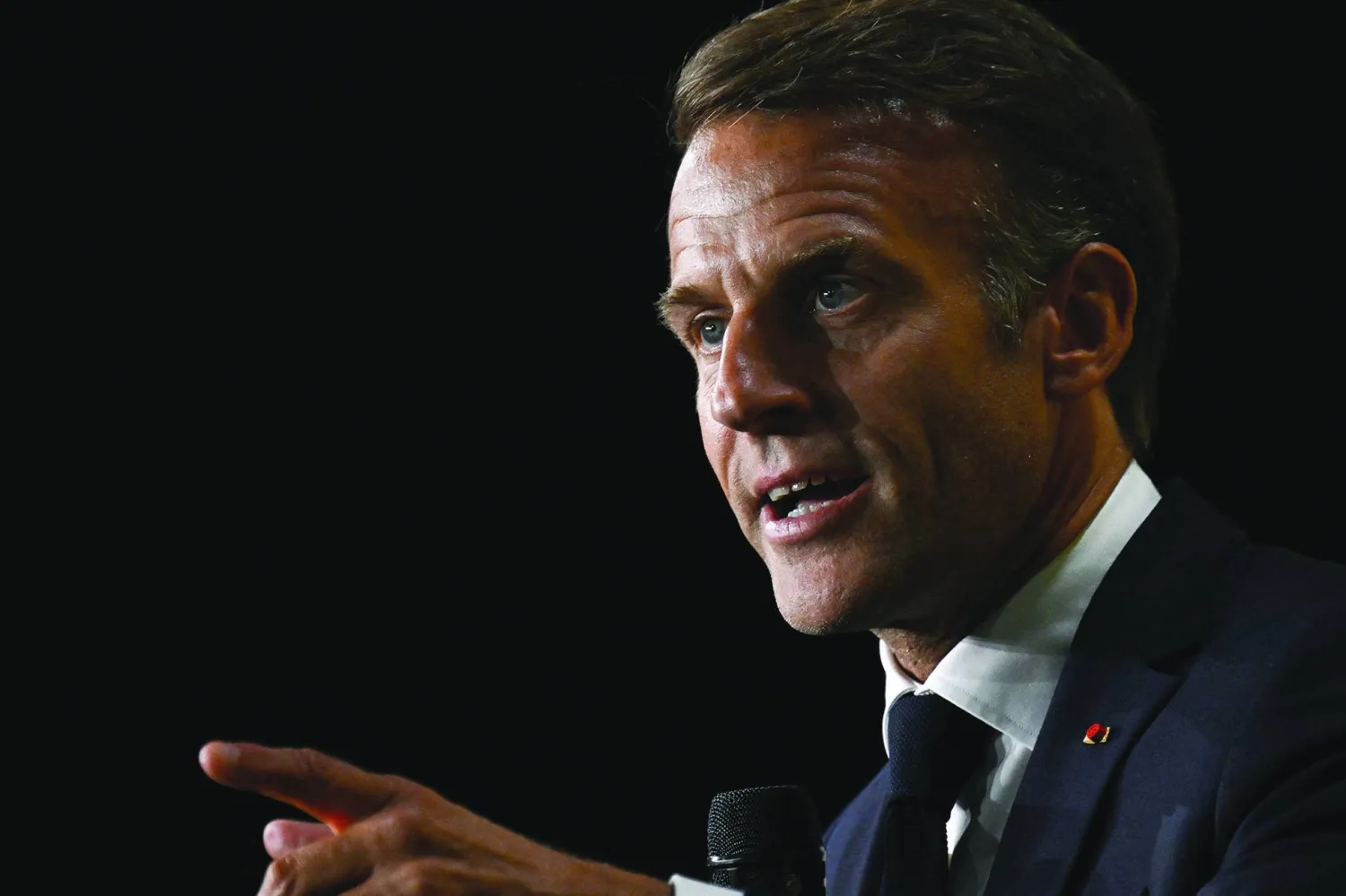
France's President Emmanuel Macron delivers a speech during the "Bpifrance Inno Generation (BIG)" event, in Paris, France, October 8, 2026.  Julien De Rosa/Pool via REUTERS
France's President Emmanuel Macron delivers a speech during the "Bpifrance Inno Generation (BIG)" event, in Paris, France, October 8, 2026. Julien De Rosa/Pool via REUTERS
TT

Policing of France's School Protests Clouds Macron's Final Months and Sparks Uproar

France's President Emmanuel Macron delivers a speech during the "Bpifrance Inno Generation (BIG)" event, in Paris, France, October 8, 2026.  Julien De Rosa/Pool via REUTERS
France's President Emmanuel Macron delivers a speech during the "Bpifrance Inno Generation (BIG)" event, in Paris, France, October 8, 2026. Julien De Rosa/Pool via REUTERS

On one side, legions of determined teenagers protesting for their future by blockading schools and taking part in marches that have sometimes spiraled into violence.

On the other, one of the largest internal security forces in Europe, deployed by the government of an unpopular and outgoing president, The Associated Press said.

The result, playing out almost daily outside high schools and on the streets of France, is a nationwide storm of unrest. The mayhem of recent weeks — with mass arrests and hundreds of injured — has sparked an uproar in a country steeped in a centuries-old culture of protest. Even some police have turned on the government's handling of the demonstrations.

Discontent shrouds Macron's final months

For President Emmanuel Macron, who leaves office in May, it’s hardly the dream ending to his decade in power. He has faced a succession of protest movements that sapped his popularity and fueled broad criticism of how his ministers use police against demonstrators.

With the high schoolers, the outcry has grown particularly loud. That's partly because the vast majority of the 8,000 people arrested in recent weeks are under 18 and because police riot-control weapons are blamed for life-changing injuries suffered by some young teens.

The protesters' push for better-resourced schools, particularly in poorer Paris suburbs and other cities and towns, also has a sympathetic audience as France hurts from record poverty and record public debt.

But police complain that they're facing violent rioters who are latching onto the protests and using the crowds as cover to attack officers, pelting them with rocks, fireworks and other projectiles and wreaking havoc with fires, vandalism and other destruction. By the government's count, more than 900 officers and more than 150 teachers and other school staffers have been injured. More demonstrations, by a variety of groups with broader complaints beyond schools, are planned Saturday.

French history partly explains why protests are veering into confrontations between riot police and some demonstrators who come ready to fight in masks and black clothes, says Walid Hrar, a police officer and union representative in the northern suburbs of Paris.

“This is the country of the French Revolution. Everyone boasts about it, in fact. Some political parties don’t hesitate to say that we need to disobey the law. That’s what Robespierre and other revolutionaries taught us in 1789,” he said.

“France always tends to react rather than anticipate,” he added. "In other words, we’re always going to extremes.”

Attention focusing on police weaponry

The police have drawn sharp scrutiny for their efforts to control crowds using a variety of so-called non-lethal weaponry, particularly grenades and other projectiles, but also tear gas, water cannons and riot shields equipped with powerful strobe lights.

"We’re sending poorly equipped, untrained public security police officers to violent demonstrations who are likely to become agitated very quickly out of anger and fear,” said Jean-Marie Godard, an author who specializes in French policing.

Hrar said some of his police colleagues “aren’t specialized in crowd control and aren’t equipped for it. We send them in because we need the manpower, so we have officers wearing uniforms that aren’t flame-resistant. And if you’re hit by a firework mortar and your uniform isn’t flame-resistant, you can catch fire. We also have officers with worn-out helmets. We have shields that aren’t suitable."

He said officers who haven't been given permission to use riot-control projectiles and grenades sometimes struggle to keep attackers at a safe distance.

“So unfortunately we make do,” he said. “You’ll inevitably end up in direct physical confrontation. When that happens, there are injuries on both sides.”

His Alliance police union announced this week that it is filing a legal complaint against the state, accusing it of endangering lives. It alleged that officers are being issued with vague and contradictory orders, leaving them “isolated, betrayed, abandoned, exposed to violence."

Probes of alleged misconduct grow French Interior Minister Laurent Nunez said this week that security forces have used crowd-control weapons at least 18,000 times during the protests — mostly smoke and tear gas but also projectiles and grenades.

They include a deafening launcher-fired grenade that Nunez said was used “about 40 times” before he suspended its deployment against high schoolers, after a 15-year-old lost a hand.

“All this equipment, all these forces, all these intermediate weapons, are used whenever necessary, with proportionality, to mark an escalation of the response, to keep people at a distance or sometimes to put them out of action,” he said.

The minister said rules governing the use of riot-control projectiles are “very clear, very strict.”

“We avoid everything above the neck,” he said.

Still, an officer suspected of firing a round that partially blinded a 16-year-old was this week charged with aggravated violence.

That case is among a growing number of investigations — totaling 36 as of Tuesday — into alleged police misconduct.

Four involve “mutilating injuries,” another six involve “significant injuries” and others are for “blows, insults and suspected sexual assaults” and include the case of an officer accused of attempting to drown a protester, Nunez said.

Expert says different groups get different policing France has more than 250,000 police and gendarmes.

Sebastian Roché, a policing specialist at France's National Center for Scientific Research, said their use can depend on the political needs of the government, which commands them. Officers have been less forgiving with the teenagers than they previously were with farmers, a powerful lobby in France, who doused government buildings with manure, blocked roads and set fires.

“It’s the political definition of the movement that defines the police response,” Roché said.

Public perceptions of the police also change and are influenced by what people see on social media, said Hrar, who noted that officers were applauded for their bravery during terror attacks in 2015.

"When you bombard people every single day with images of police intervening with batons, shields and tear gas, you’re inevitably going to create a negative impression.”


From Gaza to Congress: Adam Hamawy Becomes First Muslim to Represent New Jersey in the House

Dr. Adam Hamawy (File photo/AFP)
TT

From Gaza to Congress: Adam Hamawy Becomes First Muslim to Represent New Jersey in the House

Dr. Adam Hamawy (File photo/AFP)

Adam Hamawy, a surgeon who previously volunteered in the Gaza Strip, won a seat in the US House of Representatives on Tuesday, defeating Republican Gregg Mele in New Jersey's 12th Congressional District.

The Associated Press called the race for Hamawy at 8:26 p.m. Eastern Time. At the time, he had secured 70.8% of the vote, with 80% of ballots counted.

With his victory, Hamawy becomes the first Muslim elected to Congress from New Jersey.

Hamawy was among 12 active candidates who competed in the crowded Democratic primary to succeed liberal Rep. Bonnie Watson Coleman, who is retiring after 12 years in office. A 13th candidate remained on the primary ballot despite withdrawing from the race.

The former US Army combat surgeon comfortably defeated Mele, an attorney, to succeed the Democratic congresswoman.

The result came as little surprise. Watson Coleman, an influential progressive voice in the House, won reelection in 2024 by a margin of nearly 25 percentage points.

Hamawy's victory keeps the reliably Democratic seat in the party's hands, according to The Hill.

Earlier this year, Hamawy secured the Democratic nomination after emerging from a competitive primary field.

Early Life and Humanitarian Work

Hamawy grew up in New Jersey after his family emigrated from Egypt when he was an infant.

He attended Rutgers University and its medical school before later earning a Master of Business Administration degree from the same university.

After completing his military service, he returned to New Jersey and established a private plastic surgery practice in Princeton.

According to his campaign website, Hamawy has also volunteered to treat patients in Syria, Lebanon, Sudan, Jordan, Turkey, Bosnia, Haiti, Belize and Colombia.

He served eight years as a surgeon in the US Army, including a nine-month deployment with the 31st Combat Support Hospital in Baghdad during the Iraq War.

His Journey to Gaza

Hamawy, who lives in South Brunswick and operates a plastic surgery practice in Princeton, entered the congressional race as a political newcomer.

His campaign quickly gained momentum amid growing frustration among progressives over Israel and its war against Hamas in the Gaza Strip.

Hamawy came to national attention in 2024 when he was among a group of doctors stranded in Gaza after Israel closed the Rafah border crossing.

Democratic Sen. Tammy Duckworth of Illinois, who credits Hamawy with saving her life after her helicopter was shot down in Iraq in 2004, intervened to help secure his departure from Gaza along with that of other medical workers.

Duckworth's intervention was widely viewed as an opportunity to repay the surgeon who had helped save her life, according to The Hill.

Hamawy's volunteer work at a Gaza hospital during the war helped strengthen support for his candidacy.

He also received endorsements from prominent progressive figures, including Sen. Bernie Sanders and Rep. Ro Khanna, according to Politico.

Opposition to War

New Jersey is home to a substantial Arab American community of approximately 179,000 people. The Egyptian American population, in particular, has grown rapidly.

Hamawy's congressional district includes approximately 11,000 residents of Arab descent, according to data from the Arab American Institute.

In a video posted on his official X account, Hamawy urged voters to support his campaign, saying: "Do you want to make Trump mad? Return your mail-in ballot today."

Hamawy has called for an end to US military aid to Israel. More broadly, he has expressed opposition to providing American military assistance to countries that commit human rights violations.

In a May interview with the New Jersey Monitor, Hamawy opposed the ongoing war against Iran, describing it as "an illegal and immoral war" that needed to end.

He also accused the United States of catering to the special interests of defense contractors and warmongers, as well as organizations such as the American Israel Public Affairs Committee (AIPAC) and Israel's own special interests.

On domestic policy, Hamawy has advocated expanding access to healthcare, increasing funding for public schools and reducing costs for working-class families.

The Democrats are poised to take control of Congress following the midterm elections, having secured majorities in both the Senate and the House of Representatives, turning Tuesday's vote into a stinging defeat for President Donald Trump and his Republican Party.


Abdul El-Sayed: 'As Michigan as You Get'

Michigan Democratic Senate candidate Abdul El-Sayed speaks at an election night event, early Wednesday, Nov. 4, 2026, in Detroit. (AP Photo/Julia Demaree Nikhinson)
TT

Abdul El-Sayed: 'As Michigan as You Get'

Michigan Democratic Senate candidate Abdul El-Sayed speaks at an election night event, early Wednesday, Nov. 4, 2026, in Detroit. (AP Photo/Julia Demaree Nikhinson)

Abdul El-Sayed, 42, made history as the first Muslim elected to the US Senate after winning a crucial seat in Michigan in Tuesday's congressional midterm elections.

Born in Michigan on October 31, 1984, El-Sayed previously served as a public health official in Wayne County, in the battleground state. He has never held elected office, but he is no stranger to politics. In 2018, he ran for governor of Michigan, finishing second to Gretchen Whitmer in the Democratic primary.

El-Sayed grew up in the Detroit area with his father, Mohamed, an Egyptian immigrant who came to the United States to study at Wayne State University, and his stepmother, Jackie. His biological mother, Fatten Elkomy, is a psychiatric nurse in Missouri.

El-Sayed describes himself as "as Michigan as you get." He attended local schools, graduating from high school in 2003. During his school years, he captained the lacrosse, wrestling and football teams.

He went on to the University of Michigan, where he majored in biology and political science and played on the university's lacrosse team. He graduated in 2007 with highest distinction and was selected to deliver the student commencement address.

"We have the audacity to believe that we can change this world, and that each of us will," he told his fellow graduates, describing what made Michigan exceptional.

El-Sayed received a full-tuition scholarship to the University of Michigan Medical School. After completing two years of medical school, he was awarded a Rhodes Scholarship for 2009 to study at Oriel College, Oxford University, where he completed a doctorate in public health in 2011.

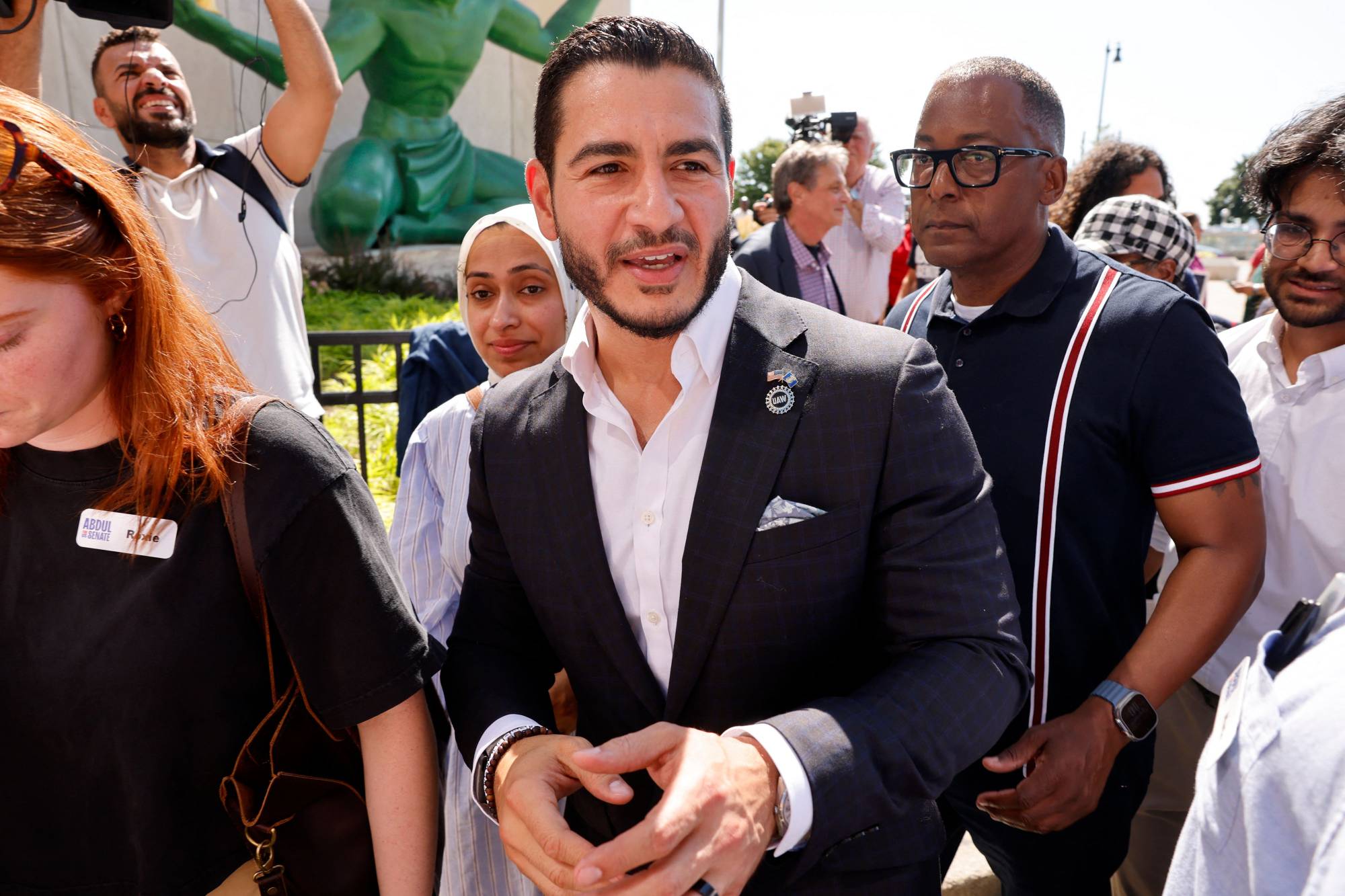
US Democratic Senate candidate from Michigan Abdul El-Sayed departs after a press conference declaring victory in the primary election in Detroit, Michigan, on August 5, 2026. (Photo by JEFF KOWALSKY / AFP)

He was the University of Michigan's first Rhodes Scholar since 2004. At Oxford, he continued playing lacrosse and earned a Full Blue, the university's highest sporting honor, as team captain.

By 2014, El-Sayed had completed his medical education, earning his medical degree from Columbia University's College of Physicians and Surgeons.

He subsequently joined Columbia's faculty as an assistant professor of epidemiology. Months later, then-Detroit Mayor Mike Duggan appointed him health officer and executive director of the city's Health Department.

El-Sayed rebuilt Detroit's Health Department following the city's bankruptcy. He later restructured Wayne County's Department of Health, Human and Veterans Services, which serves 1.8 million residents in Michigan's largest and most diverse county.

As a public servant, El-Sayed secured free eyeglasses for children in need, challenged some of Michigan's biggest polluters and expanded access to the lifesaving overdose-reversal medication naloxone, commonly known by the brand name Narcan.

He also spearheaded a program to eliminate up to $700 million in medical debt for 300,000 Michigan residents over two years.

His work earned him recognition as Public Official of the Year from the Michigan League of Conservation Voters and a place on Crain's Detroit Business's 40 Under 40 list.

Nationally recognized for his expertise in improving the American healthcare system, El-Sayed is the author of Medicare for All: A Citizen's Guide.

He later returned to public service as director of Wayne County's Department of Health, Human and Veterans Services, serving from December 2022 until April 2025, when he resigned to seek elected office once again, this time in the US Senate.

El-Sayed has also made a name for himself as a podcast host, including through America Dissected.

His medical credentials have attracted controversy, largely because he has described himself as a physician despite not holding a license to practice medicine in Michigan.

Although he studied medicine, El-Sayed came to believe that a broken political system was what was making people sick. That conviction ultimately led him to run for the Senate.

According to his campaign website, he entered the race because he believes life in America should not be so difficult and wants to build a government that serves ordinary Americans rather than Elon Musk, Donald Trump and their billionaire allies.

Responding to questions about his medical credentials in July, El-Sayed said: "I did graduate from a school that's literally called Columbia College of Physicians and Surgeons. So, you know, you can go have that argument with Columbia University if you'd like."

In his only previous bid for elected office, El-Sayed finished second to Gretchen Whitmer in Michigan's 2018 Democratic gubernatorial primary, ahead of Shri Thanedar, who subsequently won a seat in the state legislature and later in the US House of Representatives.

Throughout his Senate campaign, El-Sayed distilled his platform into a three-part message: "Money out of politics, money in your pocket, Medicare for All."

He repeatedly emphasized that he was the only candidate running for the US Senate in Michigan who had never accepted a dime of corporate campaign money and never would.

El-Sayed lives in Ann Arbor with his wife, Sarah, and their two young daughters, Emmalee and Serene.


Numbers That Tell the Story of the Democrats’ Midterm Blowout

This aerial view shows Union Station illuminated with the colors of the US flag after the midterm elections in Kansas City, Missouri, in the early hours of November 4, 2026. (AFP)
TT

Numbers That Tell the Story of the Democrats’ Midterm Blowout

This aerial view shows Union Station illuminated with the colors of the US flag after the midterm elections in Kansas City, Missouri, in the early hours of November 4, 2026. (AFP)

Democrats stormed back to power in Congress and governors' mansions across America in Tuesday's midterm elections, a stunning repudiation of Donald Trump's political agenda.

These are the numbers that tell the tale of a historic night.

- Record turnout -

Total turnout numbers were not in yet, but Americans cast more than 61.7 million votes even before election day, according to the University of Florida's Election Lab.

That figure, a runaway record for early voting in US midterms, undoubtedly boosted Democrats, who traditionally cast their ballots early more often than Republican voters.

The numbers showed large turnout among African Americans, young people and other groups that typically support Democratic candidates, National Public Radio reported.

The surge contributed to a wave election, with Democrats running the table on key races and seizing control of both chambers of Congress.

- Record fundraising -

Total spending for the 2026 midterms soared to a record $11.9 billion, substantially higher than the $8.9 billion racked up in 2022, according to OpenSecrets, a non-partisan authority on spending in US politics.

Campaign fundraising and ad buys jumped in the 2026 races, driven by the outside spending of so-called political action committees.

Such outside spending, led by Trump's mega-billionaire ally Elon Musk, favored Republicans by some $360 million.

But Democratic candidates proved adept at raising their own funds.

House and Senate candidates spent an unprecedented $3.7 billion from their campaign warchests, with Democrats outspending Republicans by $800 million, according to OpenSecrets.

In Texas, Democratic Senate candidate James Talarico broke records by bringing in a staggering $145 million, several times the $22 million raised by his Republican rival Ken Paxton who was forced to rely on outside groups to fund his campaign.

- First wins in decades -

Ninety-four years ago was the last time Kansas sent a Democrat to the US Senate. But on Tuesday night, Adam Hamilton unseated Republican incumbent Roger Marshall.

Hamilton, the pastor of a Methodist megachurch who was registered as a Republican until recently, became the first Democrat to win a Senate race in the largely rural, conservative state since 1932.

Texas also went blue for the first time in decades, with Talarico scoring a massive upset to flip a Senate seat in the Lone Star State for the first since 1988 -- the year before Talarico was born.

South Carolina also defied history, ousting Senator Darline Graham -- who had been appointed earlier this year to fill the seat of her late brother Lindsey Graham -- in favor of Democrat Annie Andrews. No South Carolina Democrat had been elected to the Senate since 1998.

- Young voters, Latinos turn away -

Young men and Latino voters -- two segments of the American electorate crucial to Trump -- turned sharply away from the president and his Republican Party, exit polls showed.

Hispanic voters had helped bring Trump to power in 2016, and were instrumental in his victory in 2024, when they only narrowly went to Democrat Kamala Harris in the presidential election, 51 percent to 48 percent, according to Pew Research.

But in recent weeks, several Latino voters have expressed anger at Trump, saying they felt betrayed.

It showed in NBC News exit polls on Tuesday, when Latino voters backed Democratic candidates by 62 percent to 35 percent over Republicans.

Young voters also soured on Trump. NBC News reported that its exit polls showed 18-29-year olds, men and women, voted for Democrats by a 72 percent to 25 percent margin. That is a sharp shift from 2024 when young voters were split between Trump and Harris.