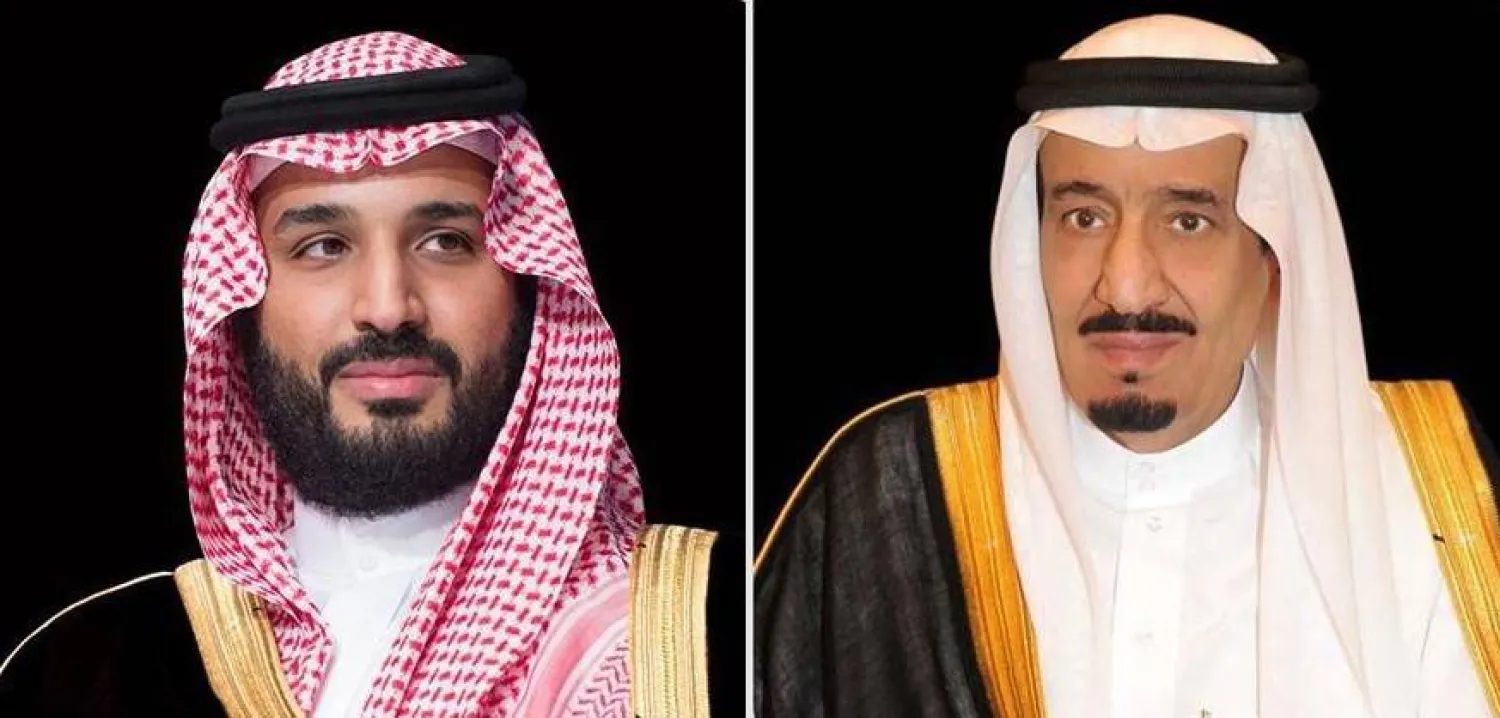
Saudi Arabia is celebrating the seventh anniversary of Crown Prince Mohammed bin Salman’s pledge of allegiance, reflecting upon the Kingdom’s rapid transformation, which is aimed at “building the state of the future" in line with Vision 2030.
The Saudi people expressed their trust in the vision of the leader, and worked to advance their country’s development journey, with regulations, laws, and structural reforms, and with definite goals and clear methods.
Crown Prince Mohammed expressed his feelings towards the Saudis a few months after the pledge of allegiance, saying: “I am one of 20 million people. I am nothing without them, and I am the least and weakest example of them all. They are the ones who motivate me and the ones who push me forward...”
Unique political system
Since its founding three centuries ago, the Saudi state has been distinguished by the uniqueness of its political system. It was not imported, copied, or imposed by other powers. In addition, it did not come out of nowhere, or arise in a context other than its environment. Rather, it stemmed from historic and Islamic roots and pure Arab heritage.
Its historic roots extend to the establishment of the Emirate of Diriyah nearly six centuries ago. The state was founded on the principles of the true Islamic religion, and it is the legitimate heir to the Arab-Islamic civilization. It is also the only regime that was able to unify the Arabian Peninsula under independent Arab rule after more than ten centuries of division.
Leadership and the people
The Saudi state went through many turns, but the greatest transformation occurred with King Abdulaziz, who was the first of the Al Saud family to hold the title of “king.” Under his rule, the state’s structures, systems, and institutions were developed.
King Abdulaziz was able to build a solid system of governance and advanced the traditional social contract. From here arose the connection between the leadership and society on a foundation that has remained constant until this day.
Anyone, who follows the words of the kings of Saudi Arabia since the era of King Abdulaziz will notice that the Saudi people are the focus of their attention.
Custodian of the Two Holy Mosques King Salman bin Abdulaziz said: “The development approach in the Kingdom aims to create a comprehensive and sustainable renaissance, whose center and goal is the human being who will manage the present and allow the development of the future.”
Good governance
Good governance is an Arab-Islamic concept in origin. The term is linked to our ancient political heritage, and an alternative to democracy, the implementation of which has failed in developing countries.
Good governance stems from the political system in Islam, which is the essence of the Saudi political rule. Western democracy is a human experience that has achieved successes and suffered failures. In theory, it is an attractive idea, but in practice, it has reproduced the monopoly of capital in the hands of the wealthy minority while pressuring the middle class by burdening it with taxes and preoccupying it with research. Thus, democracy turned into a tool to re-enslave people.
There are many Western opinions that criticize democracy, not to mention its other flaws and its lack of success in developing countries. Hence, the concept of “good governance” was coined by international organizations, intersecting with the principles of governance in Islam.
However, differences lie in the development of its mechanisms, standards and indicators for measuring its performance. Good governance focuses on the respect for the privacy and experience of every human society and takes into account its political, cultural and social contexts, supports and preserves human rights and well-being, expands people’s capabilities, choices, opportunities and freedoms, and aims for sustainable human development.
Saudis and their social contract
The Saudis remain the most knowledgeable about the dimensions of their social contract and their interconnected relationship with their state and leadership. The Saudi social contract is characterized by dynamism in the relations between societal components on the one hand, and in their relationship with authority on the other.
People have felt the state’s great role in transforming their living reality from dispersion to stability, and from chaos to security.
Principles of the Arab Islamic State
The Kingdom of Saudi Arabia presented a model for the Arab Islamic state with its principles, values, and positions, its fight against deviant movements regardless of their names and affiliations, and its preservation of the state’s stability in the face of threats.
This unique Saudi model strengthened the state’s legitimacy, raised levels of popular satisfaction, and was supportive of political stability in the country.
The Saudi people are aware of this great achievement and the efforts that have been deployed. They are, first and foremost, partners in this journey.
They have also seen the wisdom of their leadership in protecting them from wars and crises that are difficult to enumerate, and have witnessed the disasters and plights that befell countries around them, in addition to their deep awareness that the greatest state’s investments were in building the society and protecting the Saudi human being.
The Saudis believed in their leadership’s project to unify the country, and passed on that confidence to their children. Every generation becomes more convinced of the importance of this unity and supports all endeavors that achieve its requirements. We see it today in the belief in the Kingdom’s Vision 2030.
King Salman and the comprehensive vision
King Salman’s leadership of Saudi Arabia came at a very sensitive stage. He was able, with the depth of his vision, to transfer rule to the generation of Abdulaziz’ grandchildren, as part of his comprehensive idea to restructure and develop the state.
The transfer of responsibility to the generation of grandchildren in the Kingdom is a pivotal moment that many researchers have addressed over the past decades with pessimism and skepticism.
When the moment arrived, the Saudi regime not only demonstrated its stability, but also its ingenuity in preparing for the transition. All of this happened without media propaganda, and contrary to all previous speculation, confirmed the established royal family and the royal traditions that encourage its members to assume their responsibilities.
Seven remarkable years
Developments witnessed in the last seven years are astonishing by all standards, not only in terms of the tremendous political, economic and social achievements, but also in the ingenious arrangements of the ruling house.
We may not be fully aware of the value of what is happening today, nor of its political and social dimensions, not to mention its historical depth.
It is sufficient to conclude with these excerpts, as it is expected that years later, many historians - with their limited understanding of the roots of the Saudi government institution - will ask how the responsibility of a ministry such as the Ministry of Interior was transferred to a competent young man, and how the Saudi government became, in the blink of an eye, the most youthful and effective force, not only in the region, but in the entire world.
The sight of the Crown Prince surrounded by a group of senior members of the royal family, with happiness and pride on their faces as they watched a horse race that their country chose to be the most expensive on the planet, is enough to tell the whole world that the Saudi ruling house has won the bet once again and will always win, with the support of a confident population and an unparalleled legitimacy in the history of countries.