


KSrelief Signs Agreements to Strengthen Education and Healthcare Sectors in Yemen

King Salman Humanitarian Aid and Relief Center (KSrelief) signed on Wednesday a cooperation agreement to carry out the third phase of the Back to School Project in Al-Mukha district in Taiz Governorate (SPA)
TT

KSrelief Signs Agreements to Strengthen Education and Healthcare Sectors in Yemen

King Salman Humanitarian Aid and Relief Center (KSrelief) signed on Wednesday a cooperation agreement to carry out the third phase of the Back to School Project in Al-Mukha district in Taiz Governorate (SPA)

King Salman Humanitarian Aid and Relief Center (KSrelief) signed on Wednesday various agreements to promote the educational and medical sectors in several Yemeni governorates, benefiting over 13,000 individuals.
At the educational level, the Center signed a cooperation agreement with a civil society organization to carry out the third phase of the Back to School Project in Al-Mukha district in Taiz governorate, Thamud district in Hadramaut governorate, as well as in the governorates of Shabwah, Abyan, and Lahj, Yemen, benefiting some 6,000 individuals.
Assistant Supervisor General of Operations and Programs at KSrelief Engineer Ahmed Al Baiz signed the agreement on the sidelines of the International Conference on Conjoined Twins in Riyadh.
The agreement entails providing 60 fully equipped classrooms and outfitting 10 schools to create a suitable learning environment for students, and distributing 6,000 school uniforms and bags containing school supplies.
Furthermore, job opportunities will be created for low-income families (beneficiaries of previous training and empowerment projects) by having them make school bags and uniforms.
This initiative is part of the relief and humanitarian endeavors carried out by the Kingdom through KSrelief to bolster the safety and continuity of the educational process, and tackle student dropout rates in the specified regions in Yemen.

At the medical level, KSrelief and the International Wars and Disasters Victims' Protection Association (IRVD) signed a cooperation agreement to establish a prosthetic and rehabilitation center in Yemen’s Marib governorate.
This collaboration will offer physical rehabilitation services to individuals with disabilities, focusing on their integration into society.
It will involve personalized treatment plans, provision of various prosthetic limbs, occupational rehabilitation services, continuous follow-up care, and the enhancement of medical and technical staff skills to handle specialized cases.
The project aims to curb the emigration of specialized personnel and is expected to benefit 7,174 individuals.
Separately, the World Health Organization (WHO) signed a €3.4 million agreement with the German government to sustain lifesaving health and nutrition services in Yemen.
According to a WHO statement, the initiative comes at a critical time: Yemen is grappling with a protracted, grade 3 emergency – the highest level of WHO health emergency response.
It said Yemen faces multiple and parallel outbreaks of vaccine-preventable diseases, including circulating vaccine-derived poliovirus type 2 (cVDPV2), acute watery diarrhea and cholera, measles, diphtheria, malaria and dengue fever.
According to WHO, Yemen reported 204 000 suspected cases and 710 deaths between the outbreak of cholera in March 2024 and the end of September 2024.
Since the beginning of the year, 33,000 suspected measles cases have been reported, with 280 associated deaths.
By the end of 2024, it is projected that over 223,000 pregnant and breastfeeding women and more than 600,000 children will be malnourished.
Among these children, nearly 120,000 are expected to suffer from severe acute malnutrition (SAM), a 34% increase on the previous year.



Saudi Arabia Affirms Peace Requires Ceasefire, Establishing Palestinian State on 1967 Borders

Saudi Arabia's Permanent Representative to the UN Ambassador Dr. Abdulaziz Al-Wasil. File Photo/Saudi Foreign Ministry
TT

Saudi Arabia Affirms Peace Requires Ceasefire, Establishing Palestinian State on 1967 Borders

Saudi Arabia's Permanent Representative to the UN Ambassador Dr. Abdulaziz Al-Wasil. File Photo/Saudi Foreign Ministry

The Kingdom of Saudi Arabia stressed the seriousness of the situation in the region, renewing its condemnation of Israeli attacks on Palestine and Lebanon.

This came in a speech by Permanent Representative of the Kingdom to the United Nations Dr. Abdulaziz Alwasil, in which he reiterated the Kingdom’s condemnation of Iranian attacks on civilian facilities and the resulting human and material damage, SPA reported.

The Kingdom affirmed its rejection of altering the historical and legal status quo of Jerusalem and its Islamic holy sites, and its condemnation of illegal settlement activities for violating international law and undermining the prospects for peace.

The Kingdom stressed that achieving peace requires a ceasefire, preventing displacement, withdrawal from Gaza, and the establishment of a Palestinian state on the 1967 borders.


Saudi Arabia Reaffirms Commitment to NPT at Eleventh Review Conference

The Saudi flag. Asharq Al-Awsat
TT

Saudi Arabia Reaffirms Commitment to NPT at Eleventh Review Conference

The Saudi flag. Asharq Al-Awsat

Saudi Arabia has reaffirmed the importance of the Treaty on the Non-Proliferation of Nuclear Weapons (NPT) as a fundamental pillar of the global non-proliferation regime, stressing full implementation of its provisions and balance among its three pillars.

The stance was made by the Kingdom’s Permanent Representative to the United Nations, Dr. Abdulaziz Alwasil, at the general debate of the Eleventh NPT Review Conference in New York.

The Kingdom called on nuclear-weapon states to honor their disarmament pledges, affirming that the only guarantee against nuclear weapons use is their complete elimination.

It also affirmed the inherent right of States Parties to peaceful uses of nuclear energy in accordance with the treaty. It underscored the importance of transparency and cooperation with the International Atomic Energy Agency (IAEA).

The speech addressed Iranian attacks against the Kingdom, targeting civilians and civilian infrastructure, which were condemned by the international community. It stressed the importance of regional security, good neighborliness, non-interference in internal affairs, and Iran's full cooperation with the IAEA.

The Kingdom affirmed that establishing a Middle East zone free of nuclear weapons and other weapons of mass destruction is a collective international responsibility, noting that Israel's refusal to join the treaty remains a major obstacle to this goal.


Jeddah Summit Stresses Importance of Restoring Navigation Security in Hormuz

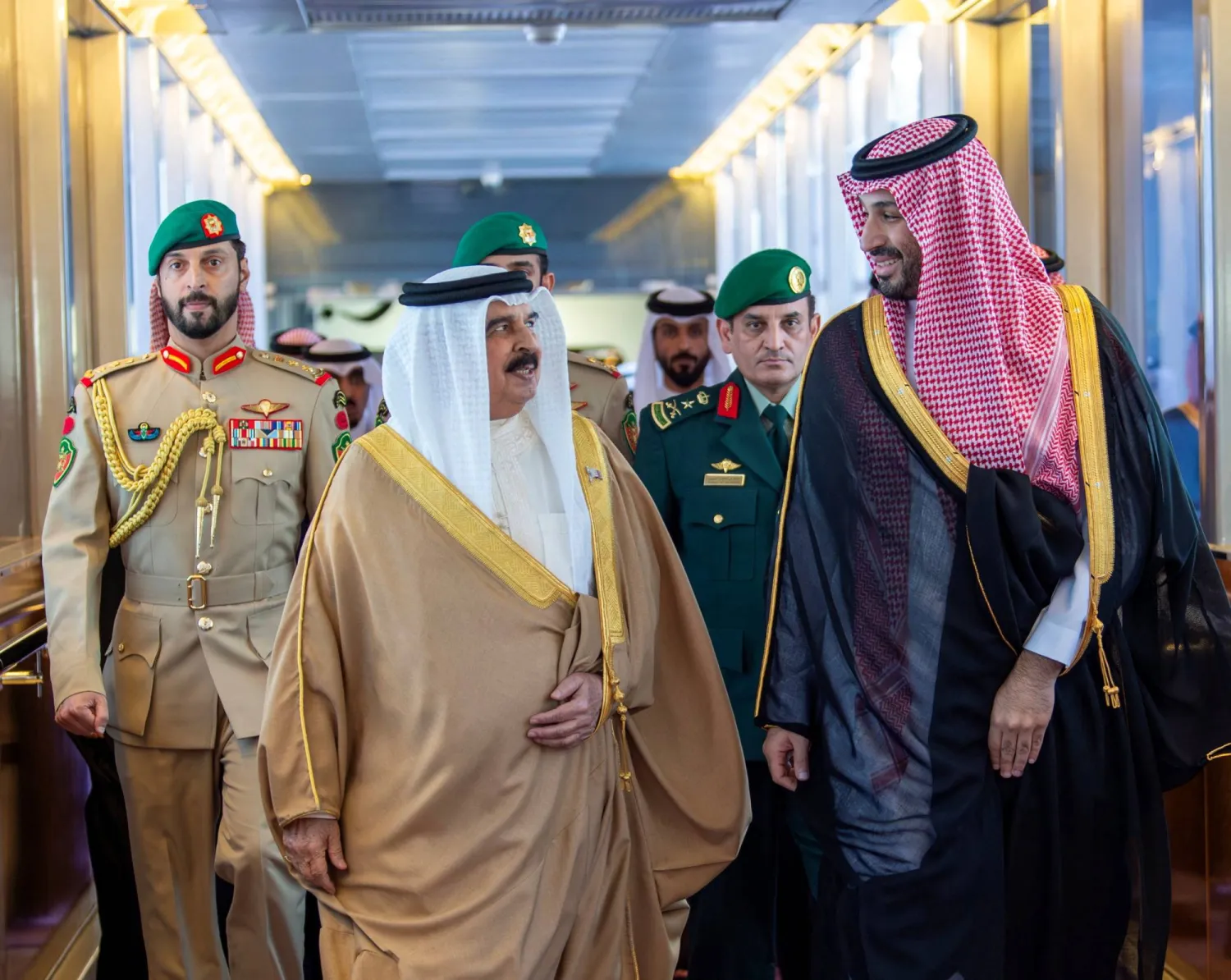
Saudi Crown Prince Mohammed bin Salman receives Bahrain's King Sheikh Hamad bin Isa al-Khalifa ahead of the Gulf Cooperation Council (GCC) meeting in Jeddah, Saudi Arabia, April 28, 2026. Bandar Algaloud/Courtesy of Saudi Royal Court/Handout via REUTERS
TT

Jeddah Summit Stresses Importance of Restoring Navigation Security in Hormuz

Saudi Crown Prince Mohammed bin Salman receives Bahrain's King Sheikh Hamad bin Isa al-Khalifa ahead of the Gulf Cooperation Council (GCC) meeting in Jeddah, Saudi Arabia, April 28, 2026. Bandar Algaloud/Courtesy of Saudi Royal Court/Handout via REUTERS

The Gulf summit, which was chaired on Tuesday by Saudi Crown Prince Mohammed bin Salman, discussed the regional situation.

It affirmed the necessity of restoring navigation security in the Strait of Hormuz and strongly condemned the flagrant Iranian aggressions against the Gulf Cooperation Council (GCC) states and Jordan.

GCC Secretary-General Jasem Albudaiwi affirmed in a statement that the summit was held at the invitation of the Saudi leadership and discussed ways to find a diplomatic path to end the crisis and pave the way for agreements and understandings that address the concerns of the Gulf states and enhance long-term security and stability.

He clarified that the leaders expressed strong condemnation and denunciation of the flagrant Iranian aggressions against the Gulf states and Jordan, emphasizing that these treacherous attacks have led to a sharp loss of confidence by the Gulf states in Iran.

Albudaiwi noted that the leaders praised the ability demonstrated by the Gulf states to deal with the challenges they faced due to this crisis, pointing out that the leaders expressed their categorical rejection of illegal Iranian measures to close the Strait of Hormuz and obstruct navigation in it, affirming the necessity of restoring navigation security and freedom and returning the situation in the Strait to what it was before February 28.

Albudaiwi also highlighted that the leaders of the Gulf states directed the urgency of completing the requirements for achieving access to all joint Gulf projects, including transport and logistics services, along with accelerating the implementation of the GCC railway project.

The Secretary-General of the Council further noted the leaders' affirmation of the importance of promptly taking steps towards establishing an oil and gas pipeline project, a water linkage project between the Gulf states, and moving forward with studying the creation of strategic Gulf reserve areas, in addition to the importance of intensifying military integration among the Council's states and accelerating the completion of the ballistic missile early warning system project.