

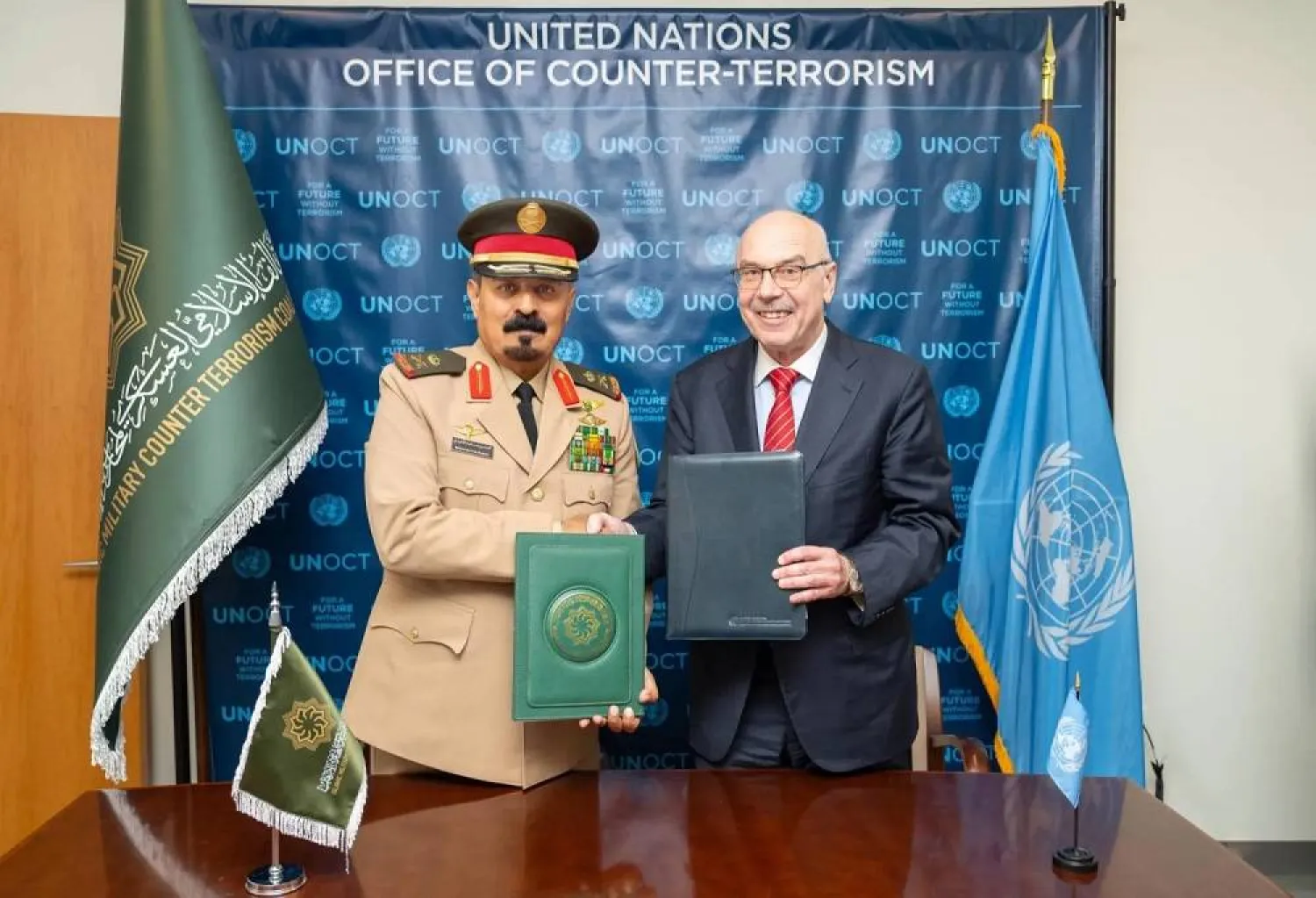

UN, Islamic Coalition Sign Strategic Partnership to Counter Terrorist Threats  

The coalition was represented by Secretary-General Maj. Gen. Mohammed Al-Moghedi and the UN office by Under Secretary-General Vladimir Voronkov. (Islamic Coalition) 
TT

UN, Islamic Coalition Sign Strategic Partnership to Counter Terrorist Threats  

The coalition was represented by Secretary-General Maj. Gen. Mohammed Al-Moghedi and the UN office by Under Secretary-General Vladimir Voronkov. (Islamic Coalition) 

The Secretariat General of the Islamic Military Counter Terrorism Coalition (IMCTC) and the UN Counter-Terrorism Centre (UNCCT) signed a Memorandum of Understanding on Tuesday to strengthen their partnership in countering terrorism and preventing violent extremism conducive to terrorism.

The MoU, signed at the UN headquarters in New York, aims to bolster international efforts against terrorism and promote global security and stability.

The partnership was signed by Major General Mohammed bin Saeed Al-Moghedi, Secretary-General of the Islamic Military Counter Terrorism Coalition, and Vladimir Voronkov, UN Under Secretary-General for Counter-Terrorism, during a meeting.

Al-Moghedi emphasized that the MoU highlights the coalition’s commitment to combating terrorism and enhancing international cooperation for global security.

Working with the UN will facilitate the exchange of expertise and strengthen member states’ abilities to address security challenges effectively, he added.

The MoU outlines strategic cooperation in areas such as specialized law enforcement training and tailored technical assistance to member states. It also focuses on organizing capacity-building training programs, exploring best practices, as well as organizing meetings, joint projects and activities on issues of common interest.



Saudi Foreign Minister Travels to France for G7 Meeting

Saudi Foreign Minister Prince Faisal bin Farhan (Asharq Al-Awsat)
TT

Saudi Foreign Minister Travels to France for G7 Meeting

Saudi Foreign Minister Prince Faisal bin Farhan (Asharq Al-Awsat)

Saudi Minister of Foreign Affairs Prince Faisal bin Farhan bin Abdullah traveled to France on Wednesday to attend the Group of Seven (G7) ministerial meeting, taking place at the Vaux-de-Cernay Abbey in the countryside outside Paris.

The meeting will address international issues and topics, including global governance reform, reconstruction challenges, maritime security, supply chains, and threats to peace and stability around the world, the Saudi Press Agency reported Thursday.


Six Arab Nations Issue Statement Condemning Attacks by Iran-aligned Iraqi Factions

Smoke rises from the area of Kuwait International Airport after a drone strike targeted a fuel depot (AP)
TT

Six Arab Nations Issue Statement Condemning Attacks by Iran-aligned Iraqi Factions

Smoke rises from the area of Kuwait International Airport after a drone strike targeted a fuel depot (AP)

Saudi Arabia, the United Arab Emirates, Kuwait, Bahrain, Qatar, and Jordan issued a joint statement on Wednesday condemning the attacks carried out by Iran-affiliated armed groups in Iraq against countries in the region and their facilities and infrastructure.

They said these assaults constitute a violation of international laws and conventions, and a flagrant breach of UN Security Council Resolution 2817 (2026), which clearly demands that Iran immediately and unconditionally cease any attacks or threats against neighboring states, including those carried out through proxy groups.

In the statement, the six countries strongly condemned what they dubbed Iranian aggression, whether carried out directly or through proxy armed groups, saying it violates their sovereignty and breaches international law, international humanitarian law, and the Charter of the United Nations.

They urged Iraq to immediately stop attacks from armed groups within its territory to maintain relations and prevent escalation.

The statement affirmed the six countries’ inherent right to self-defense and to take necessary measures to protect their sovereignty and security under the UN Charter.

The statement also condemned the destabilizing activities carried out by Iran-aligned sleeper cells and terrorist groups linked to Hezbollah. It praised the armed forces and security agencies for confronting these threats, protecting national security, and successfully uncovering and dismantling hostile networks.


Saudi Crown Prince, Pakistani PM Discuss Implications of Regional Escalation

Prince Mohammed bin Salman, Saudi Crown Prince and Prime Minister, and Pakistani Prime Minister Muhammad Shehbaz Sharif meet in Riyadh last year. (SPA)
TT

Saudi Crown Prince, Pakistani PM Discuss Implications of Regional Escalation

Prince Mohammed bin Salman, Saudi Crown Prince and Prime Minister, and Pakistani Prime Minister Muhammad Shehbaz Sharif meet in Riyadh last year. (SPA)

Prince Mohammed bin Salman, Saudi Crown Prince and Prime Minister, and Pakistani Prime Minister Muhammad Shehbaz Sharif held telephone talks on Wednesday on regional developments and the implications of the ongoing military escalation on regional and global security and stability.

Shehbaz Sharif stresses his country’s full support to Saudi Arabia, saying it will always firmly stand by its side amid the Iranian attacks against its security and sovereignty.

In a post on X, he said Pakistan will continue to stand in solidarity with the Kingdom, saying it enjoys its absolute support.

He underscored his country’s firm commitment to Saudi Arabia’s security and sovereignty, especially amid the current regional escalation.

He also condemned any attacks that target the Kingdom, hailing its restraint and urging de-escalation and an end to the hostilities.

He said he agreed with Crown Prince Mohammed to continue close coordination.