


Saudi Arabia Emphasizes Need to Strengthen Arab Security Cooperation

Saudi Minister of Interior Prince Abdulaziz bin Saud bin Naif bin Abdulaziz at the 42nd session of the Council of Arab Interior Ministers in Tunis. (SPA)
TT

Saudi Arabia Emphasizes Need to Strengthen Arab Security Cooperation

Saudi Minister of Interior Prince Abdulaziz bin Saud bin Naif bin Abdulaziz at the 42nd session of the Council of Arab Interior Ministers in Tunis. (SPA)

Saudi Minister of Interior and Honorary President of the Council of Arab Interior Ministers Prince Abdulaziz bin Saud bin Naif bin Abdulaziz underlined on Sunday the importance of boosting Arab security cooperation.

Speaking at the 42nd session of the Council of Arab Interior Ministers in Tunis, he stressed the need for integrated efforts to combat crime, monitor evolving threats, and develop a comprehensive security strategy to address shared challenges.

Prince Abdulaziz conveyed the Saudi leadership’s greetings and hopes for stronger Arab security collaboration. He thanked Tunisian President Kais Saied for hosting the meeting, the Tunisian people for their hospitality and Interior Minister Khaled Nouri for ensuring the event’s success.

Highlighting the council’s significance, he stated: “Our council represents the depth of Arab security alliances, built on trust and cooperation, as we navigate rapid changes, crises, and emerging challenges. Our security today is founded on past achievements and present capabilities to confront current and future threats.”
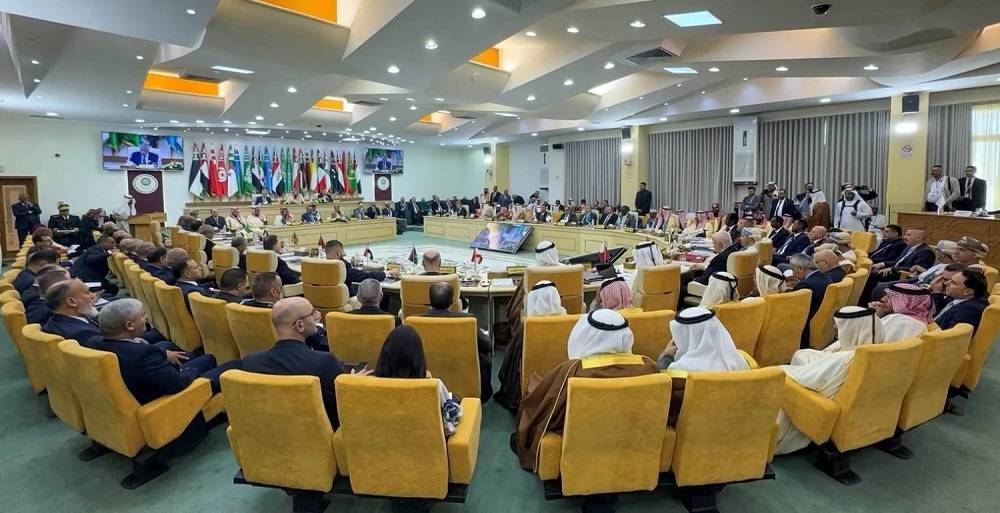
Officials at the 42nd session of the Council of Arab Interior Ministers in Tunis. (SPA)

Prince Abdulaziz warned that global instability has fueled armed terrorist groups and increased security threats, including organized crimes like drug trafficking. He highlighted how these groups exploit cyberspace, emerging technologies and covert methods to evade international oversight, making it easier for them to acquire and manufacture advanced weaponry and explosives.

Moreover, he called for continued efforts to strengthen Arab security cooperation, particularly in border security and surveillance. “Regardless of how sophisticated criminal organizations become, our security alliance remains stronger than any challenge. This drives us toward deeper collaboration and continuous, effective coordination,” he emphasized.

The council awarded the Prince Naif Medal for Arab Security (First Class) to Jordan’s King Abdullah II and Oman’s Sultan Haitham bin Tariq in recognition of their efforts to strengthen Arab security. Jordanian Interior Minister Mazen Abdullah Al-Faraya and Omani Interior Minister Hamoud bin Faisal Al-Busaidi accepted the awards on their behalf.

The ministers delivered speeches and discussed various agenda topics, reaffirming their commitment to strengthening regional security cooperation.



GCC Secretary-General Commends UN Resolution Extending UNRWA Operations

Secretary General of the Gulf Cooperation Council Jasem Mohamed Albudaiwi. GCC
TT

GCC Secretary-General Commends UN Resolution Extending UNRWA Operations

Secretary General of the Gulf Cooperation Council Jasem Mohamed Albudaiwi. GCC

Secretary-General of the Gulf Cooperation Council (GCC) Jasem Albudaiwi welcomed the resolution adopted by the United Nations General Assembly renewing the mandate of the United Nations Relief and Works Agency for Palestine Refugees in the Near East (UNRWA) for an additional three years, extending through 2029.

He stressed that UNRWA’s role is more vital today than ever, in light of the escalating challenges facing the Palestinian people, the Saudi Press Agency reported on Sunday.

Albudaiwi reaffirmed the GCC’s firm support for the agency’s programs and initiatives, underscoring the Council’s unwavering commitment to the Palestinian cause, the protection of the legitimate rights of the Palestinian people, and the continuity and sustainability of UNRWA’s operations.


KSrelief Delivers Shelter Aid to Palestinian People in Gaza

KSrelief delivers shelter aid to Palestinian people in Gaza. (SPA)
TT

KSrelief Delivers Shelter Aid to Palestinian People in Gaza

KSrelief delivers shelter aid to Palestinian people in Gaza. (SPA)

The King Salman Humanitarian Aid and Relief Center (KSrelief) delivered a new shipment of shelter aid to the Gaza Strip on Saturday, targeting urgent winter needs for displaced residents and offering protection from increasingly harsh weather conditions.

The delivery forms part of the broader Saudi campaign to support the Palestinian people, the Saudi Press Agency reported.

The latest consignment included fully equipped tents prepared by the Saudi Center for Culture and Heritage, KSrelief’s executive partner in Gaza, ahead of distribution to affected families.

The Kingdom has so far established air and sea bridges that have transported more than 7,677 tons of food, medical supplies, and shelter materials aboard 74 aircraft and eight ships.

Saudi Arabia has also supplied 20 ambulances to the Palestine Red Crescent Society. In addition, the center has signed relief agreements for projects in the strip totaling $90.35 million and is conducting joint airdrop operations with Jordan to widen access to aid.

The latest delivery underscores the Kingdom’s continued efforts to ease the humanitarian crisis facing Palestinians in Gaza.


Qatar’s PM Says Gaza Ceasefire at Critical Moment

Qatar's Prime Minister and Minister for Foreign Affairs Sheikh Mohammed bin Abdulrahman bin Jassim Al-Thani, attends a session on the opening day of the Doha Forum, an annual diplomatic conference, in Doha on December 6, 2025. (Photo by MAHMUD HAMS / AFP)
TT

Qatar’s PM Says Gaza Ceasefire at Critical Moment

Qatar's Prime Minister and Minister for Foreign Affairs Sheikh Mohammed bin Abdulrahman bin Jassim Al-Thani, attends a session on the opening day of the Doha Forum, an annual diplomatic conference, in Doha on December 6, 2025. (Photo by MAHMUD HAMS / AFP)

Qatar’s Prime Minister on Saturday said the Gaza ceasefire has reached a “critical moment” as its first phase winds down, with the remains of just one Israeli hostage still held in Gaza.

Sheikh Mohammed bin Abdulrahman Al Thani told an international conference in the Qatari capital that international mediators, led by the US, are working “to force the way forward” to the second phase to cement the deal.

“What we have just done is a pause,” he told the Doha Forum. “We cannot consider it yet a ceasefire.”

“A ceasefire cannot be completed unless there is a full withdrawal of Israeli forces, there is stability back in Gaza, people can go in and out, which is not the case today,” he said.

While the ceasefire halted the heavy fighting of the two-year war, Gaza health officials say that over 360 Palestinians have been killed by Israeli fire since the truce took effect in October.

The first phase of US President Donald Trump’s 20-point peace plan took effect Oct. 10. The fighting stopped and dozens of hostages held in Gaza were exchanged for hundreds of Palestinians held in Israeli prison. Israel sent a delegation last week to Egypt for talks on returning the remains of the last hostage.

The next phase, which includes the deployment of an international security force in Gaza, formation of a new technocratic government for the territory, disarmament of Hamas and an eventual withdrawal of Israeli forces from Gaza, has not yet begun.

Sheikh Mohammed said that even the upcoming phase should be “temporary” and that peace in the region could only take place with the eventual establishment of a Palestinian state.

“If we are just resolving what happened in Gaza, the catastrophe that happened in the last two years, it’s not enough,” he said. “There is a root for this conflict. And this conflict is not only about Gaza."

He added: “It’s about Gaza. It’s about the West Bank. It’s about the rights of the Palestinians for their state. We are hoping that we can work together with the US administration to achieve this vision at the end of the day.”