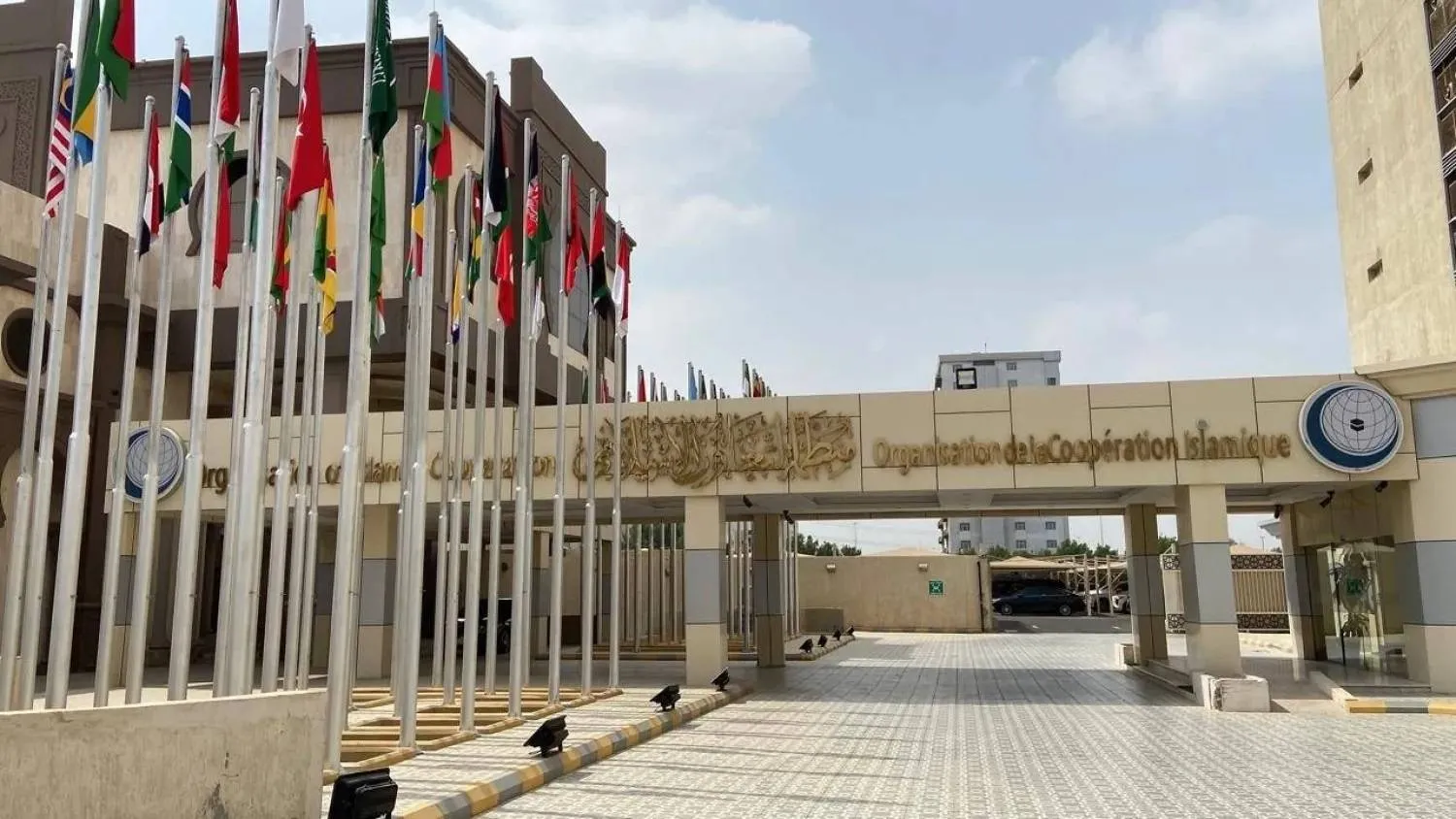

The foreign ministers of the Organization of Islamic Cooperation (OIC) countries will hold an extraordinary meeting in Jeddah on Monday to discuss Israel’s ongoing assault against the Palestinian people, its crimes of genocide and starvation and attempts to forcibly displace the people of Gaza.
“This extraordinary meeting aims to coordinate joint positions and efforts to confront the decisions and plans aiming to enshrine the full Israeli occupation and control over the Gaza Strip, as well as the Israeli crimes of genocide, starvation, displacement, blockade and the unprecedented humanitarian crisis in the Gaza Strip,” the OIC said in a statement.
It stressed that the “Palestinian issue remains the central issue of the OIC.”
It “articulated its profound concern regarding the findings of the UN-supported Integrated Food Security Phase Classification (IPC) report, which indicates a deteriorating famine crisis in the Gaza Strip.”
“The OIC assigns full responsibility for this humanitarian disaster to Israel, the occupying power, highlighting that the situation arises directly from its acts that constitute war crimes and crimes against humanity, including enforced starvation, a comprehensive blockade, systematic infrastructure destruction, and the systematic obstruction of humanitarian aid access,” it added.
“The OIC emphasizes that the declaration of famine serves as a critical alert regarding a multidimensional humanitarian, political, and legal crisis that necessitates immediate and exceptional international intervention,” it continued.
“The OIC has called for the implementation of all available international emergency protocols to facilitate the rapid, secure, and unimpeded delivery of humanitarian and food assistance to civilians adversely affected in the Gaza Strip,” it said.
Moreover, the OIC insists on the need to refer the situation concerning the blockade-induced crimes and orchestrated starvation perpetrated by Israel, along with the resultant famine in Gaza, to the International Criminal Court.
It urged the global community to “embrace its legal, political, and moral obligations by taking robust actions, which include imposing sanctions on Israel, halting the supply or transfer of military equipment to it, and bolstering international justice mechanisms to ensure accountability for its violations while adhering to international humanitarian law.”
Meanwhile, political analyst Dr. Naif al-Waqaa hailed Saudi Arabia’s efforts on the Arab and Islamic fronts that have led to significant political positions.
He noted how it has invested its international relations with some European countries to elicit a pledge from them to recognize the State of Palestine.
In remarks to Asharq Al-Awsat, he said Israel’s continued attacks against the Palestinian people reflect international double standards, warning that “only addressing the crisis through political means will grant Tel Aviv the green light to maintain its assault with impunity.”
Political researcher Mobarak al-Atty said Monday’s meeting reflects coordinated stances and intensified joint efforts “to confront Israeli plans aimed at consolidating its occupation by force and taking over Gaza.”
He added that by holding the meeting, the OIC is demonstrating that “the Palestinian cause remains central to all Islamic countries.”
He predicted that the meeting would call for an immediate and unconditional ceasefire in Gaza and demand the unimpeded delivery of humanitarian aid and provision of water and electricity.