


Emir of Qatar: Israel's Ambition to Impose its Influence on the Region Is a Dangerous Delusion

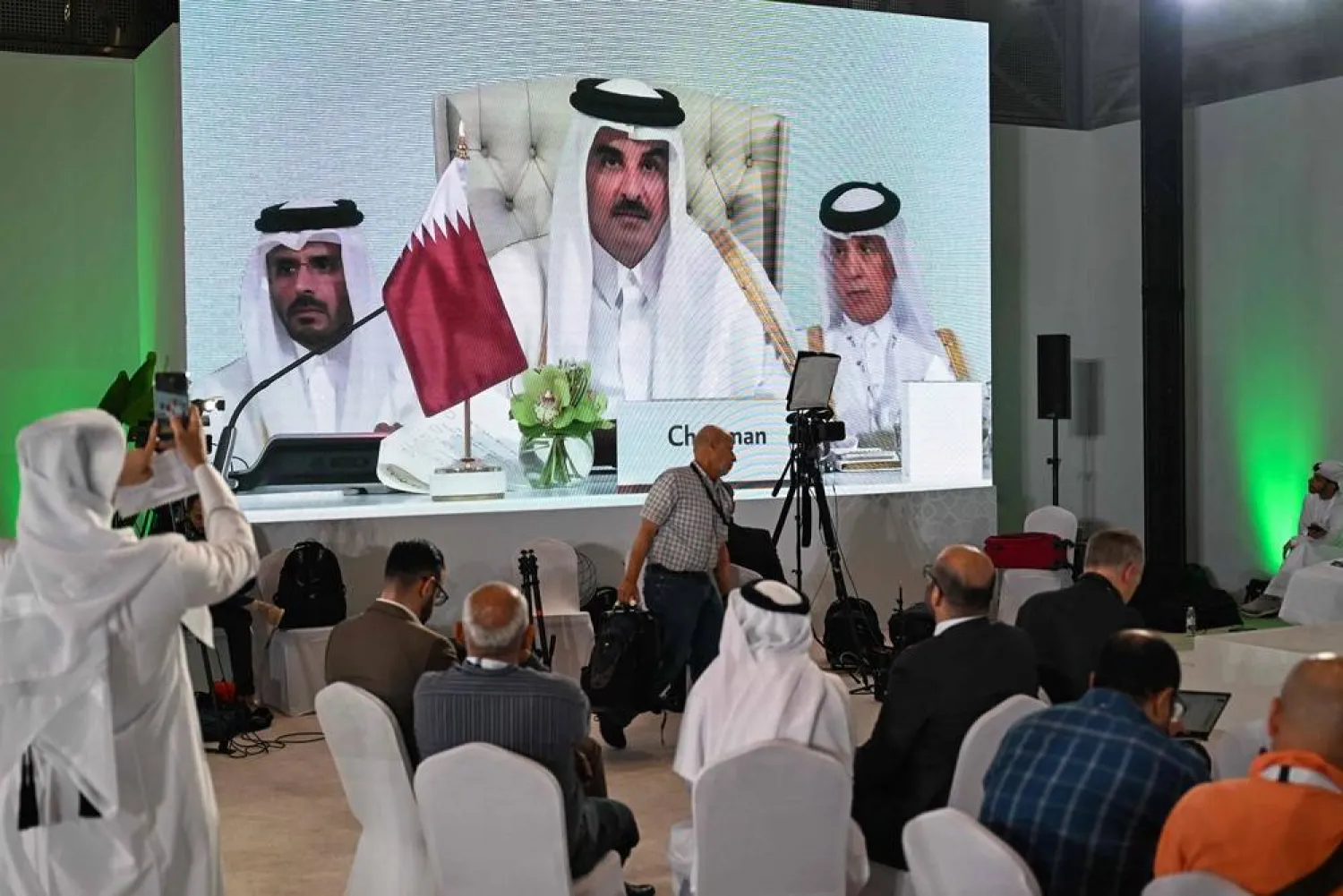
Reporters follow Qatar's Emir Sheikh Tamim bin Hamad Al-Thani's address at the media center, during the opening of the 2025 Arab-slamic emergency summit in Doha on September 15, 2025. (AFP)
TT

Emir of Qatar: Israel's Ambition to Impose its Influence on the Region Is a Dangerous Delusion

Reporters follow Qatar's Emir Sheikh Tamim bin Hamad Al-Thani's address at the media center, during the opening of the 2025 Arab-slamic emergency summit in Doha on September 15, 2025. (AFP)

Emir of Qatar Sheikh Tamim bin Hamad Al-Thani stressed on Monday that his country is determined to do everything in its power to protect its sovereignty, slamming the Israeli attack on Doha last week that targeted Hamas leaders.

Sheikh Tamim inaugurated the Emergency Arab-Islamic Summit in Doha that was attended by several Arab and Islamic leaders, including Prince Mohammed bin Salman, Saudi Crown Prince and Prime Minister.

In his opening speech, he slammed Israel’s “treacherous attack.”

“The citizens and residents of this safe country were taken unawares, and the entire world was shocked along with them, not only because this aggression is a gross and grave violation of State's sovereignty and a trampling upon international conventions and norms, but also due to the special circumstances surrounding this cowardly terrorist act,” he added.

He said Qatar, a mediation State, “which lies thousands of miles away from the place where the attacking aircraft took off, has been exerting strenuous efforts for two years to reach a settlement that would stop the deadly and destructive war – being waged against the Palestinian people in the Gaza Strip, which has long since turned into a genocidal war – and to secure the release of the Israeli hostages.”

“Doha has hosted, during these negotiations, delegations from Hamas and Israel. The mediation has already achieved, through cooperation with Egypt and the United States, the release of 135 hostages in exchange for two truces in 2023 and 2025, and the release of hundreds of Palestinian prisoners. Yet Israel has continued its war,” remarked Sheikh Tamim.

He revealed that when the attack occurred on September 9, the political leadership of Hamas was studying an American proposal that it had received from us and the Egyptians. “It is obvious that Israel, which was supposed to be the other negotiating party, at least in the context of this mediation, was aware of this meeting being held in a well-known location frequented by diplomats, journalists, and others. Thus, decided to assassinate negotiators engaged in studying an American paper and preparing their response to it,” he noted.

“Have you ever heard of anything like this before? A country that systematically and doggedly working to assassinate the very politicians it is negotiating with, and attacking the mediating country where the negotiations are taking place,” he stated.

“If Israel wants to assassinate the political leadership of Hamas, then why does it negotiate with it? And if it wants to negotiate the release of the hostages, then why assassinate all those who could conduct negotiations with it? And how can we welcome Israeli delegations to our country for negotiations, when those who sent these delegations are plotting to bomb this country?” he asked.

“These questions await no answer, but rather clarify why we say, unequivocally, that this aggression is in reality blatant, treacherous, and cowardly. It is impossible to deal with such a degree of malice and treachery,” he said. “For there are simple, basic principles in human interaction, which even those provided with wisdom and courage necessary to engage in, can't expect that there are some who pay them no heed and to whom they mean nothing.”

“Whoever works doggedly and systematically to assassinate the party he is negotiating with intends to sabotage the negotiations. When he claims that their goal behind the negotiations is to free their detainees, his acts belie their claim,” he said of Israeli Prime Minister Bejamin Netanyahu.

“Releasing his soldiers and citizens is not among his priorities, and negotiations are merely part of the war, a political tactic coupled with the war, and a means to mislead Israeli public opinion. When public opinion pressures him, he sends a delegation to negotiate. He does so with one hand, while sabotaging the negotiations with the other," he added.

“If stopping the war is the price for freeing his hostages, he doesn't want them. What he really wants is to make Gaza uninhabitable in order to displace its population. He believes in the so-called ‘Greater Israel,’ and he is exploiting the opportunity of war to expand settlements, change the status quo in the Holy Haram al-Sharif, tighten restrictions on the population in the West Bank, and plan to annex parts of it,” continued Sheikh Tamim.

“The government of Israel believes it places the Arabs before a fait accompli each time, then follows them with new ones, so they drop the old and negotiate over the new,” he noted.

“The Israeli Prime Minister, who boasts that he has changed the face of the Middle East in the last two years, truly intends that Israel intervene wherever and whenever it wishes. He dreams that the Arab region becomes an Israeli sphere of influence. This is a dangerous delusion,” warned the Qatari ruler.

“The government of extremist settlers wants the dispatch of Israeli air power for bombing in the countries of the region to become a routine matter. In Lebanon, the acceptance by the Lebanese government of an American paper is met with bombings and assassinations, and Israel seeks to drag it into a civil war to stop its aggressions against it,” he said.

“As for Syria, that same Prime Minister openly declares there is no negotiation over the occupied Golan. He speaks and acts as though the areas south of Damascus are practically influence zones for Israel which works towards the partition of Syria. We are confident that these schemes will not pass,” he added.

“Israel claims it is a democracy surrounded by enemies, while in reality it is building a regime of occupation and apartheid hostile to its surroundings, and waging a genocidal war during which crimes, that know no red flags, have been committed,” he stressed.

“Its Prime Minister has declared, days ago, that he prevented the establishment of a Palestinian State, and that such a state will not be established in the future. He is hostile to the Palestinian Authority, and opposes the agreements by which this Authority was incepted.”

“Two neighboring States signed peace agreements with Israel and abided thereof, and two other states remain committed to the Arab Peace Initiative and seek a settlement through which their occupied lands may be restored. If Israel had accepted the Arab Peace Initiative, it would have spared the region and itself countless tragedies,” said Sheikh Tamim.

“Israel is not only rejecting peace with its surroundings, but rather wants to impose its will upon them. And whoever objects to that, will be portrayed in its false propaganda, which no one believes anymore, as either a terrorist or antisemitic, while at the same time the far-right government in Israel practices terrorist and racist policies,” he declared.

“We shouldn't be contended with merely holding an emergency Summit, but that we take concrete steps to address the state of madness of power, arrogance, and bloodthirstiness obsession that has befallen the government of Israel, and what resulted and continues to result from it: First, the insistence on continuing a genocidal war, displacement, and settlement expansion in Palestine. Second, the blatant intervention in the sovereignty of Arab states; and third and finally, the treacherous aggression against my safe country - a peace broker that has dedicated its diplomacy to resolving conflicts by peaceful means, and which for that receives appreciation and respect everywhere,” he stated.

“For our part, we are determined to do everything necessary and permissible to us by international law, to preserve our sovereignty and confront this Israeli aggression,” he stressed.



Saudi Foreign Minister Receives Written Message from Chinese Counterpart

Saudi Vice Minister of Foreign Affairs Waleed Elkhereiji and Chinese Ambassador to Saudi Arabia Chang Hua.(SPA)
TT

Saudi Foreign Minister Receives Written Message from Chinese Counterpart

Saudi Vice Minister of Foreign Affairs Waleed Elkhereiji and Chinese Ambassador to Saudi Arabia Chang Hua.(SPA)

Saudi Minister of Foreign Affairs Prince Faisal bin Farhan bin Abdullah received a written message from Foreign Minister of the People's Republic of China Wang Yi concerning relations between the two countries, the Saudi Press Agency reported Thursday.

The message was received by Vice Minister of Foreign Affairs Waleed Elkhereiji during a meeting at the ministry's headquarters in Riyadh with Chinese Ambassador to Saudi Arabia Chang Hua.

During the meeting, the two sides reviewed bilateral relations and discussed regional and international developments.


MWL Condemns Escalating Israeli Settler Violence against Palestinians in West Bank

The Muslim World League (MWL) logo
TT

MWL Condemns Escalating Israeli Settler Violence against Palestinians in West Bank

The Muslim World League (MWL) logo

The Muslim World League (MWL) strongly condemned the continued attacks by Israeli settlers against Palestinians in the occupied West Bank, the Saudi Press Agency reported on Friday.

The latest Israeli aggression in the West Bank targeted the Grand Mosque in the village of Jiljilya and Al-Farouq Mosque north of Ramallah.

In a statement issued by the MWL General Secretariat, Secretary-General and Chairman of the Organization of Muslim Scholars Sheikh Dr. Mohammed Al-Issa denounced the escalating waves of violence carried out by settlers against Palestinians and their property and sacred sites in the occupied West Bank.

He said the attacks constitute a grave violation of the sanctity of places of worship and of all international and humanitarian laws and norms, undermine peace efforts, and threaten security and stability in the region.


Saudi Arabia Urges Rebuilding Trust before Any Economic Cooperation with Iran

Saudi Foreign Minister Prince Faisal bin Farhan spoke on Wednesday as a keynote guest at a European Council on Foreign Relations panel in Vienna
TT

Saudi Arabia Urges Rebuilding Trust before Any Economic Cooperation with Iran

Saudi Foreign Minister Prince Faisal bin Farhan spoke on Wednesday as a keynote guest at a European Council on Foreign Relations panel in Vienna

Saudi Arabia said trust must be rebuilt with Iran before any discussion of economic cooperation or mutual investment can begin.

The Saudi position came in response to media reports that a memorandum of understanding between the United States and Iran, signed on Wednesday by US President Donald Trump and Iranian President Masoud Pezeshkian, includes a provision for companies from the region, other countries and US partners to take part in a fund supporting Iran’s reconstruction after a final agreement is reached.

Saudi Foreign Minister Prince Faisal bin Farhan, speaking on Wednesday as a keynote guest at a European Council on Foreign Relations panel in Vienna, said he had no information about the alleged fund to rebuild Iran.

But he said the latest conflict had seen Iran attack Saudi Arabia and all Gulf states, creating a major breach of trust.

The minister said this had happened while relations with Iran were being rebuilt under the “Beijing agreement,” a process that had gained real momentum to the point that the two sides were exploring potential areas for economic cooperation and the like on the sidelines.

Dialogue to rebuild trust

“That trust has regressed,” Prince Faisal said.

“We will have to hold a dialogue on how to rebuild that trust and rebuild the relationship before any concept of economic cooperation, mutual investment, or anything of that sort can be rationally addressed,” he added.

He said Saudi Arabia’s development priority now remains focused on the domestic front.

On the nuclear file, Prince Faisal said one lesson from the previous nuclear agreement, which also completely ignored the regional context, was that any deal that fails to address regional concerns risks becoming less secure.

Without tackling the issues that matter to the region, he said, a nuclear agreement could become a source of dispute and risk as much as a solution to the nuclear issue.

Support for diplomacy

Despite ambiguity over some provisions, Riyadh supported the Pakistani and Qatari efforts that led to the memorandum of understanding.

Prince Faisal said Saudi Arabia remains committed to diplomacy, which is why it backed the diplomatic efforts that helped produce the memorandum.

That commitment, he said, is also why Riyadh is “very actively engaged” in supporting the success of the upcoming negotiations, and why it will work with regional partners to launch a regional dialogue on rebuilding trust after the conflict.

He said such talks should focus on how to overcome the crisis of trust, look toward a better future and ensure that potential flashpoints are handled through diplomacy rather than confrontation.

But he said that diplomacy cannot be effective without strong deterrence and high resilience to address potential threats and challenges.

The Saudi Foreign Minister said Riyadh would pursue a dual-track approach, including building its defense capabilities to confront threats and strengthening its logistical and economic resilience.

‘Trust first, then cooperation’

Researchers say Riyadh’s approach toward Iran reflects both hedging and flexibility.

Political researcher Ahmed Alibrahim said Prince Faisal’s remarks on Wednesday set the stage for a new phase in dealing with Iran, based on the principle of “trust first, then cooperation.”

He said Riyadh does not reject economic openness or support for regional stability, but believes that any sustainable path requires addressing the fallout from the previous phase and establishing concrete guarantees to prevent threats from recurring.

That is especially important, he said, given the previous experience of the “Beijing agreement.”

Alibrahim told Asharq Al-Awsat that Saudi support for diplomacy does not conflict with its insistence on strengthening its defense capabilities and protecting its national interests.

Recent political contacts show Saudi Arabia was a key player in supporting the Pakistan-sponsored negotiations and the accompanying Qatari efforts.

Those contacts included 11 phone consultations between the two countries’ leaders and foreign ministers in the past month alone.

The latest was Monday’s visit to Riyadh by Qatari Minister of State at the Foreign Ministry Mohammed al-Khulaifi, who met Saudi Deputy Foreign Minister Waleed al-Khuraiji.

Dr. Khaled al-Habbas told Asharq Al-Awsat that Riyadh had used its active diplomacy to support a political solution and back mediation efforts led by Pakistan with Qatari support, leading to the announced peace agreement.

He said that role was reflected in praise for Saudi Arabia’s support for de-escalation and settlement efforts.

Saudi Arabia welcomed the agreement reached between the United States and Iran to end military operations and begin 60 days of detailed negotiations aimed at a permanent agreement.

It stressed the importance of restoring security and freedom of navigation in the Strait of Hormuz, calling it essential to regional stability and the smooth flow of global trade and energy.

Riyadh said it hoped the talks would lead to a lasting peace that strengthens security in the region and the world, through understandings that account for the security interests of regional states and uphold respect for state sovereignty and non-interference in internal affairs.

Saudi Foreign Minister Prince Faisal bin Farhan also received a phone call from his Iranian counterpart on Monday, hours after the agreement was announced.

During the call, Prince Faisal affirmed the Kingdom’s welcome of the US-Iran agreement to end military operations and begin detailed negotiations toward a permanent deal.

He expressed Riyadh’s hope that the agreement would help strengthen security and stability and achieve peace in the region and the world.

Habbas said the Gulf approach to the war, led by Saudi Arabia, was marked by wisdom.

He said the Kingdom avoided becoming a party to the war while seeking from the start to prevent it, contain its effects and support a political settlement that serves regional security and stability.

He said Riyadh was likely to continue its efforts in the next phase to prevent a return to confrontation, consolidate peace and stability, and ensure maritime security in the region.