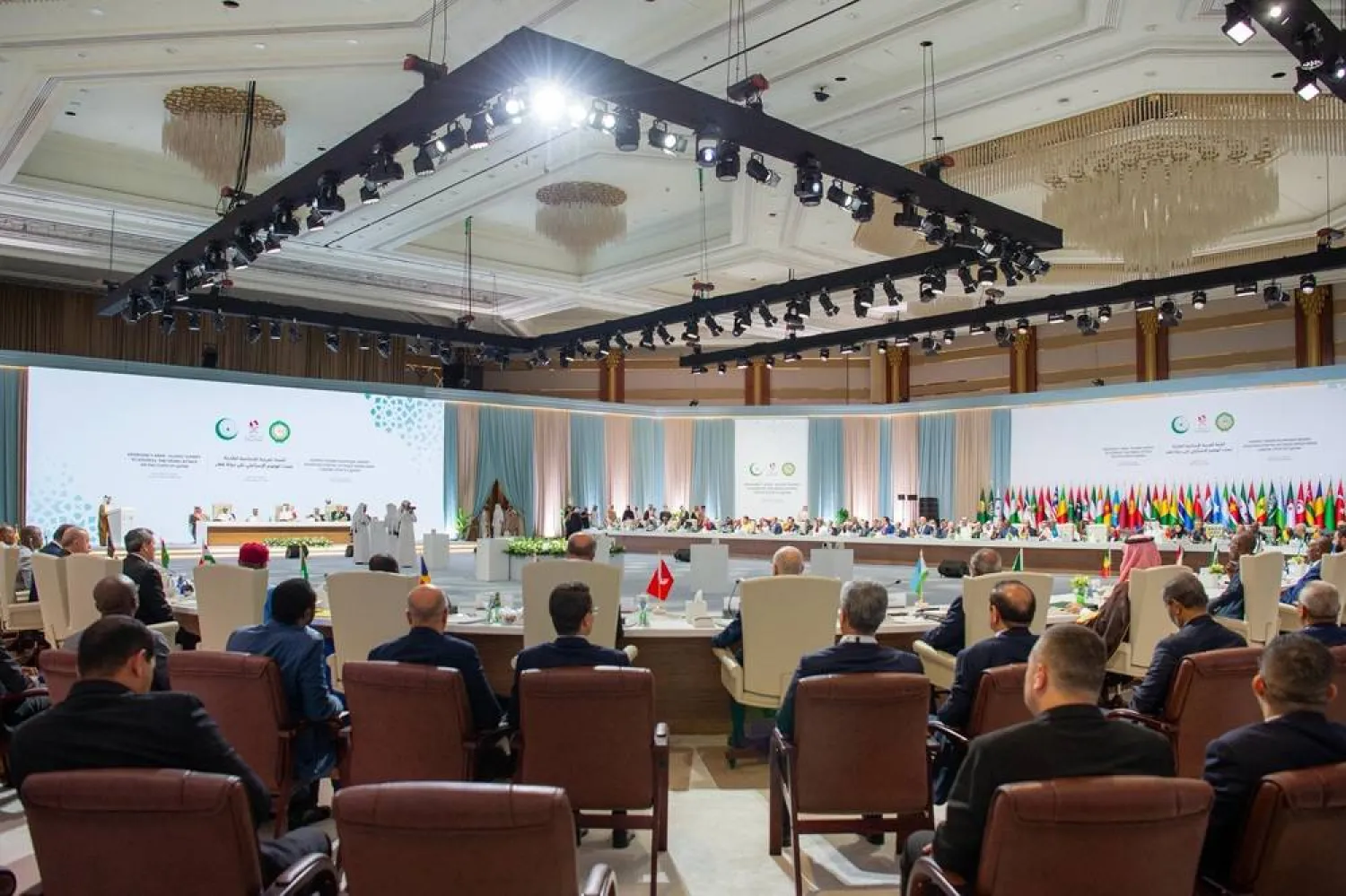

Arab and Islamic leaders declared on Monday their absolute support to Qatar, its security, stability and sovereignty against Israeli aggression.
Meeting at an emergency summit in Doha, they said they stand united in condemning and confronting the Israeli assault, which they said was a flagrant violation of Qatar’s sovereignty and international law and a dangerous threat to regional peace and security.
They added that they stand by Qatar and all the measures it takes to respond to the attack, which targeted Hamas leaders in Doha last week.
The closing statement of the Arab-Islamic summit said the “aggression on Qatari territory, a state serving as a principal mediator in efforts to secure a ceasefire and end the war on Gaza, and to release hostages and prisoners, is a grave escalation and an assault on diplomatic efforts to restore peace.”
“Such an attack on a neutral venue for mediation not only violates Qatar’s sovereignty, but also undermines international mediation and peace-making processes. Israel bears full responsibility for this assault,” it stressed.
The leaders commended the “civilized, wise, and responsible stance adopted by Qatar in addressing this treacherous assault, its firm adherence to international law, and its insistence on upholding its sovereignty and security and defending its rights by all legitimate means.”
The statement expressed support for states engaged in mediation, in particular Qatar, Egypt, and the United States, to end the aggression on the Gaza Strip.
It stressed “the categorical rejection of any attempts to justify the Israeli aggression under any pretext,” adding that the attack “undermines serious efforts to reach a just and comprehensive political solution that ends the Israeli occupation and ensures the realization of the inalienable rights of the Palestinian people.”
The statement also “categorically rejected repeated Israeli threats of a possible renewed attack on Qatar or any Arab or Islamic state,” deeming them “provocative and a grave escalation that threatens international peace and security.” It called on the international community to condemn Israel in the strongest possible terms and take deterrent measures to halt it.
It welcomed the adoption by the Council of the Arab League the resolution on the “Shared Vision for Security and Cooperation in the Region.” It underscored the concept of collective security and shared destiny of Arab and Islamic states, the need for unity in facing common challenges and threats, and the importance of beginning to put in place the required implementation mechanisms.
“We stress that any future regional arrangements must enshrine the principles of international law and the UN Charter, good-neighborly relations, respect for sovereignty, noninterference in the internal affairs of states, equality of rights and duties without preference of one state over another, settlement of disputes by peaceful means, and renunciation of the use of force,” said the statement.
It also stressed the need to end the Israeli occupation of all Arab territories, establish the State of Palestine along the lines of June 4, 1967, and rid the Middle East of nuclear weapons and all other weapons of mass destruction.
It called for confronting “Israel's schemes to impose a new fait accompli in the region, which pose a direct threat to regional and international stability and security.”
It reiterated the condemnation of “any Israeli attempts to forcibly displace the Palestinian people, under any pretext or designation, from their occupied territories of 1967, and to consider such acts crimes against humanity, flagrant violations of international law and international humanitarian law, and a policy of ethnic cleansing that are wholly rejected.”
It condemned Israeli policies “that have caused an unprecedented humanitarian catastrophe, whereby siege, starvation, and deprivation of civilians of food and medicine are used as weapons of war against the Palestinian people, in flagrant violation of international humanitarian law and the Geneva Conventions.”
It stressed that these practices are full-fledged war crimes “requiring urgent international action to put an end to them and to ensure the immediate, safe, and unimpeded entry of humanitarian assistance into all parts of the occupied Palestinian territory.”
It warned “of the catastrophic consequences of any decision by Israel, the occupying power, to annex any part of the occupied Palestinian territory, and rejecting such a move as a blatant assault on the historical and legal rights of the Palestinian people, a violation of the Charter of the United Nations, the principles of international law, and relevant United Nations resolutions, and as a nullification of all efforts to achieve a just and comprehensive peace in the region.”
It called on “all states to take all possible legal and effective measures to prevent Israel from continuing its actions against the Palestinian people, including by supporting efforts to end its impunity, holding it accountable for its violations and crimes, imposing sanctions on it, suspending the supply, transfer, or transit of weapons, ammunition, and military materials — including dual-use items — reviewing diplomatic and economic relations with it, and initiating legal proceedings against it.”
It welcome the adoption by the United Nations General Assembly of the “New York Declaration” on the implementation of the two-State solution and the establishment of an independent Palestinian State, “as a clear expression of international will supporting the legitimate rights of the Palestinian people, foremost among them their right to establish their independent state.”
It praised the efforts by Saudi Arabia and France, which contributed to the adoption of the declaration.
It also welcomed the upcoming Two-State Solution Conference, co-chaired by Saudi Arabia and France, in New York on September 22. It urged concerted efforts by the international community to ensure broad recognition of the independent State of Palestine with East Jerusalem as its capital.
“Just, comprehensive, and lasting peace in the Middle East will not be achieved by bypassing the Palestinian cause, ignoring the rights of the Palestinian people, or through violence and targeting mediators, but rather through adherence to the Arab Peace Initiative and relevant international legitimacy resolutions,” stressed the statement.
“In this regard, we call upon the international community, in particular the Security Council, to assume its legal and moral responsibilities in ending the Israeli occupation and establishing a binding timetable for that purpose.”