


Saudi Arabia Announces Int’l Coalition to Back Palestinian Authority

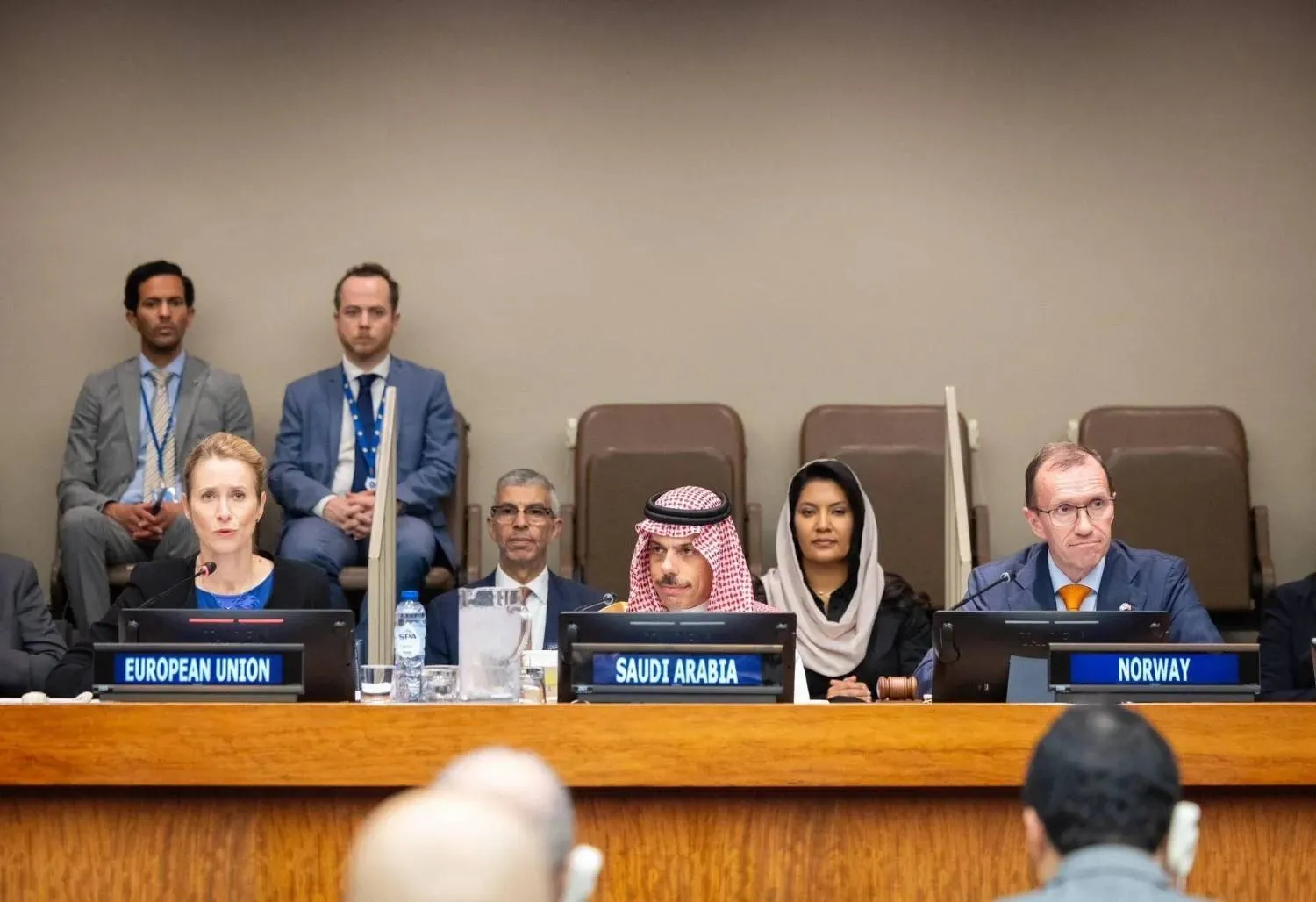
Saudi Foreign Minister Prince Faisal bin Farhan chairs high-level meeting of the Coalition to Implement the Two-State Solution in New York (Saudi Foreign Ministry/Handout)
TT

Saudi Arabia Announces Int’l Coalition to Back Palestinian Authority

Saudi Foreign Minister Prince Faisal bin Farhan chairs high-level meeting of the Coalition to Implement the Two-State Solution in New York (Saudi Foreign Ministry/Handout)

Saudi Arabia’s foreign minister said on Thursday the kingdom would provide $90 million in direct funding to the Palestinian Authority as part of a newly launched international coalition to support it, reiterating there would be no normalization with Israel without the creation of a Palestinian state.

Prince Faisal bin Farhan announced the initiative at a press conference in New York following a high-level ministerial meeting of the “Global Coalition to Implement the Two-State Solution.”

The meeting, chaired by Saudi Arabia on behalf of the Arab-Islamic Committee on Gaza and co-hosted with the European Union and Norway, was held on the sidelines of the United Nations General Assembly.

The minister said the gathering followed the UN’s adoption of the “New York Declaration,” which he described as a historic international consensus on ending Israel’s occupation and establishing an independent Palestinian state.

According to Prince Faisal, this process also coincides with growing recognition of Palestine, with 159 countries now acknowledging its statehood, representing the overwhelming majority of UN members.

This affirms that the realization of a Palestinian state has become an irreversible fact backed by growing international will, said the top Saudi diplomat.

He said the coalition’s discussions focused on turning the declaration and the wave of recognitions into an actionable plan with a clear timetable and follow-up mechanisms.

Priorities included an immediate ceasefire in Gaza, ensuring territorial unity between the West Bank and Gaza, and enabling the Palestinian Authority to assume full responsibilities.

Saudi Arabia reaffirmed that, based on its Arab, Islamic and international responsibilities, it will continue working with partners to ensure this process leads to a just and lasting peace, and to regional and international security and stability, he said.

Prince Faisal added that Arab and Islamic states had also conveyed to US President Donald Trump during a meeting in New York this week the risks of Israel annexing the West Bank.

Ending the war in Gaza will pave the way for implementing the two-state solution, and we are engaging with the United States to stop it, he said.

He stressed that a two-state solution remained the only path to revive hope for peace and was achievable.

Prince Faisal underlined the need for a viable Palestinian state alongside Israel and hoped that this will be realized in the near future.


Saudi Ambassador Inaugurates 3rd Phase of Lebanese Land Exports to the Kingdom

Part of Thursday’s inauguration ceremony. SPA
TT

Saudi Ambassador Inaugurates 3rd Phase of Lebanese Land Exports to the Kingdom

Part of Thursday’s inauguration ceremony. SPA

Saudi Ambassador to Lebanon Fahd bin Abdulrahman Al-Dosari inaugurated on Thursday the third phase of Lebanese exports to the Kingdom.

Saudi Crown Prince and Prime Minister Mohammed bin Salman had ordered the resumption of Lebanese exports to the Kingdom.

The exports will pass through the Masnaa border crossing between Lebanon and Syria.

Thursday’s inauguration ceremony was attended by Lebanese Minister of Public Works and Transport Fayez Rasamny, representing the prime minister, along with several government officials.

Rasamny praised the Kingdom’s decision to resume imports of Lebanese products, describing it as a direct support for the national economy and a step that opens new opportunities for Lebanese producers.

The ceremony also included the activation of the scanner at Masnaa. This was followed by an inspection visit to the site designated for the establishment of a new land border crossing center.


Oman Says Lasting Security in Strait of Hormuz Requires Regional Peace

Vessels near the Strait of Hormuz, as seen from Musandam, Oman, August 17, 2026. REUTERS/Stringer
TT

Oman Says Lasting Security in Strait of Hormuz Requires Regional Peace

Vessels near the Strait of Hormuz, as seen from Musandam, Oman, August 17, 2026. REUTERS/Stringer

Oman said lasting security in the Strait of Hormuz required permanent peace in the region and rejected further escalation or conflict, its foreign minister told his Japanese counterpart on Thursday, Reuters reported.

Iran has said a deal with Oman on new shipping lanes through the strait was in its final stages.


Faisal bin Farhan Stresses Diplomacy to Ease Regional Tensions

Prince Faisal bin Farhan receives Japanese Foreign Minister Toshimitsu Motegi in Riyadh on Wednesday (Saudi Foreign Ministry)
TT

Faisal bin Farhan Stresses Diplomacy to Ease Regional Tensions

Prince Faisal bin Farhan receives Japanese Foreign Minister Toshimitsu Motegi in Riyadh on Wednesday (Saudi Foreign Ministry)

Saudi Foreign Minister Prince Faisal bin Farhan on Wednesday reaffirmed the Kingdom’s commitment to reducing regional tensions and preventing renewed conflict through comprehensive, sustainable diplomatic solutions addressing the sources of instability in the Middle East.

“Diplomacy, dialogue and peaceful means remain our priorities,” Prince Faisal declared during the third Saudi-Japanese Strategic Dialogue with Japanese Foreign Minister Toshimitsu Motegi in Riyadh.

Prince Faisal highlighted the decades-long relationship between Saudi Arabia and Japan, built on mutual trust and respect, and identified maritime security as a key shared priority.

He stressed the importance of safeguarding freedom of navigation in international waterways in accordance with international law, emphasizing that the Strait of Hormuz, Bab al-Mandab and other maritime passages must remain open, secure and free from threats.

The Saudi minister described Japan as an important economic partner and noted that Riyadh sought to expand cooperation in investment, energy, resources, supply chains, defense and technology, as well as the exchange of expertise and capabilities.

He reaffirmed that Saudi Arabia would remain a reliable partner for Japan, including in energy, while praising Tokyo’s efforts to strengthen economic resilience and stabilize global energy markets and trade.

Ahead of his visit to Riyadh and Muscat, Motegi noted that Saudi Arabia was playing a mediating role in talks between the United States and Iran and had seen its international influence expand significantly in recent years.

He pledged to deepen cooperation with the Kingdom as a strategic partner, particularly in ensuring stable energy supplies.

Toshihiro Kitamura, Japan’s assistant foreign minister and ministry spokesman, told Asharq Al-Awsat that cooperation between Riyadh and Tokyo was “strategic and encompasses all fields,” adding that future defense cooperation was possible.

Speaking at a news conference in Riyadh, Kitamura explained that Japan wanted to hear Saudi Arabia’s assessment of regional developments and strengthen coordination with Riyadh and Oman in support of peace and stability, particularly regarding Iran.

He noted that more than 95% of Japan’s crude oil imports passed through the Strait of Hormuz, underscoring its importance to global trade and the world economy.

Kitamura also expressed serious concern over Houthi attacks in Bab al-Mandab and indicated that Japan aimed to broaden bilateral cooperation beyond oil under the Saudi-Japan Vision 2030 framework, in line with Saudi Vision 2030.
