


Expo 2030 Riyadh Receives BIE Flag, Signifying Start of Next World Expo Preparations

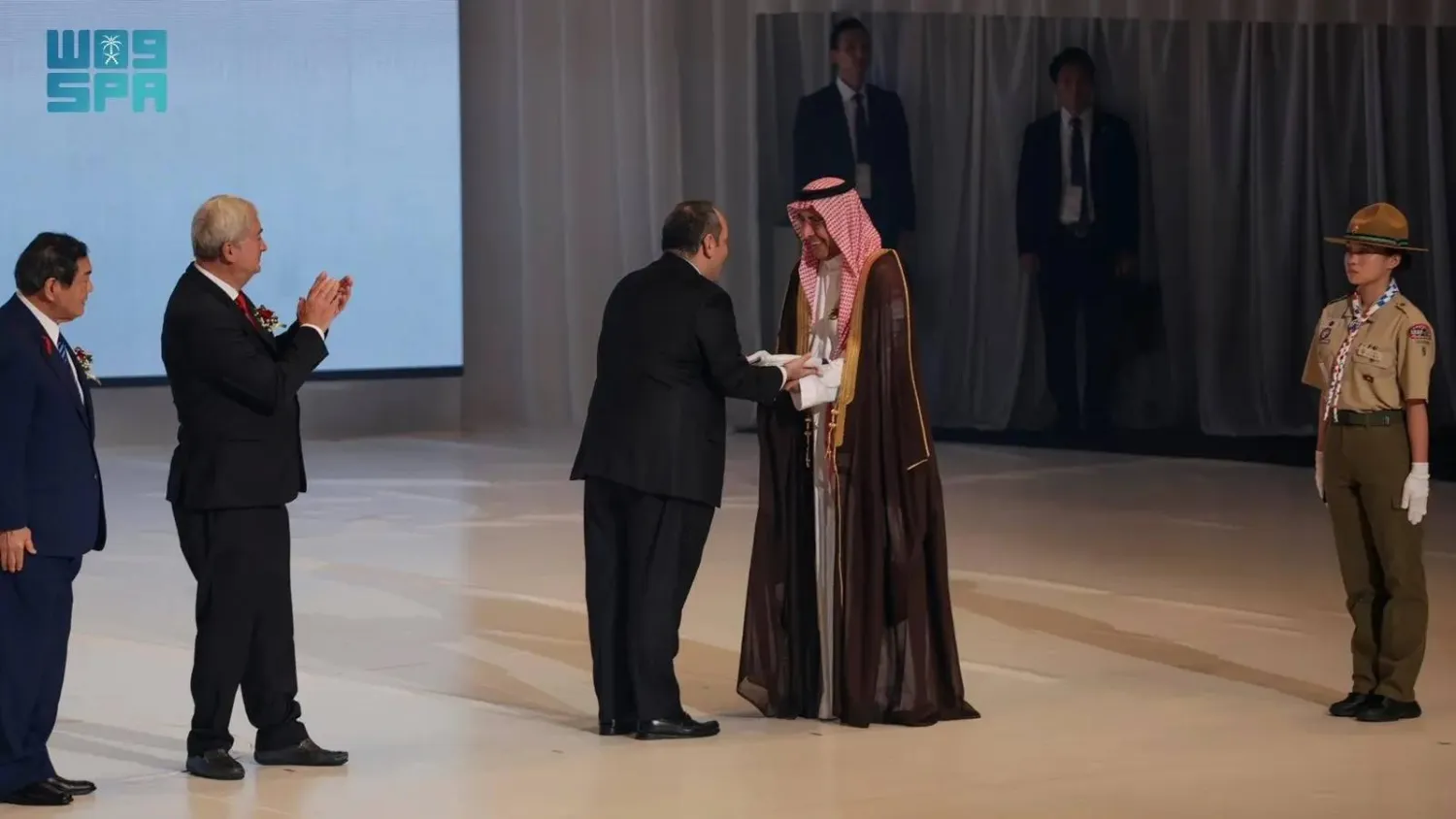
Expo 2030 Riyadh officially received the Bureau International des Expositions (BIE) flag during the closing ceremony of Expo 2025 Osaka. (SPA)
TT

Expo 2030 Riyadh Receives BIE Flag, Signifying Start of Next World Expo Preparations

Expo 2030 Riyadh officially received the Bureau International des Expositions (BIE) flag during the closing ceremony of Expo 2025 Osaka. (SPA)

Expo 2030 Riyadh officially received the Bureau International des Expositions (BIE) flag during the closing ceremony of Expo 2025 Osaka, which concluded after six months of global exhibitions, dialogue and cultural exchange.

The handover of the BIE flag, received by Minster of State and CEO of the Royal Commission for Riyadh City Eng. Ibrahim Al-Sultan, marked the formal transfer of host city responsibilities to the Kingdom of Saudi Arabia and the start of the journey toward the next World Expo, reported the Saudi Press Agency on Monday.

Under the theme “Foresight for Tomorrow,” Expo 2030 Riyadh will serve as a global platform for innovation, sustainability, and inclusive development, already key to the transformation agenda of Saudi Vision 2030.

Senior representatives from Saudi Arabia attended the ceremony, including Minister of Economy and Planning Faisal Alibrahim and Saudi Ambassador to Japan Dr. Ghazi Binzagr, underscoring national commitment and city-level preparedness.

Eng. Al-Sultan said: “At the conclusion of Expo 2025 Osaka in Japan, the handover of the flag from Japan to Riyadh marks an important milestone in the Kingdom’s journey toward hosting the world at Expo 2030 Riyadh. It also represents the official start of the countdown to organizing an unprecedented edition of the world’s most prominent exhibition."

He stated that this event embodies a new phase in the Kingdom’s journey toward the future, thanks to the unwavering support of Custodian of the Two Holy Mosques King Salman bin Abdulaziz Al Saud and Prince Mohammed bin Salman bin Abdulaziz Al Saud, Crown Prince and Prime Minister.

“The combined efforts of all state institutions, along with the warm enthusiasm of citizens and residents across the Kingdom, especially in Riyadh, will help deliver an exceptional experience that reflects Saudi Arabia’s excellence and leadership in hosting global events and embodies its vision of building a more innovative and cooperative future for the world,” he added.

CEO of Expo 2030 Riyadh Company Eng. Talal AlMarri said: “This milestone moves us firmly into delivery mode. Expo 2030 Riyadh will set new global benchmarks in sustainability, creativity, and inclusivity. It will be more than a gathering of nations; it will be a living legacy and a platform for action for the Kingdom and the world.”

Expo 2030 Riyadh Company hosted the “From Osaka to Riyadh” cultural showcase on October 10 at the Expo Arena Matsuri, drawing over 15,000 attendees and demonstrating strong event capabilities in the lead-up to 2030.

Throughout Expo Osaka, the Expo 2030 Riyadh Company engaged with participating nations through a series of workshops and bilateral meetings, focusing on understanding each country’s priorities and objectives for the next Expo. The Saudi Pavilion concluded Expo 2025 Osaka with historic visitor engagement, welcoming a record-breaking over three million attendees.

Running from October 1, 2030, to March 31, 2031, Expo 2030 Riyadh is set to welcome over 42 million visitors, with participation from 197 countries and 29 organizations. Spanning more than six million square meters across five zones, the event will explore forward-looking solutions for a more sustainable and inclusive future.

Following the six-month event, the site will evolve into a permanent Global Village, leaving a lasting legacy for Riyadh, Saudi Arabia, and the world.



Algeria Condemns Drone Attack on Saudi Arabia

File photo of the Saudi flag/AAWSAT
TT

Algeria Condemns Drone Attack on Saudi Arabia

File photo of the Saudi flag/AAWSAT

Algeria expressed its strong condemnation of the drone attack targeting Saudi Arabia, affirming its full solidarity with the Kingdom in confronting anything that threatens its security and stability, the Saudi Press Agency reported Tuesday.

The Algerian Ministry of Foreign Affairs, National Community Abroad, and African Affairs described the attack as a blatant threat to the Kingdom’s security and stability, and a flagrant violation of its sovereignty and international law.

Algeria also reiterated its full solidarity with Saudi Arabia and its support for all measures taken by the Kingdom to safeguard its security and preserve its stability.


Saudi Arabia, Kuwait Coordinate Efforts to Tackle Regional Developments

Prince Faisal bin Farhan receiving Sheikh Jarrah Jaber Al-Ahmad Al-Sabah during a previous meeting in Riyadh (Saudi Ministry of Foreign Affairs)
TT

Saudi Arabia, Kuwait Coordinate Efforts to Tackle Regional Developments

Prince Faisal bin Farhan receiving Sheikh Jarrah Jaber Al-Ahmad Al-Sabah during a previous meeting in Riyadh (Saudi Ministry of Foreign Affairs)

Saudi Arabia’s Foreign Minister Prince Faisal bin Farhan bin Abdullah received a phone call from his Kuwaiti counterpart, Sheikh Jarrah Jaber Al-Ahmad Al-Sabah during which the two officials discussed the latest regional developments and ways to enhance coordination and consultation in response to them.

The Saudi Foreign Ministry said the call addressed regional developments and the joint efforts aimed at consolidating security and stability within the framework of ongoing coordination between Riyadh and Kuwait on issues of mutual concern.

Gulf states continue their diplomatic engagement to closely monitor regional security and political developments and strengthen joint coordination in confronting shared challenges.


Holy Sites Transform into Giant Smart Cities during Hajj Season

Each year during Hajj, the Holy Sites undergo a remarkable transformation, emerging within days as one of the world's largest seasonal smart cities capable of accommodating millions of pilgrims through vast networks of energy, water, transport, communications, and digital services. (SPA)
TT

Holy Sites Transform into Giant Smart Cities during Hajj Season

Each year during Hajj, the Holy Sites undergo a remarkable transformation, emerging within days as one of the world's largest seasonal smart cities capable of accommodating millions of pilgrims through vast networks of energy, water, transport, communications, and digital services. (SPA)

Each year during Hajj, the Holy Sites undergo a remarkable transformation, emerging within days as one of the world's largest seasonal smart cities capable of accommodating millions of pilgrims through vast networks of energy, water, transport, communications, and digital services, the Saudi Press Agency said on Monday.

Behind the scenes, an around-the-clock infrastructure system operated by government and service agencies manages crowds, ensures smooth mobility, and maintains high standards of safety and comfort for pilgrims, before the sites return to their usual calm following the end of Hajj rituals.

Kidana Development Company, the executive arm of the Royal Commission for Makkah City and Holy Sites, continues to implement infrastructure and operational projects to enhance services and ensure sustainable performance throughout the Hajj season.

Projects include cooling and shading the area surrounding Jabal Al-Rahmah (Mount Arafat) across more than 392,000 square meters, increasing the number of benefiting pilgrims fivefold compared with last year.

In healthcare, Kidana doubled bed capacity compared to last year by expanding Mina Emergency Hospital to strengthen emergency preparedness and improve medical services during Hajj.

Pedestrian routes across the holy sites were also upgraded through a 103,000-square-meter shading project, while more than 66,000 square meters of rest areas were developed along walking paths to improve pilgrim comfort.

As part of the Green Holy Sites initiative, more than 60,000 trees were planted, tripling the amount of green space.

The company also replaced mist spray columns with 400 misting fans at the Jamarat facility, increasing cooling capacity to serve around 360,000 pilgrims per hour, double last year’s level.

A project aimed at humanizing the Holy Sites also enhanced the visual environment in Muzdalifah, thereby improving the urban landscape.

Additionally, infrastructure projects focused on enriching the pilgrim experience and easing mobility.

Some 74 escalators were installed to connect Mina's hillside camps, helping improve crowd movement and access to accommodations.

To expand accommodation capacity in Mina, Kidana implemented the Kidana Al-Khayf tent project near the Jamarat complex across 24,000 square meters, alongside the Rabiah Kidana lodging project spanning more than 33,000 square meters.

The company also upgraded sanitation services through 516 facilities and nearly 17,000 toilets, reducing waiting times by 75% while maintaining pilgrim accommodation capacity.

Across Muzdalifah and Arafat, more than 6,900 toilets were added through 411 sanitation complexes, bringing the total number of restroom facilities in the holy sites to more than 115,000.

Kidana is also upgrading the technical and service infrastructure in pilgrim camps through enhanced fire safety and cooling networks, expanded power systems, and projects to improve operational safety and field services.

The integrated operational model highlights Saudi Arabia’s capability to manage one of the world’s most complex seasonal environments using advanced digital technologies and smart systems, turning the Holy Sites into a fully functioning modern city that emerges briefly each year to serve millions of pilgrims from around the world.
