


New Saudi Support for Yemen’s Budget, Fuel Supply to Power Electricity Stations

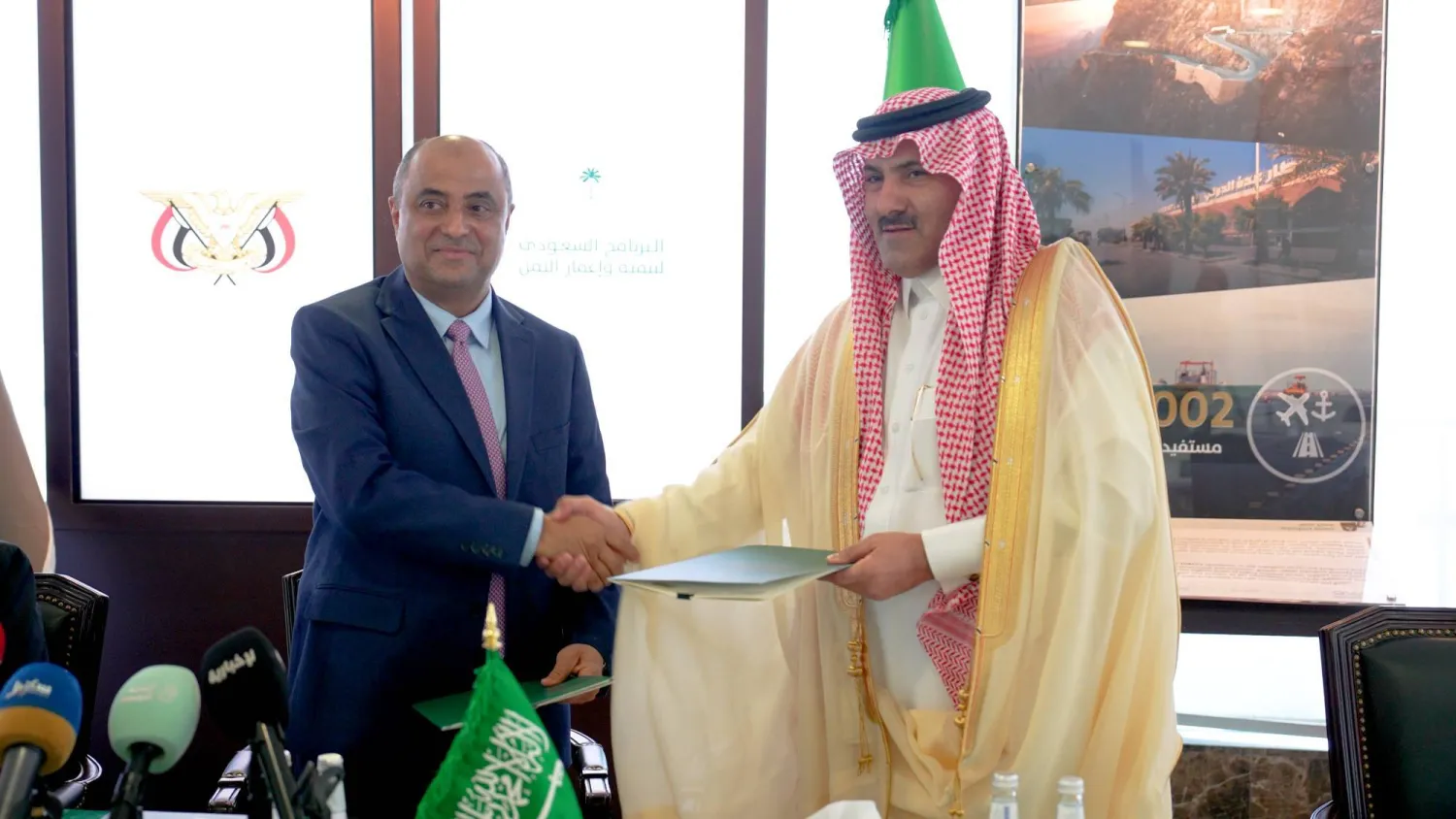
 Yemeni Prime Minister Salem bin Braik Saudi Ambassador to Yemen and SDRPY Supervisor Mohammed bin Saeed Al Jaber during the signing of one of the agreements. (Turki Al-Agili)
Yemeni Prime Minister Salem bin Braik Saudi Ambassador to Yemen and SDRPY Supervisor Mohammed bin Saeed Al Jaber during the signing of one of the agreements. (Turki Al-Agili)
TT

New Saudi Support for Yemen’s Budget, Fuel Supply to Power Electricity Stations

 Yemeni Prime Minister Salem bin Braik Saudi Ambassador to Yemen and SDRPY Supervisor Mohammed bin Saeed Al Jaber during the signing of one of the agreements. (Turki Al-Agili)
Yemeni Prime Minister Salem bin Braik Saudi Ambassador to Yemen and SDRPY Supervisor Mohammed bin Saeed Al Jaber during the signing of one of the agreements. (Turki Al-Agili)

Saudi Arabia has launched a new phase in its ongoing support for the Yemeni government by signing two development agreements and a memorandum of cooperation with Yemen through the Saudi Program for the Development and Reconstruction of Yemen (SDRPY).

The agreements aim to boost economic stability, improve basic services, and build institutional capacity.

On September 20, Saudi Arabia announced an additional $368 million (SAR 1.38 billion) in aid to the Yemeni people through the program.

The agreements include direct support to help the Yemeni government cover its budget deficit and address urgent economic and development challenges. They also provide fuel supplies needed to operate power plants across different provinces, improving services and increasing electricity availability for citizens.

The memorandum of cooperation signed with Yemen’s Ministry of Interior aims to strengthen the ministry’s institutional, technical, and technological capacities. It also seeks to enhance knowledge sharing with Saudi counterparts to boost operational efficiency and develop the ministry’s infrastructure.

Yemeni Prime Minister Salem bin Braik hailed the Saudi assistance as a “new milestone” in the enduring partnership between the two countries.

He said the agreements address core needs of the Yemeni people and reflect a broader phase of effective cooperation in supporting the state budget, powering electricity plants, and building the institutional capacities of the Interior Ministry.

“What we are signing today is not just financial support or development programs. It is a sincere expression of a firm and principled position by the Kingdom, standing by Yemen in its struggle for stability and recovery,” bin Braik said.

“Under the leadership of the Custodian of the Two Holy Mosques and the Crown Prince, the Kingdom has always been a reliable supporter in times of hardship and a partner in nation-building. This support is not a temporary reaction, but a strategic choice rooted in deep historical ties between our two nations,” he stressed.

The prime minister added that the Saudi contribution will provide a strong boost to Yemen’s economic reform and recovery efforts, enabling the government to meet its obligations. He noted that 85 percent of the support will be allocated to paying public sector salaries.

Saudi Ambassador to Yemen and SDRPY Supervisor Mohammed bin Saeed Al Jaber said the initiative marks another milestone in the close cooperation between the two countries.

“This support reflects the Kingdom’s ongoing commitment to Yemen and directly addresses its economic, service, and institutional needs,” he stated.

The SDRPY has so far implemented 265 projects and initiatives in eight key sectors: education, health, water, energy, transport, agriculture and fisheries, capacity building for government institutions, and development programs across various provinces.



Saudi Arabia Launches $1.9 Bln Development Projects in Yemen

A photo posted by Saudi Defense Minister Prince Khalid bin Salman of his meeting with Yemen’s Presidential Leadership Council (PLC) Chairman Dr. Rashad al-Alimi.
TT

Saudi Arabia Launches $1.9 Bln Development Projects in Yemen

A photo posted by Saudi Defense Minister Prince Khalid bin Salman of his meeting with Yemen’s Presidential Leadership Council (PLC) Chairman Dr. Rashad al-Alimi.

Saudi Arabia unveiled a comprehensive package of development projects across Yemen on Wednesday, announcing 28 projects and initiatives worth 1.9 billion riyals aimed at supporting stability and economic recovery nationwide.

The projects extend Saudi support for Yemen under directives from Custodian of the Two Holy Mosques King Salman bin Abdulaziz and Prince Mohammed bin Salman, Crown Prince and Prime Minister, with follow-up by Defense Minister Prince Khalid bin Salman.

In a post on the X platform, Prince Khalid stated that the support delivered through the Saudi Program for the Development and Reconstruction of Yemen (SDRPY) reflects the Kingdom’s commitment to strengthening security and stability and contributing to a better future for Yemen and its people.

Prince Khalid met on Wednesday with Yemen’s Presidential Leadership Council (PLC) Chairman Dr. Rashad al-Alimi, members of the council, the Prime Minister, and the Minister of State and Governor of Aden, for talks on fraternal ties between their countries.

The meeting discussed developments in Yemen and efforts aimed at ending the crisis through a comprehensive political settlement to achieve security and stability. It underscored the importance of continuing work on the future of the southern issue through the upcoming Riyadh conference to reach an inclusive vision for fair solutions.

Al-Alimi described the meeting with Prince Khalid as productive, saying it addressed national developments and Saudi Arabia’s promising support within a strategic partnership that meets the aspirations of the Yemeni people to restore state institutions, security, stability, and peace.

In a post on X, al-Alimi stated that the development projects represent a cornerstone for recovery and reconstruction, and a prelude to broader programs aimed at improving services and livelihoods, reflecting Saudi Arabia’s strong commitment to supporting the Yemeni state at all levels.

He expressed deep gratitude and appreciation to Saudi Arabia’s leadership for its steadfast positions alongside the Yemeni people and their political leadership at all stages.

The new package includes petroleum derivatives to operate power plants across Yemen, which is expected to improve the reliability of electricity supply to hospitals, medical centers, roads, schools, airports, ports, and other facilities, as well as support industrial activity and boost trade.

The SDRPY will begin operating the King Salman Medical and Educational City in Al-Mahra after completion of all construction works and full equipment installation, strengthening Yemen’s health sector.

The interim capital Aden will also receive development projects and initiatives, including the continued operation of Prince Mohammed bin Salman Hospital for the next three years.

The program will establish Yemen’s first desalination plant to help achieve water security and improve access to fresh water.

It will launch the second and third phases of the Aden airport rehabilitation project, including the rebuilding of the runway and the provision of navigation and communications systems, to enhance passenger services, enable international and domestic airlines to operate flights, and support economic and commercial activity.

Among the key projects is the completion of the final section of the expansion and rehabilitation of the Al Abr road, covering the Ghuwayrban to Al Makhtham stretch, following the completion of the first and second phases, totaling 90 km in Marib.

Work will also begin to rehabilitate the Al Abr to Seiyun road in Hadhramaut to boost safe mobility and support trade and economic activity.

The package also includes boosting electricity capacity through the construction of a 30 megawatt power plant in Taiz, supporting service continuity, operating Al-Mokha Hospital to ensure the continued delivery of medical services, and a project to build, expand, and upgrade the coastal road and its related intersections to promote economic and social development.


Saudi Arabia Welcomes US Designation of 3 Muslim Brotherhood Branches as Terrorist 

This 2011 photo shows a Muslim Brotherhood office in Amman, Jordan. (AFP)
TT

Saudi Arabia Welcomes US Designation of 3 Muslim Brotherhood Branches as Terrorist 

This 2011 photo shows a Muslim Brotherhood office in Amman, Jordan. (AFP)

The Saudi Ministry of Foreign Affairs welcomed on Wednesday the United States' designation of the Muslim Brotherhood branches in Egypt, Jordan, and Lebanon as terrorist organizations.

The ministry stressed the Kingdom’s condemnation of extremism and terrorism, its support for all that achieves security, stability, and prosperity of Arab countries, and the security of the region and the world.


Islamic Military Coalition Launches ‘Competence’ Military Strategic Initiative in Sierra Leone

Officials are seen at Tuesday's launch. (SPA)
TT

Islamic Military Coalition Launches ‘Competence’ Military Strategic Initiative in Sierra Leone

Officials are seen at Tuesday's launch. (SPA)

The Islamic Military Counter-Terrorism Coalition (IMCTC) launched on Tuesday the “Competence” military strategic training for counter-terrorism in Sierra Leone.

The launch was attended by Sierra Leonean Minister of Internal Affairs Morie Lengor, IMCTC Secretary General of the Islamic Military Counter-Terrorism Coalition (IMCTC) Major General Pilot Mohammed bin Saeed Al-Moghedi, senior military and security officials, civil representatives, and members of the diplomatic corps accredited to Republic of Sierra Leone.

The initiative runs from January 13 to February 3, targeting the training and capacity building of 30 military and security personnel through an intensive 15-day program focused on counter-terrorism, including handling explosives, improvised devices, and unexploded ordnance, while enhancing the operational readiness of specialized forces.

The training aims to develop the skills and capabilities of personnel in counter-terrorism units and facilitate the transfer of advanced professional knowledge and expertise among member states, enabling them to address complex terrorist threats with high-level scientific and professional methods.