

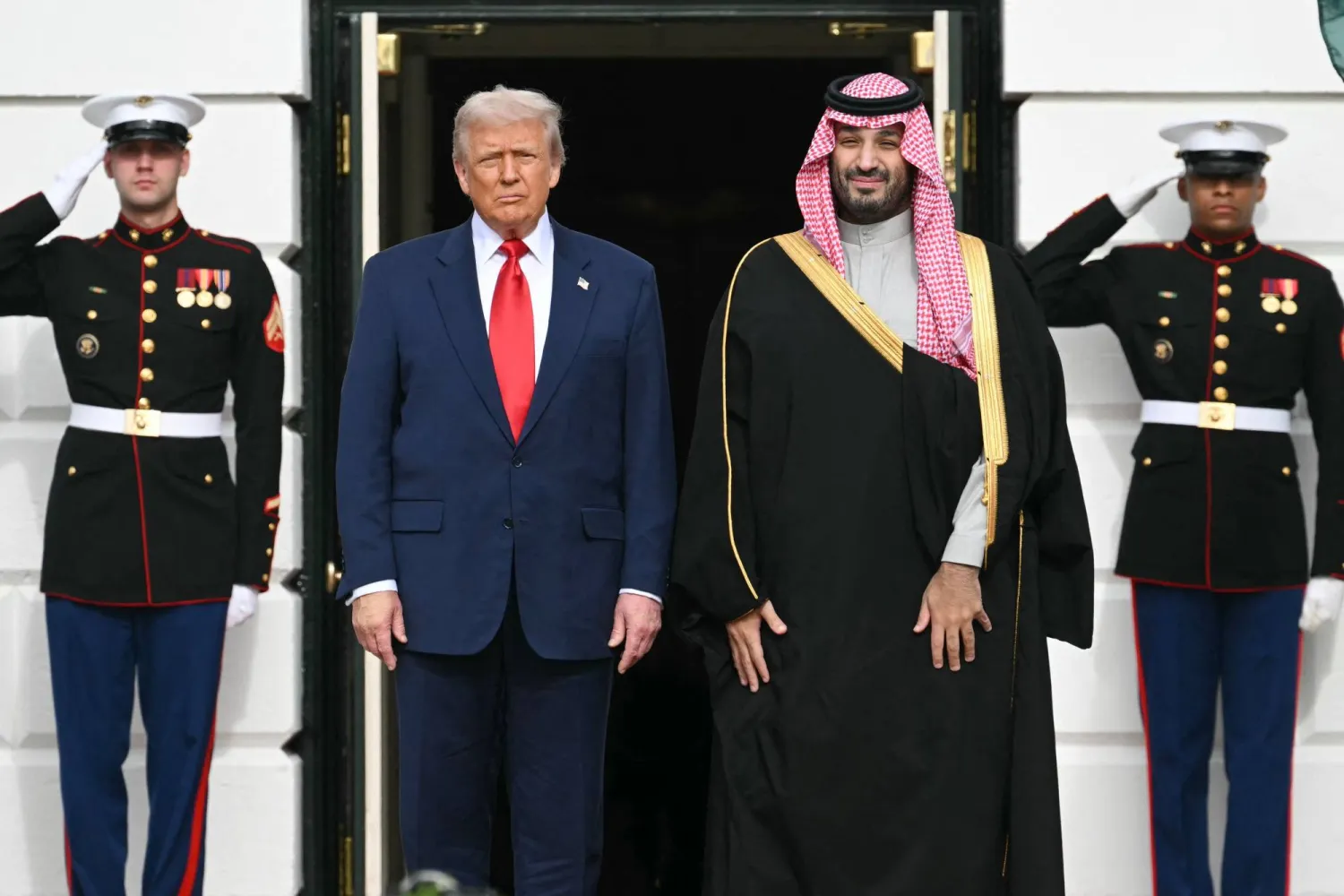

Saudi Crown Prince’s Visit to US Launches New Chapter in Relations 

US President Donald Trump greets Prince Mohammed bin Salman, Saudi Crown Prince and Prime Minister, on the South Lawn at the White House in Washington, DC on November 18, 2025. (AFP)
TT

Saudi Crown Prince’s Visit to US Launches New Chapter in Relations 

US President Donald Trump greets Prince Mohammed bin Salman, Saudi Crown Prince and Prime Minister, on the South Lawn at the White House in Washington, DC on November 18, 2025. (AFP)

The visit by Prince Mohammed bin Salman bin Abdulaziz Al Saud, Crown Prince and Prime Minister, to the United States on Tuesday paved the way for a new "great" chapter in relations between the two allies and consolidated the "unlimited" partnership between them. 

US President Donald Trump received Crown Prince Mohammed bin Salman at the White House. An official reception ceremony was held for the Crown Prince, whose motorcade was escorted by cavalry upon arrival followed by a review of the honor guard while the military band performed, and 19 artillery rounds were fired in welcome. 

The Crown Prince and Trump witnessed an aerial military display in which a formation of fighter jets flew over Washington in welcome of his arrival. 

Following the reception ceremony, Trump escorted the Crown Prince on a tour of the White House. 

During remarks at the Oval Office, Crown Prince Mohammed revealed that Saudi Arabia will invest up to $1 trillion in the US.  

"I believe, Mr. President, in today and tomorrow, we can announce that we are going to increase that $600 billion to almost $1 trillion for investment, real investment, and real opportunity," he said.  

"Now, you're saying to me now that the $600 billion will be $1 trillion?" Trump said, to which Crown Prince Mohammed replied: "Definitely."  

The Kingdom was not "creating fake opportunities to please America or please Trump," he added. Saudi Arabia has a high demand for computing power and desires US chips. 

Afterwards, the Crown Prince and Trump chaired the Saudi-US summit. 

They reviewed aspects of bilateral relations, discussed joint efforts to boost the Saudi-US strategic partnership across various fields, examined regional and international developments, explored ways to strengthen security and stability regionally and globally, and addressed several other issues of mutual interest. 

Crown Prince Mohammed and Trump signed a strategic defense agreement at the conclusion of the summit. They also signed bilateral agreements and memoranda on strategic partnership for artificial intelligence; a joint statement on completing the negotiations regarding cooperation in civil nuclear energy; a strategic framework for partnership in securing supply chains for uranium, permanent magnets, and critical minerals; and agreement to facilitate procedures for accelerating Saudi investments. 

They also signed financial and economic partnership arrangements for economic prosperity; arrangements related to cooperation in the financial markets; a memorandum of understanding (MoU) in the field of education and training; and letters concerning vehicle safety standards. 

Attending the summit from the Saudi side were Minister of Energy and Chairman of the Saudi side of the Saudi-US Strategic Economic Partnership Committee Prince Abdulaziz bin Salman bin Abdulaziz; Saudi Ambassador to the US Princess Reema bint Bandar bin Sultan bin Abdulaziz; Minister of Foreign Affairs Prince Faisal bin Farhan bin Abdullah; Minister of State, Member of the Cabinet, and National Security Adviser Dr. Musaed bin Mohammed Al-Aiban; Minister of Commerce Majid Al-Kassabi; Minister of Finance Mohammed Aljadaan; and Governor of the Public Investment Fund (PIF) Yasir Alrumayyan. 

From the American side, officials included Vice President JD Vance; Secretary of State Marco Rubio; Secretary of Defense Pete Hegseth; Secretary of the Treasury Scott Bessent; Secretary of Energy Chris Wright; White House chief of staff Susie Wiles; and special envoy for the Middle East Steve Witkoff. 


Iran Launched 83% of Missiles and Drones at the Gulf Compared to 17% at Israel

Smoke rises from a high-rise building following a drone attack in Kuwait City on March 8, 2026. (AFP/file photo)
TT

Iran Launched 83% of Missiles and Drones at the Gulf Compared to 17% at Israel

Smoke rises from a high-rise building following a drone attack in Kuwait City on March 8, 2026. (AFP/file photo)

Since the start of the war on February 28, about 83% of missiles and drones launched by Iran have targeted Gulf Cooperation Council (GCC) states, compared to 17% launched at Israel, reports indicate.

Official data shows that by Wednesday night, Iran had launched 4,391 missiles and drones at GCC vital infrastructure and civilian facilities, constituting a dangerous escalation that threatens regional security and stability.

As for Israel, which has initiated the war, it was hit by 930 Iranian missiles and drones or just 17% of the total attacks in the region.

Data shows that Iran has launched a total of 723 missile and drone attacks at Saudi Arabia since the beginning of the conflict.

The United Arab Emirates bore the brunt of Iranian attacks with 2,156 missiles and drones, followed by Kuwait with 791 attacks, Bahrain (429), Qatar (270) and Oman with 22 drone attacks.

Gulf air defense systems have demonstrated exceptional efficiency and professionalism in neutralizing these threats, proving to be an impenetrable shield safeguarding the region’s security and stability.

Arab and Muslim nations condemned the Iranian attacks, urging Tehran to cease aggression and respect international law for regional stability.

But Iran has escalated military operations against GCC countries, directly threatening the global economy and international energy security.


Saudi Defense Minister Receives Phone Call from Hungarian Counterpart

Saudi Defense Minister Prince Khalid bin Salman bin Abdulaziz. (SPA)
TT

Saudi Defense Minister Receives Phone Call from Hungarian Counterpart

Saudi Defense Minister Prince Khalid bin Salman bin Abdulaziz. (SPA)

Saudi Minister of Defense Prince Khalid bin Salman bin Abdulaziz received a phone call on Wednesday from his Hungarian counterpart Kristóf Szalay-Bobrovniczky, the Saudi Press Agency reported.

During the call, the two sides discussed regional developments, including Iran's attacks on the Kingdom and several countries in the region, and their implications for regional and international security and stability.


Saudi Foreign Minister Travels to France for G7 Meeting

Saudi Foreign Minister Prince Faisal bin Farhan (Asharq Al-Awsat)
TT

Saudi Foreign Minister Travels to France for G7 Meeting

Saudi Foreign Minister Prince Faisal bin Farhan (Asharq Al-Awsat)

Saudi Minister of Foreign Affairs Prince Faisal bin Farhan bin Abdullah traveled to France on Wednesday to attend the Group of Seven (G7) ministerial meeting, taking place at the Vaux-de-Cernay Abbey in the countryside outside Paris.

The meeting will address international issues and topics, including global governance reform, reconstruction challenges, maritime security, supply chains, and threats to peace and stability around the world, the Saudi Press Agency reported Thursday.
