Iran and the US Harden their Positions as Tehran Keeps Its Grip on the Strait of Hormuz

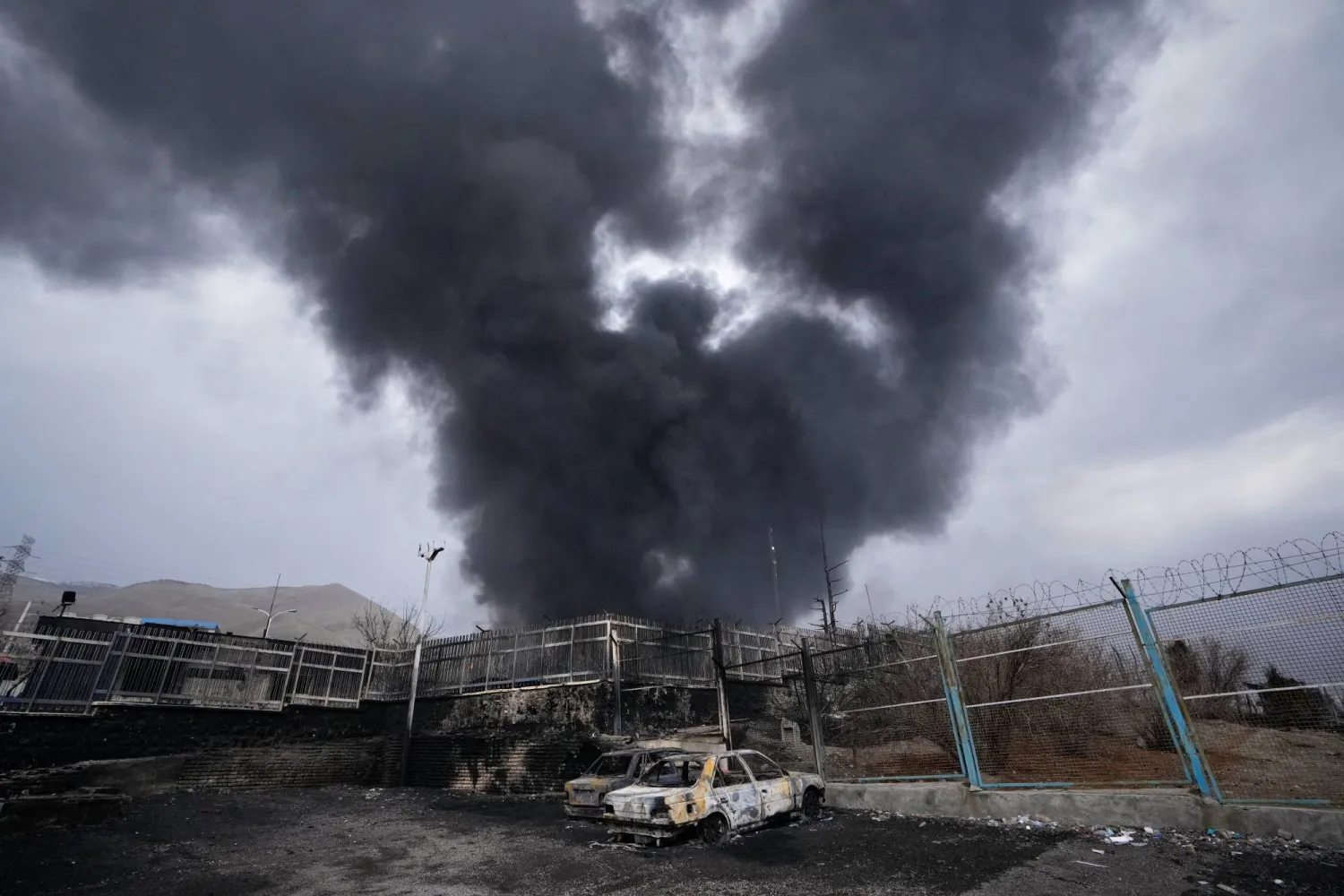
FILE - A thick plume of smoke rises from an oil storage facility hit by a US-Israeli strike in Tehran, Iran, March 8, 2026. (AP Photo/Vahid Salemi, File)
TT

Iran and the US Harden their Positions as Tehran Keeps Its Grip on the Strait of Hormuz

FILE - A thick plume of smoke rises from an oil storage facility hit by a US-Israeli strike in Tehran, Iran, March 8, 2026. (AP Photo/Vahid Salemi, File)

Iran and the United States hardened their positions as diplomacy aimed at reaching a ceasefire in the war in the Middle East appeared to be faltering on Thursday. Tehran moved to formalize its control over the crucial Strait of Hormuz while Washington prepared for the arrival of US combat forces in the region that could be used on the ground in the Iranian Republic.

Iran is instituting a “de facto ‘toll booth’ regime,” industry experts say, with some ships paying in Chinese yuan to pass through the strait, where 20% of all traded oil and natural gas is transported in peacetime.

Meanwhile, a strike group anchored by the amphibious assault ship USS Tripoli drew closer to the Mideast with some 2,500 Marines. Also, at least 1,000 paratroopers from the 82nd Airborne have been ordered to the region, The Associated Press said.

The troop movements don’t guarantee US President Donald Trump will try to use force to compel Iran to open the strait and halt its attacks on Gulf Arab states.

Trump previously deployed a large force in the Caribbean before the American military captured former Venezuelan leader Nicolás Maduro in January. In the current situation, the US is seen as focused on possibly seizing Iran’s oil terminal at Kharg Island or other sites near the strait.

US Navy Adm. Brad Cooper, who commands the American military in the region, said his forces have hit more than 10,000 targets since Israel and the US started the war Feb. 28, destroying 92% of Iran's largest ships and more than two-thirds of the country's missile, drone and naval production facilities.

“We’re not done yet,” said Cooper, who heads the US Central Command, in a video message. “We are on a path to completely eliminate Iran’s wider military apparatus.”

Iran seen as operating Strait of Hormuz as ‘de facto toll booth’

With its stranglehold on traffic through the Strait of Hormuz, which leads from the Arabian Gulf toward the open ocean, Iran has been blocking ships it perceives as linked to the US and Israeli war effort, but letting through a trickle of others.

The Fars and Tasnim news agencies, both close to Iran’s paramilitary Revolutionary Guard, quoted lawmaker Mohammadreza Rezaei Kouchi as saying that parliament was working to formalize the process of charging fees to let ships pass.

“We provide its security, and it is natural that ships and oil tankers should pay such fees,” he was quoted as saying.

Lloyd’s List Intelligence called it a “de facto ‘toll booth’ regime.”

The shipping intelligence firm said vessels have to provide manifests, crew details and their destination to Iran’s Guard for sanctions screening, cargo alignment checks that currently prioritizes oil over all other commodities, and for what is described as ‘geopolitical vetting.’”

“While not all ships are paying a direct toll, at least two vessels have and the payment is settled in yuan,” Lloyd’s List said, referring to China’s currency.

Iran's grip on the strait and relentless attacks on Gulf regional energy infrastructure has sent oil prices skyrocketing and concerns of a global energy crisis surging. Brent crude, the international standard, traded at US$104 early Thursday, up more than 40% from the day the war started.

“To make it crystal clear, this war is a catastrophe for world's economies,” German Defense Minister Boris Pistorius told reporters during a visit to Australia.

US maintains negotiations are ongoing but Iran says there are no talks

Using Pakistan as an intermediary, Washington has delivered to Iran a 15-point ceasefire proposal, which includes the reopening of the Strait of Hormuz.

Trump, speaking at a fundraiser Wednesday night in Washington, insisted that Iran still wants to cut a deal.

“They are negotiating, by the way, and they want to make a deal so badly, but they’re afraid to say it because they figure they’ll be killed by their own people,” Trump said.

Iran’s Foreign Minister Abbas Araghchi said in an interview on state TV, however, that his government has not engaged in talks to end the war, “and we do not plan on any negotiations.”

Araghchi said the US had tried to send messages to Iran through other nations, “but that is not a conversation nor a negotiation.”

Press TV, the English-language broadcaster on Iranian state television, said Iran has its own five-point proposal, which includes “sovereignty over the Strait of Hormuz.”

A wave of Israeli airstrikes hits as Iran fires on Gulf neighbors

Israel said it carried out a wave of attacks early on Thursday targeting Iranian infrastructure, and air defenses were heard in Tehran, while heavy strikes were also reported around Isfahan, a city some 330 kilometers (205 miles) south of the Iranian capital.

Ifahan is home to a major Iranian air base and other military sites, as well as one of the nuclear sites bombed by the US during the 12-day war between Israel and Iran in June.

Sirens sounded very early on Thursday morning in parts of Tel Aviv and cities in central Israel. Rescue workers said two people were injured in a blast in Kfar Qasim.

Saudi Arabia's Defense Ministry said it intercepted multiple drones over its oil-rich Eastern Province, the United Arab Emirates' air defenses also worked to intercept incoming fire, and Bahrain reported extinguishing a blaze in a neighborhood that is home to the Bahrain International Airport.

Since the war began, more than 1,500 people have been killed in Iran, its Health Ministry says. Twenty people have been killed in Israel; two Israeli soldiers have also been killed in Lebanon. At least 13 US military members have been killed. More than a dozen civilians in the occupied West Bank and Gulf Arab states have also died.

Nearly 1,100 people have died in Lebanon, authorities said. In Iraq, where Iranian-supported militant groups have entered the conflict, 80 members of the security forces have been killed.


Russia Says Ukraine Drones Kill Four, Kyiv Reports Hospital Hit

Firefighters work at the site of a reported Russian attack, amid Russia's attack on Ukraine, in a location given as Odesa Region, Ukraine, November 9, 2026, in this screengrab taken from a handout video.(State Emergency Service of Ukraine/Handout via Reuters)
TT

Russia Says Ukraine Drones Kill Four, Kyiv Reports Hospital Hit

Firefighters work at the site of a reported Russian attack, amid Russia's attack on Ukraine, in a location given as Odesa Region, Ukraine, November 9, 2026, in this screengrab taken from a handout video.(State Emergency Service of Ukraine/Handout via Reuters)

Russia said on Friday that it shot down nearly 1,200 Ukrainian drones overnight, one of the largest swarms sent by Kyiv that killed four people.

Ukrainian authorities reported that another night of Russian attacks had set a hospital ablaze and killed at least three people.

The deadly attacks came a day after intense shuttle diplomacy in US-led talks to end the war approaching its fifth year.

US envoys Steve Witkoff and Jared Kushner held hours of talks with Russian President Vladimir Putin in Moscow on Thursday before jetting to Dublin to huddle with Ukrainian President Volodymyr Zelensky.

"In the course of the previous night... aerial defense systems intercepted and destroyed 1,198" Ukrainian drones over more than 15 Russian regions, Russia's defense ministry said in a statement.

Four people working in an industrial zone, home to an oil refinery and a chemical factory, died in the southern Volgograd region, local authorities said.

In Ukraine, a hospital in Kyiv was damaged after a Russian attack triggered a fire and forced people to seek shelter. One person was wounded.

In Odesa, two people were killed and five wounded in the overnight barrage, with "private residential houses and cars" damaged, regional governor Oleg Kiper said on Telegram.

A Russian attack on Zaporizhzhia in the southeast killed a 17-year-old boy, acting regional governor Mykhailo Semikin said.

Four people, who rescuers managed to pull from under the rubble, were wounded.

Another Russian strike hit the city of Rivne, in a northwestern region far from the frontline, damaging a kindergarten and wounding six people, including two children.

Ukraine has intensified its retaliatory drone attacks on Russia's energy industry over the past year-and-a-half, seeking to cut the Kremlin's revenues and undermine its ability to finance the war Moscow launched in February 2022.

Russia is heavily targeting Ukraine's own energy grid with aerial barrages, leaving residents across the country without power as temperatures plunge ahead of winter.


UN Nuclear Watchdog Urges Iran to Take ‘Steps’ Towards Inspections

An Iranian woman walks next to a billboard depicting Iran’s national flag in a street in Tehran, Iran, 09 November 2026. (EPA)
TT

UN Nuclear Watchdog Urges Iran to Take ‘Steps’ Towards Inspections

An Iranian woman walks next to a billboard depicting Iran’s national flag in a street in Tehran, Iran, 09 November 2026. (EPA)

The UN's nuclear watchdog urged Iran to take "incremental steps" to allow inspectors to return to key nuclear facilities in the Islamic republic, adding such access was "critical" in a report seen by AFP Friday.

The International Atomic Energy Agency (IAEA) has not had access to key nuclear facilities in Iran since Israel, joined by the United States, launched a 12-day conflict in June 2025 that included strikes on nuclear sites.

Nuclear facilities have also been hit in the latest war, which erupted on February 28, and the IAEA has repeatedly called for access.

In its report, to be discussed at an IAEA board of governors meeting next week, the agency noted that it was "critical" for it to conduct "verification activities in Iran without further delay".

"The director general encourages Iran to consider technical and gradual measures by which conditions are achieved that allow for the return of agency inspectors to Iran," the report said.

"Such incremental steps could pave the way to normal safeguards implementation in Iran while contributing to a confidence-building atmosphere conducive to a wider agreement," it added.

The report detailed correspondence in recent weeks between the IAEA and Iran.

IAEA inspectors were able to visit Iran's Bushehr nuclear plant in September, but have had no access to other facilities.

The IAEA "acknowledged that the military attacks on Iran's nuclear facilities and sites created an unprecedented situation".

But because of a lack of cooperation "the agency is not able to conclude that there has been no diversion of declared nuclear material from peaceful nuclear activities in Iran", the report said.

"The agency's lack of information about ... nuclear material and access to facilities to verify it is a matter of serious proliferation concern," the IAEA said, adding it "needs to be rectified with the utmost urgency".

The IAEA board in September referred Iran to the UN Security Council over its nuclear "non-compliance", marking the first time Iran has been referred to the UN top body in 20 years for failing to comply with its nuclear reporting obligations.

Before the June 2025 strikes, the IAEA calculated that Iran possessed approximately 440 kilograms of uranium enriched to 60 percent, nearing the 90 percent needed to make a bomb and well above the 3.67-percent limit set by a 2015 now-defunct agreement with Iran.

Since June 2025, the fate of the stockpile has remained uncertain.

Iran has long denied striving to develop a nuclear bomb.


US Navy Quietly Fired Some Commanders And Officials, Drawing Congressional Pushback

 US Marine Corps aviation assets and personnel embarked aboard USS Boxer (LHD 4) support ongoing enforcement of the US blockade against Iran. (CENTCOM)
US Marine Corps aviation assets and personnel embarked aboard USS Boxer (LHD 4) support ongoing enforcement of the US blockade against Iran. (CENTCOM)
TT

US Navy Quietly Fired Some Commanders And Officials, Drawing Congressional Pushback

 US Marine Corps aviation assets and personnel embarked aboard USS Boxer (LHD 4) support ongoing enforcement of the US blockade against Iran. (CENTCOM)
US Marine Corps aviation assets and personnel embarked aboard USS Boxer (LHD 4) support ongoing enforcement of the US blockade against Iran. (CENTCOM)

The Navy has quietly fired or removed several top officers in recent months but broke with its usual practice of announcing those changes, drawing pushback from Congress, according to The Associated Press.

Two Democratic lawmakers said Thursday that the Navy failed to inform Congress that it fired the entire leadership team of a nuclear-powered attack submarine last month after an underwater collision.

Separately, the sea service in September fired the commander of a destroyer deployed to the Middle East, according to a defense official, who spoke on condition of anonymity to describe sensitive personnel matters.

Dr. Brian Monahan, a Navy rear admiral and attending physician for Congress and the Supreme Court, also departed his post during a Navy investigation — with no public announcement or confirmation.

All three are a break from the Navy’s longstanding policy to announce major removals of commanders and other highly visible officials. They also follow an increasing level of secrecy over military operations, especially in the Middle East.

“As a result of the Navy’s failure to communicate, what should have been a standard exercise in information sharing has instead raised questions about the Navy’s commitment to transparency and its commitment to a productive working relationship with Congress,” Representatives Joe Courtney of Connecticut and Adam Smith of Washington wrote in a letter to Navy leaders.

The developments could set up a contentious confirmation hearing next week for acting Navy Secretary Hung Cao as he seeks to permanently take over as the top civilian official.

Restrictions on the military sharing information go beyond the Navy.

US Central Command, which oversees operations in the Middle East, has released few details on recent limited strikes on Iran and refused to comment on or specify damage to bases or equipment, usually citing the need for operational security.

Major satellite imagery providers with US contracts have blocked or delayed public release of images in the region at the request of American officials.

As a result, it took months to determine that Iranian drone and missile strikes damaged or destroyed structures on 26 military bases and other sites with US equipment in the region, according to an AP analysis.