



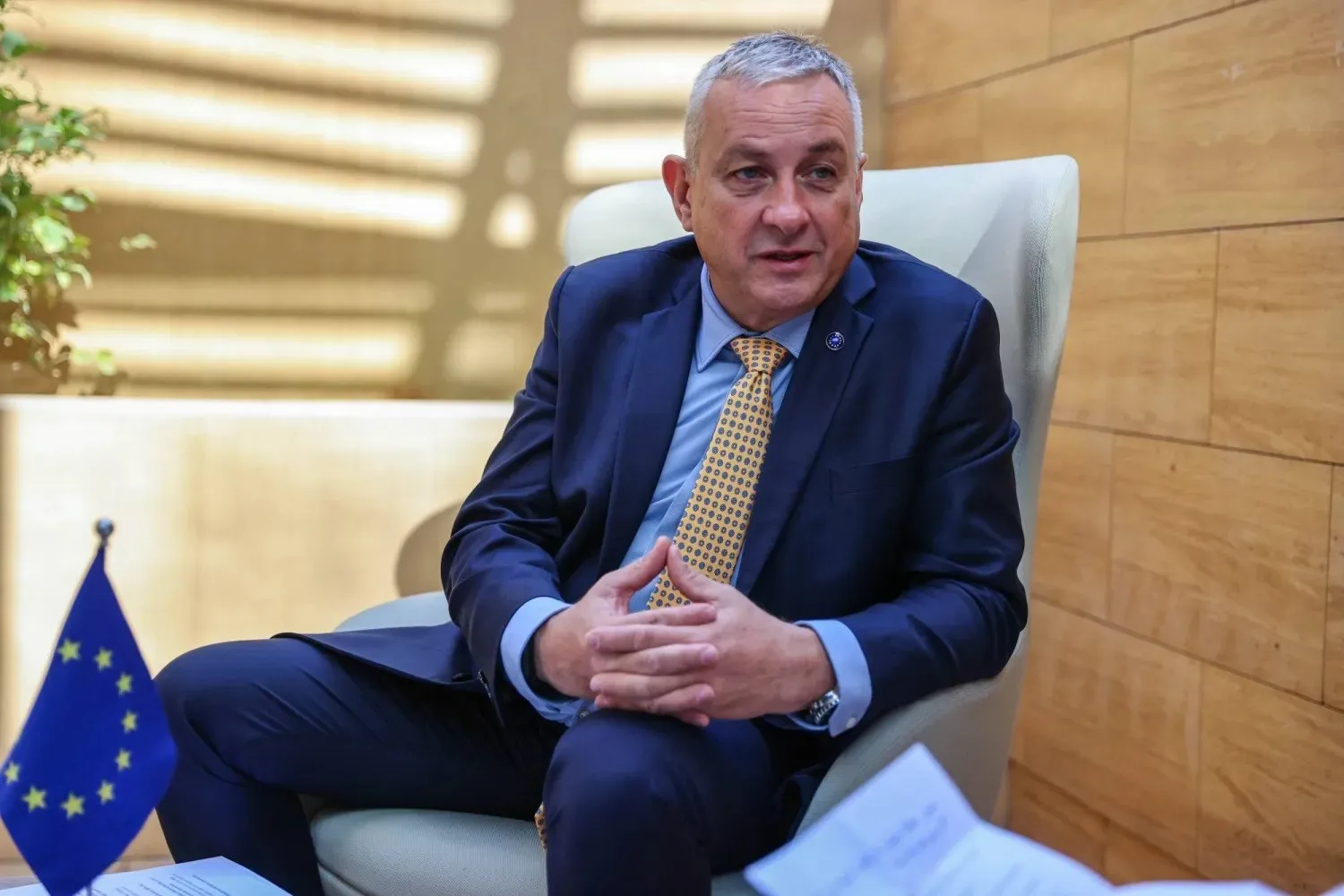

A senior European Union official has described cooperation with Saudi Arabia as boundless, stressing that the Kingdom is rapidly evolving into a major economic and technological center driven by accelerated reforms, openness, and a long-term strategic vision.
Jozef Síkela, European Commissioner for International Partnerships, told Asharq al-Awsat that Brussels now views Saudi-European relations as entering a phase of significant expansion.
He said the momentum goes beyond bilateral trade and investment, with extensive opportunities emerging in Africa, Central Asia, South Asia, the Pacific, and the Caribbean.
“The ceiling for cooperation will remain open without limits,” provided both sides align their development priorities, he underlined.
Speaking in Riyadh during the UN Industrial Development Organization (UNIDO) Global Industry Summit, Síkela said the timing of the event was ideal because it emphasized sustainable industry, job creation and local value.
He noted that Saudi Arabia’s hosting of the summit demonstrated its growing role in the global industrial landscape.
According to Síkela, the EU currently partners with UNIDO on 38 active programs worth close to USD350 million, making Brussels UNIDO’s largest voluntary contributor.
He said his previous experience as Minister of Industry, Trade and Energy allows him to use this visit to deepen discussions with Saudi ministers, the Saudi Fund, and major companies on expanding collaboration.
He argued that both sides are prioritizing the same sectors, particularly renewable energy, hydrogen, mining, environmental protection, as well as education and skills development in third countries.
Síkela described relations with Riyadh as gaining unprecedented momentum. He pointed out that Saudi Arabia is the European Union’s largest trading partner in the Gulf and is implementing an ambitious diversification agenda under Vision 2030.
A clearly defined national strategy makes the Kingdom particularly attractive for European companies, he underlined, explaining that investors look for stability and predictability, conditions that Saudi Arabia increasingly offers.
He added that if Europe’s global development framework aligns with Saudi Arabia’s economic transformation, cooperation will expand without limits.
Brussels, he noted, recognizes strong potential for joint work in the Global South, especially in regions where the Saudi Development Fund is already active. These locations are consistent with the EU’s Global Gateway initiative, which seeks to promote sustainable development using European investment, technology, and standards.
Síkela described Global Gateway as an approach focused on building the future by investing in human capital before physical infrastructure. The strategy aims to enable partner countries to use their resources effectively, build value chains, and access regional and global markets through better logistics, ports and transportation corridors.
He said that the EU remains the world’s largest development donor, contributing more than 40 percent of global spending while representing only 16 percent of global economic output. The initiative’s funding target - originally 300 billion euros by 2027 - has already been nearly achieved, leading the EU to raise it to 400 billion euros, according to the commissioner.
He also stated that the initiative is designed as a partnership between equals, avoiding imposed conditions or unbalanced relationships.
Síkela confirmed that discussions with Saudi officials included opportunities for Saudi participation in Global Gateway, alongside efforts to improve the business environment between both sides. He expressed confidence that additional measures will deepen relations in the coming period.
Looking ahead, he described Saudi Arabia as a rapidly advancing economic and technological hub. He pointed out that if he were advising European banks or companies today, he would urge them to increase their presence in the Kingdom, citing fast reforms, openness, and policy clarity as powerful advantages.


