

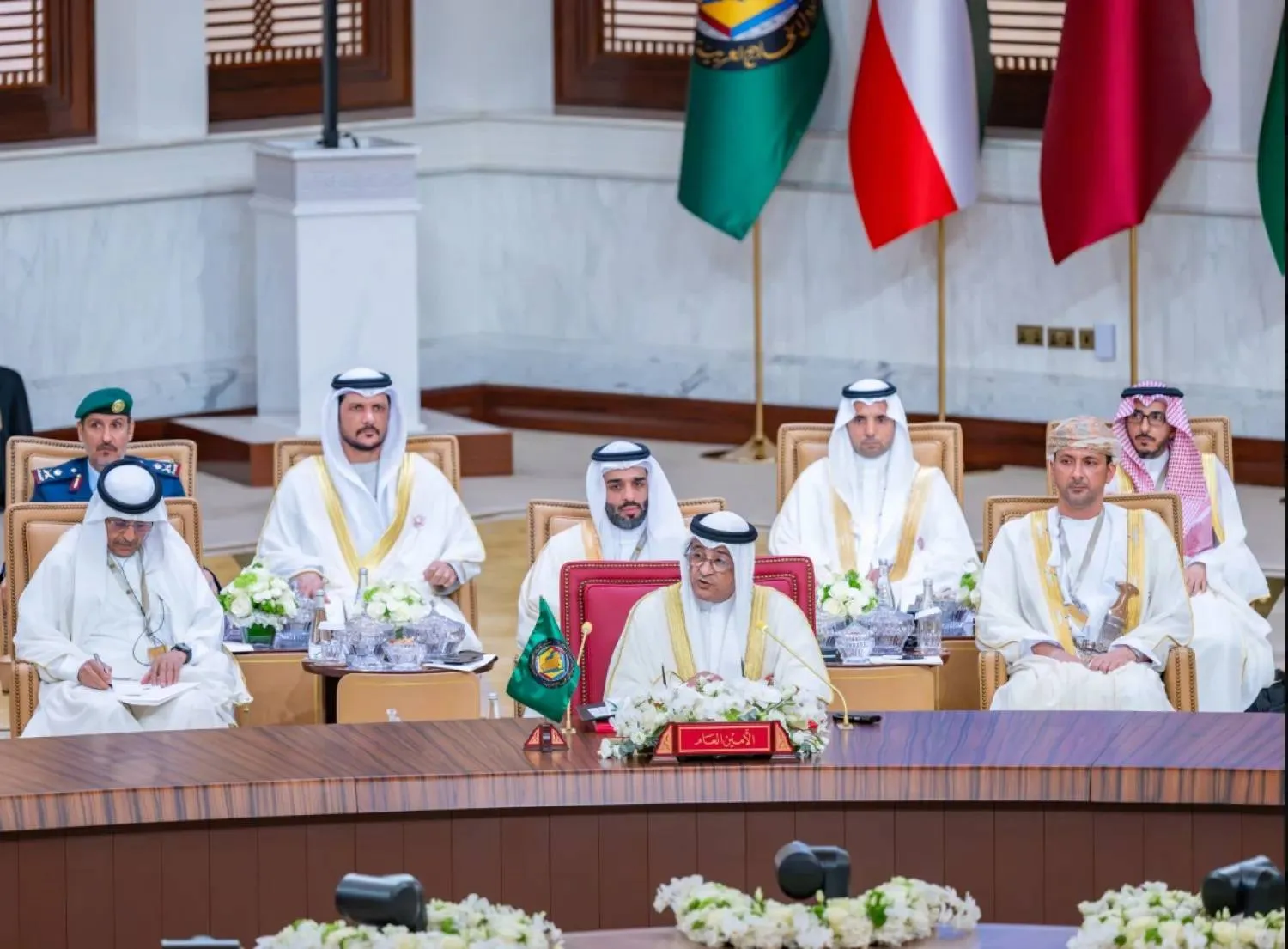

Gulf Countries Strengthen Defense Capabilities after Attacks on Qatar

GCC Secretary General Jasem Albudaiwi addresses the 46th Session of the GCC Supreme Council in Manama on Wednesday. (KUNA)
TT

Gulf Countries Strengthen Defense Capabilities after Attacks on Qatar

GCC Secretary General Jasem Albudaiwi addresses the 46th Session of the GCC Supreme Council in Manama on Wednesday. (KUNA)

Gulf Cooperation Council (GCC) Secretary General Jasem Albudaiwi confirmed on Wednesday that that the six countries of the council have demonstrated their unity during the two attacks on Qatar earlier this year.

"The incidents demonstrated to the entire world that the Gulf’s destiny is one, that Gulf's security is one, and that our voice, when united, prevails," he declared during the opening of the 46th Session of the GCC Supreme Council in Manama.

He highlighted military cooperation, including the beginning of implementing the decisions and recommendations of the extraordinary session of the Joint Defense Council held in wake of the Israeli attack on Qatar in September.

As a result, numerous joint military exercises, including the ongoing "Ittihad 25" drill for the Gulf naval forces, were held. Military committees continue to meet to boost joint deterrence capabilities, he added.

"The GCC states rose in unison to back Qatar and support its security and sovereignty. The Council stressed that the security of Qatar is an integral part of the security of all Council states and that any threat to one Gulf state is a direct threat to all Council states," Albudaiwi stated.

Israel carried out a strike on a residential neighborhood in Doha targeting Hamas leaders who were to review a US proposal for a ceasefire in the Gaza Strip. Later in September, Israeli Prime Minister Benjamin Netanyahu, in a telephone call placed from the White House, apologized to Qatar's prime minister for strikes.

The second attack against Qatar was committed by Iran in June during the war between Tehran and Tel Aviv.

Furthermore, Albudaiwi said the GCC states' positions on the Palestinian cause "remain steadfast and unwavering, reflecting the enduring values that guide their stance."

GCC states "continue to emphasize the centrality of this issue, the necessity of ending the Israeli occupation, and the establishment of an independent Palestinian state within the 1967 borders, with East Jerusalem as its capital," he remarked.

Moreover, he commended Saudi Arabia's leading role in international efforts to implement the two-state solution.

"We welcome the outcomes of the International Conference for the Peaceful Settlement of the Question of Palestine held in New York in September 2025, which included explicit support for the recognition of the State of Palestine," he said.

He welcomed the outcomes of the Sharm el-Sheikh Peace Summit held on October 14 and the agreement signed by Qatar, Egypt, Türkiye and the United States to begin implementing the first phase of the ceasefire in Gaza.

International partnerships

Albudaiwi underlined the "wise policies of the GCC states that have yielded a successful model of joint regional action, combining political stability, economic prosperity and security cooperation," saying that this has made the GCC "a shining beacon for regional and international partnerships."

He highlighted the most significant achievements during 2025, including international partnerships, the success of the GCC-US Summit held in Riyadh on May 14, the convening of the GCC-ASEAN Summit and the trilateral summit with China on May 27, in Kuala Lumpur.

He also hailed the 13 joint ministerial meetings held throughout the year with Arab and friendly countries and international groups, and the General Secretariat's continued follow-up on the implementation of memoranda of understanding and action plans with countries and international organizations.

Economic integration

Albudaiwi further outlined economic integration and development, including the establishment of the Gulf Civil Aviation Authority, the adoption of amendments to certain articles of the Unified Agreement on Value Added Tax and Excise Tax, the launch of the Gulf Industrial Platform, and the launch of the Gulf Center for the Fourth Industrial Revolution.

He noted progress on the Customs Union project through the operation of the Customs Data Exchange Platform (2026), strengthening the Gulf Common Market, regulating trade in services, mechanisms for the mutual recognition of professional qualifications, and the signing of a statement to begin free trade negotiations with Malaysia.



Saudi Crown Prince Receives Message on Bilateral Ties from President of Kazakhstan

Prince Mohammed bin Salman bin Abdulaziz Al Saud, Saudi Crown Prince and Prime Minister. (SPA file)
TT

Saudi Crown Prince Receives Message on Bilateral Ties from President of Kazakhstan

Prince Mohammed bin Salman bin Abdulaziz Al Saud, Saudi Crown Prince and Prime Minister. (SPA file)

Prince Mohammed bin Salman bin Abdulaziz Al Saud, Saudi Crown Prince and Prime Minister, received on Tuesday a written message from President of Kazakhstan Kassym-Jomart Tokayev on bilateral relations between their two countries.

The message was received by Minister of Foreign Affairs Prince Faisal bin Farhan bin Abdullah during a meeting with his Kazakh counterpart Yermek Kosherbayev in Riyadh.


Princes and Officials Take Oath Before Custodian of the Two Holy Mosques

Custodian of the Two Holy Mosques King Salman bin Abdulaziz Al Saud and other officials are seen during the ceremony in Riyadh on Tuesday. (SPA)
TT

Princes and Officials Take Oath Before Custodian of the Two Holy Mosques

Custodian of the Two Holy Mosques King Salman bin Abdulaziz Al Saud and other officials are seen during the ceremony in Riyadh on Tuesday. (SPA)

Princes and officials appointed by royal orders to their new positions took the oath of office before Custodian of the Two Holy Mosques King Salman bin Abdulaziz Al Saud in Riyadh on Tuesday.

They included Deputy Governor of Al-Baha Region Prince Fahd bin Saad bin Abdullah bin Abdulaziz bin Turki; Member of the Shura Council Prince Dr. Saad bin Saud bin Mohammed bin Abdulaziz; Deputy Governor of Madinah Region Prince Saud bin Nahar bin Saud; Deputy Governor of Northern Borders Region Prince Mohammed bin Abdullah bin Abdulaziz; and Minister of Investment Fahd Al-Saif.

They swore to be faithful to their religion, then their King and country, not to reveal any of the state’s secrets, to preserve its interests and regulations, and to perform their duties with honesty, trustworthiness, and sincerity.


Saudi Arabia Reiterates Its Categorical Rejection of Israel’s ‘State Land’ Decision in West Bank

Custodian of the Two Holy Mosques King Salman bin Abdulaziz Al Saud chairs the Cabinet meeting in Riyadh. (SPA)
TT

Saudi Arabia Reiterates Its Categorical Rejection of Israel’s ‘State Land’ Decision in West Bank

Custodian of the Two Holy Mosques King Salman bin Abdulaziz Al Saud chairs the Cabinet meeting in Riyadh. (SPA)

The Saudi government condemned on Tuesday Israel’s decision to West Bank lands as "state lands."

Reiterating its absolute rejection of these illegal measures, the Cabinet warned that they undermine peace efforts and violate the Palestinian people's inherent right to establish an independent, sovereign state within the 1967 borders, with East Jerusalem as its capital.

Custodian of the Two Holy Mosques King Salman bin Abdulaziz Al Saud chaired the Cabinet session that was held in Riyadh.

The Cabinet congratulated citizens and Muslims on the advent of the holy month of Ramadan, expressing gratitude for the Kingdom's honor in caring for the two holy mosques and their visitors.

The Cabinet highlighted the success of the Hajj and Umrah seasons, noting that the Kingdom welcomed 19.5 million international pilgrims and Umrah performers in 2025, setting new records that reflect rapid progress toward the goals of Vision 2030 and the Pilgrim Experience Program.

The Cabinet described the Kingdom's Founding Day celebration on February 22 as an expression of pride in the Saudi state's nearly three-century history, underscoring the foundations of justice, unity, and development established by leaders and citizens throughout history to ensure the nation remains a global leader in all fields.

The Cabinet was briefed on recent talks between Saudi Arabia and various nations, which focused on strengthening bilateral and multilateral cooperation and boosting coordination to foster regional and international security, stability, and prosperity.

The session further reviewed the Kingdom's economic, cultural, and social activities, stressing the state's commitment to social solidarity and giving. This includes continued support for the sixth National Campaign for Charitable Work, set to begin on Friday.

The Cabinet commended the success of the third World Defense Show held in Riyadh under the Custodian of the Two Holy Mosques' patronage, during which strategic partnerships, agreements, and memoranda of understanding were signed to localize military technologies and strengthen local supply chains in alignment with Vision 2030 objectives.