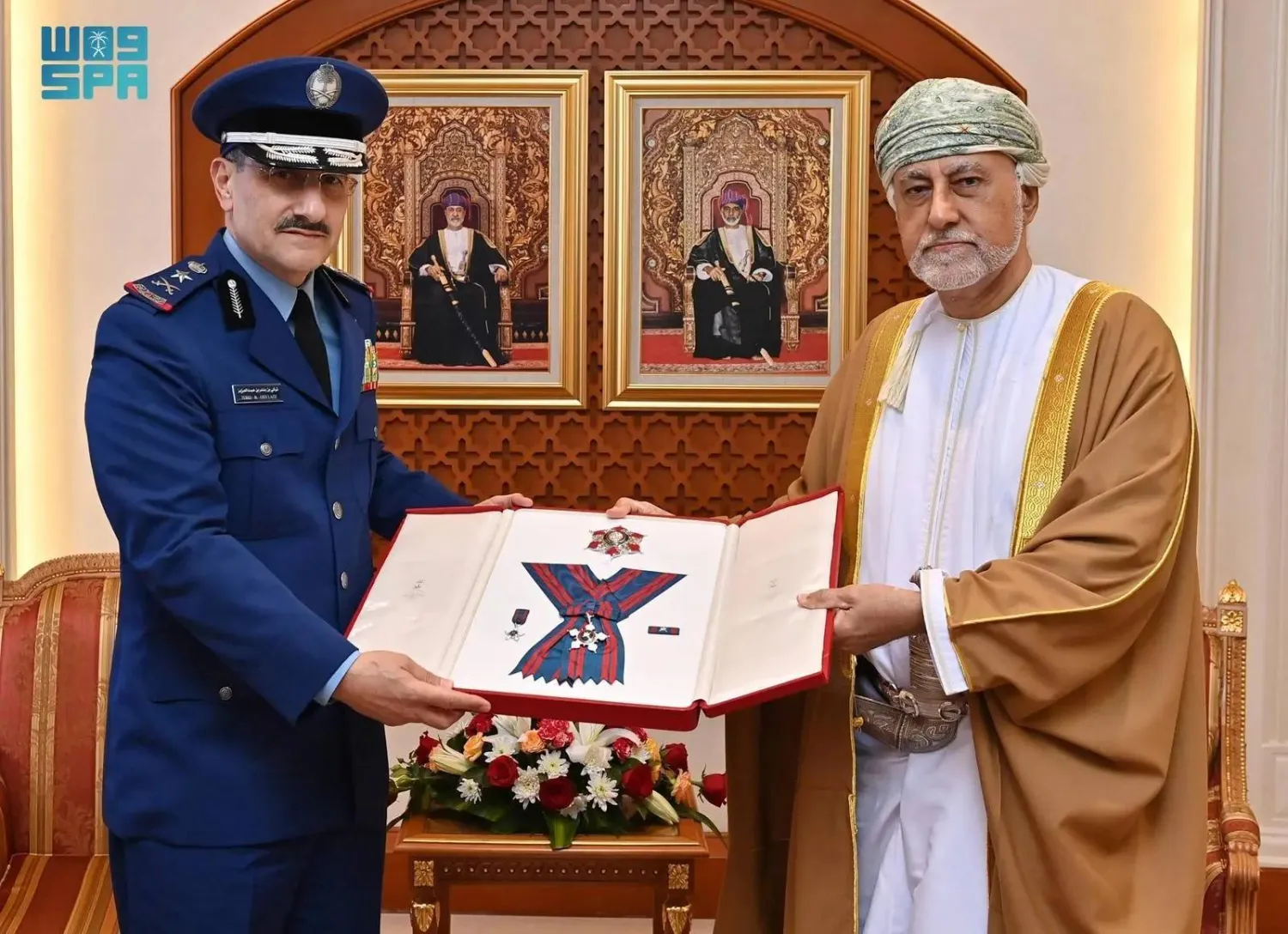
Sultan of Oman Awards Military Order to Royal Saudi Air Force Commander

Commander of the Royal Saudi Air Force (RSAF) Lieutenant General Prince Turki bin Bandar bin Abdulaziz receives the Military Order of Oman (Second Class). (SPA)
TT

Sultan of Oman Awards Military Order to Royal Saudi Air Force Commander

Commander of the Royal Saudi Air Force (RSAF) Lieutenant General Prince Turki bin Bandar bin Abdulaziz receives the Military Order of Oman (Second Class). (SPA)

Oman’s Sultan Haitham bin Tarik awarded on Wednesday the Military Order of Oman (Second Class) to Commander of the Royal Saudi Air Force (RSAF) Lieutenant General Prince Turki bin Bandar bin Abdulaziz in recognition of his efforts and contributions to strengthening military cooperation between the two countries.

The order was presented to the RSAF commander by Omani Deputy Prime Minister for Defense Affairs Shihab bin Tarik Al Said, in the presence of Commander of the Royal Air Force of Oman (RAFO) Air Vice Marshal Khamis Al Ghafri, Saudi Ambassador to Oman Ibrahim bin Saad bin Bishan, and the accompanying delegation.

During the visit, the RSAF commander also met with Minister of the Royal Office of Oman General Sultan bin Mohammed Al Nomani for talks on issues of mutual interest.

Prince Turki bin Bandar bin Abdulaziz arrived in Oman on Tuesday on an official visit during which he met with the commander of RAFO. The discussions addressed issues of common interest, particularly in the field of joint training and exercises.

The visit included a tour of the Air Center for Specialized Training, where the delegation reviewed the advanced capabilities on display, reflecting the level of development achieved by the Royal Air Force of Oman.


Crown Prince, UK PM Address Global Economic Crisis; Starmer Condemns Iran’s Attacks on Saudi Arabia

Prince Mohammed bin Salman bin Abdulaziz Al Saud, Saudi Crown Prince and Prime Minister, and British Prime Minister Keir Starmer meet in Riyadh in December 2024. (SPA)
TT

Crown Prince, UK PM Address Global Economic Crisis; Starmer Condemns Iran’s Attacks on Saudi Arabia

Prince Mohammed bin Salman bin Abdulaziz Al Saud, Saudi Crown Prince and Prime Minister, and British Prime Minister Keir Starmer meet in Riyadh in December 2024. (SPA)

Crown Prince and Prime Minister of Saudi Arabia, Prince Mohammed bin Salman bin Abdulaziz Al Saud, received a phone call on Wednesday from British Prime Minister Keir Starmer, who condemned Iran’s continued assaults against Saudi Arabia.

Starmer expressed his country’s strong condemnation of Iran’s attacks highlighting their threat to security and stability, during the phone call with the Crown Prince.

The two leaders discussed regional security amid the ongoing military escalation, its impact on regional and global stability, and the associated risks to international maritime security and the global economy.


UN Rights Council Slams ‘Egregious’ Iran Strikes on Gulf, Demands Reparation

Smoke rises from Kuwait international airport after a drone strike on fuel storage in Kuwait City, Kuwait, Friday, Wednesday, March 25, 2026. (AP Photo)
TT

UN Rights Council Slams ‘Egregious’ Iran Strikes on Gulf, Demands Reparation

Smoke rises from Kuwait international airport after a drone strike on fuel storage in Kuwait City, Kuwait, Friday, Wednesday, March 25, 2026. (AP Photo)

The UN Human Rights Council on Wednesday condemned Iran's "egregious attacks" on Gulf countries and demanded full "reparation" for all victims of its strikes.

The 47-member council backed a resolution brought by the six Gulf Cooperation Council (GCC) countries and Jordan demanding Iran immediately "cease all unprovoked attacks.”

The resolution was adopted by consensus.

The resolution "condemns in the strongest terms the egregious attacks" by Iran, condemns Tehran's actions aimed at closing the Strait of Hormuz and voices "grave concerns at the Iranian attacks on energy infrastructure.”

It demands Iran "immediately and unconditionally cease all unprovoked attacks" against the GCC states and Jordan and "provide full, effective and prompt reparation to all victims for the damage and injury caused by its attacks.”

Saudi Arabia welcomed the UN Human Rights Council’s unanimous adoption of the resolution, which reflects the international community’s rejection of Iranian attacks and its condemnation of these brutal acts as grave violations of human rights.

In a statement, the Saudi Foreign Ministry said Iranian attacks on the Kingdom and other countries in the region “constitute a flagrant violation of the sovereignty and territorial integrity of states and a clear breach of international conventions and international law.”

“Targeting countries that are not party to the conflict is a blatant act of aggression that cannot be justified or accepted,” it added.


Iran Launched 83% of Missiles and Drones at the Gulf Compared to 17% at Israel

Smoke rises from a high-rise building following a drone attack in Kuwait City on March 8, 2026. (AFP/file photo)
TT

Iran Launched 83% of Missiles and Drones at the Gulf Compared to 17% at Israel

Smoke rises from a high-rise building following a drone attack in Kuwait City on March 8, 2026. (AFP/file photo)

Since the start of the war on February 28, about 83% of missiles and drones launched by Iran have targeted Gulf Cooperation Council (GCC) states, compared to 17% launched at Israel, reports indicate.

Official data shows that by Wednesday night, Iran had launched 4,391 missiles and drones at GCC vital infrastructure and civilian facilities, constituting a dangerous escalation that threatens regional security and stability.

As for Israel, which has initiated the war, it was hit by 930 Iranian missiles and drones or just 17% of the total attacks in the region.

Data shows that Iran has launched a total of 723 missile and drone attacks at Saudi Arabia since the beginning of the conflict.

The United Arab Emirates bore the brunt of Iranian attacks with 2,156 missiles and drones, followed by Kuwait with 791 attacks, Bahrain (429), Qatar (270) and Oman with 22 drone attacks.

Gulf air defense systems have demonstrated exceptional efficiency and professionalism in neutralizing these threats, proving to be an impenetrable shield safeguarding the region’s security and stability.

Arab and Muslim nations condemned the Iranian attacks, urging Tehran to cease aggression and respect international law for regional stability.

But Iran has escalated military operations against GCC countries, directly threatening the global economy and international energy security.