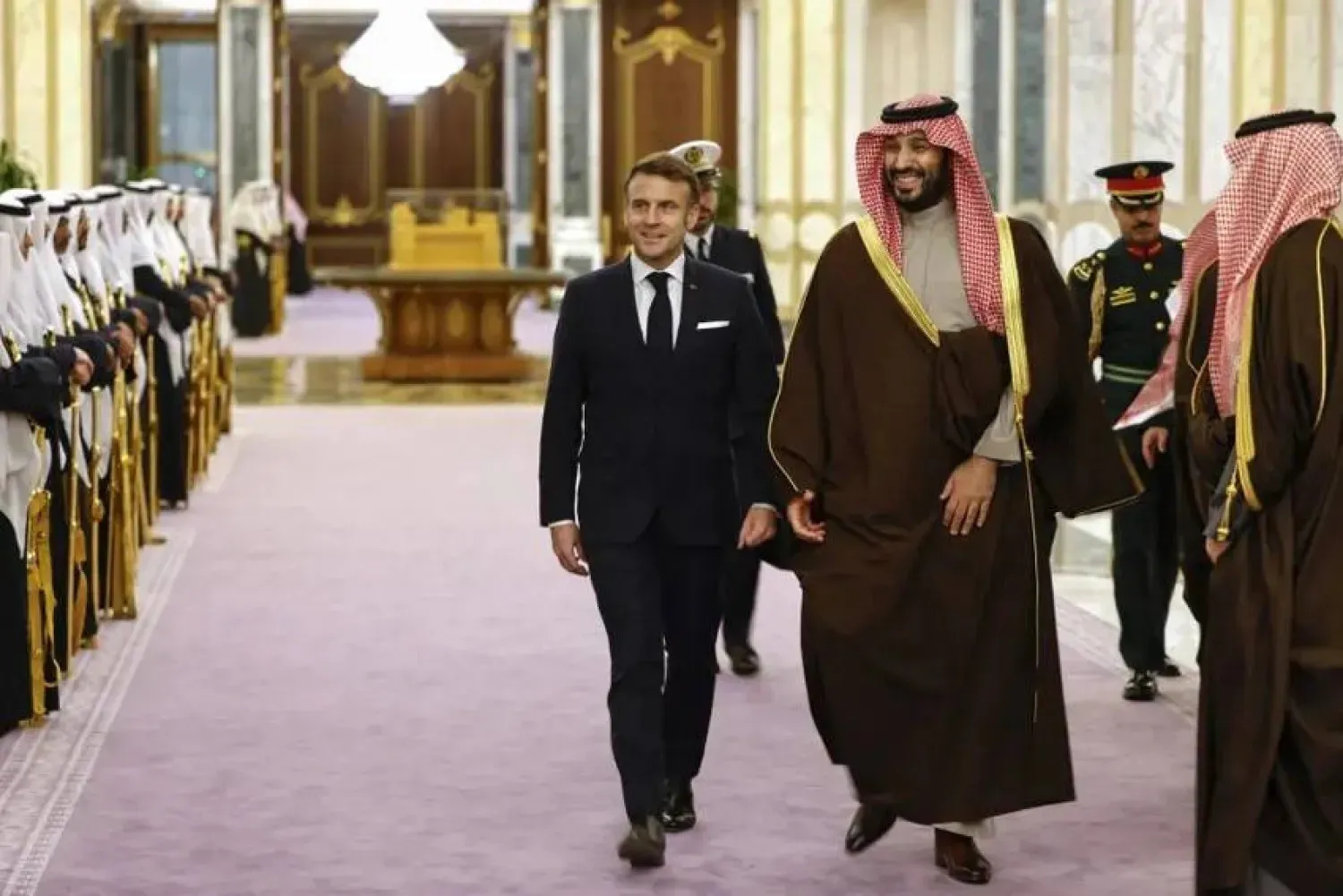
Saudi Crown Prince and Prime Minister Mohammed bin Salman’s current state visit to France marks the ninth official visit exchanged between the Saudi and French leaders since 2015, according to an Asharq Al-Awsat review of official sources.
The crown prince has traveled to France six times on official visits since 2015, including the current trip, while French President Emmanuel Macron has made three official visits to Saudi Arabia since taking office in 2017.
2015: First Visit
Mohammed bin Salman made his first official trip to France in June 2015, meeting then-President François Hollande at the Élysée Palace.
He also led the Saudi delegation at the inaugural meeting of the Saudi-French Permanent Coordinating Committee. The trip saw the signing of 10 agreements worth a total of $12 billion.
2016: Vision 2030 Joins the Agenda
Mohammed bin Salman returned to Paris in June 2016, meeting Hollande and other senior French officials.
Talks centered on developing bilateral ties and cooperation under Saudi Vision 2030, unveiled by the Kingdom two months earlier, as well as developments in the Middle East and efforts to bolster regional security and stability.
The trip broadened economic cooperation, placing Saudi Arabia’s transformation and diversification plans at the heart of discussions alongside political and defense coordination.
Several agreements and memorandums of understanding were signed, while the third Saudi-French Business Opportunities Forum brought together companies and business leaders to explore investment opportunities.
2017: Macron Makes First Saudi Trip
Macron traveled to Saudi Arabia on Nov. 9, 2017, months after taking office.
He met Mohammed bin Salman in Riyadh for talks on regional stability, counterterrorism and peace efforts, according to the French presidency.
The French leader also condemned a Houthi ballistic missile attack targeting Riyadh and voiced his country’s solidarity with the Kingdom.
2018: Three Days in France, AlUla Agreement
In April 2018, Mohammed bin Salman traveled to France for the first time since becoming crown prince and for the third time since 2015.
During the three-day trip, he held wide-ranging discussions with Macron covering political, economic, defense and cultural ties, as well as regional issues.
The two countries signed an intergovernmental agreement on cooperation to develop AlUla, while Saudi and French companies concluded 19 agreements worth more than $18 billion.
2021: Macron in Jeddah
Macron returned to Saudi Arabia in December 2021 for talks with Mohammed bin Salman in Jeddah.
Discussions focused on regional security and stability and ways to expand the bilateral partnership under Vision 2030, alongside Lebanon, Yemen, Iran and counterterrorism.
Riyadh and Paris also sought to broaden economic and investment cooperation, particularly in new technologies, future industries, renewable energy, culture and tourism.
2022: Energy and Global Crises
Mohammed bin Salman traveled to France again in July 2022, meeting Macron at the Élysée Palace as the Russia-Ukraine war weighed on global energy markets and food security.
Their discussions covered diversifying energy supplies to Europe and mitigating the impact of the food crisis, as well as developments in Lebanon and Yemen and Iran’s nuclear program.
Riyadh and Paris agreed to deepen cooperation in defense, energy, digital transformation, transport, sustainable cities and culture. France also renewed its support for Riyadh’s bid to host Expo 2030.
2023: A Broader Partnership
Mohammed bin Salman’s fifth official trip to France came in the summer of 2023, when he held bilateral and expanded talks with Macron at the Élysée Palace.
The leaders discussed bilateral ties and regional and international developments.
The crown prince also headed the Saudi delegation to the Summit for a New Global Financing Pact and attended an official reception promoting Riyadh’s Expo 2030 bid.
The trip reflected the widening scope of Saudi-French ties, extending beyond politics and defense to climate action, the global economy, investment and culture.
2024: Strategic Partnership
Macron traveled to Saudi Arabia for a third time from Dec. 2 to 4, 2024, on a state visit encompassing Riyadh and AlUla.
The trip saw the establishment of a strategic partnership between the two countries and the signing of a memorandum of understanding to create the Saudi-French Strategic Partnership Council, an umbrella framework for cooperation in politics, defense, the economy, culture, energy and technology.
Macron also attended an investment forum bringing together more than 200 Saudi and French companies and took part in the One Water Summit in Riyadh before traveling to AlUla in northern Saudi Arabia.
2026: Ninth Visit
Mohammed bin Salman’s current state visit to France is his sixth official trip to the country since 2015 and brings the total number of official visits exchanged between the two countries’ leaders to nine.
Macron has traveled to Saudi Arabia three times since becoming president in 2017.