

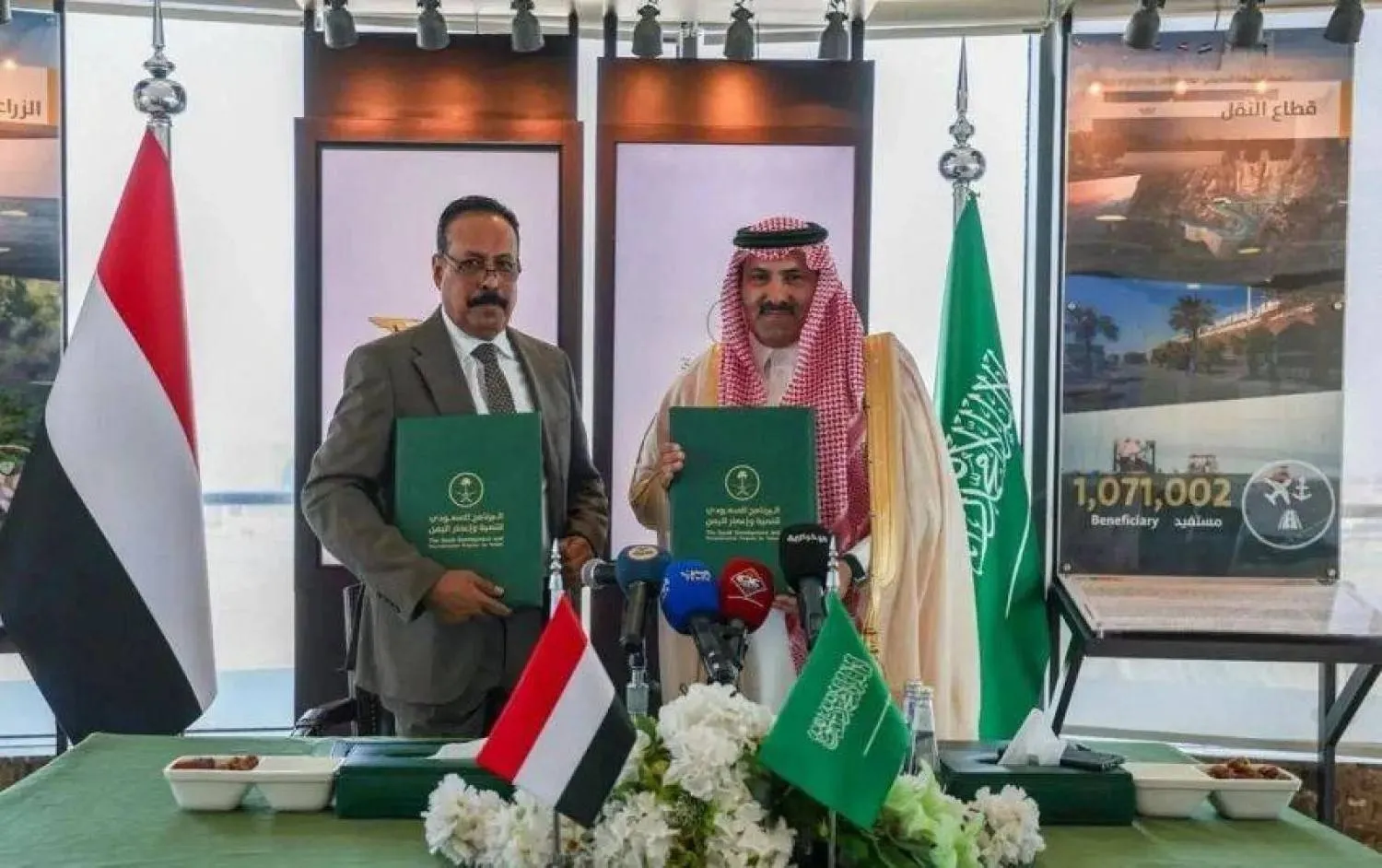

Yemen, Saudi Arabia Deepen Infrastructure and Recovery Partnership

Yemeni Minister of Public Works and Roads Hussein Al-Aqrabi and Mohammed Al-Jaber, Saudi Arabia’s Ambassador to Yemen (Saba)
TT

Yemen, Saudi Arabia Deepen Infrastructure and Recovery Partnership

Yemeni Minister of Public Works and Roads Hussein Al-Aqrabi and Mohammed Al-Jaber, Saudi Arabia’s Ambassador to Yemen (Saba)

The internationally recognized government and the Saudi Development and Reconstruction Program for Yemen (SDRPY) have signed a new memorandum of cooperation to overhaul road infrastructure and revive economic and trade sectors

The agreement, signed by Minister of Public Works and Roads Hussein Al-Aqrabi and Mohammed Al-Jaber, Saudi Arabia’s Ambassador to Yemen and the general supervisor of the program, signals a move from emergency response to sustainable development, based on institutional capacity building and improved basic services.

In a statement, the Saudi program said the deal will secure sustainable road maintenance and operations while raising technical standards.

Planned measures include installing modern vehicle weighing stations to curb overloading, a leading cause of road damage, alongside technical and advisory support to rehabilitate and operate transport networks. The initiative will also bolster the Roads Maintenance Fund in coordination with relevant Saudi authorities.

Projects on the table include expanding and rehabilitating several key arteries, most notably the strategic Al-Abr Road and the Haijat Al-Abd Road, as well as other routes across multiple provinces.

The total stretch exceeds 200 kilometers, a scale expected to cut transport costs and ease the flow of trade between governorates.

The signing coincided with talks between Tariq Saleh, a member of Yemen’s Presidential Leadership Council, and Al-Aqrabi on the ministry’s next-phase priorities.

The government’s vision places infrastructure at the heart of economic and social recovery.

Saleh underlined the ministry’s central role in establishing stability in liberated areas, describing the rehabilitation of international and inter-governorate roads as critical to easing public hardship and improving the movement of goods and supplies.

Al-Aqrabi outlined the ministry’s 2026 blueprint, focused on restoring strategic road networks and vital outlets, completing stalled projects, and improving the urban landscape to reinforce the state’s presence and strengthen public trust in government institutions.

Saleh also called for boosting the efficiency of the Roads Maintenance Fund and enforcing transparent standards in resource management and project execution, saying the current phase demands high-level performance to deliver tangible results, particularly amid Yemen’s economic and humanitarian strains.

Observers view the emphasis on transport infrastructure as a strategic calculation. Roads sit at the center of supply chains and directly affect the cost of goods and services, making their rehabilitation a practical gateway to stimulating the local economy and encouraging investment.

The development drive extends beyond transport. The same period saw expanded engagements between Yemeni officials and the Saudi program to deepen cooperation in health, education, energy, water, and agriculture.

In this context, Salem Al-Khanbashi, a member of the Presidential Leadership Council and governor of Hadhramaut, met Al-Jaber, with both sides reaffirming the depth of Yemeni-Saudi ties and commending sustained Saudi support on the military, humanitarian, and development fronts.

According to official Yemeni media, Al-Jaber said Riyadh remains committed to providing comprehensive political, economic, and developmental support to Yemen, with a focus on dialogue-based solutions that deliver security, stability, and sustainable development.

During a visit to the program’s headquarters in Riyadh, Al-Khanbashi reviewed projects implemented under a broad development framework spanning education, health, energy, transport, agriculture, and fisheries, as well as initiatives to improve basic services in Hadhramaut and other liberated provinces.

Program officials presented a detailed briefing on ongoing projects designed around citizens’ core needs, prioritizing infrastructure reinforcement and improved public service delivery to underpin social stability.

In the health sector, Yemen’s Minister of Public Health and Population, Qassem Buhaibeh, met a technical team from the Saudi program to discuss executive steps for establishing a Health Fund, described as a strategic mechanism to secure sustainable financing for medical services and upgrade care quality.

According to official sources, discussions covered the technical and procedural framework for launching the fund, including governance and transparency mechanisms to ensure resources are allocated in line with sector priorities and actual needs.

Buhaibeh said the Health Fund marks a decisive step toward stabilizing health facility finances, especially under mounting pressure on the healthcare system, praising Saudi backing that has supported infrastructure upgrades, medical equipment improvements, and human capacity development.


Empty Quarter: Reservoir of Energy and Graveyard for Drones

The Empty Quarter lies atop two of the world’s largest oil and gas fields (SPA)
TT

Empty Quarter: Reservoir of Energy and Graveyard for Drones

The Empty Quarter lies atop two of the world’s largest oil and gas fields (SPA)

Stretching across the southern Arabian Peninsula, the Empty Quarter desert spreads like an endless sea of sand. It covers three Saudi administrative regions and extends across four countries, accounting for more than 67% of Saudi Arabia’s sand accumulations and about 22% of the Kingdom’s total land area.

Occupying nearly a fifth of the Arabian Peninsula, the vast desert is viewed by observers as both a reservoir of energy and a graveyard for drones targeting Saudi Arabia. Saudi defense authorities frequently announce interceptions of attacks headed for oil installations in the desert.

The Empty Quarter, one of the world’s largest sand seas, is also among its harshest environments, with temperatures reaching unbearable levels.

National Geographic describes it as a land “tamed only by the most resilient and wise of men despite its harshness,” a testament to the endurance of nomadic Bedouin tribes who forged unique bonds of kinship and marriage across generations.

Beneath the harsh landscape lie immense riches. The Empty Quarter sits atop some of the world’s largest oil and gas reserves. Nearby lie giant fields such as Shaybah, among the world’s largest crude oil fields on the desert’s edge, and Jafurah, Saudi Arabia’s largest unconventional gas field discovered to date. Jafurah alone holds an estimated 200 trillion standard cubic feet of gas and more than 60 billion barrels of condensate.

The Jafurah oil field. Aramco

The result is a striking contrast: a silent desert resting above resources that help drive the global economy.

Since March 5, the Empty Quarter has taken on another, unexpected role — a graveyard for drones targeting Saudi Arabia.

In just one week, its sands swallowed more than 63 drones as Saudi defenses carried out 27 interception and destruction operations, preventing them from striking the Shaybah field and reinforcing confidence in the Kingdom’s ability to protect energy supplies and ensure their delivery to global markets.

Ironically, three countries across which the Empty Quarter stretches — Saudi Arabia, which holds about 80% of the desert, along with Oman and the United Arab Emirates to the east, have faced Iranian drone, ballistic missile and cruise missile attacks.

The Shaybah oil field. Reuters

While many civilian and military sites have been affected, the attempt to target Shaybah marked what analysts described as an escalation threatening global energy sources.

A recent study by King Abdullah University of Science and Technology (KAUST) found that the Empty Quarter was once far different from the barren landscape it is known for today.

In the distant past, it was home to lakes, rivers and green plains that supported rich ecosystems and helped early human populations spread across the Arabian Peninsula.

Today it is among Saudi Arabia’s hottest and driest regions, with average rainfall of less than 50 millimeters a year and summer temperatures exceeding 50°C.

But researchers say these harsh conditions followed a wetter climate period known as “Green Arabia,” which lasted between 11,000 and 5,500 years ago in the late Quaternary era.

During that time, strong monsoon rains from Africa and India — driven by orbital climate shifts — fueled vegetation and wildlife across the region.

The desert’s name reflects both its scale and isolation. Saudi sources say it was called the “Empty Quarter” because it occupies roughly a quarter of the Arabian Peninsula and lacks permanent human settlement, aside from a small number of nomadic Bedouins, with limited wildlife and vegetation.

Some sources also refer to parts of the desert as “Al-Ahqaf,” believed to apply mainly to its southern reaches between Saudi Arabia, Oman, and Yemen.

Tradition links the area to the ancient people of ‘Ad and the legendary city of Iram, said to lie buried beneath the sands.

The Empty Quarter is more than a vast expanse of desert. It is a landscape where extremes meet — immense natural wealth beneath a silent sea of dunes, and a remote terrain that has quietly become a shield protecting vital energy supplies.


Saudi Foreign Minister Discusses Regional Escalation with Spanish Counterpart

Prince Faisal bin Farhan, Saudi Foreign Minister (Asharq Al-Awsat)
TT

Saudi Foreign Minister Discusses Regional Escalation with Spanish Counterpart

Prince Faisal bin Farhan, Saudi Foreign Minister (Asharq Al-Awsat)

Saudi Minister of Foreign Affairs Prince Faisal bin Farhan bin Abdullah received a phone call on Thursday from his Spanish counterpart José Manuel Albares.

During the call, they discussed the regional escalation and the efforts being exerted in this regard.


Pakistani Prime Minister Arrives in Jeddah

Pakistan's Prime Minister arriving in Jeddah - SPA
TT

Pakistani Prime Minister Arrives in Jeddah

Pakistan's Prime Minister arriving in Jeddah - SPA

Pakistan's Prime Minister Muhammad Shehbaz Sharif and his accompanying delegation arrived in Jeddah on Thursday, SPA reported.

At King Abdulaziz International Airport, the Pakistani prime minister was welcomed by Deputy Governor of Makkah Region Prince Saud bin Mishaal bin Abdulaziz, and several other officials.
