


OIC Calls on Int’l Community to Compel Israel to Abide by Peace Plan 

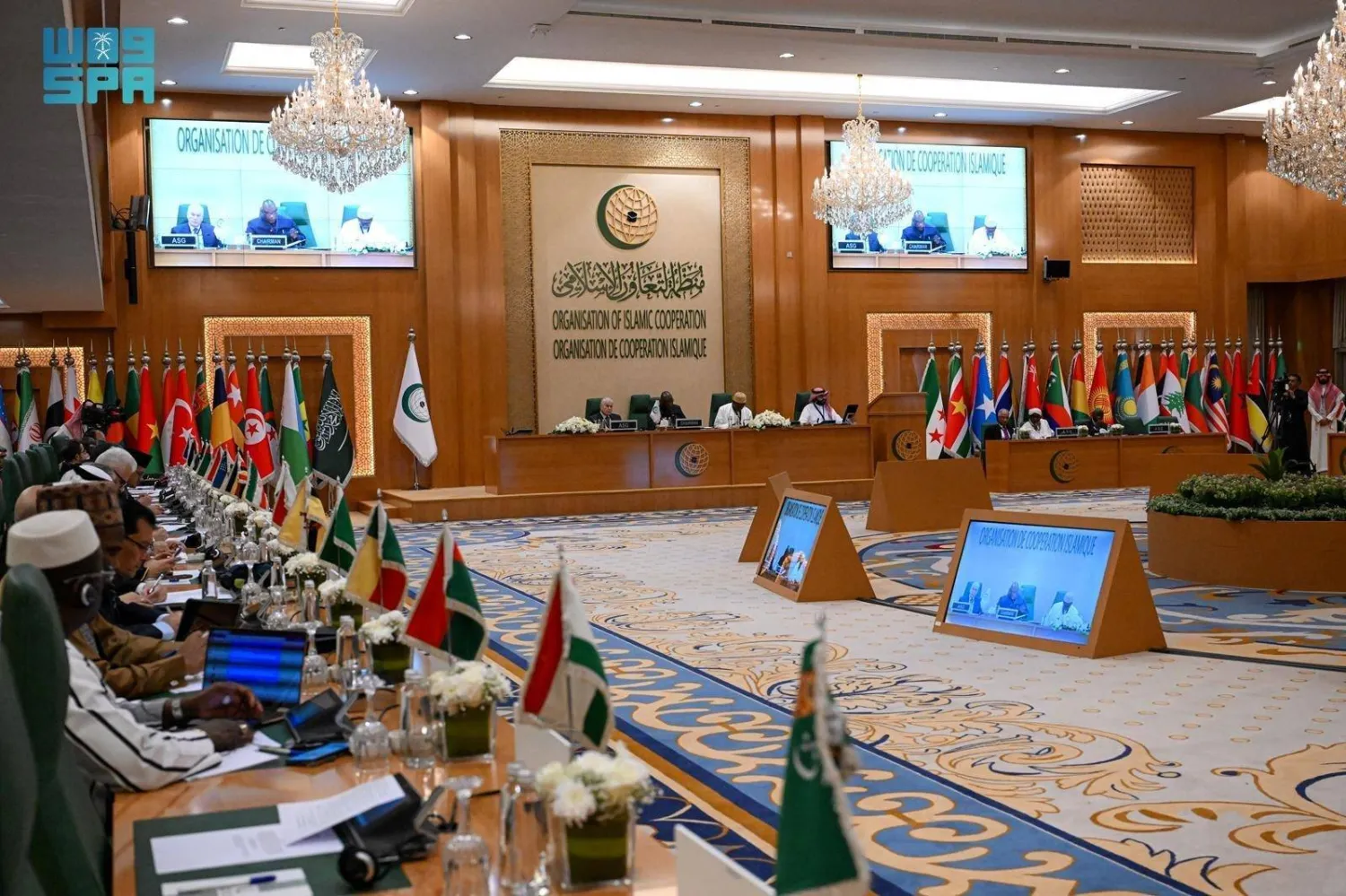
The OIC General Secretariat holds an extraordinary meeting in Jeddah on Thursday to discuss the latest developments in the Palestinian Territories. (SPA)
TT

OIC Calls on Int’l Community to Compel Israel to Abide by Peace Plan 

The OIC General Secretariat holds an extraordinary meeting in Jeddah on Thursday to discuss the latest developments in the Palestinian Territories. (SPA)

The Organization of Islamic Cooperation underscored on Thursday the centrality of the Palestinian cause and Jerusalem to the Muslim world, slamming Israel’s recent illegal measures in the West Bank.

The OIC General Secretariat held an extraordinary meeting in Jeddah to discuss the latest developments in the Palestinian Territories.

A closing statement underlined “the need to compel Israel to implement a comprehensive and sustainable ceasefire in the Gaza Strip and abide by the implementation of the US President Donald Trump’s peace plan.”

It called on it to move on to the second phase of the plan, ensuring the full withdrawal of Israeli forces from Gaza, facilitate the return of displaced people to their homes, and “for the State of Palestine to assume its full responsibility, with Arab, Islamic, and international support, to commit to the full and normal opening of all crossings with the enclave.”

It urged Trump to “fulfill his pledges to Arab and Islamic states to prevent Israeli settlement activity, the annexation of the occupied West Bank, and forced displacement.”

It expressed “its absolute rejection and strong condemnation of the recent hostile decisions and measures taken by the illegal Israeli occupation authority, including the announcement by the so-called Israeli ‘Cabinet’ of illegal decisions aimed at imposing a colonial settlement reality in the occupied Palestinian territory, particularly in the West Bank, including Jerusalem.”

It deemed these decisions null and void, rejecting any form of annexation, and warning that this “dangerous escalation is a blatant new attack on the historical and legal rights of the Palestinian people, and a flagrant violation of the Charter of the United Nations, the principles of international law, and relevant UN resolutions.”

It called on the international community, “particularly the UN General Assembly and Security Council, to assume its responsibilities, including rejecting and condemning illegal Israeli practices and decisions, and confronting them by compelling Israel to cease all its illegal measures, which are null and void and have no legal effect under international law and relevant UN resolutions.”

It urged the international community “to take all deterrent and punitive measures and exert pressure to confront the Israeli occupation and its colonial practices, which undermine the rules of international law and destabilize the foundations of the law-based international order.

They must take all measures to that end, “particularly by severing all relations with Israel, including diplomatic, economic, trade, cultural, and parliamentary relations which perpetuate the occupation and its colonial system.”

It urged them “to leverage their international relations to impose economic and political sanctions to end the occupation.”



Tehran's Ambassador in Riyadh to Asharq Al-Awsat: Saudi Arabia, Iran Aligned on Averting War

Iran’s Ambassador to Saudi Arabia Alireza Enayati. (Asharq Al-Awsat)
TT

Tehran's Ambassador in Riyadh to Asharq Al-Awsat: Saudi Arabia, Iran Aligned on Averting War

Iran’s Ambassador to Saudi Arabia Alireza Enayati. (Asharq Al-Awsat)

Iran’s Ambassador to Saudi Arabia Alireza Enayati revealed that Tehran has consulted Gulf Cooperation Council states, foremost among them Saudi Arabia, on its nuclear talks with the US, voicing appreciation for Riyadh’s support for dialogue and for agreements reached in earlier rounds.

He told Asharq Al-Awsat that Iranian President Masoud Pezeshkian discussed the latest regional developments with Prince Mohammed bin Salman, Crown Prince and Prime Minister, with both sides stressing “the need to achieve security and peace in the region and avoid war.”

He said Iran’s foreign minister also held several phone calls with his Saudi counterpart to brief him on developments in the nuclear file.

The third round of nuclear talks between Iran and the US wrapped up in Geneva on Thursday after “notable progress,” Oman’s Foreign Minister Badr Al-Busaidi, who is mediating the negotiations, said.

US President Donald Trump’s envoys, Steve Witkoff and Jared Kushner, held direct and indirect talks in two phases with Iranian Foreign Minister Abbas Araghchi.

The meetings began on Thursday morning and lasted about three hours before breaking for consultations. They resumed later in the evening and ended after roughly 90 minutes.

Enayati welcomed Oman’s “active and influential” role, saying it reflects “a shared regional vision to address issues with wisdom and diplomacy through fair dialogue.”

‘Serious’ negotiations

Tehran entered Thursday’s talks “with full seriousness, based on a fundamental principle that prioritizes dialogue,” Enayati remarked, reiterating Iran’s preference for a diplomatic solution to the nuclear issue.

He outlined what he described as key pillars of the file: “Iran’s right to enrich uranium to a certain level, its commitment not to seek nuclear weapons, and the lifting of sanctions.”

The Geneva discussions lasted about seven hours, he said, with Al-Busaidi and International Atomic Energy Agency (IAEA) chief Rafael Grossi conveying the positions of both sides. Negotiators engaged in what he described as serious talks on the substance of a potential agreement, covering both nuclear matters and sanctions.

Citing remarks by Iran’s foreign minister after the session, Enayati said “an understanding was reached on some issues.”

Technical teams are due to begin detailed reviews on Monday at the IAEA’s headquarters in Vienna, with support from agency experts. The meetings will focus on setting a framework and methodology to address technical questions.

Consultations with Gulf states

Enayati said regional countries are working jointly to safeguard security and prevent war, adding that Tehran has held consultations with Gulf states, including Saudi Arabia, on the nuclear talks.

Pezeshkian discussed regional developments with Crown Prince Mohammed, and both leaders underlined the need to secure peace and stability and avoid conflict, he told Asharq Al-Awsat.

Iran has expressed appreciation for Saudi Arabia’s backing of the dialogue track and for agreements reached in previous rounds, he added.

A senior Iranian official told Reuters that the two sides could reach a framework for a nuclear deal if Washington separates nuclear and non-nuclear issues, adding that remaining differences should be narrowed during the third round in Geneva.

Trump is pressing for a complete halt to Iranian uranium enrichment and for the inclusion of Tehran’s ballistic missile program and its support for regional armed groups in the talks.

Iran insists the negotiations remain limited to nuclear issues and maintains its program is solely for peaceful purposes.

Fears of military escalation

If diplomacy fails, uncertainty surrounds the timing of any potential US strike. If military action is intended to force concessions at the negotiating table, it is unclear whether limited strikes would achieve that goal.

If the objective were to remove Iran’s leadership, the US would likely face a broader and longer campaign. There are no public indications of planning for what might follow, including the risk of instability inside Iran.


Saudi Arabia Launches Gaza Central Kitchen to Provide 24,000 Meals Daily During Ramadan 

People are seen at the inauguration of the central kitchen in Gaza. (SPA)
TT

Saudi Arabia Launches Gaza Central Kitchen to Provide 24,000 Meals Daily During Ramadan 

People are seen at the inauguration of the central kitchen in Gaza. (SPA)

The King Salman Humanitarian Aid and Relief Center (KSrelief) inaugurated on Thursday a central kitchen in the Gaza Strip.

Launched in cooperation with the Saudi Center for Culture and Heritage as part of the Saudi fundraising campaign, the facility will provide 24,000 hot meals daily during the holy fasting month of Ramadan.

Targeting displaced families in the Deir Al-Balah and Al-Qarara areas, the project aims to distribute 3.6 million meals.

KSrelief Supervisor-General Dr. Abdullah Al Rabeeah stressed that the project is a continuation of the Kingdom's extensive air, sea, and land bridges.

He underscored Saudi Arabia's commitment to easing humanitarian crisis and supporting the most vulnerable groups, including women and children.

Beyond immediate relief, the kitchen employs 40 local workers and adheres to the highest international health standards.


Saudi Arabia Provides Yemen with $347 Million to Pay Govt Employee Salaries 

Saudi Defense Minister Prince Khalid bin Salman meets with Chairman of Yemen's Presidential Leadership Council Dr. Rashad al-Alimi and other members of the council. (X)
TT

Saudi Arabia Provides Yemen with $347 Million to Pay Govt Employee Salaries 

Saudi Defense Minister Prince Khalid bin Salman meets with Chairman of Yemen's Presidential Leadership Council Dr. Rashad al-Alimi and other members of the council. (X)

Saudi Defense Minister Prince Khalid bin Salman announced on Thursday that the Kingdom was providing new financial support to Yemen, worth 347 million dollars, to cover government employee salaries and budget relief.

The move reflects Riyadh’s ongoing support to the Yemeni economy given the mounting financial challenges.

In a post on the X platform, Prince Khalid said the latest gesture sought to meet the Yemeni government’s urgent need to secure the payment of its employees.

The initiative aims to ease economic pressure and achieve as much financial stability as possible given the complex economic difficulties the country is enduring, he added.

The new aid will cover salaries and operational costs, limit budget imbalances and support economic and social recovery in the medium-term.

Chairman of the Presidential Leadership Council Dr. Rashad al-Alimi expressed his gratitude to Saudi Arabia for its latest support, saying it embodies the depth of the strategic partnership that binds their countries.

“It reflects the Kingdom’s commitment to support Yemen during a critical time that demands strengthening of state institutions and of economic performance,” he added in a post on X.

“The support is a strong message of trust in the government’s reform efforts and the national institutions’ ability to reclaim their role,” he stressed.

“The relationship with Saudi Arabia has become a long-term strategic choice that will build a more sustainable economy, bolster security and stability and back reconstruction and development efforts,” he went on to say.

Al-Alimi underlined the importance of unifying national efforts around this partnership, saying it was a main foundation for restoring state institutions and improving public services.