


Iran Continues Attacks on Gulf States on Sixth Day of War

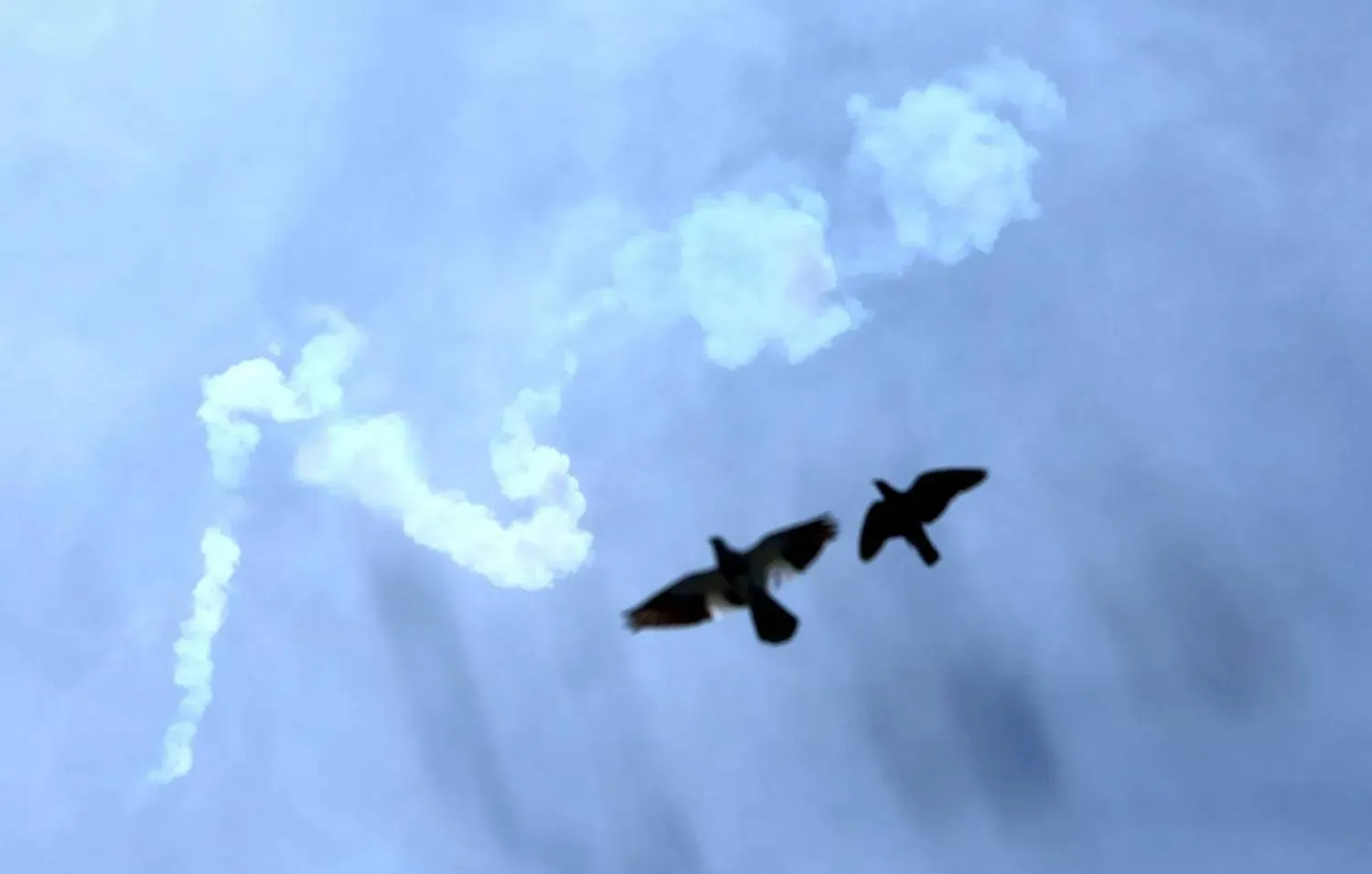
Smoke from intercepted missiles appears in the sky over Doha (EPA). 
TT

Iran Continues Attacks on Gulf States on Sixth Day of War

Smoke from intercepted missiles appears in the sky over Doha (EPA). 

On the sixth day of the war between the United States and Israel on one side and Iran on the other, Tehran continued launching attacks against Gulf countries, while air defenses in Saudi Arabia, Kuwait, Bahrain and the United Arab Emirates intercepted missiles and drones.

Saudi Arabia

Saudi Arabia’s Ministry of Defense announced that its air defenses intercepted and destroyed three cruise missiles outside the city of Al-Kharj in central Saudi Arabia. The defenses also shot down three drones east of Al-Kharj governorate.

The ministry’s official spokesman added that another drone was intercepted and destroyed east of the Al-Jawf region in northern Saudi Arabia near the border with Jordan.

Qatar

Qatar’s Ministry of Defense said Thursday that the country had come under a missile attack, confirming that its air defenses were responding to the incoming missiles.

In a statement carried by the Qatar News Agency, the ministry urged citizens, residents and visitors to remain calm and follow instructions issued by the security authorities.

Qatar’s Ministry of Interior also announced that, as a precautionary measure to ensure public safety, authorities had temporarily evacuated residents living in the vicinity of the US embassy. Alternative accommodation was provided, the ministry said in a statement on its official account on platform X.

Since the outbreak of the US–Israeli war against Iran on Saturday, Iranian forces have repeatedly launched missiles and drones at several Gulf states, including Qatar.

Complaint to the United Nations

Qatar sent identical letters to United Nations Secretary-General Antonio Guterres and to Michael Waltz, the United States’ permanent representative to the UN and president of the Security Council for March, detailing the latest Iranian attack on Qatari territory.

According to the Qatari Ministry of Foreign Affairs, the country’s permanent representative to the UN, Sheikha Alya Ahmed bin Saif Al Thani, said in the letter that the attack constituted a “flagrant violation” of Qatar’s sovereignty and a direct threat to its security and territorial integrity, warning that it represents an unacceptable escalation threatening regional stability.

The letter reviewed details of the ongoing attacks, citing Defense Ministry figures showing that Qatar had so far detected three cruise missiles, 101 ballistic missiles, 39 drones and two Su-24 fighter jets.

Qatar said its armed forces successfully intercepted three cruise missiles, 98 ballistic missiles, 24 drones and the two fighter aircraft. It stressed that the armed forces possess the capabilities necessary to protect the country’s sovereignty and confront any external threat.

The country concluded by strongly condemning the attacks and affirming its full right to respond in accordance with Article 51 of the UN Charter in defense of its national interests. It also requested that the letter be circulated as an official Security Council document.

Kuwait

Kuwait on Thursday denied reports of an incident near Mubarak Al-Kabeer Port after Iran claimed that the Iranian Revolutionary Guard Corps had attacked a US oil tanker sailing in the Gulf.

Kuwait’s Ministry of Interior said the incident occurred outside the country’s territorial waters and at least 60 kilometers away from the port.

Earlier, the United Kingdom Maritime Trade Operations (UKMTO) agency reported receiving a notification of an incident about 55 nautical miles southeast of Mubarak Al-Kabeer Port.

The captain of an oil tanker anchored in the area reported hearing and seeing a large explosion on the vessel’s port side before a small boat was seen leaving the scene.

An oil spill was observed, potentially causing environmental damage, while water also entered the tanker. UKMTO confirmed that all crew members were safe.

Iran’s Tasnim news agency reported that a fire had broken out aboard the tanker in the northern Gulf.

The Iranian Revolutionary Guard Corps also renewed its threat to seize control of the Strait of Hormuz, warning that vessels from the United States, Israel, European countries and their allies would not be allowed to pass and could be targeted.

The Strait of Hormuz plays a pivotal role in global energy trade, with about one-fifth of the world’s oil shipments passing through the waterway near Iran’s coast.

Missile attacks on vessels have repeatedly been reported in the Gulf, the Strait of Hormuz and the Gulf of Oman. Iranian missile and drone threats have nearly halted commercial shipping in the region since the latest hostilities began.

The US president said the US Navy would escort ships through the Strait of Hormuz if necessary.

United Arab Emirates

On the sixth day of the conflict, the UAE’s air defenses detected seven ballistic missiles, intercepting six while one fell inside the country. Authorities also detected 131 drones, intercepting 125 of them, while six landed on Emirati territory.

The attacks resulted in three deaths — from Pakistan, Nepal and Bangladesh — and 94 minor injuries among people of multiple nationalities, including Emirati, Egyptian, Ethiopian, Filipino, Pakistani, Iranian, Indian and others.

Reuters reported late Thursday that repeated explosions were heard in Abu Dhabi near Zayed International Airport. The UAE’s National Emergency Crisis and Disaster Management Authority urged residents to move to safe locations and take shelter until the danger passed.

Since the beginning of the Iranian attacks, the UAE says it has detected 196 ballistic missiles, intercepting 181. Thirteen fell into the sea and two struck inside the country. Authorities also detected 1,072 Iranian drones, intercepting 1,001 while 71 landed within UAE territory. Eight cruise missiles were also intercepted.

The UAE Ministry of Defense said its forces remain fully prepared to counter any threat and safeguard the country’s sovereignty, security and stability.

Bahrain

Bahrain’s Ministry of Interior said Thursday evening that a facility in the Maameer area had been targeted, adding that authorities responded immediately to the incident.

Earlier, Bahrain’s Defense Force said it had destroyed 75 missiles and 123 drones targeting the kingdom since the start of what it described as Iranian attacks.

The military urged residents to remain indoors except in cases of necessity, avoid filming military operations or debris sites and rely only on official sources for information.

Japan Evacuates Citizens

Japan’s Foreign Ministry announced Thursday that it will evacuate Japanese nationals from four Middle Eastern countries using chartered flights as the US–Israeli war against Iran continues.

According to the Kyodo news agency, Tokyo raised its travel advisory level for Kuwait, Bahrain, Qatar and the United Arab Emirates — as well as Saudi Arabia and Oman — to Level 3, urging citizens to avoid all travel.

Japanese nationals wishing to leave will be transported overland to Saudi Arabia and Oman before boarding chartered flights to Tokyo.



Saudi FM Discusses Regional Developments with Palestinian Counterpart

Saudi Minister of Foreign Affairs Prince Faisal bin Farhan bin Abdullah. (AFP)
TT

Saudi FM Discusses Regional Developments with Palestinian Counterpart

Saudi Minister of Foreign Affairs Prince Faisal bin Farhan bin Abdullah. (AFP)

Saudi Minister of Foreign Affairs Prince Faisal bin Farhan bin Abdullah held separate telephone talks on Saturday with Palestinian Prime Minister and FM Dr. Mohammad Mustafa and Brunei’s FM Dato Erywan Pehin Yusof.

They discussed the latest developments in the region and efforts being exerted in this regard.


UAE, Qatar, Bahrain Repel Iran Rocket Attacks

 Boats are docked at Dubai Creek Harbor as the Dubai skyline, including the Burj Khalifa, is seen in the background amid the U.S.-Israel conflict with Iran, in Dubai, United Arab Emirates, March 6, 2026. (Reuters)
Boats are docked at Dubai Creek Harbor as the Dubai skyline, including the Burj Khalifa, is seen in the background amid the U.S.-Israel conflict with Iran, in Dubai, United Arab Emirates, March 6, 2026. (Reuters)
TT

UAE, Qatar, Bahrain Repel Iran Rocket Attacks

 Boats are docked at Dubai Creek Harbor as the Dubai skyline, including the Burj Khalifa, is seen in the background amid the U.S.-Israel conflict with Iran, in Dubai, United Arab Emirates, March 6, 2026. (Reuters)
Boats are docked at Dubai Creek Harbor as the Dubai skyline, including the Burj Khalifa, is seen in the background amid the U.S.-Israel conflict with Iran, in Dubai, United Arab Emirates, March 6, 2026. (Reuters)

Dubai airport, the world's busiest for international traffic, suspended operations Saturday before partially resuming services, after an air defense interception in the area during attacks from Iran.

"We have partially resumed operations from today, 7 March, with some flights operating out of DXB and DWC," it said, referring to Dubai's main airport as well as the city's Dubai World Central - Al Maktoum International.

"Please do not travel to the airport unless you have been contacted by your airline that your flight is confirmed, as schedules continue to change," it told passengers.

Earlier, the government had said operations had been suspended after the aerial interception of an object near the airport, with a witness telling AFP of a loud explosion followed by a cloud of smoke.

"For the safety of passengers, airport staff, and airline crew, operations at Dubai International (DXB) have been temporarily suspended," the government's Dubai Media Office said in a social media post.

The government said in a separate post that there had been "a minor incident resulting from the fall of debris after an interception", which caused no injuries.

"The air defenses of the United Arab Emirates are currently responding to missile and drone threats coming from Iran," the Emirati Ministry of Defense had said.

The Flightradar24 tracking website earlier showed planes circling above the airport in an apparent holding pattern.

Flights from Dubai's main airport had partially resumed on Monday despite daily drone attacks targeting sites in the United Arab Emirates.

Last Saturday, four employees were injured and a terminal was damaged as war broke out in the Middle East following US-Israeli strikes on Iran.

Iranian attacks have also hit Abu Dhabi airport, the upmarket Palm Jumeirah development and the Burj Al Arab luxury hotel, while drone debris caused a fire at the US consulate in Dubai on Tuesday.

Meanwhile, Qatar’s Defense Ministry said it repelled a rocket attack against the state.

Bahrain’s Defense Force said it had intercepted and destroyed 86 rockets and 148 drones since the attacks from Iran started.


Bahrain, US, and UK Hold Emergency Consultations on Regional Security

The consultations brought together Sheikh Nasser bin Hamad, Brad Cooper, and Richard Knighton (BNA). 
TT

Bahrain, US, and UK Hold Emergency Consultations on Regional Security

The consultations brought together Sheikh Nasser bin Hamad, Brad Cooper, and Richard Knighton (BNA). 

Bahrain, the United States, and the United Kingdom held emergency consultations under Article Two of the Comprehensive Security Integration and Prosperity Agreement (C-SIPA) to review the region’s current security situation, with a focus on Iranian actions aimed at destabilizing regional security and stability.

According to a statement from Bahrain’s National Communication Center, Manama activated Article Two of the agreement, triggering exceptional consultations on Thursday within the framework of the pact’s Defense Working Group.

The move came in response to Iranian missile and drone attacks that Bahraini authorities said deliberately targeted civilian and residential areas in the kingdom.

The Bahrain News Agency reported late Friday that Lt. Gen. Sheikh Nasser bin Hamad Al Khalifa, Bahrain’s national security adviser and secretary-general of the Supreme Defense Council, held the consultations with US Central Command (CENTCOM) Commander, Admiral Brad Cooper and the United Kingdom’s Air Chief Marshal Richard Knighton, chief of the defense staff.

Participants discussed the urgent need for a coordinated allied response to what they described as a direct threat to Bahrain’s sovereignty and territorial integrity. They emphasized the strength of the partnership among the member states and reaffirmed their commitment to collectively addressing threats to regional security and stability.

The meeting also underscored the strategic partnership established under the agreement, which includes commitments to strengthen security cooperation and collective deterrence against external threats. Officials reaffirmed their determination to work jointly to counter any external aggression targeting the sovereignty or territorial integrity of member states.

Separately, Cooper condemned the Iranian attacks in a post on the official CENTCOM account on the social media platform X, describing them as unacceptable.

He added that the United States would continue working with regional partners to counter threats endangering civilians in the region.

In a phone call Thursday with Bahrain’s King Hamad bin Isa Al Khalifa, British Prime Minister Keir Starmer said the United Kingdom would deploy four additional Typhoon fighter jets to the region, to be stationed in Qatar, to provide defensive air cover for Bahrain and help strengthen the protection of its airspace.

Bahrain reiterated its commitment to regional stability, the protection of its citizens, and the defense of its sovereignty. It also urged the international community to recognize the seriousness of what it described as Iran’s deliberate targeting of civilian areas and the importance of a unified allied response, which it said reflects the strength of its security partnerships.