

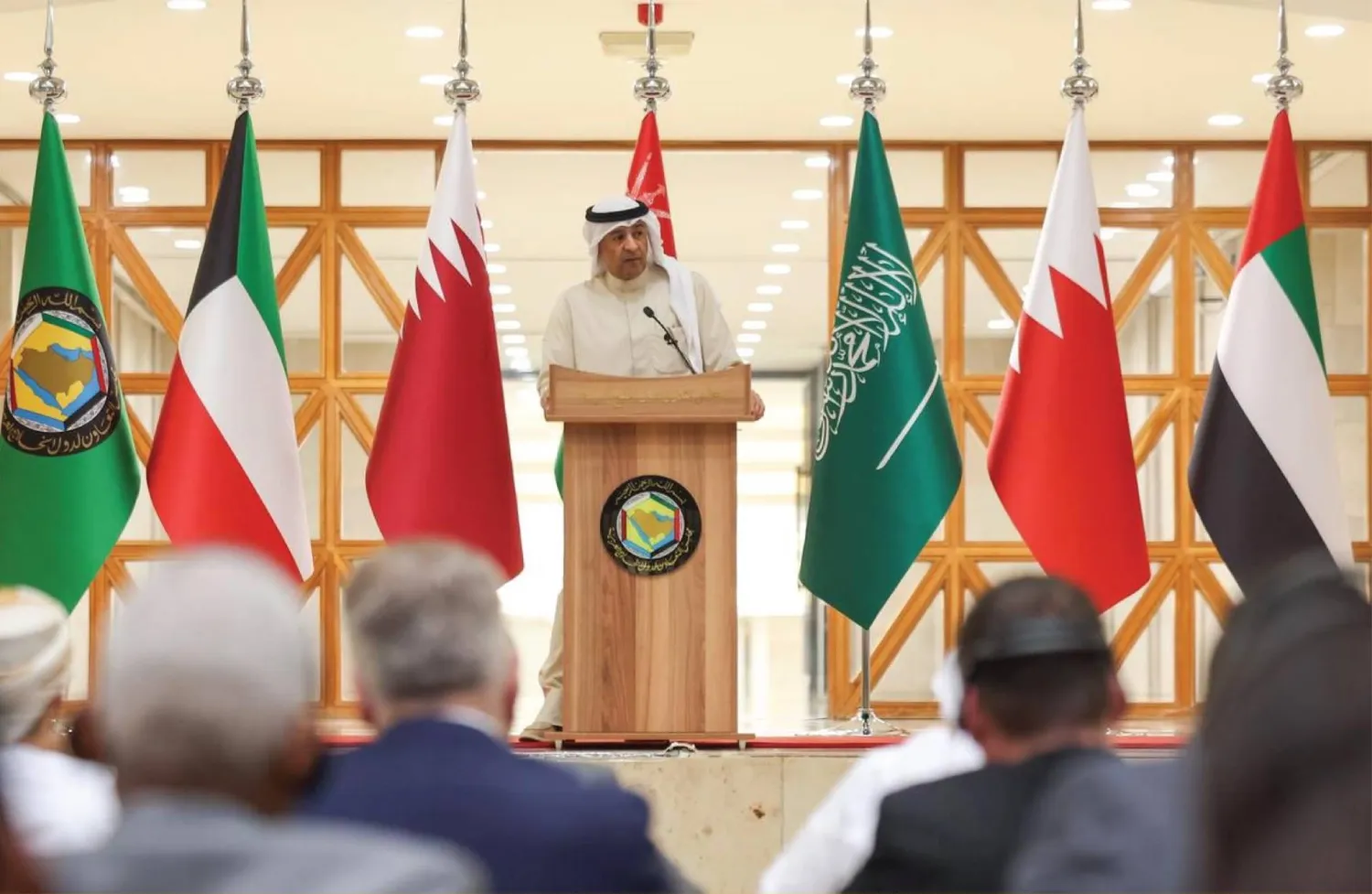

Albudaiwi: Regional Arrangements Excluding Gulf States Are Rejected

Albudaiwi affirmed that Gulf states had long been a pillar of regional and global stability (GCC)
TT

Albudaiwi: Regional Arrangements Excluding Gulf States Are Rejected

Albudaiwi affirmed that Gulf states had long been a pillar of regional and global stability (GCC)

Secretary-General of the Gulf Cooperation Council (GCC) Jasem Albudaiwi on Thursday called for Gulf states to be included in talks or agreements to resolve the crisis between Iran and the US and Israel.

“We stress the importance of involving GCC countries in any talks or agreements to resolve this crisis, in a way that contributes to strengthening their security and stability,” said Albudaiwi.

He added that the bloc rejected “any arrangements intended to redraw the map of the Middle East after the conflict ends.”

He said the GCC’s first choice was a diplomatic and political solution, describing it as “the wisest and most successful option,” while noting that Gulf states were reviewing all options in line with international law and the UN Charter.

Speaking in Riyadh to Arab and foreign ambassadors, Albudaiwi urged partners to send a unified international message to Iran demanding an immediate and unconditional halt to attacks on GCC states.

He said the Gulf’s goal “has never been to destroy Iran or weaken it, but to reach a normal relationship based on mutual respect, non-interference and non-aggression.”

He rejected framing the situation as part of “Middle East complexities,” calling it “a blatant violation of international law” and “a systematic targeting” of states not involved in any conflict.
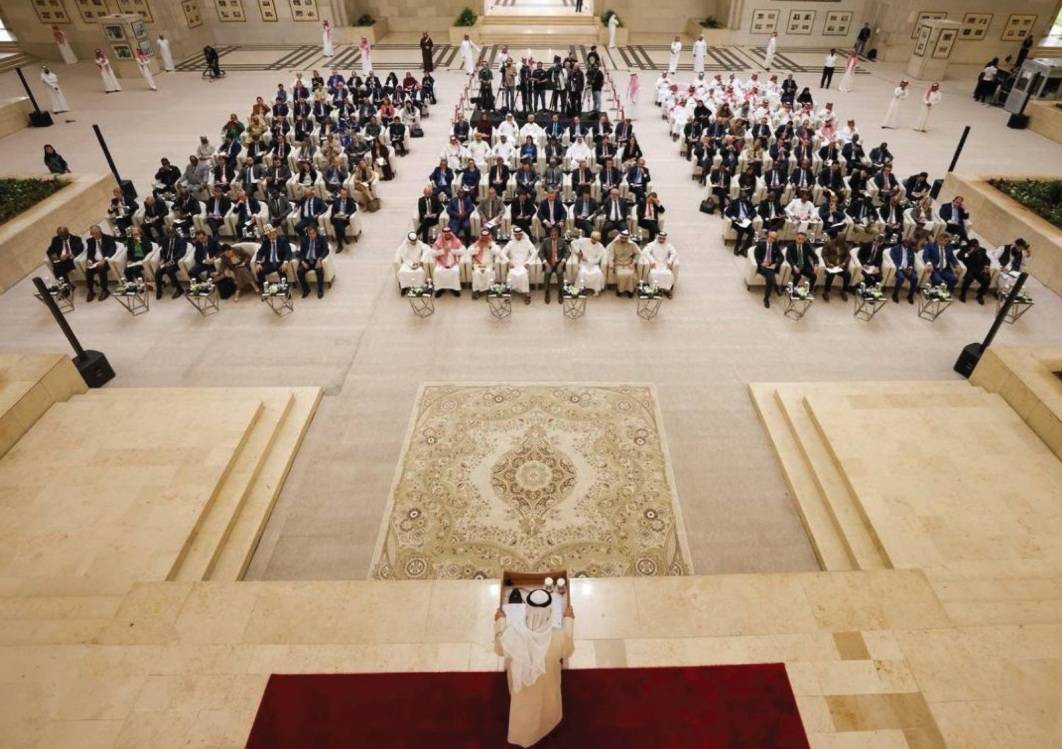
Albudaiwi said Gulf states would not accept becoming targets of aggression (GCC)

Albudaiwi said GCC states had long been a pillar of regional and global stability, a reliable energy source, and a responsible economic partner. But he said they would not accept becoming targets of aggression, arenas for regional rivalries, or seeing their citizens killed without accountability.

He said Iranian attacks over 25 days had exceeded 5,000 ballistic missiles and drones targeting GCC states.

Albudaiwi revealed that 85% of Iranian missiles launched in the war were aimed at Gulf states.

He praised Gulf air defenses for limiting the impact of the attacks, but said that this does not diminish the scale of the aggression or absolve Iran of full responsibility.

He said Iran had “crossed every line” by closing the Strait of Hormuz, blocking commercial ships and oil tankers, and imposing transit fees, in violation of international law.

He also cited repeated ship hijackings and attacks carried out through Iran’s regional proxies.

He warned that disruption to shipping would hit not only Gulf states but the global economy, especially as some countries face oil and gas shortages.

Albudaiwi explained that maritime passages are governed by international agreements, and no party can obstruct them or impose conditions.

The impact of closing the Strait of Hormuz may begin with higher energy prices, but its cumulative repercussions on the global economy, energy markets, marine insurance, and civil aviation would be catastrophic.

“What happens in the Strait of Hormuz does not stay in the Strait of Hormuz,” he added.

Albudaiwi said Gulf states were surprised by US and Israeli strikes on Iran, stressing they had made clear they would not take part in military action or allow their territory to be used against Iran, and had informed Tehran of that.

“Yet this position did not prevent it from attacking GCC states,” he said.

He said GCC states had shown restraint and chosen not to respond to avoid widening the conflict, and in the hope that Iran would come to its senses and stop these attacks.

He said Gulf states produce about 16 million barrels per day of crude oil, or 22% of global output, and account for 27% of global oil exports, or 11.5 million barrels per day.

They also hold 33% of global oil reserves and 21% of natural gas reserves.

These figures make the Gulf an indispensable pillar of the global economy, Albudaiwi affirmed, warning that any disruption would directly affect energy security and global economic stability.



Saudi FM Discusses Regional Developments with Kuwaiti, Omani Counterparts

Saudi Foreign Minister Prince Faisal bin Farhan bin Abdullah. (AFP)
TT

Saudi FM Discusses Regional Developments with Kuwaiti, Omani Counterparts

Saudi Foreign Minister Prince Faisal bin Farhan bin Abdullah. (AFP)

Saudi Foreign Minister Prince Faisal bin Farhan bin Abdullah held telephone talks on Monday with his Kuwaiti counterpart Sheikh Jarrah Jaber Al-Ahmad Al-Sabah and Omani counterpart Badr Albusaidi on the latest developments in the region.

They tackled joint efforts to maintain security and stability in the region.


UAE Dismantles Terrorist Organization

 The photos and names of the detainees released by the State Security Department (SSD). (WAM)
The photos and names of the detainees released by the State Security Department (SSD). (WAM)
TT

UAE Dismantles Terrorist Organization

 The photos and names of the detainees released by the State Security Department (SSD). (WAM)
The photos and names of the detainees released by the State Security Department (SSD). (WAM)

The UAE State Security Department (SSD) announced on Monday the dismantling of a terrorist organization and the arrest of its members, reported the country’s state news agency WAM.

They were detained for involvement in covert activities aimed at undermining national unity and destabilizing the country through plans to carry out systematic terrorist and sabotage operations on UAE soil.

Investigations revealed links between the organization and Iran’s “Wilayat al-Faqih” ideology.

Investigations also showed that members adopted extremist terrorist ideologies threatening internal security, carrying out recruitment and mobilization through secret meetings under a coordinated plan with external entities to access sensitive locations, said WAM.

According to surveillance and follow-up investigations, the organization held clandestine meetings inside and outside the country with terrorist elements and suspicious organizations, aiming to spread misleading ideas among Emirati youth and recruit them in support of foreign allegiances, incite against the UAE’s foreign policy and internal measures, and portray the country negatively.

They also collected funds through unofficial means and transferred them to suspicious external entities.

The charges brought against the members of the group include establishing a secret organization, managing its activities within the country, pledging allegiance and loyalty to external parties, and undermining national unity and social peace.

The State Security Department reaffirmed its firm commitment to confronting any threats to public security, calling on citizens and residents to report suspicious activities through official channels to further strengthen security and stability.


Mohammed bin Salman, Burhan Discuss Developments in Sudan

Prince Mohammed bin Salman bin Abdulaziz Al Saud, Saudi Crown Prince and Prime Minister, and Chairman of Sudan’s Transitional Sovereignty Council Lieutenant General Abdel Fattah Al-Burhan meet in Jeddah on Monday. (SPA)
TT

Mohammed bin Salman, Burhan Discuss Developments in Sudan

Prince Mohammed bin Salman bin Abdulaziz Al Saud, Saudi Crown Prince and Prime Minister, and Chairman of Sudan’s Transitional Sovereignty Council Lieutenant General Abdel Fattah Al-Burhan meet in Jeddah on Monday. (SPA)

Prince Mohammed bin Salman bin Abdulaziz Al Saud, Saudi Crown Prince and Prime Minister, held talks in Jeddah on Monday with Chairman of Sudan’s Transitional Sovereignty Council Lieutenant General Abdel Fattah Al-Burhan and his accompanying delegation.

They discussed the latest developments in Sudan and efforts made towards them.

They stressed the importance of ensuring Sudan’s security and stability and preserving its sovereignty, unity, and territorial integrity.

The meeting was attended by Deputy Governor of the Makkah Region Prince Saud bin Mishal bin Abdulaziz, Saudi Minister of Defense Prince Khalid bin Salman bin Abdulaziz, Minister of Foreign Affairs Prince Faisal bin Farhan bin Abdulla, Advisor to the Minister of Foreign Affairs for Political Affairs Prince Musab bin Mohammed bin Fahd bin Farhan, Minister of State, Member of the Cabinet, and National Security Advisor Dr. Musaed Al-Aiban, President of the General Intelligence Presidency Khalid bin Ali Al-Humaidan, Saudi Ambassador to Sudan Ali Hassan Jaafar, Sudanese Minister of Foreign Affairs and International Cooperation Ambassador Mohieldin Ibrahim, and several other Sudanese officials.