

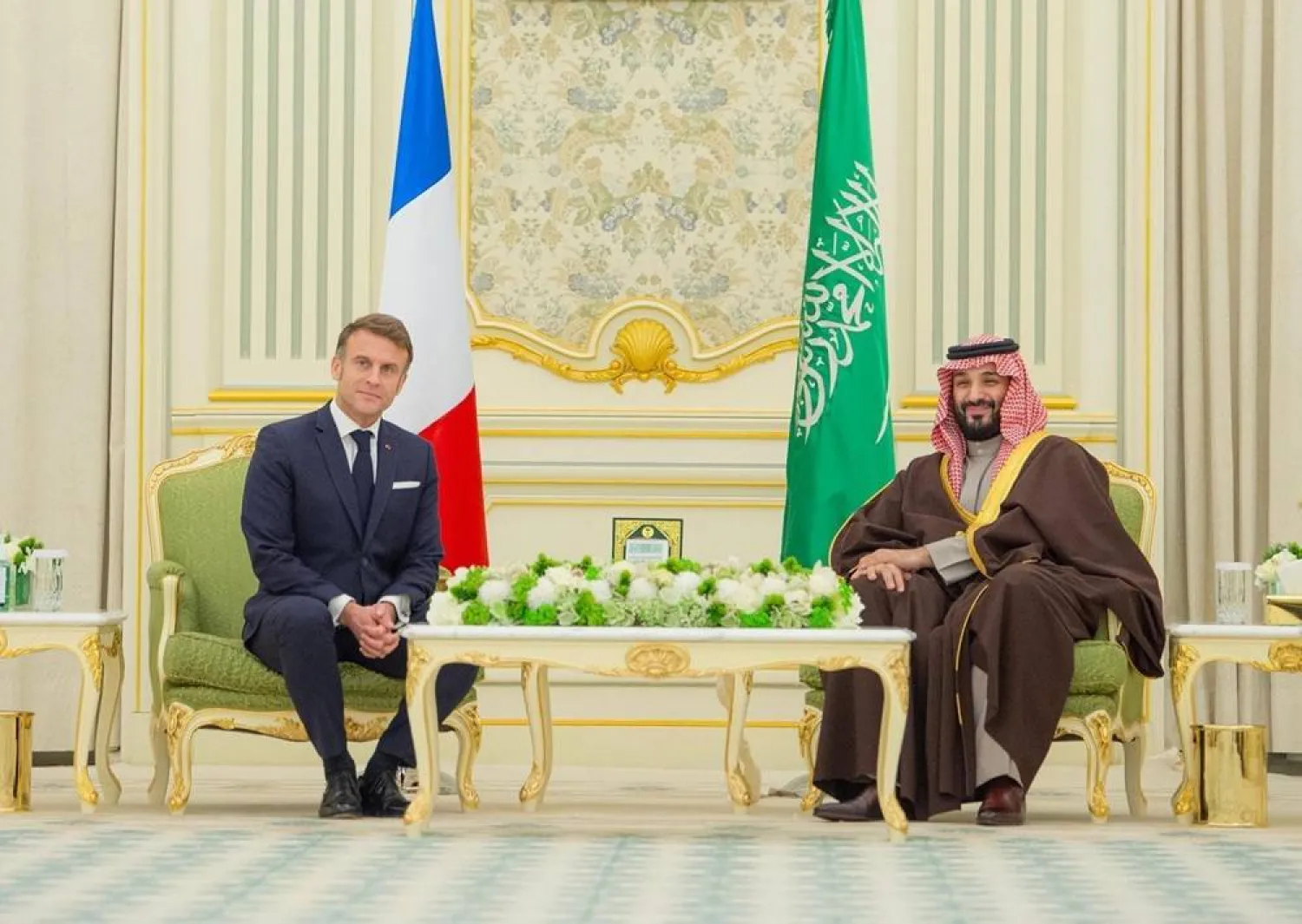

Saudi Crown Prince, France’s Macron Discuss Need to Restore Free Navigation in Hormuz

Prince Mohammed bin Salman, Saudi Crown Prince and Prime Minister, and French President Emmanuel Macron meet in Riyadh in December 2024. (SPA)
TT

Saudi Crown Prince, France’s Macron Discuss Need to Restore Free Navigation in Hormuz

Prince Mohammed bin Salman, Saudi Crown Prince and Prime Minister, and French President Emmanuel Macron meet in Riyadh in December 2024. (SPA)

Prince Mohammed bin Salman, Saudi Crown Prince and Prime Minister, held telephone talks on Saturday with French President Emmanuel Macron on the talks to end the war on Iran. 

In a post on the X platform, Macron said they tackled the situation in the Middle East. He renewed his support for the ceasefire, “which should be respected in full and be expanded to include Lebanon without delay.” 

“We also discussed the need to restore free and safe navigation in the Strait of Hormuz as soon as possible,” Macron added. 

“With the negotiations kicking off in Islamabad, we agreed to remain in close contact to help in de-escalation and freedom of navigation and to reach an agreement that ensures permanent peace and security in the region,” stressed Macron. 

Macron also spoke with Turkish President Recep Tayyip Erdogan, urging ″respect for the ceasefire and its application to Lebanon.” 

The French leader did not mention the negotiations in Pakistan, but said he and Erdogan ″underlined the need for a robust and lasting diplomatic solution.” 

Macron has been speaking regularly with other world leaders about the war and helping lead efforts for a mission to secure shipping in the Strait of Hormuz once the fighting calms.  

He has been particularly active in pushing for peace in Lebanon, a former French protectorate with close ties to France. 

Macron said on Saturday that he had spoken with Iran's President Masoud Pezeshkian, and had highlighted ‌to ‌him the ‌importance ⁠of de-escalating the current ⁠situation through the ceasefire talks in Pakistan. 

"I stressed the need for ⁠Iran to restore ‌freedom ‌of navigation and ‌security in the ‌Strait of Hormuz as quickly as possible, to which ‌France stands ready to contribute. ⁠I ⁠insisted on the importance of fully respecting the ceasefire, including in Lebanon," he said in a post on X. 

“France gives its full support to the Lebanese authorities, who are the only ones who can decide on Lebanon’s destiny.” 


Jeddah Port Welcomes First Group of Sudanese Pilgrims

The directorate reaffirmed its readiness to manage pilgrim influxes at all ports -SPA
TT

Jeddah Port Welcomes First Group of Sudanese Pilgrims

The directorate reaffirmed its readiness to manage pilgrim influxes at all ports -SPA

The General Directorate of Passports at Jeddah Islamic Port welcomed the first group of Sudanese pilgrims arriving for the 1447 AH Hajj season, completing their entry procedures with speed and efficiency, SPA reported.

The directorate reaffirmed its readiness to manage pilgrim influxes at all ports by deploying state-of-the-art technology and multilingual, highly qualified personnel to ensure a smooth transit process.

Also on Friday, the General Directorate of Passports at Prince Mohammad bin Abdulaziz International Airport in Madinah welcomed the inaugural flight of Moroccan pilgrims arriving for the 1447 AH Hajj season.

The directorate reaffirmed its full readiness to manage the influx of pilgrims across all air, land, and sea ports by deploying state-of-the-art technology and multilingual, highly qualified personnel to ensure a smooth transit process.


King of Bahrain: Iran Must Cease Meddling in Our Internal Affairs

Bahrain’s King Hamad bin Isa Al Khalifa. (BNA file)
TT

King of Bahrain: Iran Must Cease Meddling in Our Internal Affairs

Bahrain’s King Hamad bin Isa Al Khalifa. (BNA file)

Bahrain’s King Hamad bin Isa Al Khalifa called on Thursday Iran to cease interfering in the internal affairs of his country and Arab Gulf nations, stressing that the “nation comes above all and that Bahrain is a trust borne by all its citizens.”

In remarks to the media, he said the recent Iranian attacks against Bahrain’s “security, stability, and the safety of its people exposed those who betrayed the nation and aligned themselves with the enemy.”

“In times when nations face mounting challenges and when people are test, true positions are revealed,” he added, noting: “While the Bahrain Defense Force remained highly vigilant in defense of the kingdom, a small group of individuals chose to collaborate with the enemy and cooperated with those who violated national sovereignty.”

“This was a grave act of treason and an unforgivable crime,” he declared in remarks carried by Bahrain’s state news agency BNA.

King Hamad stressed that Iran must cease meddling in the internal affairs of Bahrain and Gulf Cooperation Council countries, expressing his “deep anger” over the recent developments and adding that the people of Bahrain share this sentiment.

He questioned “how one could not feel anger when those entrusted with the nation’s interests have betrayed it, and when those elected to represent the people stood with traitors who were rejected by public.”

“Public opinion stands united in rejecting such actions and called for the expulsion of those who cooperated” with Iran’s aggression, he went on to say.

“Those who betray the nation do not deserve the honor of belonging to it or the privilege of living on its land. Citizenship is not merely granted, but a binding covenant, and those who break it forfeit their right to it,” announced King Hamad.

Moreover, he expressed regret over the positions of some lawmakers “who sided with traitors instead of upholding their responsibility to protect national interests.”

He underscored the importance of maintaining unity and integrity within the Council of Representatives, adding: “Those who chose to align themselves with those who attacked the nation should go to them, as there is no place among the people for those who side with the country’s enemies.”

“The peoples of the GCC fully support the rulings against those found guilty of betrayal, including imprisonment and the revocation and withdrawal of nationality, and have called for further measures,” he went on to say.

“These deterrent measures are not acts of retribution, but a safeguard for the majority of loyal citizens, and a necessary step to prevent circumstances that could require the armed forces to assume control under military provisions in defense of Bahrain,” said King Hamad.

“Those lawmakers face two options: either to issue a clear apology to the people of Bahrain that restores trust, or to join those they chose to align with, who have left the country or been expelled under final court rulings for acts of betrayal,” he warned.

He stressed that parliamentary membership “is a trust and representation is an honor not deserved by those whose actions are tainted by betrayal. There is no place for them among the people, nor any honor in representing them going forward.”

Furthermore, King Hamad said that stability will not be restored, nor will normal life resume, “until ranks are cleansed of every traitor and accomplice.”

He reiterated that “the nation stands above all and that Bahrain is a trust borne by all.”


UAE Announces Travel Ban on Nationals to Iran, Lebanon and Iraq

The flag of the UAE. (Asharq Al-Awsat)
TT

UAE Announces Travel Ban on Nationals to Iran, Lebanon and Iraq

The flag of the UAE. (Asharq Al-Awsat)

The United Arab Emirates foreign ministry on Thursday announced a travel ban on Emirati nationals going to Iran, Lebanon and Iraq, citing regional developments including the Middle East war.

Iran has targeted the Gulf nation throughout the Middle East conflict sparked by a US-Israeli attack before a fragile ceasefire was announced, including missiles fired at civilian and energy infrastructure.

"In light of current regional developments, the Ministry of Foreign Affairs (MoFA) announces a travel ban on UAE nationals travelling to the Islamic Republic of Iran, the Lebanese Republic, and the Republic of Iraq," state news agency WAM reported.

It said the ministry called on "all UAE nationals currently in these countries to expedite their immediate return" to the UAE.
