Emir of Qatar, Syrian President Hold Talks on Regional Developments

Emir of Qatar Sheikh Tamim bin Hamad Al Thani meets Syrian President Ahmed Al-Sharaa in Doha, Qatar, April 22, 2026. (Amiri Diwan/Handout via Reuters)
TT

Emir of Qatar, Syrian President Hold Talks on Regional Developments

Emir of Qatar Sheikh Tamim bin Hamad Al Thani meets Syrian President Ahmed Al-Sharaa in Doha, Qatar, April 22, 2026. (Amiri Diwan/Handout via Reuters)

Emir of Qatar Sheikh Tamim bin Hamad Al-Thani held talks in Doha on Wednesday with Syrian President Ahmed Al-Sharaa, focusing on regional and international developments.

Sheikh Tamim hoped the visit would strengthen cooperation and expand ties between their two countries across various sectors.

Sharaa stressed Syria's commitment to enhancing bilateral relations in a way that serves the shared interests of both nations and their peoples.

He also expressed solidarity with Qatar following Iranian attacks targeting the country and other states in the region, voicing support for measures taken by Doha to safeguard its sovereignty, security and citizens.

The leaders underscored their commitment to supporting regional security and stability, while discussing bilateral relations and ways to further develop them.

The meeting was attended by Qatari Prime Minister and Minister of Foreign Affairs Sheikh Mohammed bin Abdulrahman bin Jassim Al-Thani, Chief of the Amiri Diwan Abdullah bin Mohammed Al Khulaifi, and Minister of State at the Ministry of Foreign Affairs Dr Mohammed bin Abdulaziz Al Khulaifi, as well as a number of senior officials.

Also in attendance were Syrian Minister of Foreign Affairs and Expatriates Asaad Al-Shaibani, along with a number of senior officials.

Sheikh Tamim and Al-Sharaa held a separate bilateral meeting to exchange views on key issues of mutual interest, followed by an official luncheon hosted in honor of the visiting delegation.

Al-Sharaa is on a tour of the Gulf that he kicked off in Saudi Arabia on Tuesday where he met with Prince Mohammed bin Salman, Crown Prince and Prime Minister.


Saudi Arabia, Bahrain Discuss Efforts to Bolster Regional Security, Stability

Prince Mohammed bin Salman, Crown Prince and Prime Minister, and Bahrain’s King Hamad bin Isa Al Khalifa meet in Riyadh on Tuesday. (SPA)
TT

Saudi Arabia, Bahrain Discuss Efforts to Bolster Regional Security, Stability

Prince Mohammed bin Salman, Crown Prince and Prime Minister, and Bahrain’s King Hamad bin Isa Al Khalifa meet in Riyadh on Tuesday. (SPA)

Prince Mohammed bin Salman, Crown Prince and Prime Minister, held talks in Riyadh on Tuesday with Bahrain’s King Hamad bin Isa Al Khalifa. 

The talks focused on the latest regional developments and efforts exerted towards them to bolster stability and security. 

King Hamad had arrived in the Saudi capital earlier on Tuesday. He was welcomed at King Khalid International Airport by the Crown Prince. 

The talks between the two leaders also tackled the historic ties between their countries and aspects of cooperation and means to bolster and develop them. 

Crown Prince Mohammed underscored the Kingdom’s keenness on deepening the close fraternal relations with Bahrain in all fields. 

For his part, King Hamad hailed the efforts by Custodian of the Two Holy Mosques King Salman bin Abdulaziz and Crown Prince Mohammed to strengthen ties between their countries. 

He also praised the honorable historic Saudi stances taken towards Bahrain and its people on all occasions. 

He expressed his appreciation for the Saudi leadership’s efforts in developing collective Gulf work and its pioneering role in supporting the pillars of security, peace and stability in the region. 


What Does the Approval of an Advanced Command for the Unified Military Command in Kuwait Signify?

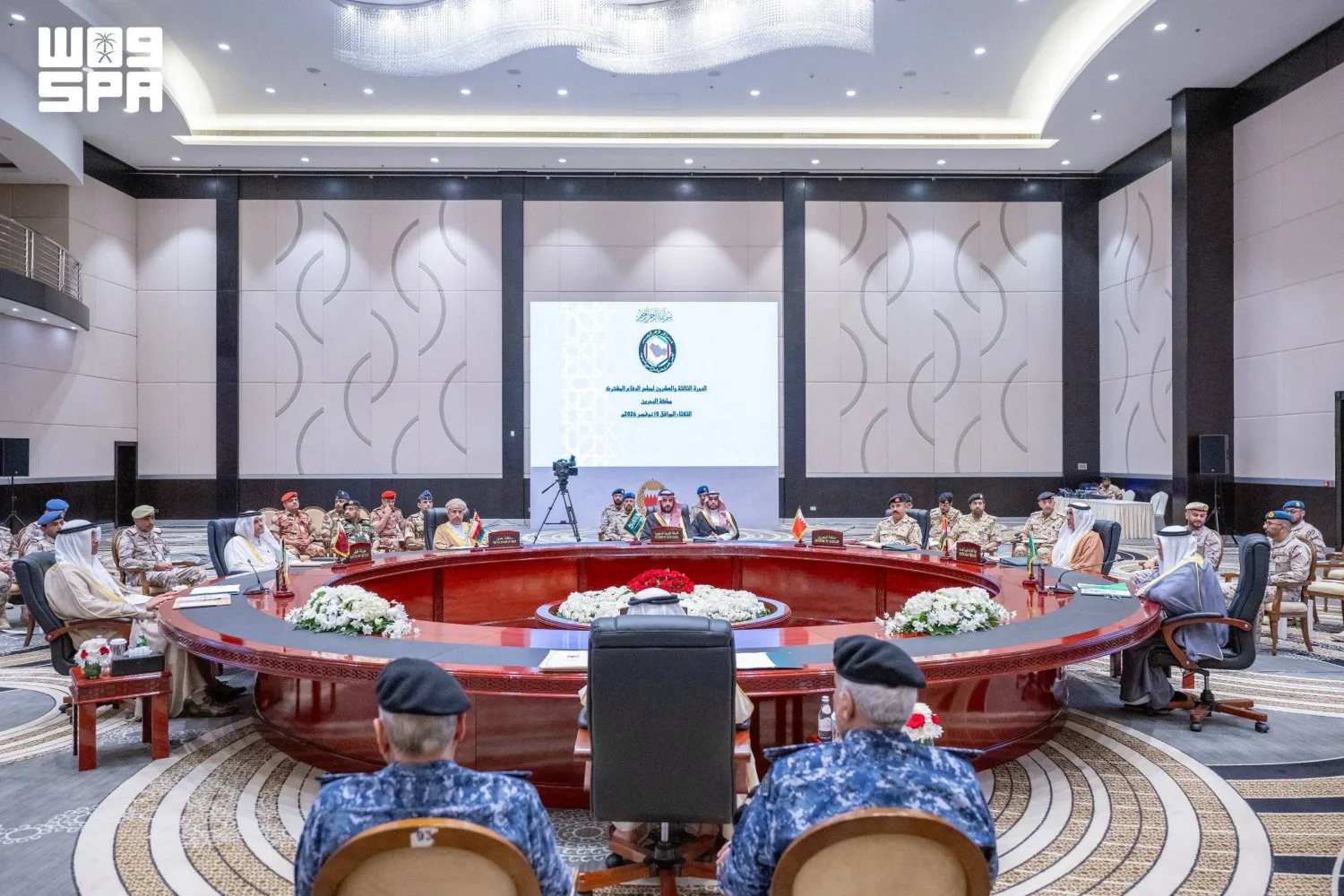
Saudi Defense Minister Prince Khalid bin Salman attends the 23rd meeting of the GCC's Joint Defense Council in Manama, Bahrain, November 10, 2026. (SPA)
TT

What Does the Approval of an Advanced Command for the Unified Military Command in Kuwait Signify?

Saudi Defense Minister Prince Khalid bin Salman attends the 23rd meeting of the GCC's Joint Defense Council in Manama, Bahrain, November 10, 2026. (SPA)

GCC defense ministers on Tuesday approved the launch of an advanced command for the Unified Military Command in Kuwait and allocated appropriate forces to it.

The ministers met at the 23rd session of the GCC Joint Defense Council in Manama, chaired by Bahrain's Minister of Defense Affairs and current session president, Lieutenant General Abdullah bin Hassan Al-Nuaimi.

Analysts and observers speaking to Asharq Al-Awsat viewed the step as a significant move toward strengthening joint Gulf security.

Political researcher Dr. Ayed Al-Manna said the announcement was a step that is both necessary and urgent to guarantee collective Gulf security through the presence of forces tasked with protecting GCC states, independent of any internal disputes or differences.

Al-Manna told Asharq Al-Awsat that unprovoked Iranian attacks against GCC states underscored the critical need for constant, comprehensive readiness to deter external aggression.

The Gulf faces multiple threats, led primarily by the Iranian axis and its regional proxies, including militias in Iraq, the Houthis in Yemen, and Hezbollah in Lebanon.

However, Al-Manna added that the security challenges extend beyond this, pointing to threats stemming from Israel and concerns surrounding the "Greater Israel" project.

He noted that the lack of stability in several regional countries and “ambitions” of targeting the Gulf, makes it imperative to boost military readiness and activate the unified Gulf force.

This step should have been taken a long time ago to bolster the security of all GCC states, he remarked.

He underscored the importance of equipping Gulf forces with the necessary military components and capabilities to enable them to deter and respond to any external aggression, meeting the collective security requirements of the council's member states.

Former Saudi officer Abdullatif Al Mulhem told Asharq Al-Awsat that establishing the Unified Military Command is a vital step in advancing joint Gulf military cooperation.

It is essential given the region's current security developments, which demand heightened coordination and readiness among the armed forces of the Gulf countries, he said.

Al Mulhem explained that the military significance of the decision lies in the GCC states strengthening the organizational structure of joint military action through an advanced command. This step is expected to boost coordination among Gulf forces and bolster their capacity to handle shared challenges and threats.

Saudi Arabia is expected to host the upcoming meeting of the Joint Defense Council as announced by Defense Minister Prince Khalid bin Salman at the Manama meeting.


Saudi FM Attends Saudi-Qatari-E4 Meeting on Sidelines of G7 Ministerial Meeting in Paris

The foreign ministers of Saudi Arabia, Qatar, France, Germany, Italy, and the United Kingdom at the Paris meeting on Tuesday. (SPA)
TT

Saudi FM Attends Saudi-Qatari-E4 Meeting on Sidelines of G7 Ministerial Meeting in Paris

The foreign ministers of Saudi Arabia, Qatar, France, Germany, Italy, and the United Kingdom at the Paris meeting on Tuesday. (SPA)

Saudi Minister of Foreign Affairs Prince Faisal bin Farhan bin Abdullah took part on Tuesday in a ministerial meeting between Saudi Arabia, Qatar, and the E4 countries, France, Germany, Italy, and the United Kingdom, on the sidelines of the Group of Seven (G7) ministerial meeting in Paris.

The meeting addressed recent developments in the Middle East, including the terrorist Houthi militia’s continued attacks on civilians and civilian objects in Yemen and Saudi Arabia and their implications for regional security.

Participants also discussed diplomatic efforts to support mediation between the United States and Iran to de-escalate tensions and contain ongoing regional crises.

The ministers underscored the importance of strengthening international coordination to secure regional waterways, keep trade flowing, and maintain global supply chains.

Also in Paris, Prince Faisal met with his Ukrainian counterpart Andrii Sybiha for talks on bilateral relations and ways to strengthen and develop them across various fields.

They discussed joint efforts to achieve peace and exchanged views on key regional and international issues of mutual interest.

The ministers signed a memorandum of understanding between the Kingdom and Ukraine on the mutual exemption from short-stay visa requirements for holders of diplomatic, special, and service passports.