

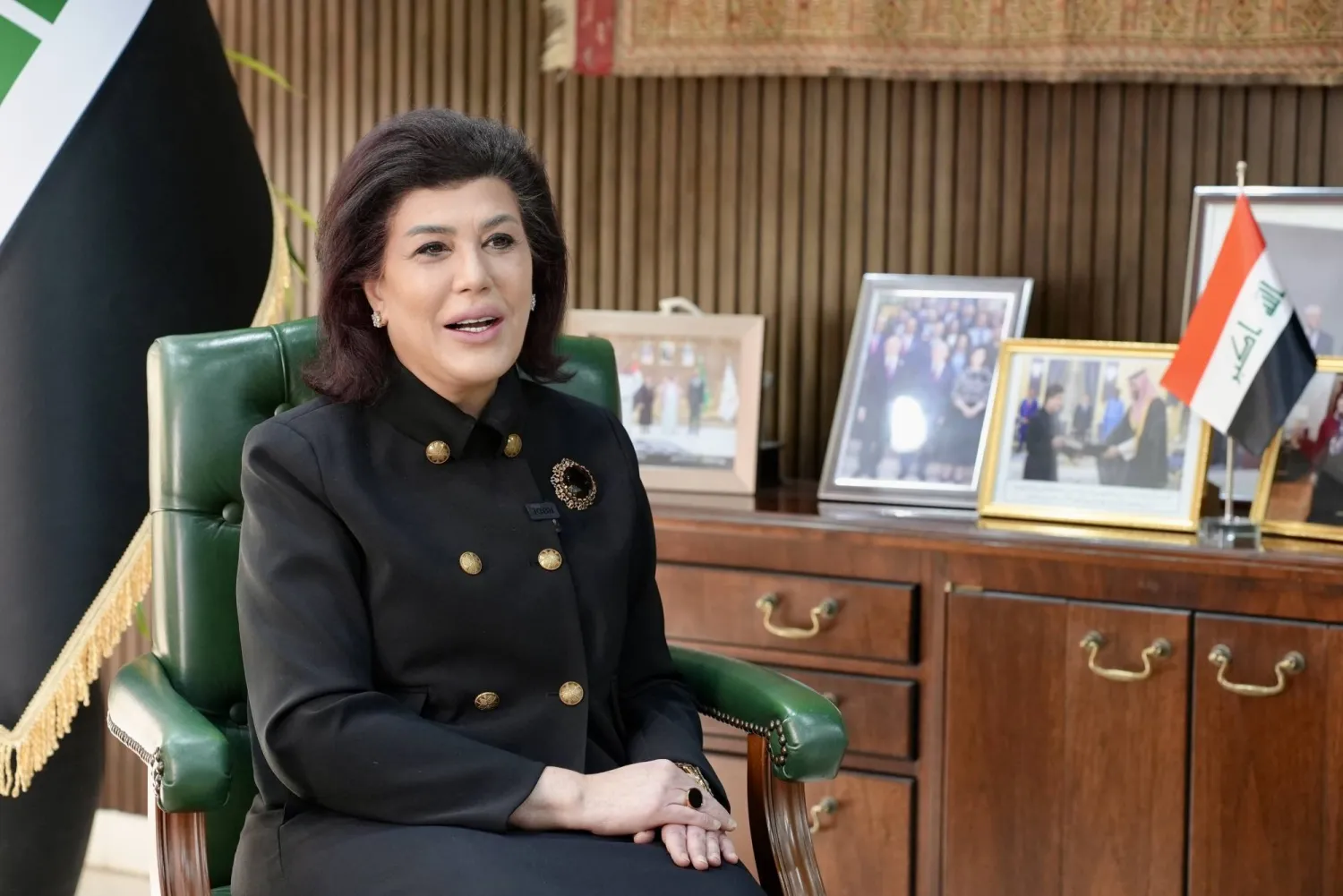

Iraqi Ambassador in Riyadh: Land Transport of Pilgrims Dictated by Regional Conditions

Iraqi Ambassador in Riyadh Safia Taleb Al-Suhail (photograph: Turki Al-Oqaili)
TT

Iraqi Ambassador in Riyadh: Land Transport of Pilgrims Dictated by Regional Conditions

Iraqi Ambassador in Riyadh Safia Taleb Al-Suhail (photograph: Turki Al-Oqaili)

Iraq’s ambassador to Saudi Arabia Safia Taleb Al-Suhail said the number of Iraqi pilgrims this year has reached around 41,000, with their convoys beginning to arrive in Saudi Arabia at a rate of about 1,500 pilgrims per day through the Jadidat Arar border crossing in the north of the Kingdom, within an integrated system of services.

Al-Suhail confirmed, in statements to Asharq Al-Awsat, that coordination between Baghdad and Riyadh is taking place at the highest levels, through the ministries of Hajj and Umrah and interior in both countries, to discuss security arrangements and ensure the transport of pilgrims until they perform their rituals with ease and reassurance.

The ambassador explained that Iraq’s adoption of exclusively land transport this year came out of concern for pilgrims’ safety in light of current regional conditions, and to avoid any emergency that could hinder their completion of the pilgrimage, praising the Jadidat Arar crossing and the facilities and advanced infrastructure it provides.

41,000 pilgrims

Safia Al-Suhail said Iraq’s quota for this season amounts to 41,000 pilgrims, according to available information, in addition to 200 doctors, as announced by the official authorities in the Iraqi Hajj and Umrah Commission.

She noted that this quota includes pilgrims from all Iraqi provinces and the Kurdistan Region, along with accompanying administrative, medical, guidance, and media staff.

Adoption of land transport

The ambassador said Baghdad adopted this season the option of transporting pilgrims exclusively by land through the Jadidat Arar crossing in northern Saudi Arabia, a decision taken out of concern for pilgrims’ safety and in line with the current realities in the region.

She added: “The first convoys of Iraqi pilgrims departed on the evening of Sunday, April 26, and their first groups were received under the supervision of Prince Faisal bin Khalid, Governor of the Northern Borders Region, who gives this matter continuous attention that we highly appreciate, as he, along with officials in Arar, ensured that the reception of Iraqi pilgrims was at the highest level of hospitality, facilitation, and services.”

Jadidat Arar crossing

Al-Suhail praised the Jadidat Arar crossing, noting that it “features advanced infrastructure that we personally reviewed along with embassy staff, including a Hajj hall exceeding 9,000 square meters, with a capacity of up to 20,000 pilgrims per day, 68 passport counters, six inspection points, in addition to an integrated medical and security system operating around the clock.”

She noted that “transport is proceeding at a rate of about 1,500 pilgrims per day, via convoys of modern, air-conditioned buses, and rest stations along the route inside Saudi territory, within a fully equipped tent city prepared by Saudi Arabia’s Ministry of Hajj and Umrah according to the highest standards, providing accommodation, meals, healthcare, and places for prayer.”

Coordination with the Saudi side

Al-Suhail stressed that relations between Iraq and Saudi Arabia are long-standing and well established, bringing together ties of religion, neighborliness, kinship, and shared interests, with the leaders of both countries keen to maintain and develop them across various fields, noting that the Hajj file holds a special place in this relationship as a matter with religious and humanitarian dimensions that rises above any other consideration.

She pointed out that Iraq was the first among more than 150 countries to sign the Hajj arrangements agreement for the 1447 AH season with Saudi Arabia’s Ministry of Hajj and Umrah, a step reflecting the depth of coordination and the keenness of both brotherly countries to remove obstacles for pilgrims, according to the ambassador.

She added: “Coordination this season has taken place at the highest levels between Iraq’s Supreme Hajj and Umrah Commission and Saudi Arabia’s Ministry of Hajj and Umrah, and in parallel between the interior ministries of both countries, as the Iraqi interior minister held extensive meetings to discuss security preparations and ensure the transport of pilgrims, attended by the head of the Supreme Hajj and Umrah Commission, the head of the Border Ports Authority, operations commanders, and provincial police leaders, in cooperation with their counterparts on the Saudi side.”

According to the ambassador, “coordination included securing the land routes inside Iraq up to the Arar crossing, after which the Saudi side assumes responsibility from the crossing to the holy sites, within an integrated framework that reflects what can be described as ‘fraternal security coordination between the two neighboring countries.’”

Preparing a tent city to accommodate pilgrims

Regarding facilities, she commended the efforts made by the Kingdom under the leadership of the Custodian of the Two Holy Mosques King Salman bin Abdulaziz and the Crown Prince in serving pilgrims, noting that services include streamlined customs and passport procedures, round-the-clock health and emergency services, full logistical support, transport and guidance services, in addition to a tent city designated to accommodate pilgrims, affirming that Saudi personnel working at the crossing are playing a notable role.

She affirmed that the Iraqi diplomatic mission, in coordination with the consulate general in Jeddah and the Iraqi Hajj mission, is following up on pilgrims’ affairs and providing the necessary consular and administrative services.

Al-Suhail recalled, in her remarks on the land route, the “Zubaydah Trail,” one of the oldest Hajj routes in Islamic history, associated with Zubaydah bint Jaafar, wife of Caliph Harun al-Rashid, who devoted her wealth to developing it and providing water for pilgrims between Kufa and Makkah.

In conclusion, the ambassador affirmed that Iraq, with its government, people, and religious authorities, places the Hajj journey above all considerations and works in a spirit of partnership with Saudi Arabia to ensure that this season is smooth, safe, and successful, God willing.



Saudi Crown Prince, Canada’s PM Discuss Ties and Regional Developments

Saudi Crown Prince Mohammed bin Salman bin Abdulaziz Al Saud. SPA
TT

Saudi Crown Prince, Canada’s PM Discuss Ties and Regional Developments

Saudi Crown Prince Mohammed bin Salman bin Abdulaziz Al Saud. SPA

Prince Mohammed bin Salman bin Abdulaziz Al Saud, Saudi Crown Prince and Prime Minister, received a phone call on Wednesday from Canadian PM Mark Carney.

During the call, the two sides discussed relations between the Kingdom and Canada, as well as areas of existing cooperation between the two countries.

They also reviewed ways to enhance and develop cooperation across various fields.

They further discussed the latest regional developments and their security and economic repercussions in the region and the world.


Swiss President Backs Saudi Arabia, Urges US-Iran Talks

Crown Prince Mohammed bin Salman and Swiss President Guy Parmelin during a bilateral meeting in Jeddah on April 23. SPA
TT

Swiss President Backs Saudi Arabia, Urges US-Iran Talks

Crown Prince Mohammed bin Salman and Swiss President Guy Parmelin during a bilateral meeting in Jeddah on April 23. SPA

Swiss President Guy Parmelin reaffirmed his country’s support for Saudi Arabia in what he described as difficult circumstances, and stressed the need to press ahead with efforts to reach a diplomatic solution between Washington and Tehran through negotiations, to safeguard regional peace and stability.

Speaking to Asharq Al-Awsat, Parmelin said the region’s security situation topped the agenda.

He expressed Switzerland’s solidarity with Saudi Arabia, praised Crown Prince Mohammed bin Salman’s wisdom and restraint, and conveyed Swiss support.

He said both sides agreed on the need to back all efforts to secure a negotiated diplomatic solution in the interest of regional stability.

Parmelin said his visit to Jeddah on April 22 and 23 marked the 70th anniversary of diplomatic ties and aimed to boost political and economic relations.

He was accompanied by State Secretary for Economic Affairs Helene Budliger Artieda and a senior business delegation representing key Swiss industries.

Deepening strategic cooperation

Parmelin said talks with Crown Prince Mohammed bin Salman, who also serves as Saudi Prime Minister, focused on strengthening economic ties amid global uncertainty.

He said both sides explored opportunities to deepen cooperation in strategic sectors, including logistics, commodities, financial services, and insurance, where both countries have strong expertise.

He said an economic roundtable, co-chaired with Saudi Investment Minister Fahad bin Abduljalil Al-Saif, was a key part of the visit.

The meeting brought together senior officials and business leaders and helped identify concrete areas for expanding cooperation and strengthening ties between Swiss and Saudi companies.

Parmelin said the signing of a new bilateral investment protection agreement with the Saudi investment minister was a main outcome of the visit.

He said the presence of Saudi Foreign Minister Prince Faisal bin Farhan at the ceremony underscored the agreement’s importance in boosting legal certainty for investors and strengthening the framework for bilateral economic engagement.

He added that the attendance of chief executives from major Swiss multinational companies highlighted the deal’s importance to the private sector in both countries.

Saudi-Swiss relations

Parmelin said relations between Switzerland and Saudi Arabia are close, longstanding, and span more than 70 years, describing them as strong and steadily evolving.

He said the partnership is built on mutual respect, regular dialogue, and growing economic ties, underpinned by a shared interest in stability, open markets, and rules-based international cooperation.

Economic cooperation lies at the core of the relationship, he said, noting that Switzerland is a key trading partner for Saudi Arabia, with around 200 Swiss companies operating in the Kingdom across sectors including pharmaceuticals, machinery, engineering, technology, commodities, logistics, financial services, and insurance.

Parmelin said Switzerland sees significant opportunities tied to Saudi Arabia’s Vision 2030 program, adding that Swiss expertise in hospitality, research, innovation, sustainable infrastructure, advanced manufacturing, education, and vocational training could support its goals.

At the institutional level, he said both countries are advancing their joint agenda through the annual Joint Economic Commission, bilateral financial dialogue, and political consultations, while maintaining constructive political exchanges and cooperation in multilateral forums.

Parmelin said Swiss-Saudi relations are broad and forward-looking, offering real opportunities to expand cooperation across existing and emerging sectors.


Saudi Arabia Affirms Peace Requires Ceasefire, Establishing Palestinian State on 1967 Borders

Saudi Arabia's Permanent Representative to the UN Ambassador Dr. Abdulaziz Al-Wasil. File Photo/Saudi Foreign Ministry
TT

Saudi Arabia Affirms Peace Requires Ceasefire, Establishing Palestinian State on 1967 Borders

Saudi Arabia's Permanent Representative to the UN Ambassador Dr. Abdulaziz Al-Wasil. File Photo/Saudi Foreign Ministry

The Kingdom of Saudi Arabia stressed the seriousness of the situation in the region, renewing its condemnation of Israeli attacks on Palestine and Lebanon.

This came in a speech by Permanent Representative of the Kingdom to the United Nations Dr. Abdulaziz Alwasil, in which he reiterated the Kingdom’s condemnation of Iranian attacks on civilian facilities and the resulting human and material damage, SPA reported.

The Kingdom affirmed its rejection of altering the historical and legal status quo of Jerusalem and its Islamic holy sites, and its condemnation of illegal settlement activities for violating international law and undermining the prospects for peace.

The Kingdom stressed that achieving peace requires a ceasefire, preventing displacement, withdrawal from Gaza, and the establishment of a Palestinian state on the 1967 borders.