

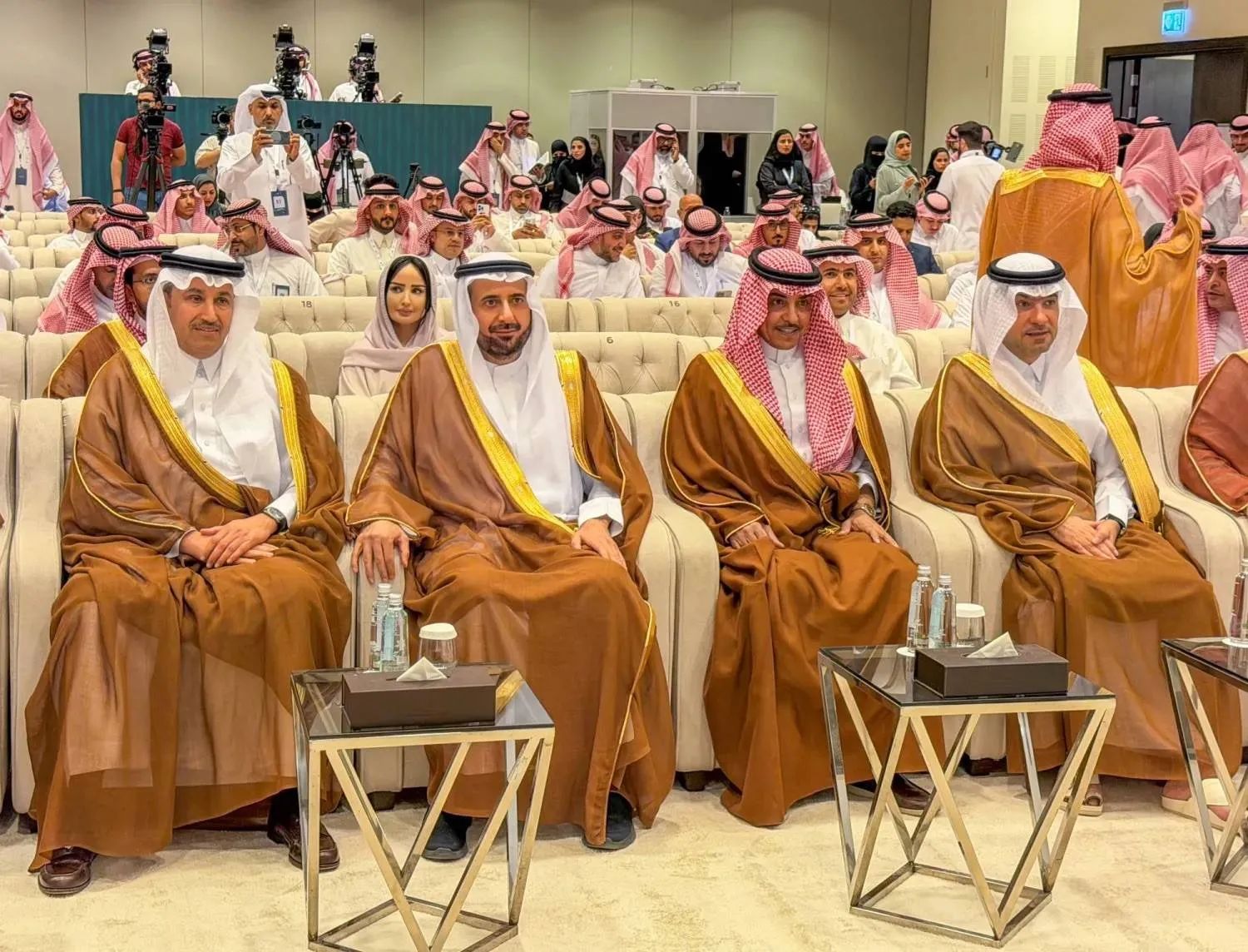

860,000 Pilgrims Arrive as Saudi Arabia Declares Full Readiness for Hajj

The ministers affirmed the Kingdom’s full readiness to serve pilgrims. (Photo by Saleh Al-Ghannam) 
TT

860,000 Pilgrims Arrive as Saudi Arabia Declares Full Readiness for Hajj

The ministers affirmed the Kingdom’s full readiness to serve pilgrims. (Photo by Saleh Al-Ghannam) 

Saudi Arabia said on Wednesday it was fully prepared to receive and serve pilgrims during this year’s Hajj season through an integrated system of security, health, transport and logistical services from arrival through departure.

Speaking at a government press conference on Wednesday, five Saudi ministers stressed the Kingdom’s readiness to ensure the safety of pilgrims, facilitate their movement and improve services at the holy sites in Makkah and Medina.

Saudi Information Minister Salman Al-Dossary said the Kingdom’s Hajj security system was operating through detailed plans based on crowd movement analysis and forecasting using artificial intelligence and modern technologies to improve response times and safety.

Al-Dossary stressed that the Interior Ministry continued to implement the “Makkah Route” initiative for an eighth year in 10 countries through 17 entry points. Since its launch, more than 1.2 million pilgrims have benefited from the program, he said. He added that fifth-generation mobile network coverage at the holy sites had reached 100%, supported by more than 4,200 technical personnel working on the ground.

More than 150 media organizations and over 3,000 local and international journalists are covering this year’s Hajj season, according to Al-Dossary.

Meanwhile, Hajj and Umrah Minister Tawfiq Al-Rabiah said more than 860,000 pilgrims had arrived so far through air, land and sea ports.

“The opportunity has been made available for more than 30 Saudi companies to provide services for foreign pilgrims and enable direct booking without intermediaries from more than 126 non-Muslim countries,” Al-Rabiah stated.

He added that accommodation capacity at Mina had been expanded through the construction of the Kedana Al-Khaif camps near the Jamarat complex over an area of 24,000 square meters.

Al-Rabiah revealed that the “Pilgrim Without a Bag” initiative had been expanded to all foreign pilgrims this year, allowing them to ship luggage directly from their home countries to their accommodation and have it returned after the pilgrimage. He said processing times had been cut from 120 minutes to 15 minutes.

He added that services for pilgrims were being coordinated among more than 60 government and operational entities through over 600 work plans. The Nusuk application now serves more than 51 million users worldwide and offers more than 130 digital services during this year’s Hajj season, he underlined.

For his part, Transport and Logistics Minister Saleh Al-Jasser noted that the aviation sector had mobilized its operational capacity across Saudi airports to ensure a smooth travel experience for pilgrims.

More than 3 million seats have been allocated through six airports linking the Kingdom to more than 300 airports worldwide via 104 airlines, he said, adding that airports were equipped to receive more than 1.5 million pilgrims arriving from abroad. Early transport packages introduced for pilgrims would help shield them from rising transportation costs, he remarked.

The minister further pointed that authorities had carried out extensive road maintenance and bridge repairs and expanded the use of road-cooling technology at the holy sites.

He explained that more than 3,000 buses have been allocated to transport pilgrims between accommodations and the Grand Mosque, while another 5,000 buses will provide shuttle services. More than 46,000 personnel have also been deployed to serve pilgrims during the Hajj season.

Municipalities and Housing Minister Majed Al-Hogail said services provided to pilgrims had evolved significantly in recent years through greater coordination among government agencies.

He told the press conference that municipal authorities across the Kingdom were working together to support pilgrims arriving through ports and regional roads, while advanced infrastructure networks covering 4.6 million square meters had been completed between the holy sites.

More than 88,000 sanitation workers are operating around the clock, while authorities are conducting 2,800 daily inspections covering food, water and public facilities, according to Al-Hogail.

Health Minister Fahad Al-Jalajel said Saudi Arabia had continued developing its Hajj system year after year until it became a global model for managing mass gatherings.

Responding to concerns over epidemics, including hantavirus, Al-Jalajel stated that there was “no concern over any epidemic” affecting pilgrims and that Saudi authorities were closely coordinating with international organizations.

He noted that more than 52,000 healthcare workers had been deployed for this year’s Hajj season, supported by over 20,000 hospital beds, including 3,800 beds at the holy sites — triple last year’s capacity.

Authorities have also allocated 3,000 ambulances, 11 medical evacuation aircraft and 7,700 paramedics, in addition to 25 healthcare centers supporting hospitals at the holy sites, he added.


Saudi Arabia Condemns Terrorist Attack in Dera Ismail Khan, Reaffirms Support for Pakistan

Victims of a blast are shifted to a hospital following a blast, in Dera Ismail Khan, Pakistan, 26 September 2026. EPA/SAOOD REHMAN
TT

Saudi Arabia Condemns Terrorist Attack in Dera Ismail Khan, Reaffirms Support for Pakistan

Victims of a blast are shifted to a hospital following a blast, in Dera Ismail Khan, Pakistan, 26 September 2026. EPA/SAOOD REHMAN

Saudi Arabia on Monday condemned a terrorist attack that targeted a security checkpoint in the Dera Ismail Khan district of northwestern Pakistan, killing and injuring several people.

In a statement, the Saudi Foreign Ministry said, "the Kingdom categorically rejects all forms of terrorist and extremist acts", reaffirming its support for Pakistan and its efforts to maintain its security and stability.

Saudi Arabia also extended its sincere condolences to the families of the victims, as well as to the Pakistani government and people.

On Saturday, a suicide bomber detonated an explosives-laden vehicle at a roadside police checkpoint in Dera Ismail Khan, a district in Khyber Pakhtunkhwa province, northwestern Pakistan, killing at least 11 people and wounding about 30 others, officials said.

Local police chief Safdar Baloch said most of those killed and wounded were security personnel and passersby.

Following the bombing, gunmen opened fire on an ambulance attending the scene of the attack as it was transporting casualties from the blast site, killing two rescue workers, according to Pakistan's state broadcaster.

Pakistani President Asif Ali Zardari and Prime Minister Shehbaz Sharif condemned the attack, offered condolences to the victims’ families.

Zardari described the targeting of civilians and law enforcement personnel as “highly condemnable” and called for intensified action against the Pakistani Taliban, which he accused of carrying out “heinous and brutal acts” with foreign support.


King Mohammed VI: Saudi Security is an Integral Part of Morocco’s Security

Moroccan King Mohammed VI (MAP)
TT

King Mohammed VI: Saudi Security is an Integral Part of Morocco’s Security

Moroccan King Mohammed VI (MAP)

Morocco’s King Mohammed VI, on his own behalf and on behalf of the Moroccan people, has condemned the repeated attacks carried out by the terrorist Houthi militias against Saudi Arabia.

The attacks targeted civilian and economic facilities, vital installations, cities, and residential areas.

The King affirmed on Sunday that what further deepens the condemnation is that the attacks have not been confined to targeting facilities and civilians. Rather, they have extended to desperate and criminal attempts to target the two holiest sites in Islam, revered by Muslims around the world: Makkah and Madinah.

In two cables addressed to Custodian of the Two Holy Mosques King Salman bin Abdulaziz Al Saud and Prince Mohammed bin Salman bin Abdulaziz Al Saud, Saudi Crown Prince and Prime Minister, the Moroccan King said: “Out of loyalty to the bonds of faith, history and shared destiny, and the strong ties of brotherhood that personally unite us, as well as our two families and our two brotherly peoples, I address you at this critical juncture facing your dear country, when our historical responsibility, religious values and strategic considerations require us all to stand united in defense of truth, sovereignty, security and the sacred sites of the Muslim Ummah.”

“These despicable attacks and desperate attempts to undermine the security, stability and well-being of the proud Saudi people are not merely an assault on the brotherly Kingdom of Saudi Arabia, its people and the Umrah performers there; they are also a blatant assault on the sentiments of more than 1.8 billion Muslims across the world. They also constitute a flagrant violation of the values and principles upon which the noble Islamic faith is founded, including peace, tolerance, and the sanctity of blood, honor and sacred sites,” he said.

“We express our condemnation of these criminal acts, for which the terrorist Houthi militias, as well as those who stand behind them, finance and arm them, bear full responsibility. We consider them all accountable before Allah Almighty, history and international law, with the international sanctions that should follow accordingly,” the Moroccan king said.

“The security and stability of the Kingdom of Saudi Arabia, like those of the other Gulf Cooperation Council (GCC) states, are an integral part of the security of the Kingdom of Morocco. Any attack on Saudi Arabia is an attack on Morocco, because we consider standing with our brothers in Saudi Arabia and in the brotherly Arab Gulf states to be standing for truth and legitimacy, while defending their vital interests is defending our shared strategic interests,” King Mohammed VI added.

He also affirmed his country's steadfast support for Saudi Arabia in confronting the risks it faces as a result of the actions of terrorist and separatist militias and the regional powers backing them, which target the security of their neighbors and the wider region with a short-sighted and destructive approach.

He indicated that these actions seek to undermine the security of the entire region, disrupt the stability enjoyed by its countries, and threaten vital maritime routes of paramount importance to the global economy and the security of international maritime navigation.

The King stressed that such attacks “constitute a flagrant violation of international law and relevant UN provisions, foremost among them Resolution 2216 (2015), which calls on the militias to withdraw, surrender their weapons and cease violence, and Resolution 2722 (2024), which calls on them to immediately cease attacks on maritime navigation.”

“The targeting of civilian areas, economic facilities and holy sites also constitutes a blatant violation of international humanitarian law and international conventions and norms, and cannot go without accountability or punishment,” he added.


Saudi Foreign Minister Arrives in Washington on Official Visit

Saudi Foreign Minister Faisal bin Farhan Al-Saud attends a multilateral meeting with leaders from the Gulf Cooperation Council, which includes the United Arab Emirates (UAE), Qatar, Bahrain, Kuwait, and Oman, during the 81st United Nations General Assembly (UNGA) in New York City, US, September 22, 2026. REUTERS/Kylie Cooper
TT

Saudi Foreign Minister Arrives in Washington on Official Visit

Saudi Foreign Minister Faisal bin Farhan Al-Saud attends a multilateral meeting with leaders from the Gulf Cooperation Council, which includes the United Arab Emirates (UAE), Qatar, Bahrain, Kuwait, and Oman, during the 81st United Nations General Assembly (UNGA) in New York City, US, September 22, 2026. REUTERS/Kylie Cooper

Saudi Foreign Minister Prince Faisal bin Farhan arrived in Washington on an official visit, where he is due to meet his US counterpart Marco Rubio.

The two officials are set to discuss bilateral relations and the latest developments on the regional and international fronts.
