

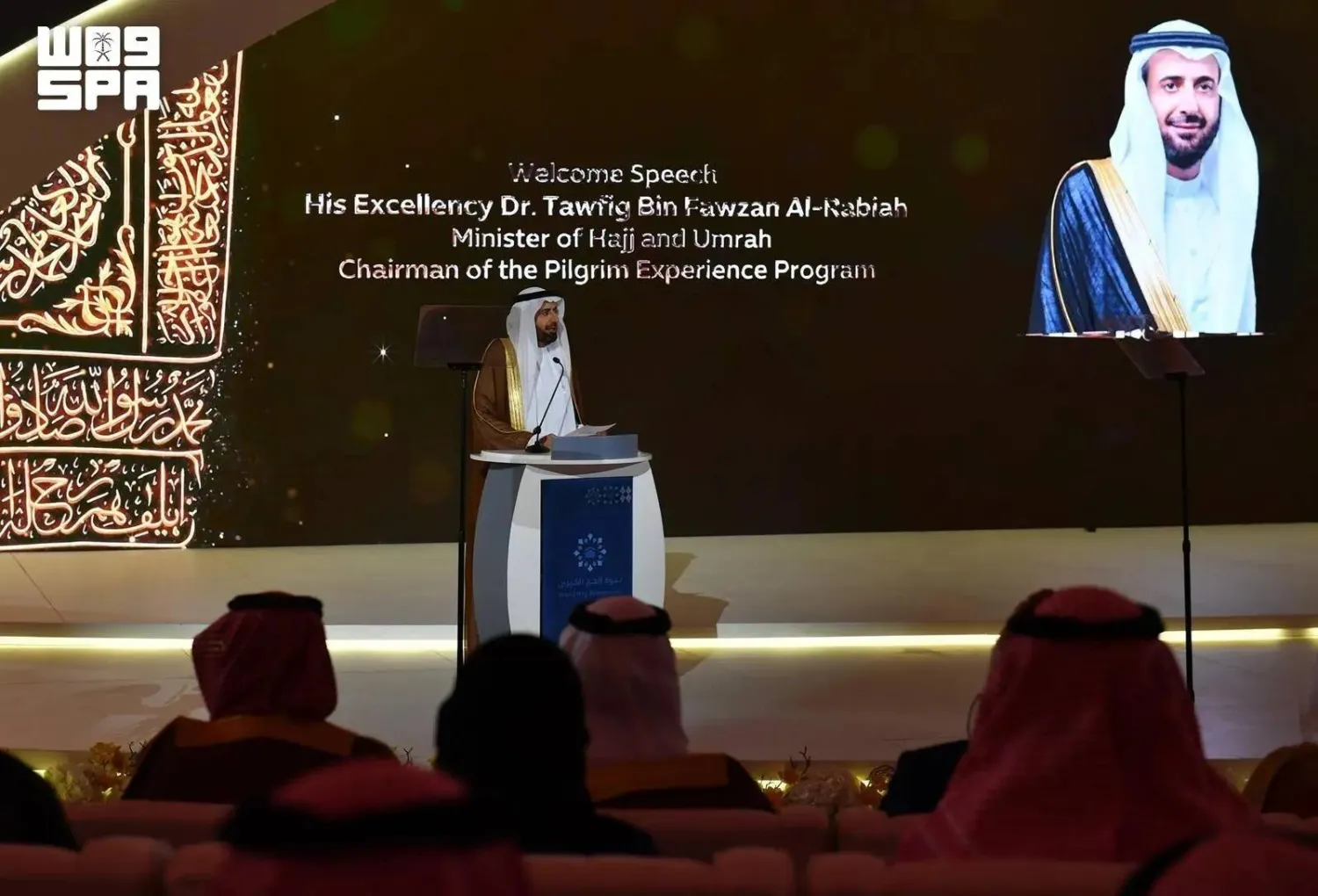

50th Grand Hajj Symposium Opens in Jeddah

The 50th edition of the Grand Hajj Symposium opened on Wednesday in Jeddah. (SPA)
TT

50th Grand Hajj Symposium Opens in Jeddah

The 50th edition of the Grand Hajj Symposium opened on Wednesday in Jeddah. (SPA)

The 50th edition of the Grand Hajj Symposium opened on Wednesday in Jeddah, marking a major milestone in the event’s long-standing role in advancing dialogue and scholarship related to Hajj and pilgrim services. Organized by the Ministry of Hajj and Umrah in cooperation with the Council of Senior Scholars, this year’s symposium is held under the theme: “The Symposium: An Effective Platform in Serving Pilgrims—Half a Century of Knowledge Enrichment.”

In his opening remarks, Minister of Hajj and Umrah Tawfig Al-Rabiah said the Grand Hajj Symposium represents the continuation of an established academic journey spanning more than 50 years of scientific dialogue on developing the Hajj services system. He noted that it reflects the Saudi leadership’s ongoing commitment to Hajj and its dedication to strengthening the role of knowledge in enhancing the quality of services provided to pilgrims, the Saudi Press Agency said on Thursday.

Al-Rabiah added that the symposium’s themes reflect the major transformations witnessed in the Hajj system over recent decades, during which the Kingdom has developed an advanced global model for crowd management and pilgrim services through integrated planning, institutional development, and modern technologies.

A speech by Grand Mufti of Saudi Arabia and Chairman of the Council of Senior Scholars Sheikh Saleh Al-Fawzan was delivered on his behalf by Secretary-General of the Council of Senior Scholars Fahd Al-Majed, who emphasized that Saudi Arabia has been honored with serving the Two Holy Mosques and their visitors. He noted that the Kingdom of Saudi Arabia's leadership places great importance on serving the Two Holy Mosques and their visitors, enabling pilgrims to perform their rituals in peace and tranquility.

The symposium program also included specialized workshops on supporting Hajj affairs offices and media delegations, international awareness communication, digital transformation in pilgrim grouping systems, and enhancing distribution efficiency and reducing random slaughter practices, as part of efforts to improve operational readiness for the 1447 AH Hajj season.

The 50th edition of the Grand Hajj Symposium reflects half a century of organized knowledge-based work in the service of Hajj and underscores the Kingdom’s approach to strengthening integration between knowledge and operations, while reinforcing the symposium’s status as a global scientific platform that keeps pace with the development of the Hajj system and anticipates the future of pilgrim services.


Qatari Prime Minister Arrives in Riyadh

Qatar’s Prime Minister and Minister of Foreign Affairs Sheikh Mohammed bin Abdulrahman bin Jassim Al Thani is welcomed upon his arrival in Riyadh. (SPA)
TT

Qatari Prime Minister Arrives in Riyadh

Qatar’s Prime Minister and Minister of Foreign Affairs Sheikh Mohammed bin Abdulrahman bin Jassim Al Thani is welcomed upon his arrival in Riyadh. (SPA)

Qatar’s Prime Minister and Minister of Foreign Affairs Sheikh Mohammed bin Abdulrahman bin Jassim Al Thani arrived in Riyadh on Wednesday.

He was received by Vice Minister of Foreign Affairs Waleed Elkhereiji at King Khalid International Airport.


UAE Halts All Trade, Financial Dealings with Iran after Attack

Tuesday's announcement is the latest measure against Iran by the UAE after it recalled its ambassador early in the conflict. (Asharq Al-Awsat)
TT

UAE Halts All Trade, Financial Dealings with Iran after Attack

Tuesday's announcement is the latest measure against Iran by the UAE after it recalled its ambassador early in the conflict. (Asharq Al-Awsat)

The United Arab Emirates has said it is suspending all trade and financial dealings with Iran after reporting an Iranian missile attack directed at its ships.

The announcement comes after a period of relative calm in the UAE, with no Iranian missiles aimed at the country since May after it bore the brunt of attacks in the early weeks of the Middle East war.

Abu Dhabi has however accused Tehran of repeatedly targeting its tankers at sea in recent weeks.

"In light of regional escalations... all trade, commercial exchanges, and financial transactions with Iran have been halted until further notice," said UAE foreign ministry communications director Afra Al Hameli.

The UAE is home to a sizeable Iranian community and has been a major trading partner for US-sanctioned Iran, at least before the war.

Tuesday's announcement is the latest measure against Iran by the UAE after it recalled its ambassador early in the conflict.

- Navigation -

Abu Dhabi on Tuesday accused Iran of firing two ballistic missiles towards the country, the first such attack since May.

It later said the salvo was directed at shipping, but Tehran denied firing missiles at the UAE.

"UAE air defenses detected two ballistic missiles launched from Iran towards the country, with the first falling outside the country's territorial waters, while the second fell within the territorial waters," the UAE ministry said in a statement posted to social media.

A second statement released later said the missiles "were targeting maritime navigation and fell into the sea".

Iranian foreign ministry spokesman Esmaeil Baqaei "categorically rejected the United Arab Emirates' claim that Iran had launched a missile towards that country", calling it harmful to regional trust and security efforts.

The first UAE statement came nearly two hours after a phone alert that warned residents of a "potential missile threat".

It was the first such alert since a false alarm in June and an alert in July for an attack that ultimately did not enter UAE territory.

Before that, the last missile warning came in early May.

However, tankers belonging to the UAE's state-owned oil company ADNOC have been repeatedly targeted in the past few weeks.

When the Middle East war began on February 28, the UAE bore the brunt of Iran's attacks, with nearly 3,000 missiles and drones directed at the country -- more than anywhere else in the region.

After a memorandum of understanding between Iran and the United States came into effect in June, which has since collapsed, the UAE reported no attacks, unlike other Gulf states.


MWL, GCC Condemn Israeli Airstrikes on Syria’s Abu al-Duhur Military Airbase

A man rides a motorbike in the town of Abu al-Duhur, Syria, August 18, 2026. (Reuters)
TT

MWL, GCC Condemn Israeli Airstrikes on Syria’s Abu al-Duhur Military Airbase

A man rides a motorbike in the town of Abu al-Duhur, Syria, August 18, 2026. (Reuters)

The Muslim World League (MWL) strongly condemned on Tuesday the Israeli airstrikes targeting Syria’s Abu al-Duhur Military Airbase, saying they are a violation of all international laws and norms.

In a statement, MWL Secretary-General and Chairman of the Organization of Muslim Scholars Sheikh Dr. Mohammed bin Abdulkarim Al-Issa slammed “the aggression against the sovereignty and resources of Syria”, reiterating the league's “full solidarity” with the country in confronting threats to its security, sovereignty and people.

Secretary-General of the Gulf Cooperation Council (GCC) Jasem Albudaiwi also strongly condemned the attack.

“The brutal Israeli targeting of Syrian territory is an unacceptable violation of its sovereignty and territorial sanctity, contradicting international rules and norms that prohibit infringing upon state sovereignty,” he said.

Such continued practices raise tension and escalation and undermine regional and international efforts aimed at achieving security and stability in the region, he warned.

Albudaiwi called on the international community to assume its responsibilities, take a firm stance against these violations, and work to halt Israeli attacks on Syrian territory to safeguard its security and stability.

He reiterated the GCC states' solidarity with Syria, and support for its sovereignty and territorial integrity.