

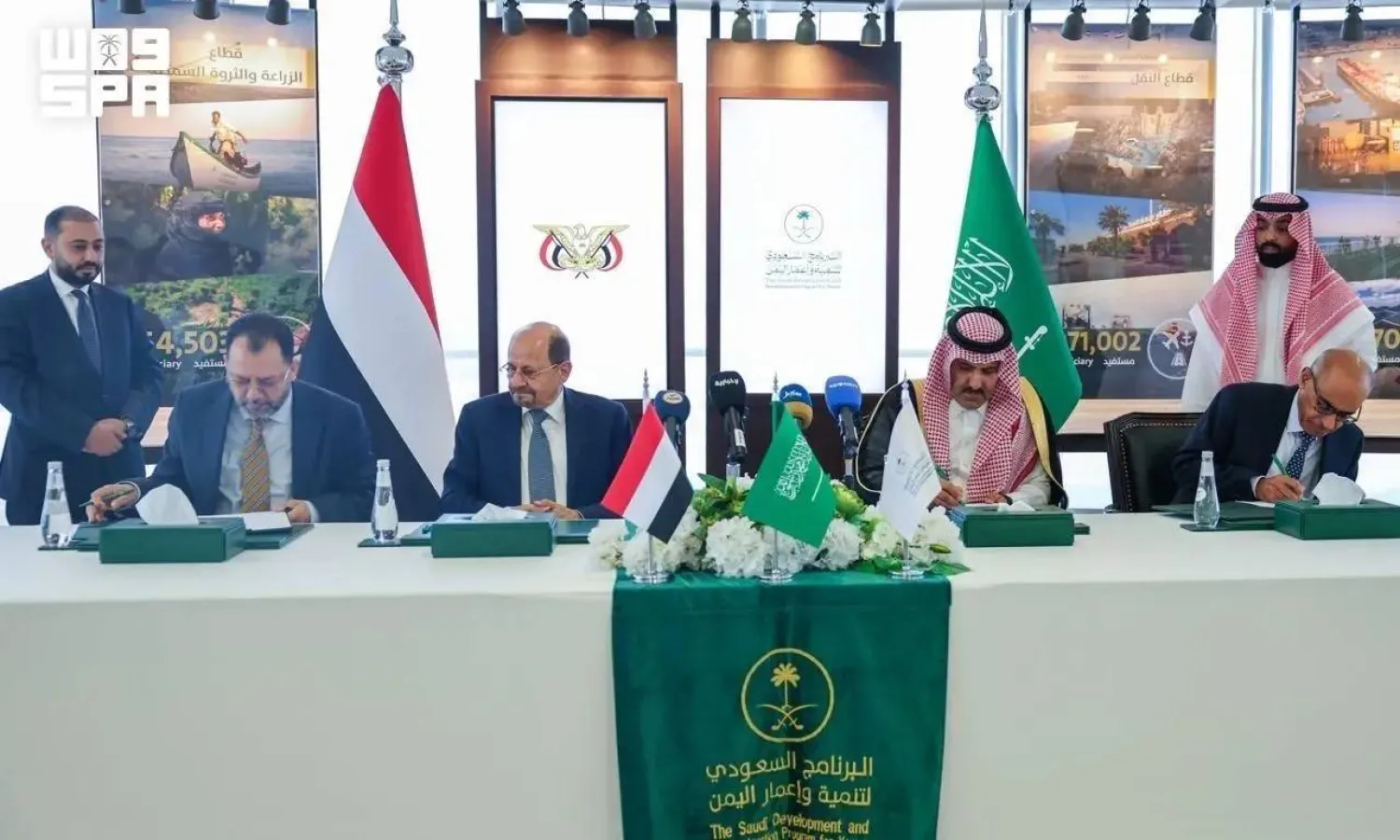

Saudi Arabia, Yemen Sign $150 Mn Petroleum Supply Deal to Support Energy Sector, Power Plants

Tuesday's agreement was signed by Minister of Electricity and Energy Eng. Adnan Al-Kaf and Saudi Ambassador to Yemen and SDRPY General Supervisor Mohammed bin Saeed Al Jaber. (SPA)
TT

Saudi Arabia, Yemen Sign $150 Mn Petroleum Supply Deal to Support Energy Sector, Power Plants

Tuesday's agreement was signed by Minister of Electricity and Energy Eng. Adnan Al-Kaf and Saudi Ambassador to Yemen and SDRPY General Supervisor Mohammed bin Saeed Al Jaber. (SPA)

Saudi Arabia and Yemen signed on Tuesday an agreement worth $150 million to supply petroleum derivatives for power plants across various Yemeni governorates.

The agreement was signed under the patronage of Yemeni Prime Minister Dr. Shaya Mohsin Zindani and is part of Saudi Arabia’s support through the Saudi Development and Reconstruction Program for Yemen (SDRPY) to the Yemeni Ministry of Electricity and Energy, reported the Saudi Press Agency.

It was signed by Minister of Electricity and Energy Eng. Adnan Al-Kaf and Saudi Ambassador to Yemen and SDRPY General Supervisor Mohammed bin Saeed Al Jaber.

The petroleum derivatives support, consisting of diesel and mazut, will fuel more than 70 electricity generation plants across various Yemeni governorates, helping boost the stability and continuity of electricity services and support vital sectors linked to electrical energy.

The support reflects Saudi Arabia’s longstanding commitment to supporting the Yemeni people and alleviating their humanitarian suffering, particularly amid rising temperatures.

It is expected to contribute to stimulating commercial activity, creating job opportunities, and promoting economic growth in Yemen.

An additional agreement was also signed between the Yemeni oil company PetroMasila, the Yemeni Ministry of Electricity and Energy, and SDRPY to support the sustainability of PetroMasila’s operations as a state-owned company, strengthening its capabilities, improving operational efficiency, and ensuring continuity of services in support of the Yemeni government.

The initiative will be implemented under a comprehensive governance framework to ensure that assistance reaches the final beneficiaries, through a supreme committee linked to the prime minister and comprising several Yemeni entities responsible for overseeing and monitoring the distribution of petroleum derivatives to power plants based on the identified needs of electricity generation facilities across Yemen.

SDRPY provided petroleum derivatives grants in 2018 valued at $180 million, one in 2021 worth $422 million, another in 2022 amounting to $200 million, and one in 2026 valued at $81.2 million.

The current $150 million grant comes as searing summer temperatures approach and amid an urgent need to improve electricity service quality to better daily life and living standards for the Yemeni people.



GCC Commits to Peace and Good Neighborliness, Says Security of Gulf States Is ‘Indivisible’

Heads of delegations are seen at the 167th Ministerial Council of the Gulf Cooperation Council (GCC) in Manama on Wednesday. (GCC)
TT

GCC Commits to Peace and Good Neighborliness, Says Security of Gulf States Is ‘Indivisible’

Heads of delegations are seen at the 167th Ministerial Council of the Gulf Cooperation Council (GCC) in Manama on Wednesday. (GCC)

The 167th Ministerial Council of the Gulf Cooperation Council (GCC) condemned on Wednesday the latest Iranian attacks against Bahrain, Kuwait and Jordan as “flagrant violations against their sovereignty and security of their people.”

Meeting in Manama, the council slammed the attacks as violations of international law, United Nations Charter and values of good neighborliness.

“These hostile acts do not serve any understanding or rapprochement, but rather distance peoples from one another, undermine the foundations of trust, sow discord and close the doors of dialogue to which the GCC states have always called for,” it said in a statement.

“Aggression does not build relations, and intimidation does not create stability,” it stressed, while expressing its full solidarity with Bahrain, Kuwait and Jordan.

“The security of the GCC states is indivisible, and that any attack against one of them is an attack against them all,” it went on to say.

The council reassured the citizens of its states and residents on their territories that the joint defense capabilities and air defense systems are confronting these attacks with high efficiency and readiness, and that the leaderships of the GCC states are moving forward in safeguarding the security and stability of the region.

“These attacks will only increase the cohesion, determination and resolve of the peoples of the GCC states to resist and confront them,” continued the statement.

Moreover, it underscored the right of GCC states to defend themselves “individually and collectively, and to respond to this aggression by all legitimate means, in accordance with Article 51 of the Charter of the United Nations, which guarantees the inherent right of states to defend themselves if an armed attack occurs against them.”

“The council holds Iran fully responsible for these acts and their grave repercussions on the security of the region, international navigation and energy supplies, and demands their immediate cessation and a complete end to any targeting of the GCC states, their interests and their citizens,” urged the statement.

The council called upon the Security Council and the international community to assume their responsibilities in condemning this aggression and holding its perpetrators accountable, in a manner that ensures respect for the sovereignty of states and the preservation of regional and international peace and security.

The council, while renewing the GCC states’ commitment to the option of peace, good neighborliness and diplomatic solutions as a means of settling disputes, posed “a fundamental question to the aggressor: How can future relations be built amid the continuation of these attacks and the insistence on pursuing them?”

“Persistence in the path of aggression will only lead to further isolation, while the door to understanding remains open to those who choose the language of wisdom and good neighborliness,” it added.


Saudi Foreign Ministry: Saudi Arabia Condemns Blatant Iranian Attacks Against Bahrain, Kuwait and Jordan

Saudi Foreign Ministry: Saudi Arabia Condemns Blatant Iranian Attacks Against Bahrain, Kuwait and Jordan
TT

Saudi Foreign Ministry: Saudi Arabia Condemns Blatant Iranian Attacks Against Bahrain, Kuwait and Jordan

Saudi Foreign Ministry: Saudi Arabia Condemns Blatant Iranian Attacks Against Bahrain, Kuwait and Jordan

The Saudi Ministry of Foreign Affairs expressed the Kingdom of Saudi Arabia’s strong condemnation and denunciation of the blatant Iranian attacks and flagrant violations of the sovereignty of the Kingdom of Bahrain, the State of Kuwait, and the Hashemite Kingdom of Jordan, considering them a threat to the security and safety of their territories and airspace.

In a statement, the ministry said: “The Kingdom affirms that the continuation of these attacks threatens regional and international security and undermines efforts aimed at de-escalation and the restoration of security and stability in the region.”

The Kingdom also reiterated its full solidarity with Bahrain, Kuwait, and Jordan, and its support for all measures taken by these nations to safeguard their sovereignty, security, stability, and the safety of their citizens and residents.


Saudi Foreign Minister Arrives in Bahrain for GCC Ministerial Meeting

Saudi Minister of Foreign Affairs Prince Faisal bin Farhan bin Abdullah arrives in Manama  - SPA
Saudi Minister of Foreign Affairs Prince Faisal bin Farhan bin Abdullah arrives in Manama - SPA
TT

Saudi Foreign Minister Arrives in Bahrain for GCC Ministerial Meeting

Saudi Minister of Foreign Affairs Prince Faisal bin Farhan bin Abdullah arrives in Manama  - SPA
Saudi Minister of Foreign Affairs Prince Faisal bin Farhan bin Abdullah arrives in Manama - SPA

Saudi Minister of Foreign Affairs Prince Faisal bin Farhan bin Abdullah arrived in Manama on Wednesday to participate in the 167th meeting of the Gulf Cooperation Council (GCC) Ministerial Council, chaired by Bahrain’s minister of foreign affairs, in his capacity as the current session chair, and attended by foreign ministers of the GCC member states.

He was welcomed at Manama International Airport by Bahraini Foreign Minister Dr. Abdullatif bin Rashid Al Zayani and GCC Secretary-General Jasem Albudaiwi.