


GCC Commits to Peace and Good Neighborliness, Says Security of Gulf States Is ‘Indivisible’

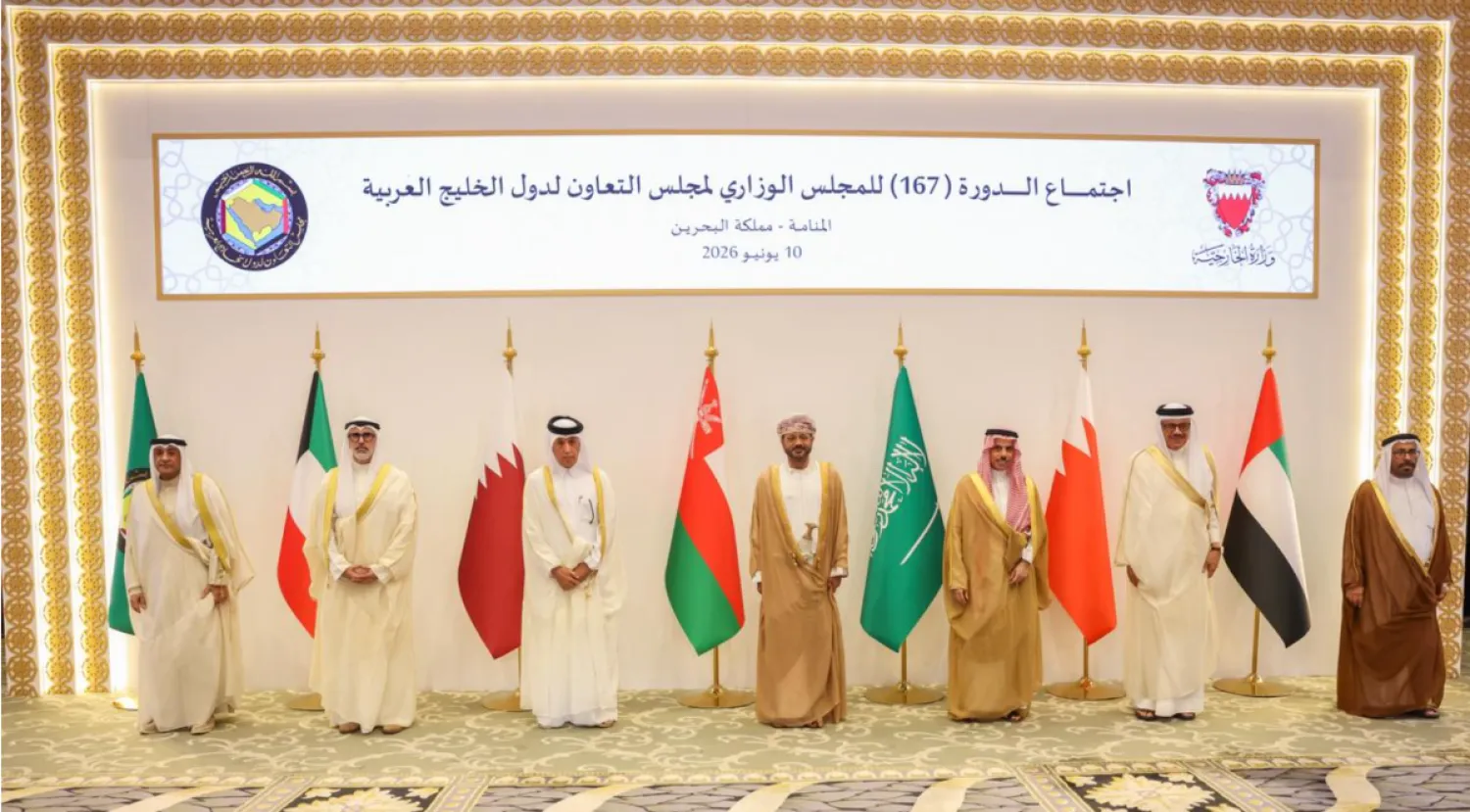
Heads of delegations are seen at the 167th Ministerial Council of the Gulf Cooperation Council (GCC) in Manama on Wednesday. (GCC)
TT

GCC Commits to Peace and Good Neighborliness, Says Security of Gulf States Is ‘Indivisible’

Heads of delegations are seen at the 167th Ministerial Council of the Gulf Cooperation Council (GCC) in Manama on Wednesday. (GCC)

The 167th Ministerial Council of the Gulf Cooperation Council (GCC) condemned on Wednesday the latest Iranian attacks against Bahrain, Kuwait and Jordan as “flagrant violations against their sovereignty and security of their people.”

Meeting in Manama, the council slammed the attacks as violations of international law, United Nations Charter and values of good neighborliness.

“These hostile acts do not serve any understanding or rapprochement, but rather distance peoples from one another, undermine the foundations of trust, sow discord and close the doors of dialogue to which the GCC states have always called for,” it said in a statement.

“Aggression does not build relations, and intimidation does not create stability,” it stressed, while expressing its full solidarity with Bahrain, Kuwait and Jordan.

“The security of the GCC states is indivisible, and that any attack against one of them is an attack against them all,” it went on to say.

The council reassured the citizens of its states and residents on their territories that the joint defense capabilities and air defense systems are confronting these attacks with high efficiency and readiness, and that the leaderships of the GCC states are moving forward in safeguarding the security and stability of the region.

“These attacks will only increase the cohesion, determination and resolve of the peoples of the GCC states to resist and confront them,” continued the statement.

Moreover, it underscored the right of GCC states to defend themselves “individually and collectively, and to respond to this aggression by all legitimate means, in accordance with Article 51 of the Charter of the United Nations, which guarantees the inherent right of states to defend themselves if an armed attack occurs against them.”

“The council holds Iran fully responsible for these acts and their grave repercussions on the security of the region, international navigation and energy supplies, and demands their immediate cessation and a complete end to any targeting of the GCC states, their interests and their citizens,” urged the statement.

The council called upon the Security Council and the international community to assume their responsibilities in condemning this aggression and holding its perpetrators accountable, in a manner that ensures respect for the sovereignty of states and the preservation of regional and international peace and security.

The council, while renewing the GCC states’ commitment to the option of peace, good neighborliness and diplomatic solutions as a means of settling disputes, posed “a fundamental question to the aggressor: How can future relations be built amid the continuation of these attacks and the insistence on pursuing them?”

“Persistence in the path of aggression will only lead to further isolation, while the door to understanding remains open to those who choose the language of wisdom and good neighborliness,” it added.

Saudi Arabia, Sudan Hold Political Consultation and Follow-Up Committee Meeting in Riyadh

Saudi Arabia and Sudan chair the Political Consultation and Follow-Up Committee in Riyadh on Monday. (SPA)
TT

Saudi Arabia, Sudan Hold Political Consultation and Follow-Up Committee Meeting in Riyadh

Saudi Arabia and Sudan chair the Political Consultation and Follow-Up Committee in Riyadh on Monday. (SPA)

Saudi Minister of Foreign Affairs Prince Faisal bin Farhan bin Abdullah received his Sudanese counterpart Mohieldin Salem Ahmed Ibrahim in Riyadh on Monday.

The ministers co-chaired a meeting of the Political Consultation and Follow-Up Committee between their countries, during which they reviewed bilateral relations and ways to further develop and strengthen them across various fields.

Saudi Minister of Foreign Affairs Prince Faisal bin Farhan bin Abdullah and his Sudanese counterpart Mohieldin Salem Ahmed Ibrahim meet in Riyadh on Monday. (SPA)

They discussed the latest regional developments and exchanged views on topics of mutual interest.

They reaffirmed their commitment to advancing bilateral relations and strengthening cooperation across various fields.


Iran Considers Missing Pilots to Be Prisoners in Qatar

Qatar denied detaining the three Iranian pilots and invited Tehran “to review the details of the search and rescue operations in April, but the Iranian side has yet to respond to the invitation” (QNA).
TT

Iran Considers Missing Pilots to Be Prisoners in Qatar

Qatar denied detaining the three Iranian pilots and invited Tehran “to review the details of the search and rescue operations in April, but the Iranian side has yet to respond to the invitation” (QNA).

Iran's foreign ministry said on Monday it will consider three missing pilots to be prisoners in Qatar, despite Doha's denials, until it clarifies their fate.

Tehran has said the Iranians went missing while carrying out an operation against the United States' Al Udeid Air Base in Qatar on March 2, shortly after the outbreak of the Middle East war.

On Saturday, Iranian authorities alleged for the first time that the pilots had been captured in Qatar, after previously saying one pilot had been killed and three others were missing following their sortie.

"It is imperative to obtain clarification on their situation," foreign ministry spokesman Esmaeil Baqaei told a weekly press briefing.

"Until the pilots' situation is clarified, we consider them prisoners and will spare no effort to shed light on their fate."

Qatar denies holding the pilots and said an invitation had been sent to Iran "to be briefed on the details of the search and rescue operations in April, but the Iranian side has yet to respond".

Last month, Iran's military said it had retrieved the body of pilot Majid Kazemi, who was killed during the attack on Al Udeid, the largest US military base in the Middle East.

In early March, Qatar's defense ministry said it had shot down two Iranian Sukhoi Su-24 bombers but it was not immediately clear whether they were the same aircraft referred to by Iran.

Qatar, which took part in mediation efforts to end the fighting, came under fire after the truce broke down, reporting attacks on its territory and on at least one Qatari tanker transiting the strait.


UAE President, Sultan of Oman Discuss Bilateral Ties and Regional Developments

UAE President Sheikh Mohamed bin Zayed Al Nahyan and Sultan Haitham bin Tariq of Oman - WAM
TT

UAE President, Sultan of Oman Discuss Bilateral Ties and Regional Developments

UAE President Sheikh Mohamed bin Zayed Al Nahyan and Sultan Haitham bin Tariq of Oman - WAM

UAE President Sheikh Mohamed bin Zayed Al Nahyan and Sultan Haitham bin Tariq of Oman discussed the longstanding fraternal ties between the two countries and ways to further strengthen cooperation, particularly in the economic and development fields, in support of shared priorities and interests, as well as the prosperity and wellbeing of their peoples.

The two leaders exchanged views on regional and international issues of joint interest, particularly the serious developments in the Middle East and ongoing efforts to strengthen security, stability, and peace for the benefit of all countries and peoples of the region.

The two leaders reaffirmed their commitment to continued consultation on various issues in light of the shared challenges the region is facing and the need to bolster cooperation to safeguard its security and stability, WAM reported.

Sultan Haitham bin Tariq arrived in the UAE earlier on Monday and was welcomed at the Presidential Airport in Abu Dhabi by Sheikh Mohamed bin Zayed Al Nahyan, along with a number of Sheikhs, ministers, and officials.
