


Saudi Arabia, Egypt, Türkiye, Pakistan Move to Deepen Partnership, Cooperation

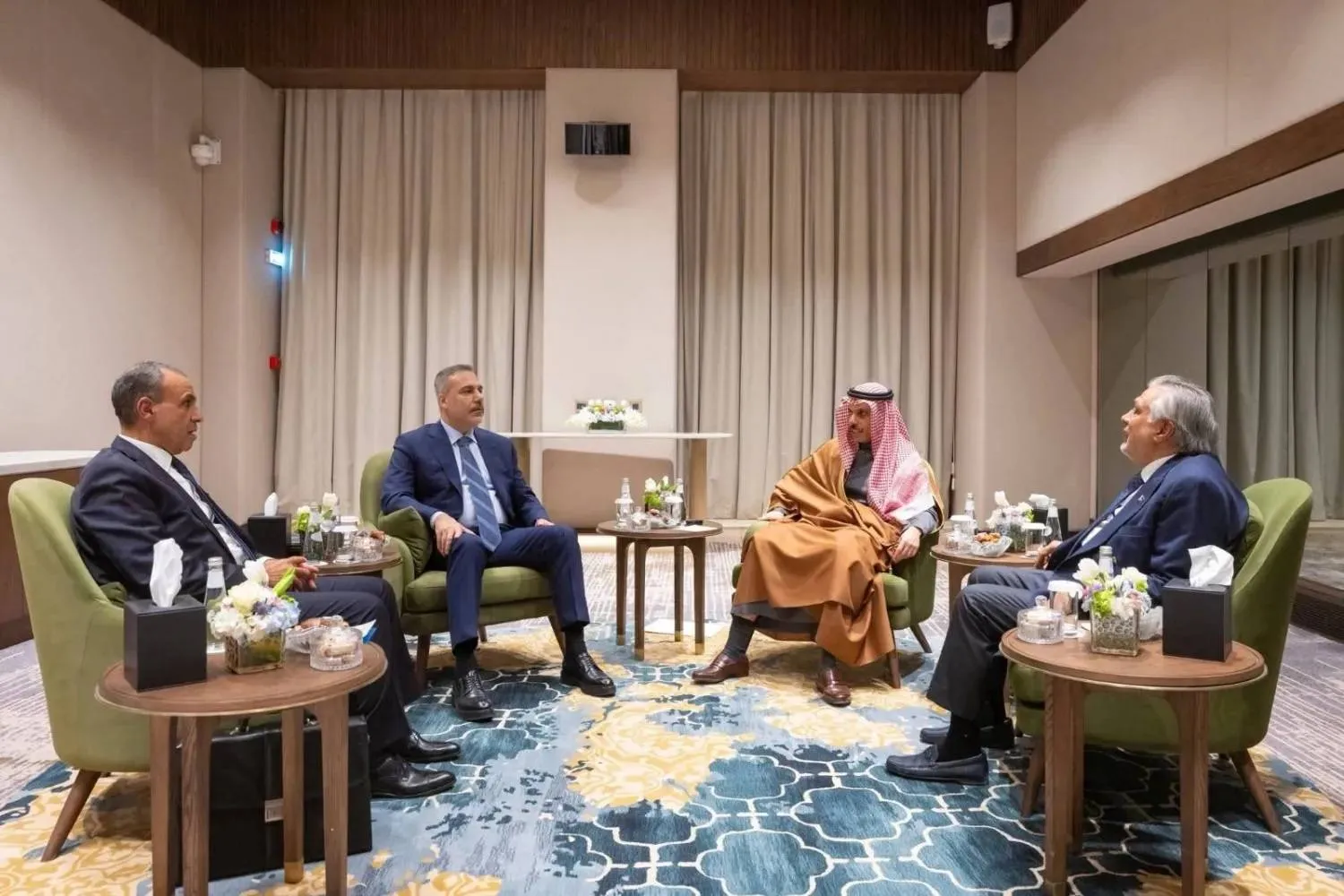
 Foreign ministers attend a four-way meeting in Riyadh on March 20. (Egyptian Foreign Ministry)
Foreign ministers attend a four-way meeting in Riyadh on March 20. (Egyptian Foreign Ministry)
TT

Saudi Arabia, Egypt, Türkiye, Pakistan Move to Deepen Partnership, Cooperation

 Foreign ministers attend a four-way meeting in Riyadh on March 20. (Egyptian Foreign Ministry)
Foreign ministers attend a four-way meeting in Riyadh on March 20. (Egyptian Foreign Ministry)

Egypt will host a four-way meeting with the foreign ministers of Saudi Arabia, Türkiye and Pakistan, days after Washington and Tehran finalized a memorandum of understanding to stop the war that began in late February.

Egyptian Foreign Minister Badr Abdelatty will meet his Saudi counterpart, Prince Faisal bin Farhan, Türkiye’s Hakan Fidan and Pakistan’s Mohammad Ishaq Dar in Cairo on Sunday for a four-way meeting, Egypt’s state news agency reported late on Thursday.

The talks will be followed by an expanded session and a press conference.

A former Egyptian diplomat told Asharq Al-Awsat the meeting would focus on “ways to consolidate cooperation, deepen partnership and coordinate on regional issues, complete efforts to cement de-escalation in the region, and narrow differences during the next 60 days of negotiations between Washington and Tehran.”

The quartet played a prominent role in reaching the US-Iran agreement days ago. Its efforts formally began with a meeting in March in the Saudi capital, Riyadh, followed by meetings in Islamabad and Antalya as part of efforts to end the Iran war.

The meeting comes two days after the Swiss government said negotiations between the United States and Iran, due to begin on Friday in Switzerland, had been postponed indefinitely.

The announcement came hours after a planned visit by US Vice President JD Vance was canceled.

Iranian Supreme Leader Mojtaba Khamenei said earlier on Thursday that he had approved the memorandum of understanding signed by Washington and Tehran, despite expressing reservations about it.

US forces said they had lifted a naval blockade on Iranian ports after the memorandum was signed by the US and Iranian presidents on Wednesday.

Ambassador Mohamed Hegazy, a member of the Egyptian Council for Foreign Affairs and a former assistant foreign minister, told Asharq Al-Awsat the call for the four-way meeting marked an important step in regional consultations at a time of deep strategic shifts in the Middle East.

He cited the ceasefire, the containment of the US-Iran military confrontation, and the risks of the continuing war in Gaza and its impact on regional security and stability.

He said the “consultative quartet” of influential regional states had “proved its presence as an effective regional and international framework capable of addressing problems and issues in coordination with regional states and major powers to calm regional conditions and deal with their problems.”

Hegazy said the meeting’s importance went beyond traditional political coordination. He expected the agenda to include support for consolidating the “Washington-Tehran agreement,” continuing negotiations, discussing Gaza and Lebanon, and backing efforts to secure a sustainable regional calm.

The meeting is also expected to “open the door to deepening partnership and coordination among the quartet, and to studying the possibility of holding a regional or international conference on security and cooperation in the Middle East, similar to successful experiences in other regions,” Hegazy said.

Such a conference, he said, would aim to draft a declaration of principles governing regional relations and establish institutional mechanisms for dialogue, dispute settlement, and stronger economic, security and humanitarian cooperation among the region’s countries.

Egypt’s Foreign Ministry said on Friday that Abdelatty held separate phone calls with Pakistan’s Mohammad Ishaq Dar and Iranian Foreign Minister Abbas Araghchi to discuss regional developments after the US-Iran memorandum of understanding.

An official statement said the Egyptian and Pakistani ministers stressed “the importance of continuing coordination and joint consultation in the coming phase to ensure the implementation of the memorandum of understanding and reach a final and sustainable agreement that takes into account the interests and concerns of all parties and strengthens diplomatic solutions, in a way that achieves security and stability in the region.”

In his call with Araghchi, Abdelatty expressed hope that the memorandum of understanding would become “an important turning point in support of security and stability in the region, and contribute to opening the way to addressing all issues through dialogue and diplomatic means.”

He also voiced hope for a final and sustainable agreement that addresses the concerns of all parties and supports efforts to achieve lasting security and stability in the region.

Hegazy said it was important to maintain “serious dialogue among the main regional powers over the shape of the regional order that should govern relations among the countries of the region in the next phase, ensuring a shift from the logic of managing successive and recurring crises to building a stable system of security, cooperation and development.”

The current phase requires “the formulation of mutual understandings with Iran on the security of the Arabian Gulf, in a way that reassures all parties and lays the foundation for normal relations based on good neighborliness, common interests, and the non-use or threat of force,” Hegazy said.

He also called for strengthening political and security dialogue mechanisms to prevent the region from returning to cycles of escalation and confrontation, and for building frameworks to manage cooperation and development among the region's countries across various fields.


Gulf States Step Up Coordination after Iran Escalation

Gulf consultations and reciprocal visits followed Iranian attacks over the past 72 hours (QNA)
TT

Gulf States Step Up Coordination after Iran Escalation

Gulf consultations and reciprocal visits followed Iranian attacks over the past 72 hours (QNA)

Gulf states have sharply stepped up coordination after Iranian attacks hit several Gulf countries over the past 48 hours, holding nearly seven rounds of consultations so far, including two official visits, five phone calls and a series of official statements.

The latest attacks came at dawn on Thursday, when missiles targeted Bahrain and Qatar. Jordan also said it had intercepted Iranian missiles that had entered its airspace.

Saudi Foreign Minister Prince Faisal bin Farhan discussed regional developments on Thursday with Sheikh Mohammed bin Abdulrahman bin Jassim Al Thani, Qatar’s prime minister and foreign minister, in a call Prince Faisal received from the Qatari official.

The two reviewed the latest developments in the military escalation between the United States and Iran over the past two days.

Qatar’s foreign minister condemned and rejected attacks on commercial ships in the Strait of Hormuz, despite a climate of calm and efforts to reduce escalation in the region.

He said such acts would undermine trust, threaten the security of international navigation and damage efforts to cement regional security and stability.

The two ministers stressed that all parties must commit to dialogue and diplomacy and implement what had been agreed under the memorandum of understanding, in a way that preserves regional security, protects gains achieved and strengthens regional stability.

Prince Faisal also spoke by phone with Kuwaiti Foreign Minister Sheikh Jarrah Jaber Al-Ahmad Al-Sabah. They discussed the latest regional developments, particularly the current escalation, efforts to reduce tensions and ways to advance diplomatic solutions.

The Saudi and Omani foreign ministers had discussed developments related to the Strait of Hormuz in Muscat on Wednesday.

They stressed the need to protect the security of waterways, ensure freedom of navigation, support efforts to strengthen regional security and stability, and settle disputes through dialogue and peaceful means.

On Wednesday, Bahraini Foreign Minister Dr. Abdullatif Al Zayani discussed with Prince Faisal “the latest regional developments, the heinous Iranian attacks on the Kingdom of Bahrain and the State of Kuwait, and the Iranian attacks that targeted the Saudi tanker Wadyan and the Qatari tanker Al-Rakiyat as they crossed the Strait of Hormuz.”

The Bahraini statement described the attacks as “a rejected assault on the security and safety of international navigation and global energy supplies, and a grave violation of international law and UN Security Council Resolution 2817.”

Separately, the Kuwait News Agency and the Emirates News Agency said Sheikh Mohammed bin Zayed, president of the United Arab Emirates, arrived in Kuwait on Thursday on a “fraternal visit.”

He was received by Kuwait’s Emir Sheikh Mishal Al-Ahmad, the crown prince, the prime minister and several senior Kuwaiti officials.

Sheikh Mohammed bin Abdulrahman bin Jassim Al Thani and Sheikh Abdullah bin Zayed Al Nahyan, the UAE’s deputy prime minister and foreign minister, also reviewed on Thursday “the latest developments in the military escalation between the United States and Iran over the past two days.”

Qatar’s prime minister again condemned and rejected “the attacks that targeted commercial ships in the Strait of Hormuz, despite the atmosphere of calm and efforts to reduce escalation in the region.”

He said such acts would undermine trust, threaten the security of international navigation and damage efforts to cement regional security and stability.

He urged all parties to commit to dialogue and diplomacy and implement what had been agreed under the memorandum of understanding, in a way that preserves regional security, protects gains achieved and strengthens regional stability.

Al Thani discussed the same issue with his Omani counterpart, Badr Al Busaidi, in a phone call on Thursday. He renewed Doha’s support for “all efforts aimed at containing the escalation and reaching a comprehensive agreement that helps consolidate security and stability and achieve sustainable peace in the region.”

The Kuwaiti army released the latest tally of Iranian attacks. A Kuwaiti Defense Ministry spokesman said the armed forces had detected three ballistic missiles, one cruise missile and 10 hostile drones inside Kuwaiti airspace at dawn on Thursday, and had intercepted and dealt with them successfully.

Bahrain Defense Force said, “The deliberate use of missiles and drones to target civilians and private property is a blatant violation of international humanitarian law.”


Saudi Crown Prince, Canadian PM Discuss Regional, Int’l Developments

Prince Mohammed bin Salman, Saudi Crown Prince and Prime Minister, and Canadian Prime Minister Mark Carney meet in Jeddah on Thursday. (SPA)
TT

Saudi Crown Prince, Canadian PM Discuss Regional, Int’l Developments

Prince Mohammed bin Salman, Saudi Crown Prince and Prime Minister, and Canadian Prime Minister Mark Carney meet in Jeddah on Thursday. (SPA)

Prince Mohammed bin Salman, Saudi Crown Prince and Prime Minister, held official talks with Canadian Prime Minister Mark Carney in Jeddah on Thursday.

Discussions focused on regional and international developments and efforts exerted towards them.

They also tackled bilateral ties between their countries and opportunities to develop them in various fields.

Carney’s office had previously said talks will address bilateral relations with focus on energy, critical minerals, investment, infrastructure, advanced technologies and defense cooperation.

The visit reflects the strength of relations between Saudi Arabia and Canada and the keenness of their leaderships on bolstering political coordination and expanding economic cooperation and investments amid the regional and international changes.

The visit underscores Saudi Arabia’s political and economic standing and its pioneering role on the international stage. It reflects Ottawa’s desire to bolster consultations with Riyadh on issues of common interest and elevate bilateral ties.

Prince Mohammed bin Salman, Saudi Crown Prince and Prime Minister, receives Canadian Prime Minister Mark Carney at the Al-Salam Palace in Jeddah. (SPA)

Crown Prince Mohammed and Carney also witnessed the signing of three memoranda of understanding (MoUs): 

First: An MoU between the Saudi Ministry of Energy and Natural Resources Canada, signed by Minister of Energy Prince Abdulaziz bin Salman bin Abdulaziz and Canadian Foreign Minister Anita Anand. 

Second: An MoU between the Government of the Kingdom of Saudi Arabia and the Government of Canada on establishing the Saudi-Canadian Coordination Council as a platform to implement a joint action document serving as a roadmap for the next phase of bilateral relations, signed by Minister of Foreign Affairs Prince Faisal bin Farhan bin Abdullah and Anand. 

Third: An MoU between the Saudi Ministry of Communications and Information Technology and Innovation, Science and Economic Development Canada, on artificial intelligence investment and skills development, signed by Saudi Data and AI Authority President Dr. Abdullah Alghamdi and Anand. 

The meeting of talks was attended by Saudi Minister of Energy Prince Abdulaziz bin Salman bin Abdulaziz, Minister of National Guard Prince Abdullah bin Bandar bin Abdulaziz, Minister of Defense Prince Khalid bin Salman bin Abdulaziz, Minister of Foreign Affairs Prince Faisal bin Farhan bin Abdullah, Minister of State, Member of the Cabinet and National Security Adviser Dr. Musaed Al-Aiban, Minister of Finance Mohammed Aljadaan, Deputy Governor of Makkah Region Prince Saud bin Mishal bin Abdulaziz, and Saudi Ambassador to Canada Amal Almoallimi. 

The meeting was also attended by Canadian Minister of Finance and National Revenue François-Philippe Champagne, Minister of Foreign Affairs Anita Anand, Minister of National Defense David McGuinty, Canadian Ambassador to Saudi Arabia Jean-Philippe Linteau, Member of Parliament Sameer Zuberi, Chief of Staff to the Prime Minister Marc-André Blanchard, Foreign and Defense Policy Advisor at the Privy Council Office Jennifer May, Chief Executive Officer of the Defense Investment Agency Doug Guzman, and Prime Minister's Senior Advisor on Foreign, Defense, and Security Policy Scott Gilmore. 


Saudi Foreign Minister Meets with Canadian Foreign Minister

The two officials discussed developments in the region, condemning and denouncing the Iranian violations - SPA
TT

Saudi Foreign Minister Meets with Canadian Foreign Minister

The two officials discussed developments in the region, condemning and denouncing the Iranian violations - SPA

Saudi Minister of Foreign Affairs Prince Faisal bin Farhan bin Abdullah met in Jeddah on Thursday with Canadian Minister of Foreign Affairs Anita Anand to review bilateral relations and discuss ways to expand cooperation and partnership between Saudi Arabia and Canada.

The two officials discussed developments in the region, condemning and denouncing the Iranian violations targeting tankers in the Strait of Hormuz alongside the heinous attacks targeting a number of countries in the region.

They stressed the need to de-escalate tensions, return to the negotiating track, and prioritize dialogue to achieve a comprehensive agreement that consolidates regional and international peace and security.
