Arab, Int’l Condemnation of Houthi Accusations against Saudi Arabia

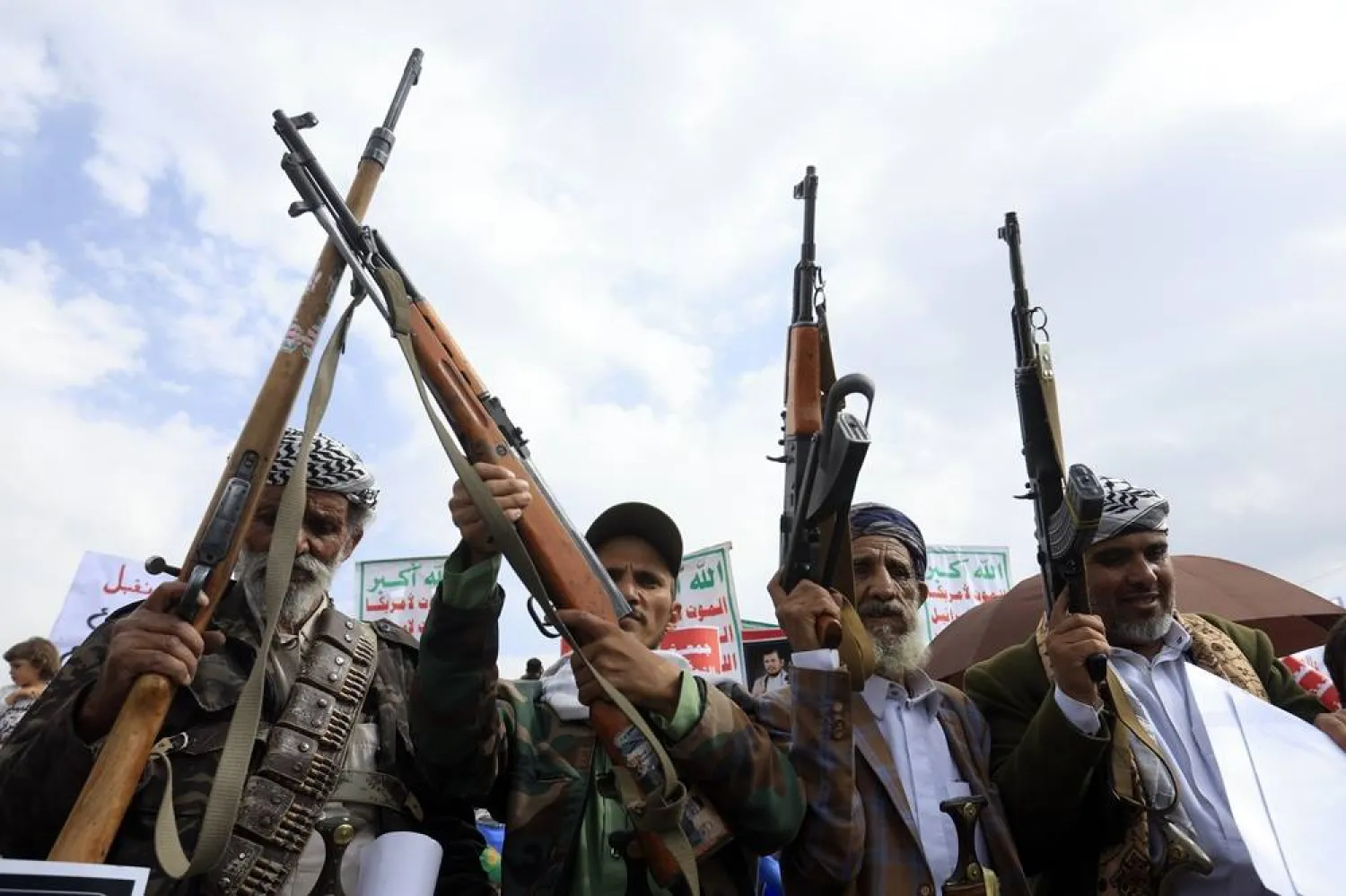
Houthi supporters hold up their weapons during a protest in Sanaa, Yemen, 17 July 2026. (EPA)
TT

Arab, Int’l Condemnation of Houthi Accusations against Saudi Arabia

Houthi supporters hold up their weapons during a protest in Sanaa, Yemen, 17 July 2026. (EPA)

Arab and international condemnations poured in on Tuesday against the Houthi militias in Yemen in wake of their accusations against Saudi Arabia. 

Egypt strongly condemned the accusations “which would undermine the security and stability of the region and threaten the safety of maritime navigation, international trade, and vital waterways.” 

A Foreign Ministry statement said the accusations are a “flagrant violation of international law, the United Nations Convention on the Law of the Sea (UNCLOS), and the relevant UN Security Council resolutions.” 

It stressed Egypt’s “full solidarity with Saudi Arabia and all member states of the Gulf Cooperation Council (GCC), and its support for all measures they take to preserve their security, stability, sovereignty, and territorial integrity.” 

It stressed the importance of prioritizing political and diplomatic solutions and respecting the rules of international law in a manner that contributes to de-escalation and the preservation of the region's security and stability. 

Sudan strongly condemned the accusations, warning that such provocations further threaten regional stability, freedom of navigation in the Red Sea, and efforts to achieve peace in Yemen. 

In a statement, the Ministry of Foreign Affairs and International Cooperation reaffirmed Sudan’s support “for all measures taken by the Kingdom to safeguard its security, stability, sovereignty, and territorial integrity.” 

The Sudanese government “called on the regional and international community to increase pressure and take effective measures to counter the activities of terrorist militias and work toward their complete elimination.” 

Britain also strongly condemned the Houthi accusations, stressing that these provocations further destabilize the region, threaten freedom of navigation in the Red Sea, and undermine efforts to achieve peace in Yemen. 

In a statement, the British Foreign, Commonwealth and Development Office emphasized that the United Kingdom stands firmly with Saudi Arabia and its other partners in the region in confronting these threats, calling on the Houthi militias to immediately cease their escalatory actions. 

Arab League Secretary-General Nabil Fahmy underlined his full solidarity with and support for Saudi Arabia against anything that could undermine its security, stability, or sovereignty, following the statements by the so-called military spokesperson of the Houthi terrorist militias, which included false accusations and threats directed at the Kingdom. 

In a statement, the secretary-general described the remarks as “a serious and unacceptable escalation that would fuel tensions in the region and undermine efforts aimed at de-escalation and promoting security and stability.” 

Fahmy called on the Houthi militias “to refrain from escalatory rhetoric and to avoid any actions or statements that could further heighten tensions, stressing that prioritizing dialogue and adhering to regional and international efforts to reach a comprehensive political settlement to the Yemeni crisis remain the only path to achieving security and stability in Yemen and the region.” 

He underlined that the security and territorial integrity of the Kingdom “are an integral part of the Arab national security system.” 

The Arab League supports all legitimate measures the Kingdom takes to protect its national security and safeguard its territorial integrity, in accordance with international law and the UN Charter, he added. 

The United Nations expressed “deep concern” over the Houthi accusations. 

Spokesperson for the United Nations Secretary-General Stéphane Dujarric warned of the risk of a broader regional escalation. 

Dujarric said the United Nations is also deeply concerned about the resumption of hostilities and renewed escalation across large parts of the region, stressing that immediate de-escalation is essential. 

“All parties must respect their obligations under international humanitarian law,” he said, reiterating the UN’s call for all sides to resolve their differences through dialogue and diplomacy. 

Dujarric noted that these developments come as the world is already grappling with the impact of the near closure of the Strait of Hormuz and its repercussions for the global economy. 

Secretary-General of the Organization of Islamic Cooperation (OIC) Hissein Brahim Taha strongly condemned the Houthi accusations. 

He deemed the Houthi statements “unacceptable and cannot be justified under any circumstances,” stressing that “the continued threats to maritime navigation pose a threat to regional and international security.” 

He noted that these actions “form part of a series of attacks and baseless allegations made by the Houthi terrorist militias against Saudi Arabia, most recently the attack targeting the Kingdom's Southern Region.” 

He reaffirmed the OIC’s full solidarity with Saudi Arabia and its support for all measures the Kingdom takes to safeguard its security and stability. 

He recalled Saudi Arabia's “sustained efforts to help achieve peace, security, and stability in Yemen, alongside the generous humanitarian and relief assistance it has provided and the development projects it has implemented for the benefit of the Yemeni people to alleviate their suffering.” 

He called for the implementation of relevant UN Security Council resolutions on Yemen and on the rights and freedom of navigation in the Red Sea. 


GCC Secretary-General: GCC-UK Relations Built on Cooperation, and Shared Interests

Secretary-General of the Gulf Cooperation Council (GCC) Jasem Albudaiwi. SPA
TT

GCC Secretary-General: GCC-UK Relations Built on Cooperation, and Shared Interests

Secretary-General of the Gulf Cooperation Council (GCC) Jasem Albudaiwi. SPA

Secretary-General of the Gulf Cooperation Council (GCC) Jasem Albudaiwi stated that relations between the GCC states and the United Kingdom (UK) are founded on a long history of cooperation, trust, and shared interests, which has contributed to exploring and establishing a distinguished economic and trade partnership between the two sides.

His remarks came during his opening speech at the GCC-UK Strategic Dialogue, on Tuesday in the British capital, London, in the presence of several ministers from both sides, alongside numerous officials, business leaders, and investors, SPA reported.

During his speech, the secretary-general stated that the foundations of the economic partnership between the two sides bring together the ambitious development visions of the GCC states and the UK’s extensive expertise across a wide range of vital sectors. He noted the importance of strengthening cooperation amid global economic transformations, geopolitical developments, and the challenges confronting trade, investment, and supply chains.

In the same context, he added that the member states continue to advance towards achieving important goals in economic integration, diversifying productive bases, improving business environments, and empowering the private sector, pointing out that the combined gross domestic product (GDP) of the GCC states reached approximately $2.4 trillion, placing them collectively among the world’s 10 largest economies; and the total foreign trade of the GCC states exceeded $1.8 trillion, ranking them collectively fifth globally.

Furthermore, he highlighted efforts to strengthen cybersecurity and the digital economy. This transformation, he explained, supports economic growth and enhanced global competitiveness for the GCC states.

Moreover, he indicated that the total trade volume between the GCC states and the UK reached approximately $70 billion in 2025, making the GCC states collectively the UK’s 10th-largest trading partner; and the total value of investment assets and liabilities between the UK and the GCC reached approximately $643 billion in 2024, reflecting the depth of economic and investment ties between both sides.

Building on this, he stated that the conclusion of negotiations on the GCC-UK Free Trade Agreement (FTA) represents a strategic step towards expanding trade, encouraging investment, and creating new opportunities for the private sector.

He noted that the conclusion of the FTA negotiations is the fruit of sustained joint efforts and intensive negotiations. He expressed his sincere appreciation to the negotiating teams from both sides, and to all the institutions that contributed to this achievement.

According to SPA, he highlighted that this agreement provides for the elimination of customs duties on more than 99% of GCC exports to the UK, which will open broader horizons for increasing non-oil exports, particularly in the aluminum, fertilizer, and manufacturing sectors. He added that the agreement also provides opportunities for logistics and re-exports, while enabling small and medium-sized enterprises to expand their operations and increase their access to the British market.

He further underlined the importance of the FTA, noting that its benefits extend beyond trade to lay a more robust foundation for long-term economic and investment partnerships. These partnerships cover, in particular, advanced manufacturing, the digital economy and artificial intelligence, clean energy, financial services, education, food security, and logistics. He stressed that these sectors support joint investment, technology and knowledge transfer, and building stronger productive capacities.


Erdogan Submits Makkah Joint Defense Agreement to Parliament for Ratification

Saudi Crown Prince Mohammed bin Salman, Turkish President Recep Tayyip Erdogan and Pakistani Prime Minister Shehbaz Sharif following the signing of the Makkah Agreement (Turkish Presidency)
TT

Erdogan Submits Makkah Joint Defense Agreement to Parliament for Ratification

Saudi Crown Prince Mohammed bin Salman, Turkish President Recep Tayyip Erdogan and Pakistani Prime Minister Shehbaz Sharif following the signing of the Makkah Agreement (Turkish Presidency)

Turkish President Recep Tayyip Erdogan on Tuesday submitted the Makkah Joint Defense Agreement, signed by Saudi Arabia, Türkiye and Pakistan on August 7, to parliament for ratification.

Burhanettin Duran, head of Türkiye's Presidential Directorate of Communications, said the submission of the bill to ratify the agreement marked an important step toward institutionalizing strategic cooperation among the three brotherly countries.

"This strategic partnership between our countries aims to strengthen collective deterrence, enhance joint defense capabilities, and protect security and stability in our region," Duran said.

In a statement posted on his X account, Duran explained that the Makkah Agreement, based on the principle that countries in the region should assume responsibility for regional affairs, reflects a shared commitment to prioritizing security and solidarity.

"We hope that the parliamentary ratification process will benefit our country and our brotherly nations, Saudi Arabia and Pakistan. I would also like to extend my sincere thanks in advance to all political parties and members of parliament who will contribute to this process," he added.

Parliamentary sources said Parliament Speaker Numan Kurtulmus, who is currently on an official visit to Kyrgyzstan, would refer the bill to the Foreign Affairs Committee upon his return.

The committee, chaired by former Foreign Minister Mevlut Cavusoglu, will discuss the legislation before it is submitted to a plenary session for ratification.

The Makkah Joint Defense Agreement contains several key provisions, including one stipulating that an attack on any signatory country is considered an attack on all three, similar to Article 5 of the North Atlantic Treaty Organization (NATO).

Other provisions cover joint weapons production, technology transfers between defense industry companies, military training, joint exercises, specialized military personnel development, intelligence sharing and counterterrorism cooperation.

On the eve of the bill's submission to parliament, Turkish Foreign Minister Hakan Fidan and Saudi Foreign Minister Prince Faisal bin Farhan discussed regional security issues.

According to Turkish Foreign Ministry sources, the two ministers focused during a telephone call on Monday on Houthi attacks targeting Saudi Arabia's sovereignty and territorial integrity.

In a related development, President Erdogan strongly condemned the Houthi attacks, noting that the strike on King Khalid International Airport in Riyadh had killed several people, including Umrah pilgrims, and left hundreds wounded.

Speaking at a meeting with village heads at the presidential complex late Monday, Erdogan said the Houthi attacks against Saudi Arabia, which he described as a friend and brotherly nation, had significantly heightened tensions in the region.


Qatar: Lack of Updates on US-Iran Talks a Positive Sign

Qatari Foreign Ministry Spokesperson Majed Al-Ansari attends the Global Security Forum in Doha (Asharq Al-Awsat)
TT

Qatar: Lack of Updates on US-Iran Talks a Positive Sign

Qatari Foreign Ministry Spokesperson Majed Al-Ansari attends the Global Security Forum in Doha (Asharq Al-Awsat)

Qatar confirmed on Tuesday that negotiations between the United States and Iran over Tehran's nuclear program are continuing despite escalating regional tensions and fears of renewed military confrontation. Doha also reaffirmed its support for Saudi Arabia in defending its sovereignty against attacks targeting the Kingdom.

Dr. Majed bin Mohammed Al-Ansari, Adviser to the Prime Minister and Official Spokesperson for Qatar's Ministry of Foreign Affairs, said at the eighth Global Security Forum in Doha that negotiations between Washington and Tehran over Iran's nuclear program remain ongoing, with both sides continuing to engage in the diplomatic process.

Speaking at the forum, held under the theme "The Future of Alliances," Al-Ansari explained that the absence of public information about the negotiations does not mean they have stalled. Instead, he suggested that the lack of public reporting could be a sign that mediators are doing their work effectively behind closed doors.

"The fact that we're not hearing about it is a good sign that we're doing our job properly," he said, emphasizing that the chances of successful mediation improve when diplomatic contacts take place away from public scrutiny.

Addressing regional security developments, the Qatari foreign ministry spokesperson reiterated Doha's support for Saudi Arabia in confronting attacks on its sovereignty.

"Qatar is supporting our brothers in Saudi Arabia in defending their sovereignty against this attack," he said.

Discussing the challenges facing Qatari diplomacy, Al-Ansari acknowledged that mediation efforts involve difficulties that vary according to the parties involved and the nature of each conflict. He stressed that Doha seeks to draw on its previous experiences to strengthen its ability to manage negotiations.

He explained that the challenge is not necessarily identifying which party is the most difficult to negotiate with, but rather understanding the nature of each crisis and responding to its particular circumstances.

Every mediation effort, he said, offers lessons that contribute to the accumulated expertise of Qatari diplomacy.

Al-Ansari added that Qatar aims to build on this experience to ensure that the challenges it encounters do not undermine the consistency of its position or its commitment to its mediation responsibilities.

His remarks come amid growing concerns over a wider confrontation in the Middle East, as diplomatic efforts continue to contain tensions and find political solutions to regional crises, particularly the standoff between Washington and Tehran and the repercussions of attacks targeting Gulf countries.

Senior officials and security experts attending the 2026 Global Security Forum in Doha are examining the reshaping of international alliances amid intensifying geopolitical competition and the emergence of increasingly influential blocs.

The forum provides an opportunity for senior decision-makers to exchange views, assess emerging security challenges and explore practical ways to strengthen international cooperation.

Discussions also address the pressures facing international institutions, the growing influence of emerging powers and non-state actors, and the future of multilateral cooperation and collective security, with particular emphasis on the central role of diplomacy, dialogue and mediation in strengthening regional and global security.