

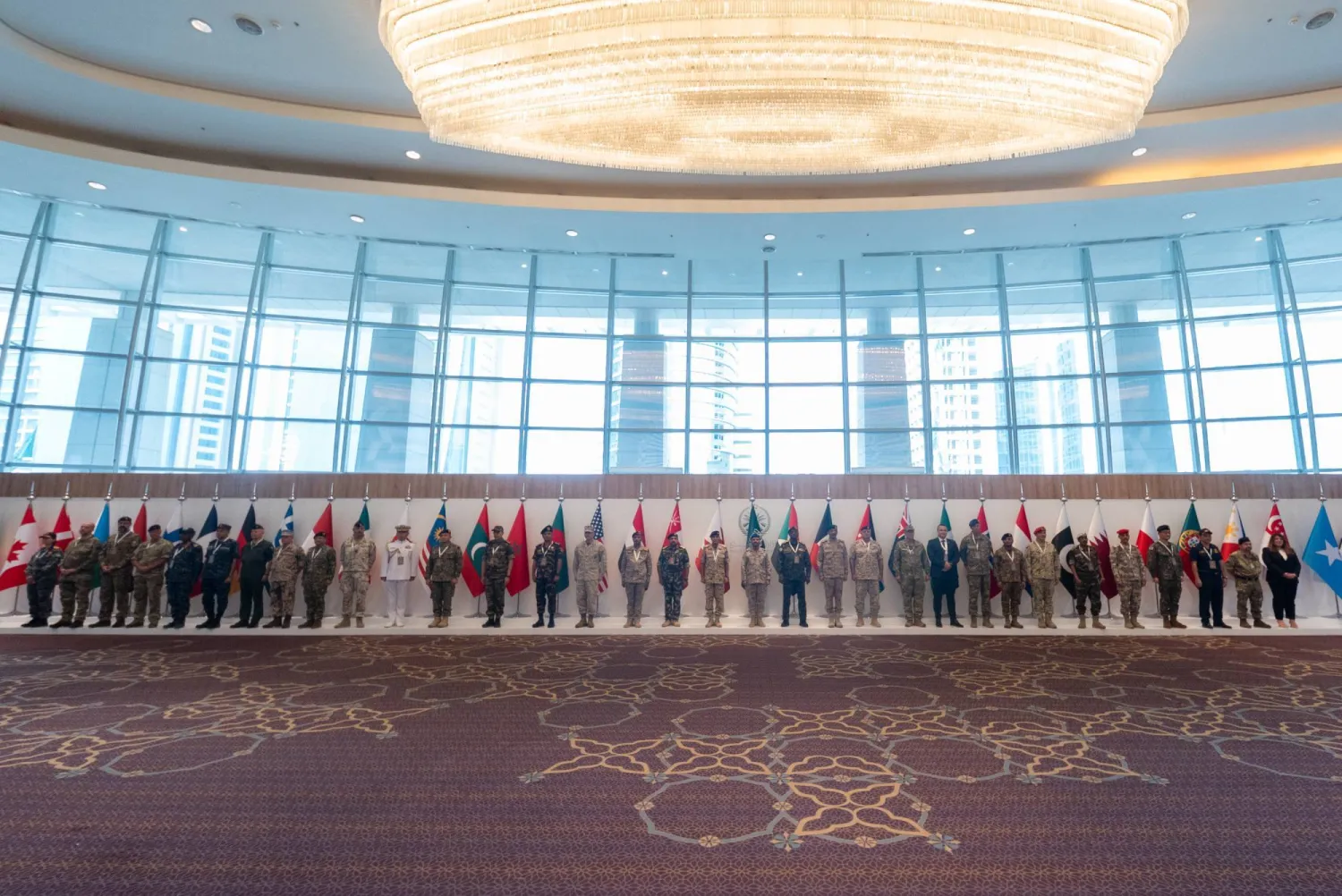

Saudi Proposal Lays Groundwork for Regional Maritime Defense Alliance

The Saudi-led maritime defense alliance aims to reshape regional maritime security. (Ministry of Defense)
TT

Saudi Proposal Lays Groundwork for Regional Maritime Defense Alliance

The Saudi-led maritime defense alliance aims to reshape regional maritime security. (Ministry of Defense)

Saudi Arabia's proposal to establish a Multinational Maritime Defense Alliance lays the groundwork for a new regional security framework aimed at countering Houthi threats to international shipping and preventing Iran and its proxies from turning the Red Sea, the Gulf of Aden, and the Bab al-Mandab Strait into tools of political leverage and geopolitical pressure.

A study by the Red Sea Center for Political and Security Studies concluded that the initiative is not merely a temporary military arrangement to address the current escalation. Rather, it represents a broader effort to redesign the regional maritime security architecture by shifting from responding to attacks after they occur to building a collective deterrence framework led by regional states to protect commercial shipping and global energy supply routes.


Curbing Iran's Proxy


The study, prepared by Mohammed Al-Walas Bahybah, founder and chairman of the Red Sea Center for Political and Security Studies, based in Marib, links the initiative's significance to Iran's use of the Houthis in Yemen to threaten commercial vessels and oil tankers, turning the security of maritime routes into a tool of political coercion and bargaining over issues extending beyond the Yemeni conflict.

According to the study, the proposed alliance seeks to close the operational space exploited by regional powers and non-state actors to threaten maritime navigation by enhancing intelligence and operational coordination, strengthening naval capabilities, and building a deterrence framework that raises the cost of future Houthi attacks.

It says a unified regional position would undermine the narrative the Houthis use to justify targeting ships, as any future attack would no longer amount to a confrontation with a single state but rather a challenge to a collective security framework with the capacity to deter and respond.


Saudi Shift From Containment to Initiative


The study argues that the alliance reflects a shift in Saudi Arabia's approach from managing crises and containing their repercussions to shaping proactive and more sustainable security arrangements, based on the principle that safeguarding the Red Sea is a shared responsibility among its littoral states.

According to the study, the proposed framework would include 14 Arab and Muslim countries, including Saudi Arabia, Egypt, Türkiye, and Pakistan, alongside Yemen's internationally recognized government, with Riyadh serving as the alliance's headquarters.

It says bringing together countries with differing political priorities and regional interests under the common objective of protecting maritime navigation demonstrates Saudi Arabia's ability to forge broad security consensus while strengthening its role in shaping the future of collective security in the Middle East.


Yemen as a Partner in Securing Maritime Routes


The study places particular emphasis on the participation of Yemen's internationally recognized government, noting that the country's coastline overlooks both the Red Sea and the Gulf of Aden, while the Bab al-Mandab Strait constitutes one of the world's most vital trade and energy supply corridors.

It argues that Yemen's participation would provide an opportunity to strengthen its naval, intelligence, and operational capabilities, improve the protection of its coastline and territorial waters, and reaffirm its role as a responsible partner in the regional and international security architecture.


Joint Base on Mayun Island


The study proposes establishing a joint military base on Yemen's Mayun Island as one of the alliance's future priorities, citing the island's strategic location at the heart of the Bab al-Mandab Strait.

It concludes that a successful alliance would usher in a new era of "regional maritime deterrence," sending a message to the Houthis and their backers that the security of international trade and global energy supplies is no longer open to political bargaining or the imposition of faits accomplis through force.



Saudi FM Meets Indian, Vietnamese, Bahraini Counterparts on Sidelines of BRICS, Calls UAE FM

Saudi Minister of Foreign Affairs Prince Faisal bin Farhan bin Abdullah met with Indian Minister of External Affairs Dr. Subrahmanyam Jaishankar. (SPA)
TT

Saudi FM Meets Indian, Vietnamese, Bahraini Counterparts on Sidelines of BRICS, Calls UAE FM

Saudi Minister of Foreign Affairs Prince Faisal bin Farhan bin Abdullah met with Indian Minister of External Affairs Dr. Subrahmanyam Jaishankar. (SPA)

Saudi Minister of Foreign Affairs Prince Faisal bin Farhan bin Abdullah met in New Delhi with his counterparts from India, Vietnam and Bahrain on the sidelines of the BRICS summit and held phone talks with his UAE counterpart, the Saudi Press Agency reported Sunday. 

During his meeting with Indian Minister of External Affairs Dr. Subrahmanyam Jaishankar, the two officials reviewed Saudi-Indian relations and their growth and development across various fields. The two sides also discussed opportunities to further advance relations in ways that serve the shared interests of the two countries and their peoples. 

They also discussed regional and international developments and exchanged views on a number of issues of mutual interest. They emphasized the importance of continued consultation and coordination to support efforts to consolidate security and stability and find political and diplomatic solutions to current challenges and crises. 

Prince Faisal had earlier held separate meetings with his counterparts from Bahrain and Vietnam. Discussions with the Bahraini FM touched on the latest regional developments, particularly the attacks carried out by the Houthi militia targeting areas in Saudi Arabia.

With his Vietnamese counterpart, discussions focused on strengthening bilateral relations, expanding economic, trade, and tourism cooperation, supporting private-sector partnerships, and exchanging views on issues of mutual interest. 

Prince Faisal also received a phone call from Deputy Prime Minister and Minister of Foreign Affairs of the United Arab Emirates Sheikh Abdullah bin Zayed Al Nahyan. 

During the call, they discussed the latest regional developments and ongoing efforts to contain the escalation in light of the rapidly evolving situation in the region. 

They underscored the importance of unifying positions and strengthening consultations between the two brotherly countries, in a manner that supports the framework of joint Gulf action, safeguards the security of their states, and protects their national assets. 


Ukrainian Official Expects Imminent Bilateral Meeting Between Zelenskyy and Trump

Ukraine's President Volodymyr Zelenskyy, US President Donald Trump's son-in-law Jared Kushner and US Special Envoy Steve Witkoff attend a press conference, amid Russia's attack on Ukraine, in Kyiv, Ukraine September 6, 2026. (Reuters)
TT

Ukrainian Official Expects Imminent Bilateral Meeting Between Zelenskyy and Trump

Ukraine's President Volodymyr Zelenskyy, US President Donald Trump's son-in-law Jared Kushner and US Special Envoy Steve Witkoff attend a press conference, amid Russia's attack on Ukraine, in Kyiv, Ukraine September 6, 2026. (Reuters)

A high-ranking Ukrainian source suggested that a bilateral meeting could take place this September between Ukrainian President Volodymyr Zelenskyy and his US counterpart Donald Trump, as the latter’s special envoys continue their shuttle diplomacy efforts in an attempt to find mutually acceptable solutions to advance diplomacy between Kyiv and Moscow.

Anatolii Petrenko, Ukraine’s Ambassador to Saudi Arabia, told Asharq Al-Awsat: “We remain in constant contact with the US negotiating team. We are coordinating further steps and preparing next communications.”

“Ukraine’s peace proposals remain constructive. We must continue working actively and jointly with the US and our European partners to keep diplomacy moving forward,” he added.

“We thank President Donald Trump for his personal engagement and efforts to bring an end to this war,” he stressed.

“We believe that the best format moving forward would be a meeting between leaders - President Zelenskyy and Putin - with the possible involvement of President Trump, because the most sensitive issues can only be resolved at the level of leaders,” said the ambassador.

“Such a meeting can take place in any neutral location suitable for both sides. For Ukraine any country except Russia and Belarus is doable. The Ukrainian side is ready for such a meeting without preconditions,” he went on to say.

Anatolii Petrenko, Ukraine’s Ambassador to Saudi Arabia. (Ukrainian Embassy in Saudi Arabia)

“We are grateful to the United States for the assistance provided and look to continued support for Ukraine’s energy sector and the strengthening of Ukraine’s air and missile defense ahead of a difficult winter amid Russia’s aggression,” Petrenko said.

Moreover, he stated that the Ukrainian-American talks covered all issues on peace efforts and the bilateral agenda, including renewed diplomatic efforts to end the war, security guarantees, prosperity plan, and winter package.

“Such a substantial meeting can already be viewed as a success. It allowed us to work through many details on a really broad agenda,” he added.

“There were three rounds of substantial talks, including with the participation of representatives of France, Germany, and the United Kingdom. Ukraine welcomes the participation of European representatives, which demonstrates unity and solidarity with Ukraine,” he told Asharq Al-Awsat.

Ukraine also appreciates Saudi Arabia’s “steadfast support for our state’s territorial integrity and sovereignty, as well as the humanitarian assistance generously extended to our nation.”

“The principled and balanced position of Saudi Arabia in accordance with international law allows it to play an effective and constructive mediation role to comprehensively advance the efforts aimed at reaching long lasting and just peace,” Petrenko noted.

“We believe that the pace and spirit of bilateral interaction development between Ukraine and Saudi Arabia demonstrates a gradual transformation into the projected framework of political, economic and security cooperation with the initial outlines of a strategic partnership,” he said.

“The momentum we have built will allow us to sustain the upward dynamics and convert the accumulated political capital into joint projects and long-term mechanisms of mutually beneficial cooperation,” he added.


Saudi Arabia at BRICS Summit: Our National Security and Safety of Our Assets Are Non-Negotiable

Minister of Foreign Affairs Prince Faisal bin Farhan bin Abdullah speaks at the BRICS Summit in New Delhi on Sunday. (SPA)
TT

Saudi Arabia at BRICS Summit: Our National Security and Safety of Our Assets Are Non-Negotiable

Minister of Foreign Affairs Prince Faisal bin Farhan bin Abdullah speaks at the BRICS Summit in New Delhi on Sunday. (SPA)

Saudi Arabia stressed on Sunday that its national security, territorial integrity, and capabilities are non-negotiable, and that the member states of the Gulf Cooperation Council (GCC) will not accept the targeting of their lands, facilities, or vital interests, under any pretext or designation.

Speaking at the BRICS 2026 Summit in New Delhi, Minister of Foreign Affairs Prince Faisal bin Farhan bin Abdullah said: “In light of the current developments in the region, the priority should be to de-escalate tensions and create space for political and diplomatic efforts.”

Delivering a speech on behalf of Prince Mohammed bin Salman bin Abdulaziz Al Saud, Crown Prince and Prime Minister, Prince Faisal added that security in the Arabian Gulf “cannot be achieved without respect for the sovereignty and independence of its states, non-interference in their internal affairs, adherence to the principles of good neighborliness, and the peaceful settlement of disputes.”

“The security of the Kingdom, integrity of its territory, and protection of its national assets are non-negotiable, and GCC states will not accept any targeting of their territories, facilities, or vital interests, regardless of the pretexts or justifications invoked,” he declared.

He underscored the importance of safeguarding freedom of navigation and the safety of commercial vessels in the Strait of Hormuz and other maritime corridors, stating that “any disruption to these routes would have repercussions for global markets, supply chains, and economic growth.”

Prince Faisal highlighted the purposes for which international institutions were established and the urgent need to strengthen their capacity to fulfill their responsibilities.

He added that “the credibility of the international system depends on how consistently its rules and laws are applied”, noting that the Kingdom “looks forward to continuing its engagement with BRICS and its partners across the international community.”