

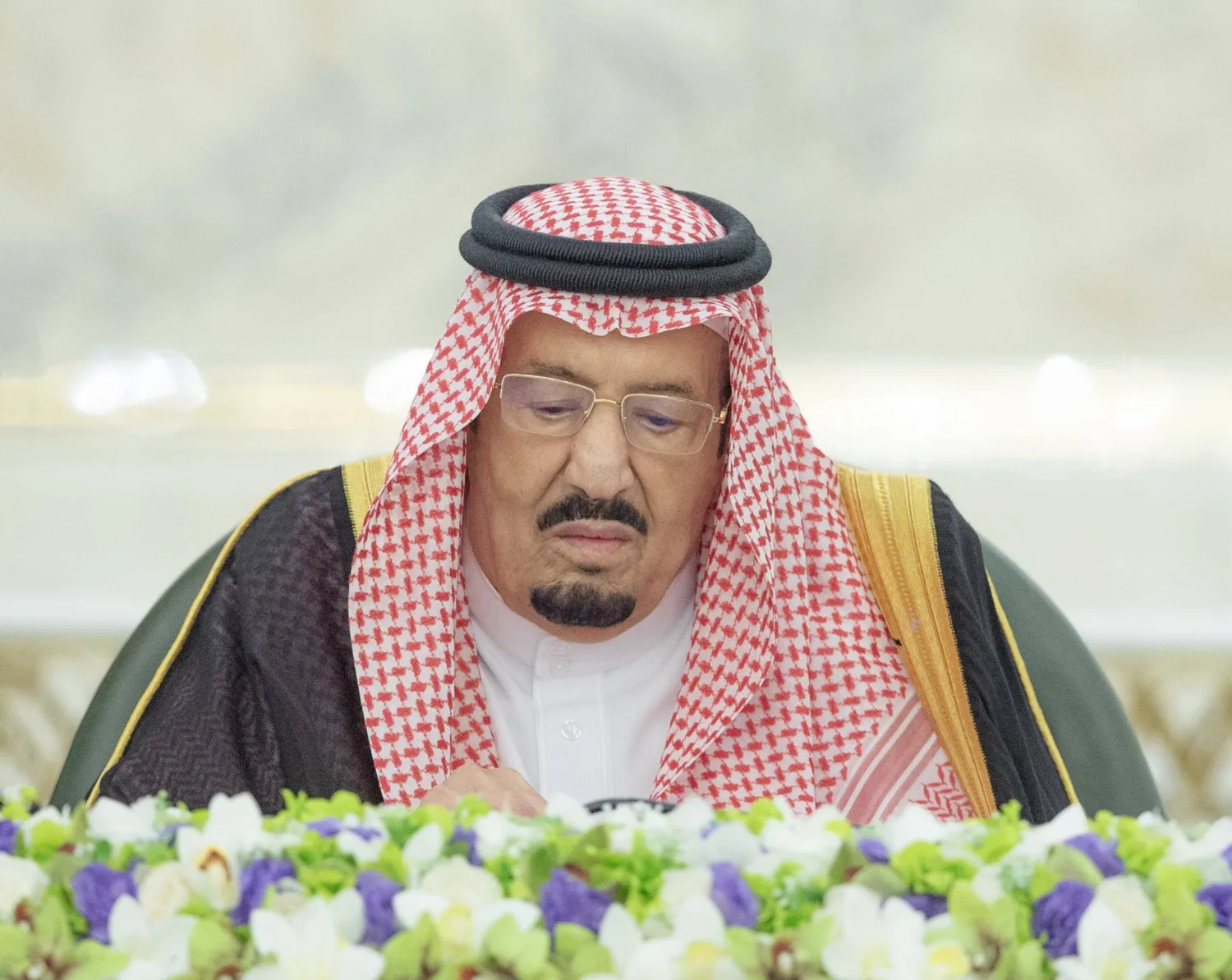

Saudi Cabinet Welcomes Launch of Multinational Maritime Defense Alliance

Custodian of the Two Holy Mosques King Salman bin Abdulaziz Al Saud  - SPA
Custodian of the Two Holy Mosques King Salman bin Abdulaziz Al Saud - SPA
TT

Saudi Cabinet Welcomes Launch of Multinational Maritime Defense Alliance

Custodian of the Two Holy Mosques King Salman bin Abdulaziz Al Saud  - SPA
Custodian of the Two Holy Mosques King Salman bin Abdulaziz Al Saud - SPA

Custodian of the Two Holy Mosques King Salman bin Abdulaziz Al Saud chaired the Cabinet session on Tuesday, which reviewed Saudi Arabia’s recent discussions and consultations with brotherly and friendly nations to enhance bilateral and multilateral cooperation across various fields, achieve mutual interests, and support regional and international security and stability.

The Cabinet welcomed the institutional and operational activation of the Saudi-led Multinational Maritime Defense Alliance following the completion of its organizational and planning frameworks. This marks a new phase of joint action to achieve full operational readiness and fulfill its mission to enhance collective maritime security, protect freedom of navigation across maritime straits and waterways, and support the continuity of international trade and global supply chains.

The Cabinet reiterated its categorical rejection of repeated Iranian attacks on commercial vessels and tankers, viewing them as a dangerous escalation and a direct threat to the safety and security of maritime navigation.

It also affirmed that these attacks constitute a grave violation of international laws and norms and a blatant defiance of the Security Council resolution obligating respect for commercial vessels' freedom of navigation through the Strait of Hormuz and condemning any threats or actions obstructing it.

On bilateral relations, the Cabinet deemed establishing the Saudi-Sudanese Coordination Council an extension of both nations' commitment to institutionalized joint coordination, advancing cooperation and integration through tangible outputs, initiatives, projects, and objectives to achieve desired aspirations.

The Cabinet commended the Kingdom's successful presidency of the 16th session of the UNCCD Conference of the Parties (COP16), which launched international partnerships and initiatives to combat land degradation, desertification, and drought, enhance water and food security, support climate adaptation, and advance innovative solutions for environmental protection and sustainable development.

On World Humanitarian Day, observed on August 19, the Cabinet expressed pride in Saudi Arabia's pioneering humanitarian role and its prominent standing among the world's leading donor nations. This reflects the Kingdom's long history of generosity, proactive initiative, and providing aid, assistance, and disaster relief to countries and communities in need globally.

Domestically, as the new academic year approaches, the Cabinet reviewed the education sector's achievements, notably in improving organizational and operational efficiency, advancing educational institutions, expanding students' scientific expertise, upgrading teachers' capabilities, and providing exemplary learning environments with leading curricula and specialized programs that foster innovation and creativity—all contributing to human capital development and Saudi Vision 2030 goals.

The Cabinet also commended the Public Investment Fund's (PIF) financial performance and continued progress toward its targets, evidenced by revenue and net profit growth in 2025. This reflects PIF's ongoing drive to spur economic diversification in the Kingdom, expand domestic and international investments, and bolster key strategic sectors, including artificial intelligence, technology, energy, infrastructure, and advanced manufacturing.

The Cabinet praised government agencies' tangible progress in the 2026 Digital Experience Maturity Index, reflecting ongoing commitment to developing operations, innovating flexible and effective technological solutions, and delivering top-tier procedures and services to citizens, residents, and visitors, in line with the Kingdom's leadership and competitiveness in international rankings and indicators.



Pakistan PM Condemns in ‘Strongest Possible Terms’ Attack on Makkah

Pakistan's Prime Minister Shehbaz Sharif meets with Russian President Vladimir Putin (not pictured) at Diaoyutai State Guesthouse in Beijing, China, September 2, 2025. (Reuters)
TT

Pakistan PM Condemns in ‘Strongest Possible Terms’ Attack on Makkah

Pakistan's Prime Minister Shehbaz Sharif meets with Russian President Vladimir Putin (not pictured) at Diaoyutai State Guesthouse in Beijing, China, September 2, 2025. (Reuters)

Pakistan's Prime Minister Shehbaz Sharif condemned on Wednesday “in the strongest possible terms the dastardly and heinous” attack on the holy city of Makkah.

“The people of Pakistan are saddened and perturbed by this outrageous act,” he said on X.

Saudi defenses intercepted on Tuesday a hostile drone fired by the terrorist Houthis in Yemen before it entered the prohibited airspace area of the holy city of Makkah.

Official Spokesperson of the Coalition to Restore Legitimacy in Yemen Major General Turki Al-Malki revealed that this was the second hostile and terrorist attempt to target Makkah. The first took place on July 27, 2017.


UN Condemns Houthi Attacks on Saudi Arabia, Stresses Red Sea Maritime Security

The Saudi flag. Asharq Al-Awsat
TT

UN Condemns Houthi Attacks on Saudi Arabia, Stresses Red Sea Maritime Security

The Saudi flag. Asharq Al-Awsat

The United Nations condemned attacks by the Houthi militia targeting civilian infrastructure and the energy sector in Saudi Arabia, stressing the importance of protecting maritime security in the Red Sea and restoring and respecting navigation rights and freedoms in the Bab al-Mandab Strait in line with international law and relevant Security Council resolutions.

The statement came during an emergency session of the UN Security Council held on Tuesday to discuss developments in the Bab al-Mandab Strait, during which UN Assistant Secretary-General for the Middle East, Europe, the Americas, Asia and the Pacific Khaled Khiari referred to the recent attacks on Saudi Arabia.

He stressed the need to restore and respect navigation rights and freedoms in the Red Sea and the Bab al-Mandab Strait in line with international law and Security Council resolutions, including resolution 2722.

He also warned that ongoing disruptions in these maritime corridors could affect international peace and security, global energy markets, food security, and the economies of the most vulnerable countries.


Saudi Defenses Intercept Drone that Attempted to Enter Makkah Airspace

Official Spokesperson of the Coalition to Restore Legitimacy in Yemen Major General Turki Al-Malki. (Asharq Al-Awsat)
TT

Saudi Defenses Intercept Drone that Attempted to Enter Makkah Airspace

Official Spokesperson of the Coalition to Restore Legitimacy in Yemen Major General Turki Al-Malki. (Asharq Al-Awsat)

Saudi defenses intercepted on Tuesday a hostile drone fired by the terrorist Houthis in Yemen before it entered the prohibited airspace area of the holy city of Makkah.

Official Spokesperson of the Coalition to Restore Legitimacy in Yemen Major General Turki Al-Malki revealed that this was the second hostile and terrorist attempt to target Makkah.

The first took place on July 27, 2017.

“This can only be described as a disgraceful act, an attempt to target the birthplace of revelation, the land of the message, and the destination that draws the hearts of millions of Muslims from around the world,” Al-Maliki continued.

“It was also an attempt to terrorize the Umrah performers visiting the Grand Mosque in peace and to harm citizens and residents,” he noted.

“This hostile attempt will remain a mark of shame on the record of violations committed by the extremist terrorist Houthi militia, as it was a deliberate act intended to provoke the feelings of millions of Muslims,” he added.

“The security of the Two Holy Mosques and the Umrah performers is a red line, and the Joint Forces Command of the Coalition will not hesitate to take the necessary and deterrent measures against the terrorist Houthi militia and its hostile and terrorist behavior,” Al-Malki stressed.

Repeated attacks

The repeated attacks on houses of worship highlight the stark contradiction between the Houthi militia's declared rhetoric and its conduct on the ground.  

While the Iran-backed group seeks to hide behind religion and adopt sectarian slogans to advance its military agenda, its practices prove that it is executing regional agendas that destabilize the security of the region and target its religious and civil foundations. 

The pace of attacks by the Houthis has witnessed a systematic escalation targeting Islamic holy sites and civilian objects within Saudi Arabia. This included attempted attacks toward the cities of Makkah and Madinah, as well as causing material damage to a mosque and injuring civilians in the Jazan region, in flagrant violation of the principles of international humanitarian law. 

According to Islamic law, mosques possess a sanctity guaranteed by explicit texts that mandate their protection and prohibit targeting them or transforming them into arenas of conflict, in times of both peace and war alike. 

The recent attack that caused damage to a mosque in the Jazan region is more evidence of the militia’s violation of Islamic legal tenets and values. This exposes its use of religious cover as a tool for political deception and to mask its violations against civilian objects and houses of worship. 

Dr. Qais Al-Mubarak, a former member of the Saudi Council of Senior Scholars, said: “The preservation of life is one of the fundamental, essential interests for creation, and a Muslim is commanded to safeguard it and everything that ensures its preservation. Muslims have reached a consensus on this, and this meaning is further reinforced if the killing takes place in houses of worship.” 

Dr. Al-Mubarak stressed that what the Houthis have done in Yemen, including harming the Yemeni people and demolishing houses, is among the greatest evils.  

He added: “Today, they are targeting the holy sites in the Two Holy Mosques, without any consideration for their visitors and what might befall them from these indiscriminate attacks.” 

“This is a great evil that no nation would accept, is prohibited by all divine laws, and is only committed by those who hold no value or respect for human life; for the preservation of life is universally agreed upon among Muslims,” he added. 

Dr. Youssef Al-Rumaih, security advisor and professor of crime and terrorism counter-measures at Qassim University, stated that the Houthis’ terrorist targeting of holy sites inside Saudi Arabia demonstrates their disregard for the most basic Islamic principles.  

Despite pretending to uphold Islamic law, the group's actions never rise above mere rhetoric, exposed by the reckless projectiles they fire at the holiest sanctuaries of Islam, he remarked. 

“This terrorist group is beholden to regional agendas,” he said, pointing to the negative impacts that subservience to regional agendas has brought upon many countries in the Arab region, leaving them vulnerable to divisions and undermining their stability and social peace. 

Dr. Mohammed Al-Omari, a researcher in the history of Islamic legal sciences, said the recent Houthi attacks have gone beyond the military and security dimensions to become a direct assault on the sanctity of Islamic holy sites and a provocation to the sentiments of more than two billion Muslims around the world. 

“Makkah is not merely a geographical location, but rather the Holy City and the unifying Qibla for Muslims. Compromising its security or targeting the mosques of God in any region are an assault on the Islamic faith and collective conscience,” he stressed. 

“Saudi Arabia, its leadership and people, remains dedicated to the honor of protecting and caring for the Two Holy Mosques, and safeguarding the security of these holy sites against any threat,” he added.