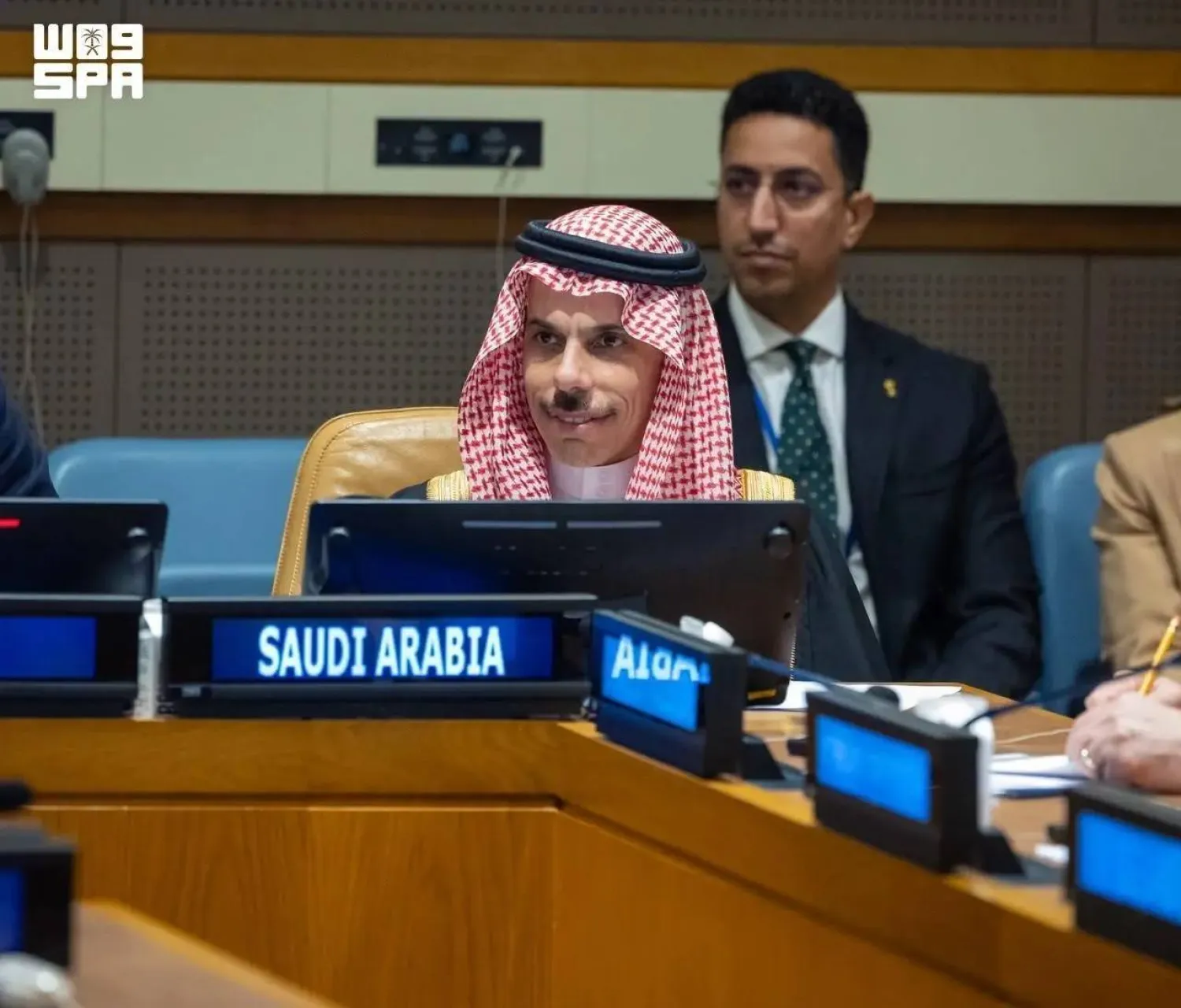
Saudi FM: Palestinian State, End to Occupation Are Pillars of Regional Security, Stability

Saudi Minister of Foreign Affairs Prince Faisal bin Farhan bin Abdullah co-chaired a high-level meeting in New York alongside France, the United Kingdom, and Canada. (SPA)
TT

Saudi FM: Palestinian State, End to Occupation Are Pillars of Regional Security, Stability

Saudi Minister of Foreign Affairs Prince Faisal bin Farhan bin Abdullah co-chaired a high-level meeting in New York alongside France, the United Kingdom, and Canada. (SPA)

Saudi Foreign Minister Prince Faisal bin Farhan bin Abdullah called for the immediate, full implementation of US President Donald Trump’s plan to end the conflict in Gaza and unhindered delivery of humanitarian aid.   

An independent Palestinian state and an end to the occupation are essential to regional security and stability, he said, as Saudi Arabia strengthened coordination with Syria and Türkiye on shared challenges.  

Prince Faisal co-chaired Tuesday’s high-level meeting, “The Road Ahead: One Year after the New York Declaration and the Comprehensive 20-point Peace Plan for Gaza” with France, Britain, and Canada on the sidelines of the 81st UN General Assembly.  

He welcomed moves by France, Britain, Canada and a growing number of other countries to recognize a Palestinian state and strengthen accountability over illegal settlement activity. He urged countries that have yet to recognize Palestine to do so.  

Prince Faisal called for action against settlement expansion, settler violence and annexation policies, and for the preservation of Jerusalem’s historic and legal status quo.   

He also urged all sides to reject violence, hatred and incitement and create conditions for peace and reconciliation.  

On Gaza, he pressed for the peace plan’s full and immediate implementation and unhindered aid access, leading to the unification of Gaza and the West Bank under the Palestinian National Authority.  

Security must rest on interdependence and mutual interests, rather than the security of one side at another’s expense, he said.   

Saudi Arabia would keep working with its partners for a comprehensive, just and lasting peace based on the Arab Peace Initiative, relevant UN resolutions and the New York Declaration — one that ends the conflict, safeguards rights and security for all, and opens the way to regional stability, cooperation and prosperity.  

In a separate meeting in New York, Prince Faisal met Syrian Foreign Minister Asaad al-Shaibani and Turkish Foreign Minister Hakan Fidan.   

They reviewed cooperation among the three countries and opportunities to expand economic and trade ties in support of shared interests, growth and prosperity.  

They also discussed closer coordination to tackle shared challenges and stressed the need to continue consultations and efforts toward regional security and stability.  

Prince Faisal later met with his South Korean counterpart to discuss regional developments and other issues of mutual interest, as well as ways to strengthen bilateral ties. 


Saudi Energy Ministry: East-West Pipeline Targeted, Limited Fire Extinguished

Saudi Energy Ministry: East-West Pipeline Targeted, Limited Fire Extinguished
TT

Saudi Energy Ministry: East-West Pipeline Targeted, Limited Fire Extinguished

Saudi Energy Ministry: East-West Pipeline Targeted, Limited Fire Extinguished

The Saudi Ministry of Energy said on Monday that a limited fire broke out at the East-West pipeline in Madinah following an attack.

Emergency teams successfully extinguished it without any injuries or fatalities.

An official source at the ministry said that "the pipeline's operational activities were unaffected," adding that "emergency teams and specialized technical crews immediately commenced their operations upon the occurrence of the targeting, taking all necessary procedures to secure the site and verify its safety in accordance with approved safety regulations and contingency plans."


Saudi, Omani FMs Discuss Regional Situation

Saudi Minister of Foreign Affairs Prince Faisal bin Farhan bin Abdullah arrives for the G7 foreign ministers summit in Paris, Nov. 9, 2026. (AP)
TT

Saudi, Omani FMs Discuss Regional Situation

Saudi Minister of Foreign Affairs Prince Faisal bin Farhan bin Abdullah arrives for the G7 foreign ministers summit in Paris, Nov. 9, 2026. (AP)

Saudi Minister of Foreign Affairs Prince Faisal bin Farhan bin Abdullah held on Monday a phone call with his Omani counterpart Badr bin Hamad Al Busaidi on regional developments.

They stressed the need to continue diplomatic efforts to contain the crisis, safeguard maritime navigation and shipping routes, and limit the impact of these developments on regional security and stability.


Riyadh and Moscow Look to Shape a New Century of Cooperation, Coordination

Saudi Crown Prince Mohammed bin Salman meets with Russian President Vladimir Putin at Al-Yamamah Palace in Riyadh in 2023 (SPA)
TT

Riyadh and Moscow Look to Shape a New Century of Cooperation, Coordination

Saudi Crown Prince Mohammed bin Salman meets with Russian President Vladimir Putin at Al-Yamamah Palace in Riyadh in 2023 (SPA)

Experts and diplomats said the centennial of Saudi-Russian diplomatic relations offers an opportunity to assess the partnership's evolution, examine how the two countries have adapted to regional and international changes, and explore new areas of mutual interest.

Participants in a webinar titled "Saudi-Russian Relations: A Future Vision," organized Monday by the Riyadh-based Gulf Research Center (GRC), said coordination between Riyadh and Moscow has helped stabilize energy markets and enabled the two countries to manage shared interests despite differences over regional and international issues.

Dr. Abdulaziz Sager, chairman of the Gulf Research Center, said the centennial provides an opportunity to review the relationship's development and assess both countries' ability to respond to changing circumstances and capitalize on opportunities for cooperation.

He noted that reciprocal visits by the two countries' leaders and cooperation within OPEC+ have marked important milestones in the development of political and economic ties.

Sager said cooperation has continued despite the countries' differing alliances, citing the war in Ukraine and Saudi Arabia's consistent calls for a political settlement through dialogue.

He argued that their energy partnership extends beyond managing oil markets, demonstrating Riyadh and Moscow's ability to sustain economic cooperation despite political differences.

On regional issues, Sager said the two countries share positions on supporting a two-state solution, Red Sea security, and the protection of international shipping and trade.

However, he stressed the need for more candid dialogue on areas of disagreement, particularly Russia's relations with Iran.

He expressed hope that Moscow would use its influence with Tehran to encourage it to respect the sovereignty of regional states and act as a responsible member of the international community.

On the economic front, Sager said bilateral trade remains below the two countries' potential.

Citing official figures, he noted that Saudi imports from Russia exceeded SAR 12 billion, while Saudi exports to Russia amounted to no more than SAR 274 million.

He identified energy, investment, industry, mining, food security and tourism as promising areas for cooperation, calling for existing understandings to be translated into concrete projects and for a more balanced trade relationship.

Saudi Ambassador to Russia Sami Al-Sadhan said the presentation of a document of recognition to King Abdulaziz by Karim Khakimov in 1926 marked the historic beginning of bilateral relations, with the Soviet Union becoming the first country to recognize the Kingdom.

He highlighted several important milestones in the relationship, including high-level visits, most notably those by Custodian of the Two Holy Mosques King Salman bin Abdulaziz and the Crown Prince to Russia in 2017.

Al-Sadhan said the visits focused on deepening the partnership in areas including OPEC+ cooperation, technology, investment and cultural exchange.

He also pointed to growing ties across several sectors, the launch of direct flights between the two countries, and the entry into force of a mutual visa-waiver agreement on May 11, 2026.

The ambassador said the achievements of the past century provide a foundation for strengthening mutual trust and expanding cooperation over the next 100 years.

For his part, Aslan Aziev, senior counsellor at the Russian Embassy in Riyadh, said the political dialogue initiated by the two countries' leaders forms the foundation of their partnership strategy.

He noted that Saudi Arabia and Russia, as major oil producers and leading members of OPEC+, play an important role in supporting the stability of oil markets and the broader energy sector.

Aziyev said bilateral engagement has expanded to industry, agriculture, investment, digitalization and trade.

He cited the participation of 70 Russian companies and 170 Saudi companies in an industrial exhibition held in Riyadh in 2026, as well as Saudi Arabia's designation as guest of honor at the St. Petersburg International Economic Forum.

On regional affairs, Aziyev said Moscow and Riyadh maintain dialogue on security and stability, adding that the Gulf is a priority in Russian foreign policy.

He expressed confidence that sustained dialogue and mutual respect would continue to strengthen trust between the two countries despite their differences.

Former Saudi ambassador and minister Abdulaziz Khoja recalled his diplomatic experience in Moscow, saying he was appointed the Kingdom's first ambassador to the Soviet Union after a decades-long break in relations.

Khoja said he arrived in Moscow as the Soviet Union was disintegrating and recalled that President Boris Yeltsin welcomed him and ordered officials to facilitate the opening of the Saudi Embassy and provide the necessary support for its staff.

He described the task of restoring momentum to bilateral relations as an immense responsibility during a particularly difficult period in Russia's history.