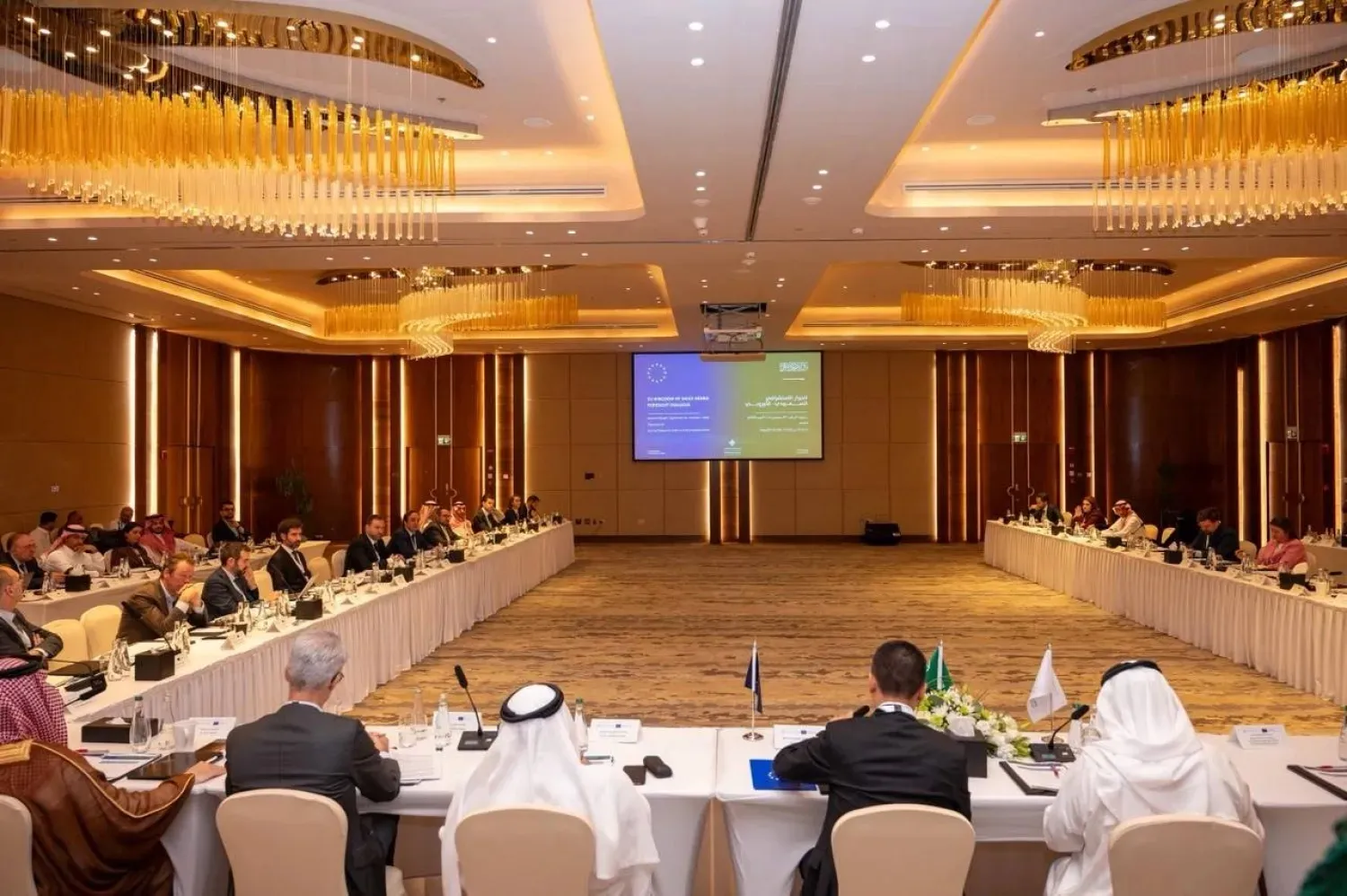
Di Maio Tells Asharq Al-Awsat: Saudi Summit to Drive More Ambitious Gulf-EU Partnership

Geopolitical shifts call for stronger cooperation between Europe and Gulf states, Di Maio says (Gulf Research Center)
TT

Di Maio Tells Asharq Al-Awsat: Saudi Summit to Drive More Ambitious Gulf-EU Partnership

Geopolitical shifts call for stronger cooperation between Europe and Gulf states, Di Maio says (Gulf Research Center)

The upcoming Gulf-EU summit in Saudi Arabia carries added weight amid regional turmoil, with both sides seeking a stronger partnership spanning security, defense, the economy, new technologies and artificial intelligence, said Luigi Di Maio, the European Union’s special representative for the Gulf region.


Speaking to Asharq Al-Awsat on Wednesday at the Saudi-European Foresight Dialogue in Riyadh, organized by the Gulf Research Center and the EU, Di Maio said European leaders’ attendance would underscore the importance both sides placed on their ties.


It would also signal solidarity and political support for countries in the region, particularly Saudi Arabia, amid current developments.


Riyadh will host the second Gulf-EU summit in October, bringing together monarchs and heads of state and government from both sides.


Di Maio said regional conditions made the summit all the more important, with European leaders’ participation demonstrating both the strength of the relationship and support for Gulf countries, especially Saudi Arabia.


High ambitions


The summit comes two years after the first meeting of the Gulf Cooperation Council and EU leaders in Brussels, which set the stage for regular summits.


Di Maio said that the meeting established a two-year cycle, with Saudi Arabia set to host the second summit.


He declined to disclose the main agenda items while preparations and negotiations were underway, but said both sides wanted a highly ambitious summit.


Geopolitical upheaval


Di Maio linked closer Gulf-EU ties to rapid shifts in the international order, saying the two regions faced shared security challenges that demanded stronger cooperation.


He described a new era in which the world was moving from multilateralism toward a multipolar order, exposing Europe and the Gulf to upheaval from accelerating geopolitical changes.


Both regions would be better placed to confront those challenges together, he said, with each needing stronger cooperation with the other.


From defense to AI


Di Maio said the scope for cooperation extended well beyond politics and security, encompassing the economy, defense, ties between people and modern technologies.


He called for stronger partnerships across those fields, including the race in artificial intelligence, as well as closer links between universities and businesses in the two regions.


Many initiatives were already underway among European and Gulf institutions, companies and communities, he said.


The time had come to bring them into a more structured, integrated partnership, building on the strategic partnership for peace and prosperity agreed by leaders at the first summit.


Greater European involvement


Abdulaziz bin Sager, chairman of the Gulf Research Center, called for Gulf-EU agreement on key regional issues.


He pointed to France’s support for Saudi efforts toward a two-state solution and work to advance it in New York, alongside several countries’ recognition of a Palestinian state.


In a separate interview with Asharq Al-Awsat, bin Sager said priorities included building a shared understanding of Gulf security and addressing Iranian attacks on regional countries, the closure of the Strait of Hormuz and Tehran’s use of proxies to obstruct shipping through the Bab al-Mandab Strait.


Those actions affected the global economy, freedom of navigation and political positions, he said.


He called for commitments to translate into active participation in safeguarding maritime navigation. The European Aspides mission was a capable force, he said, but needed to double its capabilities.


“Europeans also benefit from the security of maritime routes. Protecting navigation is an international responsibility, not Saudi Arabia’s alone,” he said.


UK Boosts Its Defensive Military Support to Saudi Arabia

09 June 2026, Brandenburg, Schoenefeld: A Eurofighter Typhoon flies over the grounds of Berlin ExpoCenter Airport the day before the International Aerospace Exhibition begins. (dpa)
TT

UK Boosts Its Defensive Military Support to Saudi Arabia

09 June 2026, Brandenburg, Schoenefeld: A Eurofighter Typhoon flies over the grounds of Berlin ExpoCenter Airport the day before the International Aerospace Exhibition begins. (dpa)

Britain announced Tuesday that it is expanding military support for Saudi Arabia against the Houthis to include “defensive” air patrols by Royal Air Force jets.

Defense Secretary Wes Streeting said Royal Air Force Typhoon jets will “conduct defensive counter-air operations over Saudi Arabia, helping to protect Saudi cities, civilian populations and critical national infrastructure” from missiles and drones fired by the Iran-backed militants in Yemen.

That means the British planes would try to shoot down missiles or drones in the air, but Streeting said the British planes won’t strike Houthi targets on the ground.

The UK will also send a military transport plane and an unspecified number of military advisers to Saudi Arabia, Streeting said.

The announcement follows Britain’s decision last month to offer in-air refueling of Saudi planes operating against the Houthis. That mission is being extended by another 90 days, Streeting said.

The conflict between the Houthis and Yemen’s Saudi-backed government has reignited, with the Houthis aiming missile and drone strikes at Saudi Arabia, including Riyadh airport.

Streeting called the attacks “despicable” and said targeting the airport showed “the lengths the Houthis are going to escalate the situation in the region.”

Streeting said in a written statement to Parliament that “the government remains clear that there is no long-term military solution to the conflict in Yemen.”

“We continue to support a UN-led political process as the best route to a durable peace,” he said.

Egypt has also announced military assistance, saying it will provide “all possible forms of support” to help Saudi Arabia “defend its security and stability.”

President Abdel-Fattah al-Sisi said Saturday that his government would take “any measure” to defend Saudi Arabia and called for parliament to convene to authorize the deployment of troops and military equipment.

Parliament held two days of deliberations and is scheduled to reconvene for a vote next week.


GCC Secretary-General: GCC-UK Relations Built on Cooperation, and Shared Interests

Secretary-General of the Gulf Cooperation Council (GCC) Jasem Albudaiwi. SPA
TT

GCC Secretary-General: GCC-UK Relations Built on Cooperation, and Shared Interests

Secretary-General of the Gulf Cooperation Council (GCC) Jasem Albudaiwi. SPA

Secretary-General of the Gulf Cooperation Council (GCC) Jasem Albudaiwi stated that relations between the GCC states and the United Kingdom (UK) are founded on a long history of cooperation, trust, and shared interests, which has contributed to exploring and establishing a distinguished economic and trade partnership between the two sides.

His remarks came during his opening speech at the GCC-UK Strategic Dialogue, on Tuesday in the British capital, London, in the presence of several ministers from both sides, alongside numerous officials, business leaders, and investors, SPA reported.

During his speech, the secretary-general stated that the foundations of the economic partnership between the two sides bring together the ambitious development visions of the GCC states and the UK’s extensive expertise across a wide range of vital sectors. He noted the importance of strengthening cooperation amid global economic transformations, geopolitical developments, and the challenges confronting trade, investment, and supply chains.

In the same context, he added that the member states continue to advance towards achieving important goals in economic integration, diversifying productive bases, improving business environments, and empowering the private sector, pointing out that the combined gross domestic product (GDP) of the GCC states reached approximately $2.4 trillion, placing them collectively among the world’s 10 largest economies; and the total foreign trade of the GCC states exceeded $1.8 trillion, ranking them collectively fifth globally.

Furthermore, he highlighted efforts to strengthen cybersecurity and the digital economy. This transformation, he explained, supports economic growth and enhanced global competitiveness for the GCC states.

Moreover, he indicated that the total trade volume between the GCC states and the UK reached approximately $70 billion in 2025, making the GCC states collectively the UK’s 10th-largest trading partner; and the total value of investment assets and liabilities between the UK and the GCC reached approximately $643 billion in 2024, reflecting the depth of economic and investment ties between both sides.

Building on this, he stated that the conclusion of negotiations on the GCC-UK Free Trade Agreement (FTA) represents a strategic step towards expanding trade, encouraging investment, and creating new opportunities for the private sector.

He noted that the conclusion of the FTA negotiations is the fruit of sustained joint efforts and intensive negotiations. He expressed his sincere appreciation to the negotiating teams from both sides, and to all the institutions that contributed to this achievement.

According to SPA, he highlighted that this agreement provides for the elimination of customs duties on more than 99% of GCC exports to the UK, which will open broader horizons for increasing non-oil exports, particularly in the aluminum, fertilizer, and manufacturing sectors. He added that the agreement also provides opportunities for logistics and re-exports, while enabling small and medium-sized enterprises to expand their operations and increase their access to the British market.

He further underlined the importance of the FTA, noting that its benefits extend beyond trade to lay a more robust foundation for long-term economic and investment partnerships. These partnerships cover, in particular, advanced manufacturing, the digital economy and artificial intelligence, clean energy, financial services, education, food security, and logistics. He stressed that these sectors support joint investment, technology and knowledge transfer, and building stronger productive capacities.


Erdogan Submits Makkah Joint Defense Agreement to Parliament for Ratification

Saudi Crown Prince Mohammed bin Salman, Turkish President Recep Tayyip Erdogan and Pakistani Prime Minister Shehbaz Sharif following the signing of the Makkah Agreement (Turkish Presidency)
TT

Erdogan Submits Makkah Joint Defense Agreement to Parliament for Ratification

Saudi Crown Prince Mohammed bin Salman, Turkish President Recep Tayyip Erdogan and Pakistani Prime Minister Shehbaz Sharif following the signing of the Makkah Agreement (Turkish Presidency)

Turkish President Recep Tayyip Erdogan on Tuesday submitted the Makkah Joint Defense Agreement, signed by Saudi Arabia, Türkiye and Pakistan on August 7, to parliament for ratification.

Burhanettin Duran, head of Türkiye's Presidential Directorate of Communications, said the submission of the bill to ratify the agreement marked an important step toward institutionalizing strategic cooperation among the three brotherly countries.

"This strategic partnership between our countries aims to strengthen collective deterrence, enhance joint defense capabilities, and protect security and stability in our region," Duran said.

In a statement posted on his X account, Duran explained that the Makkah Agreement, based on the principle that countries in the region should assume responsibility for regional affairs, reflects a shared commitment to prioritizing security and solidarity.

"We hope that the parliamentary ratification process will benefit our country and our brotherly nations, Saudi Arabia and Pakistan. I would also like to extend my sincere thanks in advance to all political parties and members of parliament who will contribute to this process," he added.

Parliamentary sources said Parliament Speaker Numan Kurtulmus, who is currently on an official visit to Kyrgyzstan, would refer the bill to the Foreign Affairs Committee upon his return.

The committee, chaired by former Foreign Minister Mevlut Cavusoglu, will discuss the legislation before it is submitted to a plenary session for ratification.

The Makkah Joint Defense Agreement contains several key provisions, including one stipulating that an attack on any signatory country is considered an attack on all three, similar to Article 5 of the North Atlantic Treaty Organization (NATO).

Other provisions cover joint weapons production, technology transfers between defense industry companies, military training, joint exercises, specialized military personnel development, intelligence sharing and counterterrorism cooperation.

On the eve of the bill's submission to parliament, Turkish Foreign Minister Hakan Fidan and Saudi Foreign Minister Prince Faisal bin Farhan discussed regional security issues.

According to Turkish Foreign Ministry sources, the two ministers focused during a telephone call on Monday on Houthi attacks targeting Saudi Arabia's sovereignty and territorial integrity.

In a related development, President Erdogan strongly condemned the Houthi attacks, noting that the strike on King Khalid International Airport in Riyadh had killed several people, including Umrah pilgrims, and left hundreds wounded.

Speaking at a meeting with village heads at the presidential complex late Monday, Erdogan said the Houthi attacks against Saudi Arabia, which he described as a friend and brotherly nation, had significantly heightened tensions in the region.