Energy, Real Estate Lead Sectors Luring Foreign Flows into Egypt

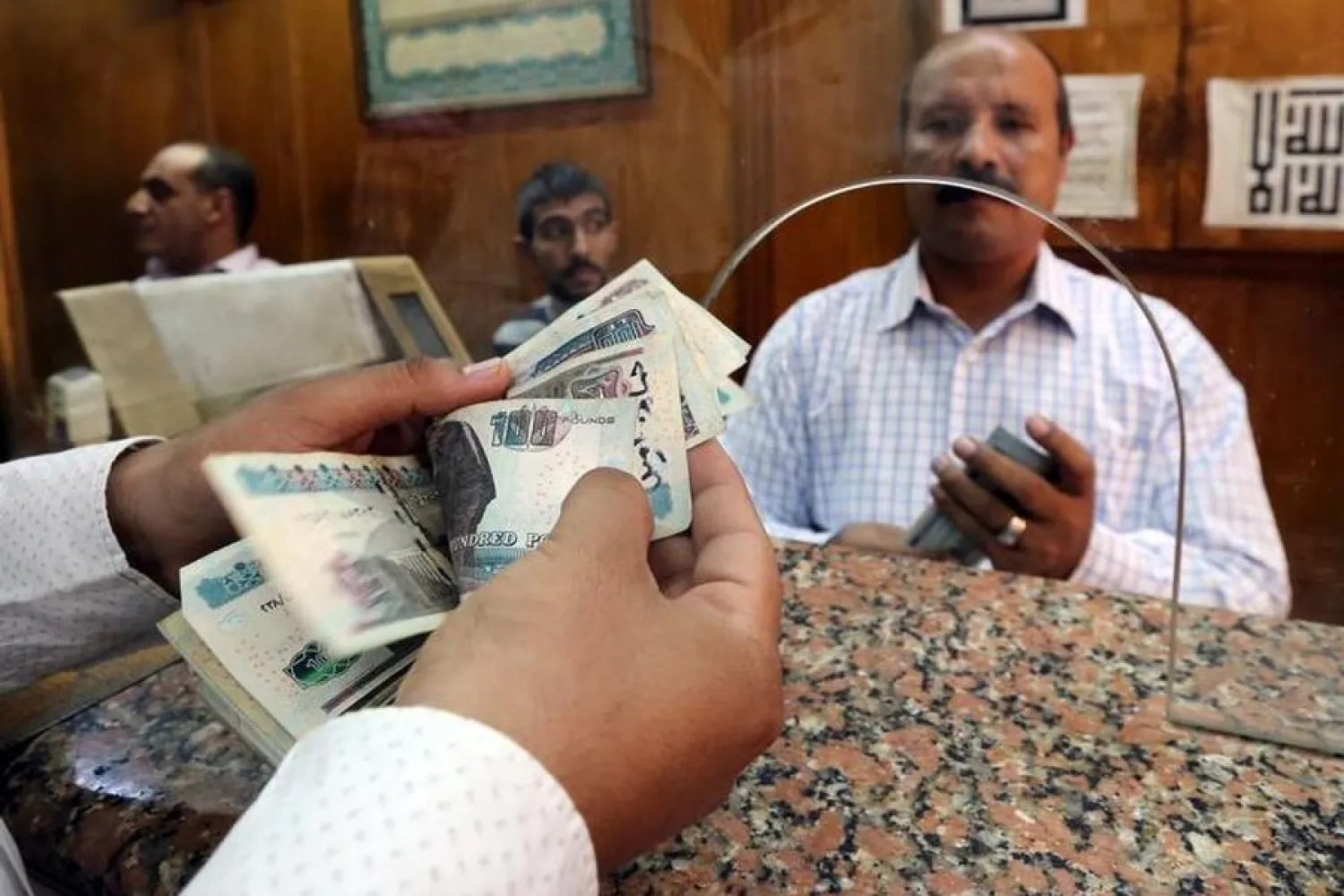
An employee counts Egyptian pounds in a bank in Cairo, Egypt, November 3, 2016. (Reuters)
TT

Energy, Real Estate Lead Sectors Luring Foreign Flows into Egypt

An employee counts Egyptian pounds in a bank in Cairo, Egypt, November 3, 2016. (Reuters)

International investment institutions expected Egypt to witness a significant economic improvement starting next year in terms of foreign investment inflows, especially in the oil and gas, real estate and consumer product sectors. They also forecast inflation rates to fall sharply in the Egyptian markets followed by a sharp cut of interest rates by the Central Bank of Egypt, from nearly 20 percent now to around 10 percent by the end of 2019.

In a report on the Egyptian economy, Renaissance Capital, an investment firm specialized in emerging markets, predicted that in the coming period Egypt would witness an increase in inflows driven by the new discoveries of oil and gas fields, especially after the Egyptian government solved the debts crisis with the international oil companies and paid the largest share of dues. The real estate, retail and consumer product sectors come next on the list of foreign investors’ interests.

Renaissance Capital said more than 50 percent of foreign direct investment that flowed into Egypt in the fourth quarter of 2016 ($ 4.1 billion) went to the oil and gas sector. The firm pointed out that Britain, the United States and Belgium are among the biggest contributors to foreign direct investment in Egypt, while the UAE is the largest contributor among the Gulf Cooperation Council countries. It also noted that Britain has always been the largest contributor to foreign direct investment in Egypt, as its investments during the first quarter of 2017, acquired 55 percent of the total foreign direct investment of $1.8 billion, followed by the United States by 14 percent and $482 million.

The report showed that with many multi-national companies operating in the Egyptian market in the food sector, the retail sector may see significant investments in the coming years, as Egypt is still in the early stages of growth in the modern retail sector. The banking sector is also witnessing great opportunities due to the operations of mergers and acquisitions taking place in the country.

London-based Capital Economics, expected the Egyptian central bank's monetary policy committee to smoothen the monetary policy by the end of the year by cutting interest rates more than expected.

In a report issued on Sunday, it said the decision of the policy committee at its meeting last Thursday not to change the lending and deposit rates (18.75 percent for deposits and 19.75 percent for overnight lending) came with the possibility of a sharp drop in inflation over a period of six to nine months. It also expected interest rates to fall to 12.75 percent by the end of 2018 and 10.20 percent by the end of 2019.

Capital Economics said that the Central Bank's decision to fix the interest rate came despite the significant increase in inflation in the past month on an annual basis, since the Policy Committee had not found any need for more policy restrictions. The last raise in interest rate was 200 basis points last month, which came in anticipation of the recent increase in inflation.

Capital Economics predicted that inflation in Egypt would begin to fall more quickly than expected, pointing out that inflation in Egypt had peaked, and that its decline promises a large financial recovery that would help the Egyptian economy.


Oil Falls as Trump Downplays Prospect of Escalation with Iran

Oil prices are set for a sharp weekly decline amid expectations of a de-escalation in the Iran war following election losses suffered by Trump's party (Reuters).
TT

Oil Falls as Trump Downplays Prospect of Escalation with Iran

Oil prices are set for a sharp weekly decline amid expectations of a de-escalation in the Iran war following election losses suffered by Trump's party (Reuters).

Oil prices fell on Tuesday, adding to the previous day's losses after US President Donald Trump downplayed the need for military action against Iran "at this point", easing fears of sustained supply disruptions in the Middle East.

Brent crude futures declined 70 cents, or 0.75%, to $91.88 a barrel by 0246 GMT, while US West Texas Intermediate (WTI) futures fell 78 cents, or 0.90%, to $86.07 a barrel. Both benchmarks had fallen 1% earlier in the session.

Brent settled down 5.85% in the previous session after sliding to its lowest since ‌August 31.

Trump said ‌on Monday he plans to hold off ‌on ⁠new military strikes against ⁠Iran for the time being after appeals from countries in the region, including from Qatar's prime minister in White House talks.

Trump, in a Reuters interview and a later appearance in the White House press briefing room, said he plans to keep up a naval blockade in the Strait of Hormuz for now.

"The market continues to prioritize President Trump's ⁠more conciliatory tone toward Iran since the midterms," ‌said Tim Waterer, chief market analyst at ‌KCM Trade.

"While attacks on shipping around the Strait of Hormuz are still occurring, ‌they have not escalated in a way that has forced a ‌fresh risk premium into the market," he said.

On the supply side, OPEC oil output rose in October, a Reuters survey found, led by gains in Saudi Arabia, Kuwait and Iraq despite continued constraints on exports.

Brent has retreated ‌about 22% from the six-month high of $118 it touched on October 30 as fears that ⁠Trump might step ⁠up attacks on Iran following the US midterms have eased, however there is still concern shipping could be disrupted.

"Despite the recent selloff, prices are unlikely to fall below $90 per barrel for Brent without more durable signs of de-escalation and a US-Iran deal," Gregory Brew, a senior analyst with Eurasia Group said in a note.

"At the same time, risks to shipping remain high, as Iran continues to attack vessels transiting the Strait of Hormuz," Brew said.

Elsewhere, Russian and Ukrainian officials planned to meet on Tuesday for two days of US-brokered talks — their first since February — after Trump suggested last week that a broad peace deal was possible in their 4-1/2-year-old war and could incorporate Europe's security.


HUMAIN Secures $667 Million Infra Financing to Advance Saudi Arabia’s AI Infrastructure

A photo taken during the signing ceremony of the two agreements in Riyadh (SPA) 
TT

HUMAIN Secures $667 Million Infra Financing to Advance Saudi Arabia’s AI Infrastructure

A photo taken during the signing ceremony of the two agreements in Riyadh (SPA) 

The National Infrastructure Fund (Infra) and HUMAIN, a PIF company delivering full-stack artificial intelligence capabilities globally, signed on Monday two financing agreements totaling up to SAR 2.5 billion ($667 million) to support AI computing deployment and the development of critical power infrastructure in Saudi Arabia.

The agreements were signed in Riyadh in the presence of Governor of the Public Investment Fund, Yasir Al-Rumayyan, Minister of Economy and Planning and Chairman of Infra’s Board of Directors, Faisal bin Fadhil Alibrahim and Governor of the National Development Fund, Abdulaziz Alarifi.

The facilities are the first transactions announced under Infra’s AI Data Center Financing Program. They build on the strategic financing framework announced by Infra and HUMAIN at Davos in January 2026, which outlined non-binding financing terms of up to SAR 4.5 billion ($1.2 billion) to support AI and digital infrastructure projects in the Kingdom.

The GPU financing facility, of up to SAR 1.1 billion ($293.3 million), will support the procurement and deployment of graphics processing units (GPUs), representing approximately 25 MW of IT load.

A second facility of up to SAR 1.4 billion ($373.3 million), will finance the development of substations, transmission infrastructure and grid connections to support HUMAIN’s AI data centers in Saudi Arabia.

The planned power infrastructure is designed to support future data center development with up to 1 GW of IT capacity, helping create the conditions for investment by developers, hyperscalers and institutional investors.

“Through these agreements, we aim to unlock investment well beyond Infra’s own commitment,” said Chief Executive Officer of Infra, Engineer Esmail bin Mohammed Alsallom.

He noted that supporting HUMAIN’s computing deployment alongside essential power infrastructure helps prepare a broader pipeline of data center projects for investment.

“Our role is to strengthen project readiness and bankability, with commercial viability and economic value guiding how we deploy our capital,” Alsallom said, adding that this partnership connects Infra’s priorities with commercial discipline, helping build a financing market that can attract a broader pool of private and institutional capital and sustain the local AI infrastructure growth.

For his part, Chief Executive Officer of HUMAIN, Tareq Amin, said that AI infrastructure is becoming foundational to the next generation of computing, and scaling it requires both significant investment and the infrastructure to support it.

“These facilities with Infra will help accelerate the deployment of advanced computing capacity and the power infrastructure required to support it. At HUMAIN, we are focused on building and operating AI infrastructure at scale, while developing the technologies and platforms that enable organizations and customers globally to put AI to work,” he added.


Lucid Gets Crucial $1.75 Billion Liquidity Boost From PIF

A Lucid Air Grand Touring electric car is displayed during the New York International Auto Show in New York City, US, April 1, 2026. REUTERS/Jeenah Moon/File Photo 
TT

Lucid Gets Crucial $1.75 Billion Liquidity Boost From PIF

A Lucid Air Grand Touring electric car is displayed during the New York International Auto Show in New York City, US, April 1, 2026. REUTERS/Jeenah Moon/File Photo 

Lucid Group, an American electric vehicle (EV) manufacturer, said on Monday a $1.75 billion increase in a loan facility from Saudi Arabia's Public Investment Fund (PIF), its largest investor, would help fund the ‌electric-vehicle maker into the fourth quarter of 2027, according to Reuters.

The larger delayed-draw term loan lifts the company’s pro forma liquidity to $3.75 billion, strengthening new CEO Silvio Napoli's hand as he seeks to turn around the company facing an industry-wide demand weakness following the expiry of a federal ⁠tax credit last year.

Lucid said it expects its liquidity to fund operations until production of its midsize vehicle begins in the second half of 2027.

The company’s shares were down about 5% in extended trading.

Lucid cut its third-quarter cash outflow to $1.04 billion from $1.48 billion in the previous quarter by cutting production, including eliminating a second shift at its Arizona factory and reducing inventory and operating costs.

“These actions are already showing through in Q3, ‌with ⁠free cash flow consumption 30% lower sequentially,” CFO Alexander De Bock said.

Lucid said it would provide 2027 guidance and a mid-term plan with its year-end results. It had withdrawn its annual production forecast earlier this year amid a sweeping operational ⁠review by its newly appointed CEO.

The company said headcount fell about 28% between the first and third quarters. It said it had achieved $800 million of a targeted $1.4 ⁠billion cash flow improvement this year through lower inventory, operating costs and capital spending.

New chief technology, finance, customer and transformation officers joined early in ⁠the third quarter, the company said. Lucid is also cutting management layers and tying incentives to four priority projects.