


Player Simulation Continues to Fool Football Association

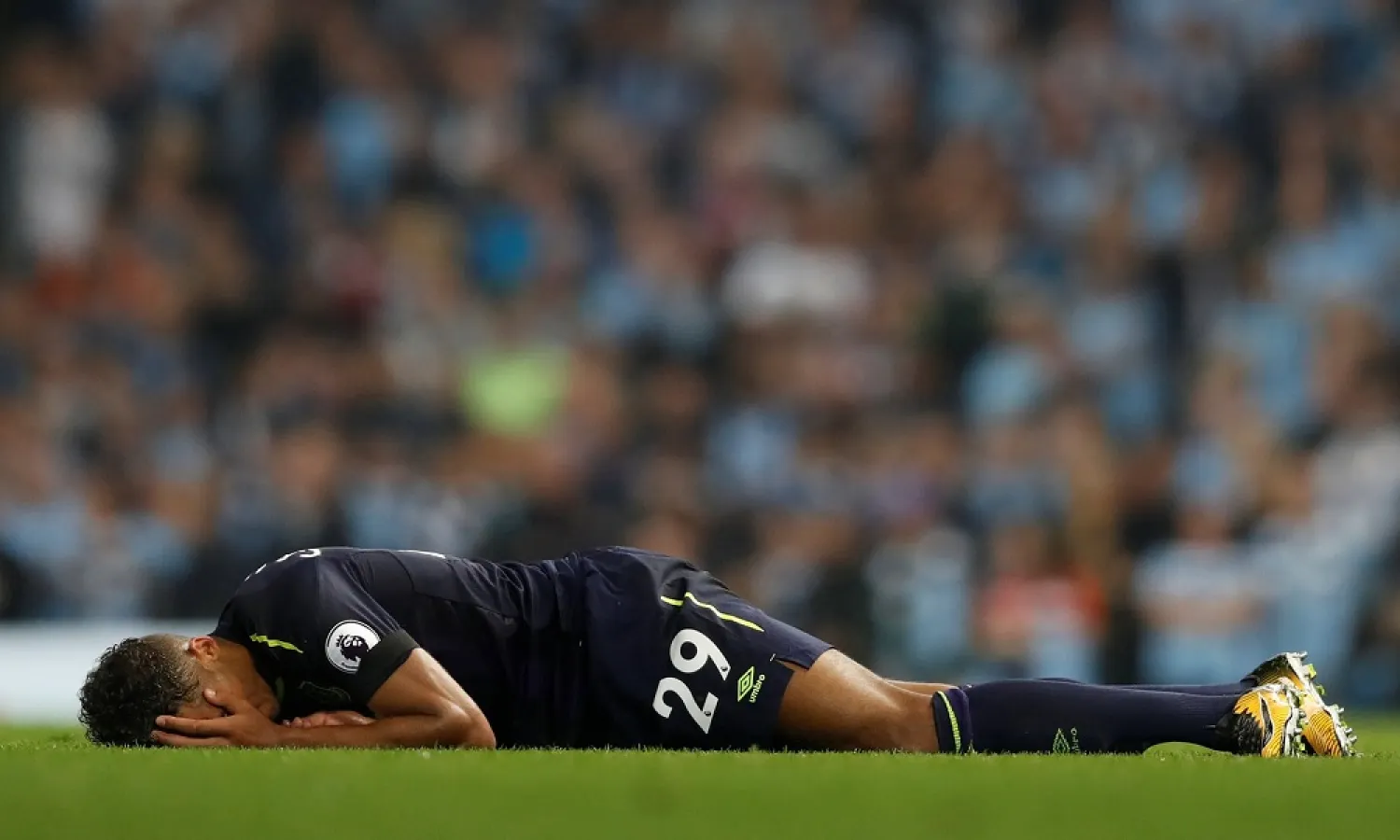
Everton’s Dominic Calvert-Lewin lies on the ground after a coming together with Manchester City’s Kyle Walker, who was shown a second yellow card for the incident. (Reuters)
TT

Player Simulation Continues to Fool Football Association

Everton’s Dominic Calvert-Lewin lies on the ground after a coming together with Manchester City’s Kyle Walker, who was shown a second yellow card for the incident. (Reuters)

What a disappointment. Only three weeks into the Premier League season and already it looks as if the Football Association’s initiative on diving and simulation is struggling to keep pace.

Towards the end of last season we were told, if you recall, that the FA now had powers that would permit it to punish divers and cheaters retrospectively with two-match bans, subject to their attempts to con referees being exposed by video replays to the satisfaction of a panel of experts.

The intention, it was made clear, was to charge players believed to have cheated to win a penalty or get a player sent off, be that for a straight red card or a second yellow. A new offense would appear on the FA charge sheet, to wit: “Successful deception of a match official.”

One suspected at the time that such a tricky area might not prove so simple to police, and those fears were borne out in the 1-1 draw between Manchester City and Everton at the Etihad on Monday night. Most commentators on television and in print concluded that Everton’s Dominic Calvert-Lewin had exaggerated both the force and the nature of contact with Kyle Walker to deceive the match officials into thinking some sort of assault had taken place, possibly an elbow to the face. As a result the City player received a second yellow shortly after his first one, and the home side had to play more than 50 minutes with 10 men. When Everton themselves went down to 10 men a couple of minutes before the end of normal time there was a vehement protest from Morgan Schneiderlin that Sergio Agüero had also given the impression he had been kicked when in fact he had not. That incident was less crucial given the stage of the game by then, but few disagreed with Ronald Koeman’s suggestion that the referee, Bobby Madley, had attempted to even up the situation in recognition of his earlier mistake.

A bit of a mess, then, with Pep Guardiola refusing to discuss the officials’ performance or the disciplinary aspects of a feisty game, and Gary Neville suggesting on Sky the “high hurdle” it is supposed to require for a player to receive a second yellow when already on a booking had not been reached. That high hurdle would have been reached had Walker actually elbowed Calvert-Lewin, though television replays clearly established that he had not. One for the peacekeepers at the FA to sort out, surely.

Or perhaps not. It turns out neither incident was clear-cut enough for the governing body’s new machinery to get involved, because while the degree of fouling in each case was debatable, some contact was made on both occasions so it is apparently far too risky to go around accusing anyone of diving. Quite clearly, what the FA needs before it wheels its panel of experts into action is a bona fide dive, one with a take-off, a flight and a landing, quite possibly with a half-pike or two in the middle. At which point, presumably, the panel will respond with scores out of 10, including marks for artistic impression.

What this means in practice is the FA will take action over swan dives in search of penalties, the sort of thing that is usually easy to spot with a couple of television replays anyway if there is no actual contact, but stay away from more difficult areas such as players overreacting to challenges from opponents who have already been booked. That, too, is unsporting conduct. And by falling poleaxed to the floor clutching his face, Calvert-Lewin appeared to have deceived the match officials, whether or not he realized he was going to get Walker dismissed. Agüero’s overreaction, if that is what it was, seemed less reprehensible. Schneiderlin did catch him on the follow-through, and though it did not appear the most heinous act or obvious of fouls, modern professionals know they have to draw the referee’s attention to contact if they expect to win a free-kick.

That, however, is not what Calvert-Lewin seemed to be doing. The FA probably needs to add another new offense to its charge sheet as soon as possible. It should be known as “doing a Rivaldo”, in the same way that chipped penalties are now named after Antonin Panenka, and it should lead to an extremely dim view being taken of players who clutch their face in an attempt to convince the referee that they have been struck rather than simply touched. It is hard to know exactly what Calvert-Lewin was thinking without asking him, but one could readily understand why both Madley and his fourth official reached the conclusion that an elbow might have been involved. It is not always easy for referees to spot everything that takes place on the pitch but that is precisely why it was anticipated that television replays might come in handy after the event.

If we are not going to get such situations reviewed, there is probably no need for a panel of experts after all. Most people sitting at home in their armchairs are able to spot the more blatant dives. If the FA is serious about tackling simulation/cheating/deception, call it what you will, it ought to realize that not everything worth investigation takes place in the penalty area and that players who have already been booked just might be being targeted by opponents.

Retrospective trial by video might still have its uses, though. It would be worth pursuing if only to deter the face-clutchers. A clearer case of attempting to deceive the referee is hard to imagine and it would be relatively easy to stamp out. If the standard punishment for being caught doing a Rivaldo was a two-match ban, dished out retrospectively if necessary, referees would suddenly find their jobs a whole lot easier.

The Guardian Sport


Shakhtar Boss Pays Ukrainian Racer $200,000 After Games Disqualification

Ukrainian President Volodymyr Zelenskiy holds helmet as he meets with a Ukrainian skeleton racer Vladyslav Heraskevych , who was disqualified from the Olympic skeleton competition over his "helmet of remembrance" depicting athletes killed since Russia's invasion and his father and coach, Mykhailo Heraskevych, amid Russia's attack on Ukraine, in Munich, Germany February 13, 2026. (Ukrainian Presidential Press Service/Handout via Reuters)
TT

Shakhtar Boss Pays Ukrainian Racer $200,000 After Games Disqualification

Ukrainian President Volodymyr Zelenskiy holds helmet as he meets with a Ukrainian skeleton racer Vladyslav Heraskevych , who was disqualified from the Olympic skeleton competition over his "helmet of remembrance" depicting athletes killed since Russia's invasion and his father and coach, Mykhailo Heraskevych, amid Russia's attack on Ukraine, in Munich, Germany February 13, 2026. (Ukrainian Presidential Press Service/Handout via Reuters)

The owner of ‌Ukrainian football club Shakhtar Donetsk has donated more than $200,000 to skeleton racer Vladyslav Heraskevych after the athlete was disqualified from the Milano Cortina Winter Games before competing over the use of a helmet depicting Ukrainian athletes killed in the war with Russia, the club said on Tuesday.

The 27-year-old Heraskevych was disqualified last week when the International Bobsleigh and Skeleton Federation jury ruled that imagery on the helmet — depicting athletes killed since Russia invaded Ukraine in 2022 — breached rules on athletes' expression at ‌the Games.

He ‌then lost an appeal at the Court ‌of ⁠Arbitration for Sport hours ⁠before the final two runs of his competition, having missed the first two runs due to his disqualification.

Heraskevych had been allowed to train with the helmet that displayed the faces of 24 dead Ukrainian athletes for several days in Cortina d'Ampezzo where the sliding center is, but the International Olympic Committee then ⁠warned him a day before his competition ‌started that he could not wear ‌it there.

“Vlad Heraskevych was denied the opportunity to compete for victory ‌at the Olympic Games, yet he returns to Ukraine a ‌true winner," Shakhtar President Rinat Akhmetov said in a club statement.

"The respect and pride he has earned among Ukrainians through his actions are the highest reward. At the same time, I want him to ‌have enough energy and resources to continue his sporting career, as well as to fight ⁠for truth, freedom ⁠and the remembrance of those who gave their lives for Ukraine," he said.

The amount is equal to the prize money Ukraine pays athletes who win a gold medal at the Games.

The case dominated headlines early on at the Olympics, with IOC President Kirsty Coventry meeting Heraskevych on Thursday morning at the sliding venue in a failed last-minute attempt to broker a compromise.

The IOC suggested he wear a black armband and display the helmet before and after the race, but said using it in competition breached rules on keeping politics off fields of play. Heraskevych also earned praise from Ukraine President Volodymyr Zelenskiy.


Speed Skating-Italy Clinch Shock Men’s Team Pursuit Gold, Canada Successfully Defend Women’s Title

 Team Italy with Davide Ghiotto, Andrea Giovannini, Michele Malfatti, celebrate winning the gold medal on the podium of the men's team pursuit speed skating race at the 2026 Winter Olympics, in Milan, Italy, Tuesday, Feb. 17, 2026. (AP)
Team Italy with Davide Ghiotto, Andrea Giovannini, Michele Malfatti, celebrate winning the gold medal on the podium of the men's team pursuit speed skating race at the 2026 Winter Olympics, in Milan, Italy, Tuesday, Feb. 17, 2026. (AP)
TT

Speed Skating-Italy Clinch Shock Men’s Team Pursuit Gold, Canada Successfully Defend Women’s Title

 Team Italy with Davide Ghiotto, Andrea Giovannini, Michele Malfatti, celebrate winning the gold medal on the podium of the men's team pursuit speed skating race at the 2026 Winter Olympics, in Milan, Italy, Tuesday, Feb. 17, 2026. (AP)
Team Italy with Davide Ghiotto, Andrea Giovannini, Michele Malfatti, celebrate winning the gold medal on the podium of the men's team pursuit speed skating race at the 2026 Winter Olympics, in Milan, Italy, Tuesday, Feb. 17, 2026. (AP)

An inspired Italy delighted the home crowd with a stunning victory in the Olympic men's team pursuit final as

Canada's Ivanie Blondin, Valerie Maltais and Isabelle Weidemann delivered another seamless performance to beat the Netherlands in the women's event and retain their title ‌on Tuesday.

Italy's ‌men upset the US who ‌arrived ⁠at the Games ⁠as world champions and gold medal favorites.

Spurred on by double Olympic champion Francesca Lollobrigida, the Italian team of Davide Ghiotto, Andrea Giovannini and Michele Malfatti electrified a frenzied arena as they stormed ⁠to a time of three ‌minutes 39.20 seconds - ‌a commanding 4.51 seconds clear of the ‌Americans with China taking bronze.

The roar inside ‌the venue as Italy powered home was thunderous as the crowd rose to their feet, cheering the host nation to one ‌of their most special golds of a highly successful Games.

Canada's women ⁠crossed ⁠the line 0.96 seconds ahead of the Netherlands, stopping the clock at two minutes 55.81 seconds, and

Japan rounded out the women's podium by beating the US in the Final B.

It was only Canada's third gold medal of the Games, following Mikael Kingsbury's win in men's dual moguls and Megan Oldham's victory in women's freeski big air.


Lindsey Vonn Back in US Following Crash in Olympic Downhill 

Milano Cortina 2026 Olympics - Alpine Skiing - Women's Downhill 3rd Official Training - Tofane Alpine Skiing Centre, Belluno, Italy - February 07, 2026. Lindsey Vonn of United States in action during training. (Reuters)
TT

Lindsey Vonn Back in US Following Crash in Olympic Downhill 

Milano Cortina 2026 Olympics - Alpine Skiing - Women's Downhill 3rd Official Training - Tofane Alpine Skiing Centre, Belluno, Italy - February 07, 2026. Lindsey Vonn of United States in action during training. (Reuters)

Lindsey Vonn is back home in the US following a week of treatment at a hospital in Italy after breaking her left leg in the Olympic downhill at the Milan Cortina Games.

“Haven’t stood on my feet in over a week... been in a hospital bed immobile since my race. And although I’m not yet able to stand, being back on home soil feels amazing,” Vonn posted on X with an American flag emoji. “Huge thank you to everyone in Italy for taking good care of me.”

The 41-year-old Vonn suffered a complex tibia fracture that has already been operated on multiple times following her Feb. 8 crash. She has said she'll need more surgery in the US.

Nine days before her fall in Cortina d'Ampezzo, Italy, Vonn ruptured the ACL in her left knee in another crash in Switzerland.

Even before then, all eyes had been on her as the feel-good story heading into the Olympics for her comeback after nearly six years of retirement.
