

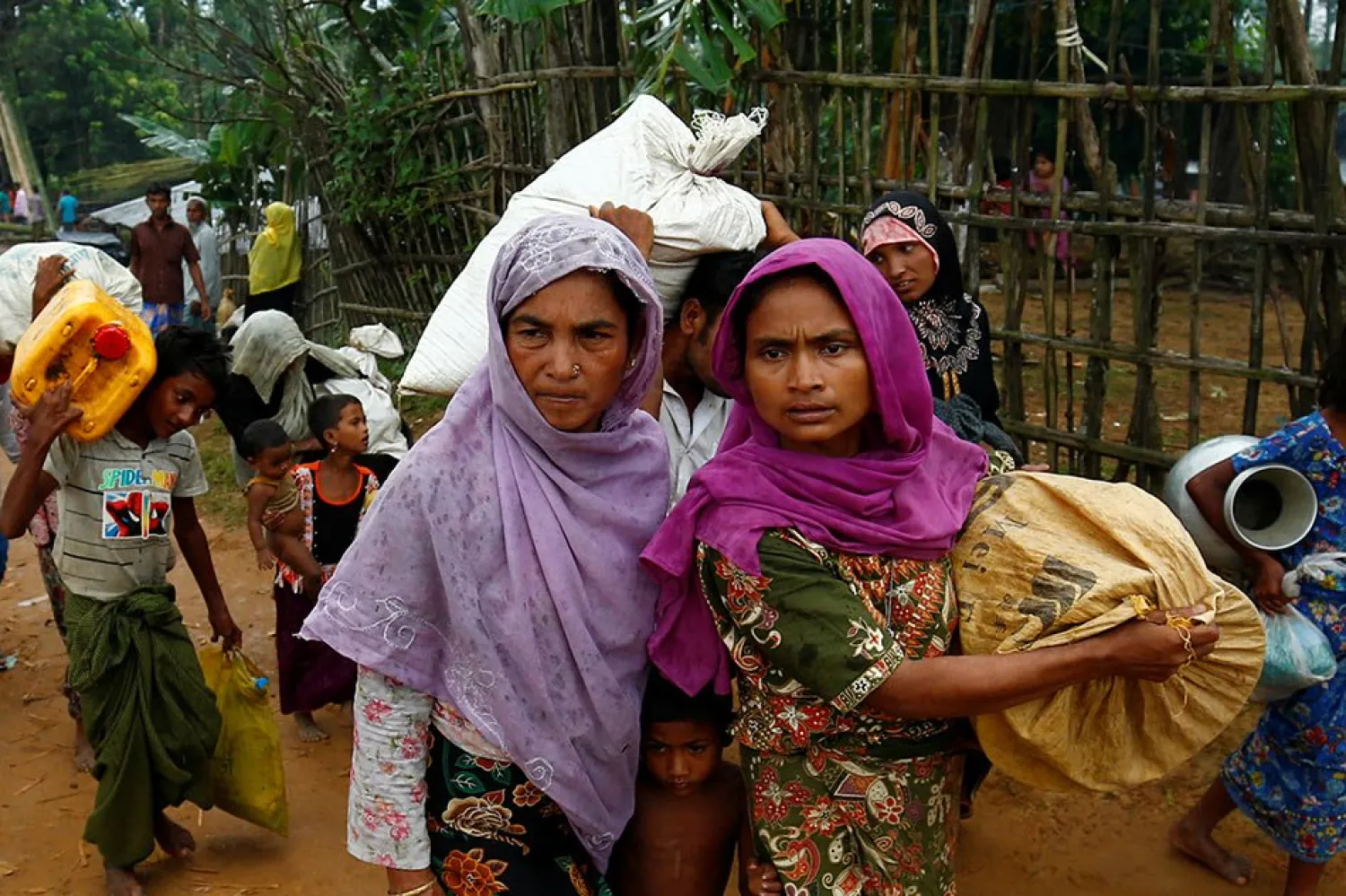

Bangladesh Starts Immunization of Rohingya Refugees amid Health Fears

Rohingya refugees arrive near the a makeshift refugee camp Bangladesh. (Reuters)
TT

Bangladesh Starts Immunization of Rohingya Refugees amid Health Fears

Rohingya refugees arrive near the a makeshift refugee camp Bangladesh. (Reuters)

Authorities in Bangladesh kicked off on Sunday an immunization campaign among Muslim Rohingya refugees as an aid group warned that many could die due to a lack of food, shelter and water.

The campaign started in a crowded border camp as the country struggled to take in more than 400,000 Rohingya, who have fled Myanmar in the last three weeks where they were victims of a government crackdown.

The UN has since described the crisis as ethnic cleansing.

Bangladesh Prime Minister Sheikh Hasina, who lambasted Myanmar for "atrocities" during a visit to border camps last week, left Dhaka to address the annual UN gathering in New York.

Abdus Salam, the top government administrator in the Cox's Bazar district hospital, said that some 150,000 children will be immunized over seven days for measles, rubella and polio. UN says there are some 240,000 children living in dire conditions.

"There are a lot of weak and malnourished children among the new arrivals," UNICEF representative in Bangladesh, Edouard Beigbeder, said in an email. "If proper preventive measures are not taken, highly infectious diseases, especially measles, could even cause an outbreak."

On the first day of the immunization campaign on Saturday, doctors treated some 9,000 children for rubella and nearly 5,000 for polio. Salam said that basic and emergency health services were being provided through 36 medical camps with focus on children and women.

"Many of them are suffering from diarrhea, dehydration and skin diseases. They are coming to hospitals with such complications," he said.

As the weather fluctuates in Cox's Bazar between rains and sunny and humid days, many children are suffering from flu and risk pneumonia, he said.

Two preexisting Rohingya camps were already beyond capacity and the new arrivals were staying in schools or huddling in makeshift settlements with no toilets along roadsides and in open fields.

The refugees began pouring from Myanmar's Rakhine state after a Rohingya insurgent group launched attacks on security posts August 25, prompting Myanmar's military to launch "clearance operations" to root out the rebels. Those fleeing have described indiscriminate attacks by security forces and Buddhist mobs.

The Myanmar government says hundreds have died, mostly "terrorists," and that 176 out of 471 Rohingya villages have been abandoned. Myanmar has insisted that Rohingya insurgents and fleeing villagers themselves are destroying own homes. It has offered no proof to back these charges.

In a state hospital, a Rohingya man who identified himself as Rahmatullah was looking over his 10-year-old son recovering from a bullet that left a deep wound as it pierced his right leg.

"Why did they shoot him? What's his crime? He is just a child," Rahmatullah said. "It was 9 in the morning and I was visiting my neighbor's home at my Baagguna village when they came and started shooting indiscriminately." He said he fled with 10 of his family members.

"I started running for the hill, where I hid myself and later collected my son and others and left," he said.

Eric P. Schwartz, head of the US-based charity Refugees International and a former assistant secretary of state for population, refugees and migration, said he couldn't recall seeing so much misery in the camps and called for international pressure on Myanmar to stop the violence.

He said the US should re-impose sanctions on Myanmar that were in place before it made transition from military to civilian rule. But officials in Washington have been careful not to undermine the weak civilian government of Nobel Peace laureate Aung San Suu Kyi, which took office last year, ending five decades of ruinous army rule. The military remains politically powerful and oversees security operations.

Suu Kyi is due to make her first address to the nation on the crisis on Tuesday.

Mark Pierce, Bangladesh country director for the Save the Children aid agency said in a statement: “Many people are arriving hungry, exhausted and with no food or water.”

“I’m particularly worried that the demand for food, shelter, water and basic hygiene support is not being met due to the sheer number of people in need. If families can’t meet their basic needs, the suffering will get even worse and lives could be lost.”

Pierce said the humanitarian response needed to be rapidly scaled up.

Bangladesh border guards said on Sunday the flow of refugees leaving Myanmar had eased off over the past day, apparently because bad weather had discouraged people from taking to boats to reach Bangladesh.

Human Rights Watch said satellite imagery showed 62 Rohingya villages had been torched since the violence erupted.




Israeli Air Force Deploys First Laser Interception System

FILED - 26 March 2024, Israel, Jerusalem: Israel Katz attends a meeting at a hotel in Jerusalem. Photo: Christoph Soeder/dpa
TT

Israeli Air Force Deploys First Laser Interception System

FILED - 26 March 2024, Israel, Jerusalem: Israel Katz attends a meeting at a hotel in Jerusalem. Photo: Christoph Soeder/dpa

Israel's defense ministry said on Sunday it had deployed a new "Iron Beam" laser system for the air force to intercept aerial threats.

The laser system's main developers, the ministry's research and development department and defense contractor Rafael, delivered it to the air force at a ceremony in northern Israel.

"For the first time globally, a high-power laser interception system has achieved full operational maturity, successfully executing multiple interceptions," Defense Minister Israel Katz said at the ceremony, according to a statement.

"This monumental achievement... delivers a critical message to our enemies, near and far alike: do not challenge us, or face severe consequences," AFP quoted him as saying.

The handover marks a major milestone in a project more than a decade old.
"Israel has become the first country in the world to field an operational laser system for the interception of aerial threats, including rockets and missiles," said Yuval Steinitz, chairman of Rafael.

The laser system seeks to enhance and slash the cost of Israel's interception of projectiles, and will supplement other aerial defense capacities such as the more well-known Iron Dome.

Iron Dome offers short-range protection against missiles and rockets. The David's Sling system and successive generations of Arrow missiles are Israeli-American technology built to bring down ballistic missiles.

The defense ministry announced in early December that the laser system was complete, and would be deployed by the end of the month.

During the 12-day war launched by Israel against Iran in June, the country's missile defense system failed to intercept all the projectiles fired by Tehran toward Israeli territory.

Israel has since acknowledged being hit by more than 50 missiles during the war with Iran, resulting in 28 deaths.


Trump Says Had 'Productive' Call with Putin Ahead of Zelensky Meeting

US President Donald Trump takes part in a Christmas Eve dinner in the ballroom of his Mar-a-Lago club in Palm Beach, Florida, US, December 24, 2025. REUTERS/Jessica Koscielniak
TT

Trump Says Had 'Productive' Call with Putin Ahead of Zelensky Meeting

US President Donald Trump takes part in a Christmas Eve dinner in the ballroom of his Mar-a-Lago club in Palm Beach, Florida, US, December 24, 2025. REUTERS/Jessica Koscielniak

US President Donald Trump said he had a productive telephone call with his Russian counterpart Vladimir Putin on Sunday ahead of a planned meeting in Florida with Ukraine's leader Volodymyr Zelensky.

"I just had a very good and productive telephone call with President Putin of Russia" before the planned talks with Zelensky at Trump's Florida estate at 1:00 pm local time (1800 GMT), the US leader said on Truth Social.

Putin said Ukraine was in no hurry for peace and if it did not want to resolve their conflict peacefully, Moscow would accomplish all its goals by force.

Putin's remarks on Saturday, carried by state news agency TASS, followed a vast Russian drone and missile attack that prompted Zelensky to say Russia was demonstrating its wish to continue the war while Kyiv wanted peace.


Russia Sends 3 Iranian Satellites into Orbit, Report Says

In this photo released by Roscosmos space corporation on Thursday, Feb. 29, 2024, the Soyuz-2.1b rocket blasts off at the Vostochny cosmodrome outside the city of Tsiolkovsky, about 200 kilometers (125 miles) from the city of Blagoveshchensk in the far eastern Amur region, Russia. A Russian Soyuz rocket successfully put an Iranian satellite into orbit along with 18 Russian satellites on Thursday. (Roscosmos space corporation via AP)
TT

Russia Sends 3 Iranian Satellites into Orbit, Report Says

In this photo released by Roscosmos space corporation on Thursday, Feb. 29, 2024, the Soyuz-2.1b rocket blasts off at the Vostochny cosmodrome outside the city of Tsiolkovsky, about 200 kilometers (125 miles) from the city of Blagoveshchensk in the far eastern Amur region, Russia. A Russian Soyuz rocket successfully put an Iranian satellite into orbit along with 18 Russian satellites on Thursday. (Roscosmos space corporation via AP)

Russia on Sunday sent three Iranian communications satellites into orbit, the second such launch since July, Iranian state television reported.

The report said that a Russian rocket sent the satellites to circle the Earth on a 500-kilometer (310-mile) orbit from the Vostochny launchpad in eastern Russia. The three satellites are dubbed Paya, Kowsar and Zafar-2.

The report said that Paya, weighing 150 kilograms (330 pounds), is the heaviest satellite that Iran has ever deployed into orbit. Kowsar weighs 35 kilograms (77 pounds), but the report didn't specify how heavy Zafar-2 is.

The satellites feature up to 3-meter resolution images, applicable in the management of water resources, agriculture and the environment. Their life span is up to five years.

Russia occasionally sends Iran's satellites into orbit, highlighting the strong ties between the two countries. In July, a Russian rocket sent Iranian communications satellite Nahid-2 into orbit.

Russia, which signed a “strategic partnership” treaty with Iran in January, strongly condemned the Israeli and US strikes on Iran that came during a 12-day air war in June and killed nearly 1,100 Iranians, including military commanders and nuclear scientists. Retaliatory missile barrages by Iran killed 28 people in Israel.

As a long-standing project, Iran from time-to-time launches satellite carriers to send its satellites into space.

The United States has said that Iran’s satellite launches defy a UN Security Council resolution and called on Tehran to undertake no activity involving ballistic missiles capable of delivering nuclear weapons. UN sanctions related to Iran’s ballistic missile program expired in 2023.