

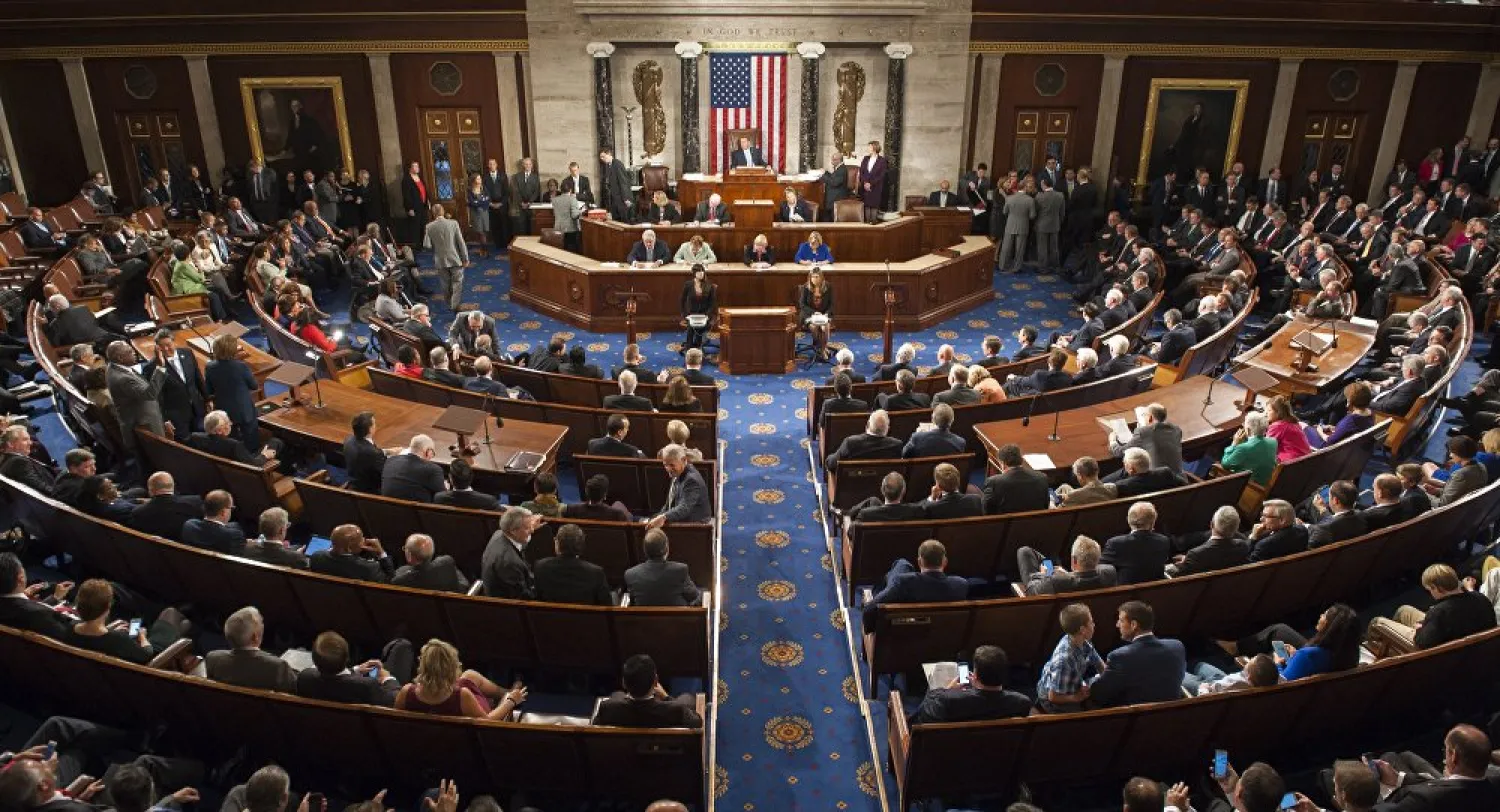

US House Committee to Vote on Hezbollah Sanctions Bill

US House of Representative - AFP 2017/ SAUL LOEB
TT

US House Committee to Vote on Hezbollah Sanctions Bill

US House of Representative - AFP 2017/ SAUL LOEB

US House of Representative Foreign Affairs Committee will vote on Thursday on legislation that tightens sanctions against Hezbollah, which is highly supported by both the Republican and the Democratic parties, according to informed sources.

Two bills were introduced by the committee's chairman Ed Royce along with Democrat Representative Eliot Engel.

The first bill restricts Hezbollah’s ability to fundraise and have access to the international financial system and deal with financial institutions, while the second bill condemns Hezbollah for using civilians as human shields during warfare.

The bills enjoy wide bipartisan support and are expected to pass unanimously. The committee passed a bill in 2015 to sanction Hezbollah without any opposition, and it is unlikely for the new bills to be protested.

Bill number HR 3329 suggests imposing mandatory sanctions with respect to fundraising and recruitment activities of Hezbollah.

Article 101 of the bill imposes sanctions on any foreign person that can be determined knowingly assists, sponsors, or, provides significant financial, material, or technological support for Hezbollah's: Bayt al-Mal, Jihad al-Bina, the Islamic Resistance Support Association, the Foreign Relations Department of Hezbollah, the External Security Organization of Hezbollah, al-Manar TV, al-Nour Radio, or the Lebanese Media Group, or any successor or affiliate.

The bill also dictates that any foreign person determined by the US President to be engaged in fundraising or recruitment activities for Hezbollah or a foreign person owned or controlled by a foreign person should be sanctioned.

Whereas HR 3342 imposes sanctions on foreign persons that are responsible for gross violations of the use of human civilians as human shields by Hezbollah.

The bill dictates: "Identification of foreign persons that are responsible for gross violations of internationally recognized human rights by reason of the use by Hezbollah of civilians as human shields, and for other purposes."

The bill also indicated that throughout the 2006 conflict between Hebzbollah and Israel, Hezbollah utilized human shields to protect themselves from Israeli counterattacks, including storing weapons inside civilian homes and firing rockets from inside populated civilian areas.

Hezbollah has rearmed itself to include an arsenal of over 150,000 missiles provided by the Syrian and Iranian governments. Hezbollah conceals the weapons in Shi’ite villages in southern Lebanon, according to HR 3342.

The bill requires the US administration to consider the use of human shields by Hezbollah as a gross violation of internationally recognized human rights and to officially and publicly condemn the use of innocent civilians as human shields by Hezbollah. It also asks the government to take effective action against those that engage in the breach of international law through the use of human shields.

It also asks the President to direct the US Permanent Representative at the UN to secure support for a resolution that would impose multilateral sanctions against Hezbollah for its use of civilians as human shields.



Sudan Paramilitary Strike on Southeastern City Kills 27

RSF fighters. (AFP file photo)
TT

Sudan Paramilitary Strike on Southeastern City Kills 27

RSF fighters. (AFP file photo)

Sudan's paramilitary Rapid Support Forces launched drones at an army base in the southeastern city of Sinja on Monday, killing 27 people, military and health sources told AFP.

Sinja, the capital of Sennar state, lies around 300 kilometers (180 miles) southeast of the capital Khartoum, along a strategic road connecting the national capital to the army-controlled east.

The strike comes a day after the army-aligned government announced its return to Khartoum after close to three years operating from its wartime base in the eastern city of Port Sudan.

Since April 2023, the war between the army and the RSF has killed tens of thousands of people, displaced 11 million internally and across borders, and created the world's largest displacement and hunger crises.

Sinjah had largely been spared the fighting since the army recaptured the area in late 2024 as part of a wider offensive that saw it later retake Khartoum.

The military source, speaking anonymously because they were not authorized to brief the media, said RSF drones "targeted the headquarters of the army's 17th Infantry Division" in Sinja.

Ibrahim al-Awad, the Sennar state health minister, said that the attack carried out by the RSF also wounded 73 people.

A security source told AFP on condition of anonymity that the attack targeted the army headquarters "during a meeting attended by military, security and government officials" from several eastern and central states.

One resident of Sinja told AFP that they "heard explosions and anti-aircraft fire".

The Sennar region had last been targeted by drones in October.

- Fragile return -

In the year following its recapture, more than 200,000 people returned to Sennar state, according to the United Nations' migration agency.

But the agency has warned many such returns across the country remain "fragile", often taking place in areas with damaged infrastructure and ongoing insecurity.

Along with the government, millions of civilians had fled Khartoum early in the war when RSF fighters quickly overran it.

Since the army regained control last year, around 1.2 million have gradually returned, according to the latest UN figures.

Reconstruction efforts are underway, but the RSF, which with its allies now rules around a third of the country, sporadically launches long-range drones deep into army-controlled territory, particularly targeting infrastructure.

The army and its government control Sudan's north, east and center.

The RSF now dominates the vast western region of Darfur and has pushed through the southern region of Kordofan, aiming to capture cities that would bring it closer to Khartoum.

With multiple cities under paramilitary siege, hundreds of thousands face mass starvation in Kordofan.

The UN has called the conflict a "war of atrocities", with both sides accused of targeting civilians.


Drone Strike Kills 3 in Gaza as Hamas Prepares to Transfer Governance to New Committee

 A tent camp for displaced Palestinians stretches across an area in Deir al-Balah, in the central Gaza Strip, Saturday, Jan. 10, 2026. (AP)
A tent camp for displaced Palestinians stretches across an area in Deir al-Balah, in the central Gaza Strip, Saturday, Jan. 10, 2026. (AP)
TT

Drone Strike Kills 3 in Gaza as Hamas Prepares to Transfer Governance to New Committee

 A tent camp for displaced Palestinians stretches across an area in Deir al-Balah, in the central Gaza Strip, Saturday, Jan. 10, 2026. (AP)
A tent camp for displaced Palestinians stretches across an area in Deir al-Balah, in the central Gaza Strip, Saturday, Jan. 10, 2026. (AP)

An Israeli drone strike on Monday killed three Palestinians who had crossed the ceasefire line near central Gaza’s Morag corridor, hospital officials said.

Israel’s military did not immediately respond to questions about the strike, which came as Gaza awaits an expected announcement this week of a “Board of Peace” to oversee its governance.

Hamas said it will dissolve its existing government once the new committee takes over the territory, as mandated under the US-brokered peace plan.

The Gaza Health Ministry reports that more than 440 people have been killed since Israel and Hamas agreed last October to suspend their two-year war. Since then each side has accused the other of violating the ceasefire, which remains in its initial stage as efforts continue to recover the remains of the final Israeli hostage in Gaza.

Israel’s military controls a buffer zone that covers more than half of Gaza, while the Hamas-run government retains authority over the rest.

Throughout the war, Israel has supported anti-Hamas groups, including an armed group in southern Gaza that claimed responsibility on Monday for the killing of a senior Hamas police officer in Khan Younis.

Lt. Col. Mahmoud al-Astal was gunned down in the Muwasi area, the Hamas-run Interior Ministry said in a statement.

Hamas spokesperson Hazem Kassem, in a post on Telegram on Sunday, called for a speeding up of the establishment of the Palestinian technocratic committee set to govern Gaza.

Hamas and the rival Palestinian Authority have not announced the names of who will sit on the committee and it remains unclear if they will be cleared by Israel and the US.

Officials say that Trump will announce his appointments to the Board of Peace in the coming days.

Under Trump’s plan, the board would supervise the new Palestinian government, the disarmament of Hamas, the deployment of an international security force, additional pullbacks of Israeli troops and reconstruction. The US has reported little progress on any of these fronts so far.

According to Turkish officials, Foreign Minister Hakan Fidan participated on Monday in a video conference with the US and others meeting to discuss “preparations for the second stage” of the ceasefire agreement. The talks, held as a continuation of the meeting in Miami at the end of December, also included officials from Egypt and Qatar.

Dozens of Palestinians, including medical workers, held a protest in Gaza City on Monday to demand the release of thousands of Palestinian prisoners still being held in Israeli prisons. The protest was organized by the Palestinian Prisoners Committee outside the building of the International Committee of the Red Cross in Gaza City.

Meanwhile, groups that advocate for Palestinian prisoners said that Israeli authorities have confirmed the death of a detainee from Gaza.

In a statement Sunday, the Prisoners’ Affairs Commission and the Palestinian Prisoner Society said that Hamza Abdullah Abdelhadi Adwan died in prison on Sept. 9, based on information the family received from the Israeli military.

Adwan, 67, a father of nine with serious health problems, had been detained at a checkpoint on Nov. 12, 2024. Two of his children were killed in the Gaza war.

Since the start of the war, 87 Palestinian detainees have died in Israeli prisons — including 51 from Gaza — according to the Palestinian Prisoners’ Affairs Commission. They said that more than 100 detainees — some not yet identified — had died of torture, starvation, medical neglect, and abuse.


Israeli-Backed Group Kills a Senior Hamas Police Officer in Gaza, Threatens More Attacks

Palestinians walk along a road amid destroyed buildings in Jabalia, in the northern Gaza Strip, on January 10, 2026. (AFP)
TT

Israeli-Backed Group Kills a Senior Hamas Police Officer in Gaza, Threatens More Attacks

Palestinians walk along a road amid destroyed buildings in Jabalia, in the northern Gaza Strip, on January 10, 2026. (AFP)

An Israeli-backed Palestinian group said on Monday it had killed a senior Hamas police officer in the southern Gaza Strip, an incident which Hamas blamed on "Israeli collaborators".

A statement from the Hamas-run interior ministry said gunmen opened fire from a passing car, ​killing Mahmoud Al-Astal, head of the criminal police unit in Khan Younis, in the south of the enclave. It described the attackers as "collaborators with the occupation".

Hussam Al-Astal, leader of an anti-Hamas group based in an area under Israeli control east of Khan Younis, claimed responsibility for the killing in a video he posted on his Facebook page. The surname he shares with the dead man, Al-Astal, is common in that part of Gaza.

"To those who work with Hamas, your destiny is to be killed. Death is coming to you," he ‌said, dressed in ‌a black military-style uniform and clutching an assault rifle.

Reuters could ‌not ⁠independently ​verify ‌the circumstances of the attack. An Israeli military official said the army was not aware of any operations in the area.

The emergence of armed anti-Hamas groups, though still small and localized, has added pressure on the movement and could complicate efforts to stabilize and unify a divided Gaza, shattered by two years of war.

These groups remain unpopular among the local population as they operate in areas under Israeli control, although they publicly deny they take Israeli orders. Hamas has held public executions ⁠of people it accuses of collaboration.

Under a ceasefire in place since October, Israel has withdrawn from nearly half of ‌the Gaza Strip, but its troops remain in control of ‍the other half, largely a wasteland ‍where virtually all buildings have been levelled.

Nearly all of the territory's two million people ‍now live in Hamas-held areas, mostly in makeshift tents or damaged buildings, where the group has been reasserting its grip. Four Hamas sources said it continues to command thousands of fighters despite suffering heavy losses during the war.

Israel has been allowing rivals of Hamas to operate in areas it controls. In ​later phases, US President Donald Trump's plan for Gaza calls for Israel to withdraw further and for Hamas to yield power to an internationally backed administration, ⁠but there has so far been no progress towards those steps.

Prime Minister Benjamin Netanyahu acknowledged Israeli backing for anti-Hamas groups in June, saying Israel had "activated" clans, but has given few details since then.

The ceasefire has ended major combat in Gaza over the past three months, but both sides have accused the other of regular violations. More than 440 Palestinians and three Israeli soldiers have been killed since the truce took effect.

Gaza health authorities said on Monday Israeli drone fire killed at least three people near the center of Khan Younis.

The Israeli military did not have an immediate comment on the drone incident.

The war erupted on October 7, 2023 when Gazan fighters invaded Israel, killing about 1,200 people and taking some 250 hostages, according to ‌Israeli tallies.

Israel’s subsequent military assault on Gaza has killed more than 71,000 Palestinians, according to the enclave’s health ministry, and led to accusations of genocide and war crimes, which Israel denies.