‘False Peace’ for Markets? A Trader Is Betting Millions on It

Bitcoin and other digital currencies are gaining popularity, but the exchanges where they trade have many weaknesses. Credit Dado Ruvic/Reuters
TT

‘False Peace’ for Markets? A Trader Is Betting Millions on It

Bitcoin and other digital currencies are gaining popularity, but the exchanges where they trade have many weaknesses. Credit Dado Ruvic/Reuters

Last Wednesday was another good day to make money on Wall Street: Stocks pushed up, interest rates were at rock bottom and the VIX gauge of investor unease was again trending downward.

But as investors celebrated yet another bounce-back from a market slip, Christopher Cole, a trader who runs a hedge fund here that makes bets on various forms of financial apocalypse, spotted something amid the sprawl of data and code that decorated the wall of screens before him.

“Optically, volatility is still very low, but fear is increasing,” Mr. Cole said, pulling up a chart on one of his six trading windows. It showed that in the months beyond the 30-day period measured by the Chicago Board Options Exchange’s VIX index, investors were expecting some violent moves to come in the stock market.

Betting against a flare-up of such turmoil has been one of the longest-running and most profitable trades in recent financial history.

Mr. Cole, who opened Artemis Capital to outside investors in 2012, is taking the opposite side, arguing with the passionate intensity of the true believer that this market calm cannot last.

In doing so, he draws parallels to the stock market crash of 1987, when investors were similarly lulled into believing that volatility would not erupt.

So far, those betting against chaos have carried the day.

From day traders perched in front of their living room laptops to sophisticated institutional investors the world over, many have made piles of money betting that the VIX will keep moving lower.

After peaking at close to 90 at the time of the financial crisis, the VIX recently sank to a multidecade low of just below 9, the occasional sharp spike upward notwithstanding. (As of Wednesday afternoon, it was 10.5.)

Several factors have helped along the way, analysts say. They include aggressive money printing and bond purchasing by global central banks and the profusion of exchange traded investments, which make it cheap and easy for professionals and amateurs alike to bet on a falling VIX.

Now, just a month ahead of the 30th anniversary of Black Monday, when the Standard & Poor’s 500 stock index plunged 20 percent, Mr. Cole is wagering on a similar calamity, underpinned by a vicious spike in the VIX and a steep sell-off in stocks.

“The fact that everyone has been incentivized to be short volatility has set up this reflexive stability — a false peace,” he said. “But if we have some sort of shock to the system, all these self-reflexive elements reverse in the other direction and become destabilizing as opposed to stabilizing.”

Calling an end to the second-longest bull market in modern financial history has, understandably, become quite fashionable. Not just on the perma bear fringes, either. Wall Street houses talk regularly about overvalued stock markets, and establishment voices like Lloyd C. Blankfein, the chief executive of Goldman Sachs, have mused openly that “things have been going up for too long.”

A little-known British investment firm, Ruffer Capital, has caused a stir by predicting a shattering denouement, and many hedge funds are buying up cheap VIX options, which will pay off handsomely if the index shoots up.

Artemis Capital is of a slightly different stripe. It is, as Mr. Cole likes to say, a hedge fund with a capital H. That means, in times of bull market fever, the fund will bet on a reversal, offering downside protection for cautious investors by finding creative ways to purchase exposure to financial chaos. These trades entail purchasing a variety of derivative instruments that pay off if there is a dramatic upward spike in the VIX, which can cause stocks to fall precipitously.

Of late, money managers seeking such a hedge have grown markedly. Mr. Cole, who started with $1 million in 2012, is now sitting on $200 million, and demand has been so strong recently that he expects to hit $300 million soon, at which point he will restrict further access.

Mr. Cole, 38, has the bouncy enthusiasm of a young child, and he spends each waking day reading, coding and free associating about what it will be that marks the bull market’s end.

Like many dyed-in-the-wool market skeptics, he has his quirks. To remind himself to make full use of each day, he wears a watch that counts off the time he has left to live — 50 years and 4 months.

At the moment, Mr. Cole calculates that as much as $1.5 trillion in investor money is betting the markets will remain as they more or less have been since 2009: volatility free.

This sum, he says, includes about $60 billion in funds that are explicitly short volatility in its many forms. The bulk of this amount is in funds that deploy strategies where volatility is a critical input for allocating exposure to the stock market. So the lower volatility is, the more these funds load up on stocks.

Piling on to the low volatility trade have been corporations, which this year may buy back close to $1 trillion worth of stock, analysts estimate.

In 1987, portfolio insurance transformed a market decline into a historic rout when computer driven programs sold stock market futures into a panicked marketplace absent of willing buyers. Mr. Cole says this $1.5 trillion in short volatility money can play a similar role today if the fear gauge index spikes sharply.

All of a sudden VIX sellers will become VIX buyers, which will send the index soaring and stocks plummeting.

As he sees it, the formulaic strategies that sold stock market futures into a falling market in 1987 and the short volatility money of today are akin to barrels of petroleum that can turn a mere fire into a seismic conflagration.

“In 1987, we were in a bull market, and the Fed was behind the curve with regard to inflation and interest rates,” Mr. Cole said. “What could cause a crisis now is if rates suddenly spike higher, share buybacks seize up and then the volatility sellers turn into volatility buyers all at once.”

It is, in many ways, a moral argument for him.

Volatility sellers reap cheap and fleeting gains, which he compares to speeding, obesity and marrying for money. Those willing to suffer the immediate pain of being long volatility — before the reward of calamity comes — Mr. Cole sees as being more virtuous.

To say that Mr. Cole is obsessed with volatility — as both a financial and a philosophical construct — would be an understatement. In his investor letters and papers, he cites the poems of Goethe, the movies of William Friedkin and George Lucas, and Joseph Campbell’s works on mythology as teaching tools for interpreting the whims of sudden change.

Ultimately, though, he believes that those who have held volatility in abeyance for so long — from risk parity funds to global central banks — will face a reckoning.

“Volatility is an instrument of truth, and the more you deny the truth, the more the truth will find you through volatility,” Mr. Cole said. “If central banks want to keep saving the day, that is fine. But volatility will then be transmuted through other forms like populism and identity politics and threaten the fabric of democracy. And that is something that my hedge fund will never be able to protect against.”

The New York Times


Riyadh to Host Middle East’s Largest General Aviation Airshow in November 

The AERO Middle East x Sand & Fun 2026 will be held in Riyadh from November 24 to 28. (SPA)
TT

Riyadh to Host Middle East’s Largest General Aviation Airshow in November 

The AERO Middle East x Sand & Fun 2026 will be held in Riyadh from November 24 to 28. (SPA)

The Saudi Aviation Club announced that it will organize the AERO Middle East x Sand & Fun 2026 in Riyadh from November 24 to 28, reported the Saudi Press Agency on Tuesday.

The event is set to be the largest of its kind for general aviation in the Middle East, combining international business, investment, and innovation with live flying displays and interactive public experiences. It is being held in partnership with Messe Frankfurt Saudi Arabia.

Held at Thumamah Airport, the exhibition will bring together leading global companies operating in the general aviation industry, including aircraft and components manufacturers, avionics and navigation systems providers, as well as maintenance, repair, and overhaul (MRO) companies, offering an integrated platform that covers the full value chain of the sector.

The event will also spotlight startups in advanced air mobility (AAM) and innovators of electric vertical take-off and landing (eVTOL) aircraft, showcasing technologies and business models shaping the future of aviation.

General Supervisor of the Saudi Aviation Club Dr. Ahmed Alfahaid stated that AERO Middle East x Sand & Fun 2026 represents a qualitative leap for the Kingdom’s aviation sector and reinforces its positioning as a global hub for general aviation and advanced air mobility.

The partnership with Messe Frankfurt Saudi Arabia goes beyond presenting global innovations to providing a vital platform for international investment and strategic collaboration, he stressed.

Moreover, the event contributes to achieving Saudi Vision 2030 objectives, including the Kingdom’s ambition to rank among the world’s top 10 general aviation markets, he added.


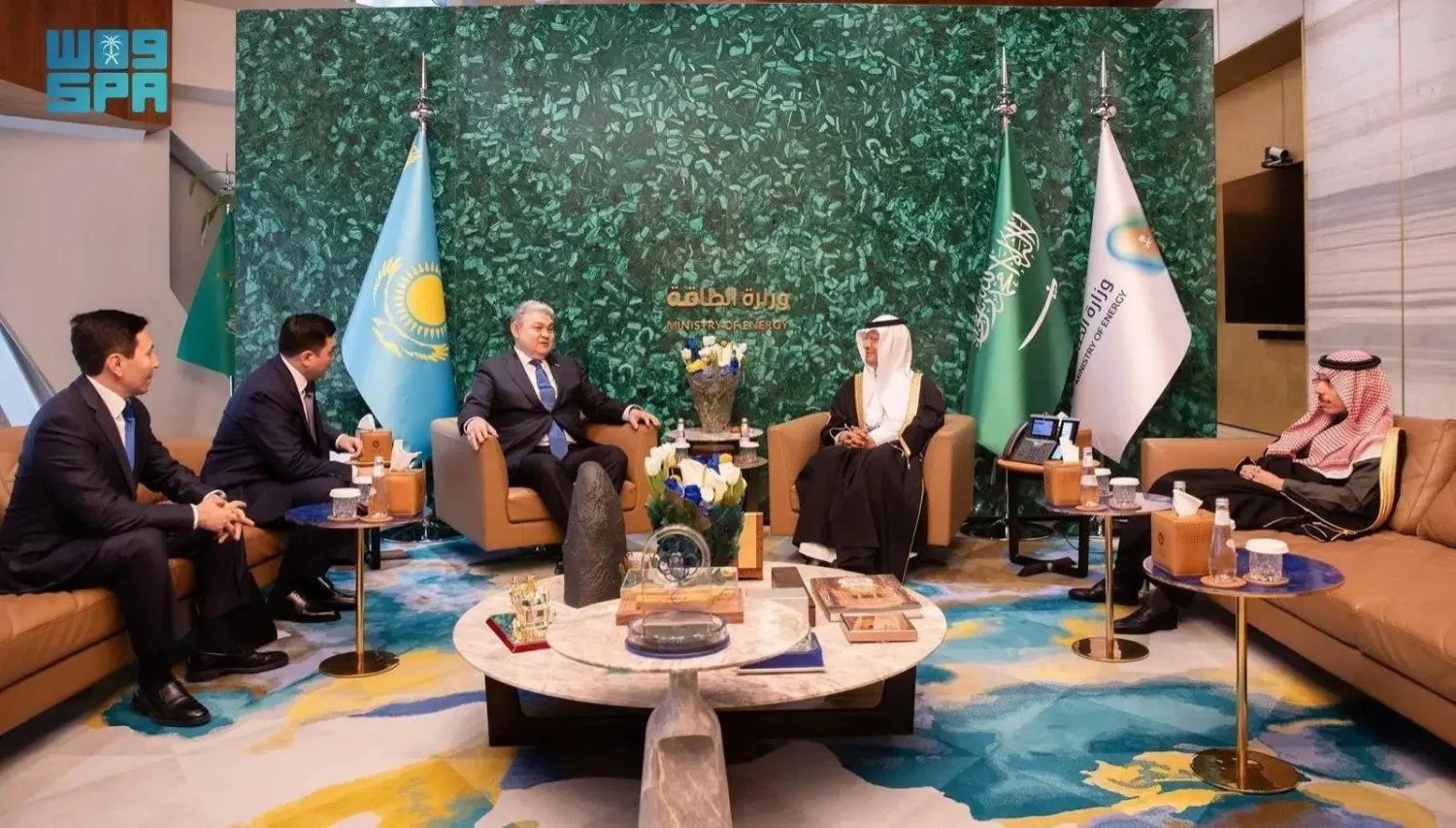
Saudi Arabia, Kazakhstan Agree to Establish Coordination Council

Saudi Minister of Energy Prince Abdulaziz bin Salman bin Abdulaziz receives Kazakhstan’s Foreign Minister Yermek Kosherbayev in Riyadh. (SPA)
TT

Saudi Arabia, Kazakhstan Agree to Establish Coordination Council

Saudi Minister of Energy Prince Abdulaziz bin Salman bin Abdulaziz receives Kazakhstan’s Foreign Minister Yermek Kosherbayev in Riyadh. (SPA)

Saudi Arabia and Kazakhstan agreed to establish a Saudi-Kazakh Coordination Council, reported the Saudi Press Agency on Tuesday.

Saudi Minister of Energy Prince Abdulaziz bin Salman bin Abdulaziz received in Riyadh Kazakhstan’s Foreign Minister Yermek Kosherbayev. Saudi FM Prince Faisal bin Farhan bin Abdullah and Minister of Energy of Kazakhstan Yerlan Akkenzhenov also attended the meeting.

The talks tackled the establishment of the coordination council, which will be chaired by the Saudi minister of energy and Kazakhstan’s foreign minister. The council reflects the two countries’ commitment to strengthening cooperation and expanding their bilateral partnership.

Prince Abdulaziz and Kosherbayev signed an agreement on the establishment of the council, which aims to boost coordination and consultation between the two countries and develop frameworks for cooperation across various sectors of mutual interest, elevating bilateral relations to broader levels.

Prince Abdulaziz and Kosherbayev discussed relations between their countries and ways to develop them further, especially in the energy field. They tackled opportunities for cooperation and investment in renewable energy and energy storage systems and discussed oil market developments.


Saudi-Qatari Partnership Paves Way for Logistics Corridors to Boost Regional Trade Efficiency 

The MoU was signed by Mawani President Eng. Suliman Almazroua and CEO of Qatar Ports Management Company Captain Abdullah Mohammed Al-Khanji. (QNA)
TT

Saudi-Qatari Partnership Paves Way for Logistics Corridors to Boost Regional Trade Efficiency 

The MoU was signed by Mawani President Eng. Suliman Almazroua and CEO of Qatar Ports Management Company Captain Abdullah Mohammed Al-Khanji. (QNA)

The Saudi Ports Authority (Mawani) and Qatar Ports Management Company signed on Tuesday a memorandum of understanding (MoU) aimed at boosting maritime and logistics cooperation between the two sides.

The agreement will contribute to the development of the ports sector, raising operational efficiency, and supporting regional and international trade flows.

The MoU was signed by Mawani President Eng. Suliman Almazroua and CEO of Qatar Ports Management Company Captain Abdullah Mohammed Al-Khanji. Qatari Ambassador to Saudi Arabia Bandar bin Mohammed Al Attiyah attended the signing ceremony.

The agreement reflects Saudi Arabia and Qatar’s commitment to building effective partnerships, exchanging expertise, establishing an organized framework for cooperation management, and developing joint investment opportunities in line with Saudi Vision 2030 and Qatar National Vision 2030.

The MoU outlines eight key areas of cooperation, including the exchange of best practices in port management and operations, and the study of opportunities for direct maritime and land connectivity between the ports of both countries to enhance trade flow efficiency.

It includes collaboration in logistics services, exploring the establishment of joint maritime corridors serving bilateral and regional trade, and assessing the feasibility of creating shared regional distribution centers.

In the fields of digital transformation and artificial intelligence, the two sides agreed to deepen cooperation on developing smart systems, data governance, and the unified maritime window, thereby boosting operational efficiency and keeping pace with technological advancements in the maritime sector.

The MoU places strong emphasis on maritime safety and environmental protection, including exchanging expertise in combating marine pollution and emergency response; developing joint maritime emergency plans; establishing an emergency communication line between the two countries; and cooperating to ensure compliance with international conventions, conduct joint exercises, and develop risk monitoring systems.

The cooperation also covers human capital development through joint training programs and field-exchange of expertise, as well as academic and research collaboration in maritime transport and logistics.

In terms of joint investment, both sides will study local and global investment opportunities in ports and related services and coordinate with the private sector to support these initiatives.

The MoU further includes cooperation in cruise tourism through enhanced maritime connectivity and joint promotion of Gulf cruise routes, as well as international and regional representation by coordinating positions in international maritime organizations and supporting joint initiatives, notably “Green Ports” and “Safe Sea Corridors.”

The agreement reflects the commitment of Mawani and Qatar Ports Management Company to advancing the ports sector and boosting its role as a key driver of trade and economic growth, contributing to Gulf integration and enhancing regional competitiveness in maritime and marine services.