

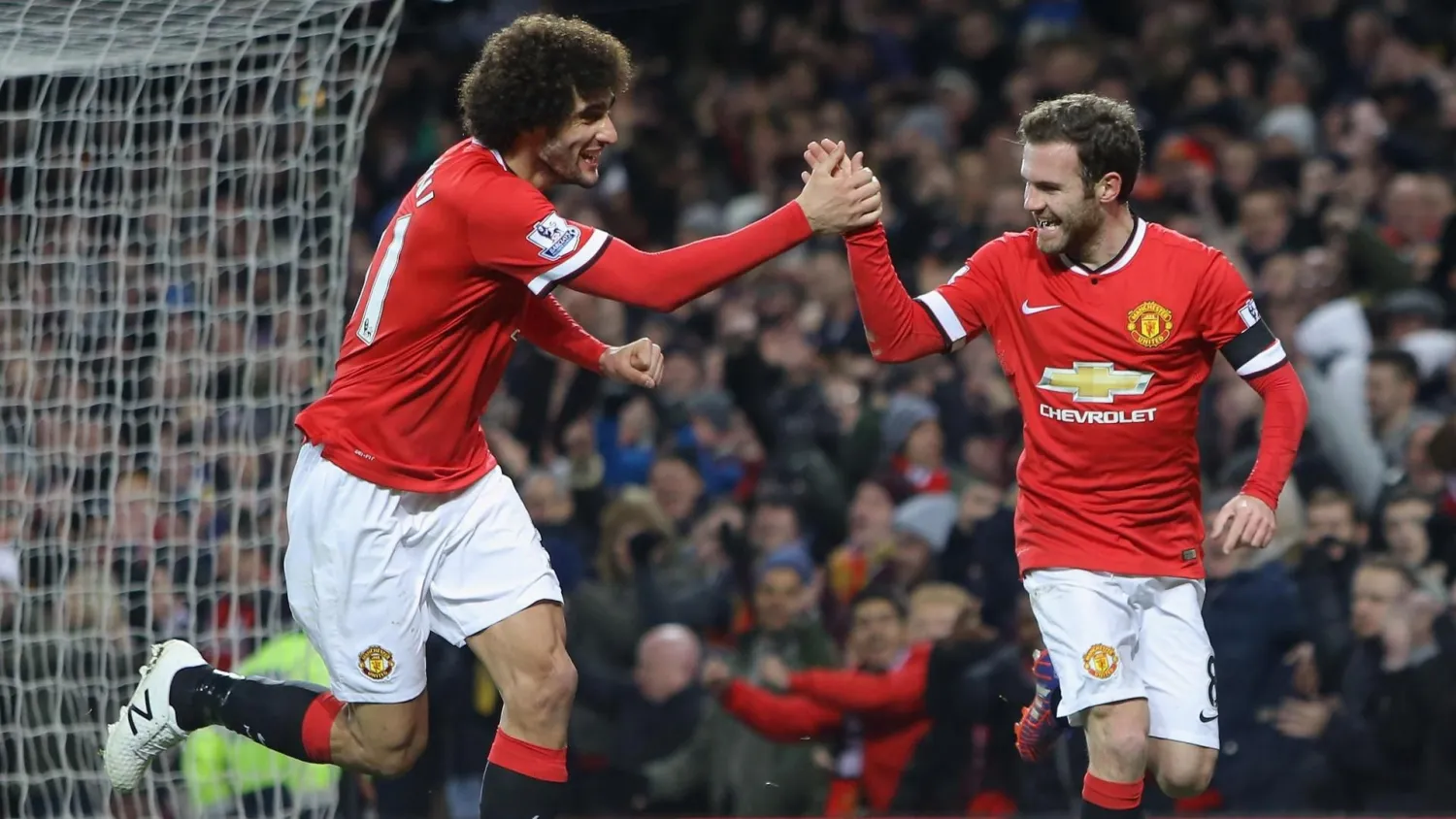

Mata-Marouane: The Moyesian Odd Couple Nearing a United Redemption

 Juan Mata and Marouane Fellaini
Juan Mata and Marouane Fellaini
TT

Mata-Marouane: The Moyesian Odd Couple Nearing a United Redemption

 Juan Mata and Marouane Fellaini
Juan Mata and Marouane Fellaini

In the years after the fall of the Berlin Wall a phenomenon bubbled up in Eastern Europe called “ostalgie”, or nostalgia for the old east. Seized with ostalgie, citizens of the new world found themselves tiring of the glories of capitalism, with its treacly soft drinks, unfettered access to soft-rock music and a natureless ecstasy of identical consumer products; and yearning instead for the old certainties of communism, the gulag and mass-produced cardboard trousers. As recently as last year a majority of Romanians said they missed the murderous despot Nicolae Ceausescu. Presumably, again, because you knew where you stood and the statues were nice.

It goes to show you can miss anything if you really want to. With exceptions of course. For example there are to date no documented examples of what social scientists might call “Moyestalgia”, which is defined as nostalgia for the events and personnel of David Moyes’s time in charge of Manchester United over 10 grippingly doomed months between July 2013 and April 2014.

I think I know why this is. I think it’s because it was a terrible time when nothing good happened. But for the neutral there is still something grippingly cinematic about the basic category-mistake of Moyes at United, a man not so much out of his depth as tossed and tumbled head over heels in a vast tide of industrial-scale confusion. Squint and you can still just about see his pale, frazzled ghost wandering about on the touchline, still looking like a doomed wedding cake figurine in his sad blue suit, shouting at shadows, pointing at things that never happened, feeling the ground beneath his shiny little shoes shift and fall away.

At the end of which there is a still a chance to take a different memory from this. On the face of it José Mourinho’s current title contenders have almost nothing in common with the brown-paper-and-string stylings of the Moyes succession. From De Gea to Lukaku, through Bailly-Jones-Pogba-Matic and the controlled creativity of Rashford-Martial this second-season team has a classic Mourinho spine in place, those powerful interlocking units that have marked his most successful moments.

Almost nothing, but not quite. In the last few weeks it has been fascinating to see a couple of Moyesian hangovers integrated into the machine. Marouane Fellaini and Juan Mata were the only players signed under Moyes. Even at the time they seemed oddly mismatched, evidence in their silhouettes alone of a certain confusion. On the one hand an awkward, angular midfield wardrobe. On the other a technician whose entire career has been a triumph of vision and skill over his own slight physique.

In the years since both players have been a little bruised and marginalized. Mata and Fellaini are both 29 now and in the last year of their contracts. No other player has come to United for that much money and stayed for this long without winning a league title (even Juan Sebastián Verón got one of those). For all the good moments, they are still on some level, a part of the unforgiven.

Except there is a chance now for an alternative ending. Neither looks like a first-choice starter with everyone fit. But both have become functioning parts in a team that has drawn drooling reviews for its power, its unity of purpose, the sheer relief of no longer looking like an odd-job of high-priced parts. This is in its own way an act of genuine team building, the ability to integrate a pair of wobbly wheels and weld them to the main frame.

Even then Mata and Fellaini stand out. And not only for that air of shared survivor-dom but for something agreeably timeless and touching, a little soul, a few scars. If Fellaini can recover his fitness in time they may even appear against Crystal Palace on Saturday, yoked together on the touchline like an odd-couple man-child double act in a Steinbeck novella. Watching the pair of them answer questions in front of the post-match cameras you half expect to hear things like: “I’m sorry mister my brother he gone strangled your rabbit he don’t mean no harm he just kinda clumsy whoah put the gun down mister.”

Perhaps just me, but something does seem to be working here. The last time Manchester United lost a game that Fellaini started was the 4-0 to Chelsea in October 2016. Of his last 45 first-team appearances only three have ended in defeat. One was as an 89th-minute sub in the EFL Cup semi-final second leg. Another was the FA Cup game at Chelsea where Ander Herrera was sent off. The last was against Real Madrid in the European Super Cup in August, when United actually “won” during Fellaini’s 35 minutes on the pitch.

Still, though, Fellaini divides opinion. Some see a blunt, stodgy, elbow-flailing obstacle. Others see only his bad points. But he is a high-class team player when the system works for him. This season he has seemed to do a little less to good effect, having fewer shots, fewer fouls, fewer headers, holding his position and still able to reel out his most outstanding quality, that astonishing Velcro chest control, a footballer with a chest like a hand, able to rise like a huge, angular sea and simply clutch the ball out of the sky with a wriggle of the shoulders.

Mata is obviously a different type, all bandy-legged fine-point craft. His time at Old Trafford has been a bit easier, maybe because he looks like a United player, maybe because he is such an endearing, likeable figure, and maybe because he’s changed a bit. The idea Mata doesn’t track back should always be judged against the fact hustling and harrying for 90 minutes is so much harder for a player of his size and stamina. But this season he has clearly taken the Mourinho pill. These are early days, of course. We are still grinding through the high gears. If a United title challenge does come Mata-Marouane will add another shade to the pursuit, plus perhaps a deeper emotional tone. It is easy to dismiss footballers’ finer feelings, to see only pampered traveling contractors. But these are still creatures of ambition and anxiety. Both Mata and Fellaini may end up with more appearances for United than any other club by the end of this season, the current febrile four-year spell the dominant segment of their careers. Whatever happens this could, in its own way, end up a redemption story. Perhaps even – the pallor, the panic, the ghosts – a minor sporting exorcism.

(The Guardian)


Shakhtar Boss Pays Ukrainian Racer $200,000 After Games Disqualification

Ukrainian President Volodymyr Zelenskiy holds helmet as he meets with a Ukrainian skeleton racer Vladyslav Heraskevych , who was disqualified from the Olympic skeleton competition over his "helmet of remembrance" depicting athletes killed since Russia's invasion and his father and coach, Mykhailo Heraskevych, amid Russia's attack on Ukraine, in Munich, Germany February 13, 2026. (Ukrainian Presidential Press Service/Handout via Reuters)
TT

Shakhtar Boss Pays Ukrainian Racer $200,000 After Games Disqualification

Ukrainian President Volodymyr Zelenskiy holds helmet as he meets with a Ukrainian skeleton racer Vladyslav Heraskevych , who was disqualified from the Olympic skeleton competition over his "helmet of remembrance" depicting athletes killed since Russia's invasion and his father and coach, Mykhailo Heraskevych, amid Russia's attack on Ukraine, in Munich, Germany February 13, 2026. (Ukrainian Presidential Press Service/Handout via Reuters)

The owner of ‌Ukrainian football club Shakhtar Donetsk has donated more than $200,000 to skeleton racer Vladyslav Heraskevych after the athlete was disqualified from the Milano Cortina Winter Games before competing over the use of a helmet depicting Ukrainian athletes killed in the war with Russia, the club said on Tuesday.

The 27-year-old Heraskevych was disqualified last week when the International Bobsleigh and Skeleton Federation jury ruled that imagery on the helmet — depicting athletes killed since Russia invaded Ukraine in 2022 — breached rules on athletes' expression at ‌the Games.

He ‌then lost an appeal at the Court ‌of ⁠Arbitration for Sport hours ⁠before the final two runs of his competition, having missed the first two runs due to his disqualification.

Heraskevych had been allowed to train with the helmet that displayed the faces of 24 dead Ukrainian athletes for several days in Cortina d'Ampezzo where the sliding center is, but the International Olympic Committee then ⁠warned him a day before his competition ‌started that he could not wear ‌it there.

“Vlad Heraskevych was denied the opportunity to compete for victory ‌at the Olympic Games, yet he returns to Ukraine a ‌true winner," Shakhtar President Rinat Akhmetov said in a club statement.

"The respect and pride he has earned among Ukrainians through his actions are the highest reward. At the same time, I want him to ‌have enough energy and resources to continue his sporting career, as well as to fight ⁠for truth, freedom ⁠and the remembrance of those who gave their lives for Ukraine," he said.

The amount is equal to the prize money Ukraine pays athletes who win a gold medal at the Games.

The case dominated headlines early on at the Olympics, with IOC President Kirsty Coventry meeting Heraskevych on Thursday morning at the sliding venue in a failed last-minute attempt to broker a compromise.

The IOC suggested he wear a black armband and display the helmet before and after the race, but said using it in competition breached rules on keeping politics off fields of play. Heraskevych also earned praise from Ukraine President Volodymyr Zelenskiy.


Speed Skating-Italy Clinch Shock Men’s Team Pursuit Gold, Canada Successfully Defend Women’s Title

 Team Italy with Davide Ghiotto, Andrea Giovannini, Michele Malfatti, celebrate winning the gold medal on the podium of the men's team pursuit speed skating race at the 2026 Winter Olympics, in Milan, Italy, Tuesday, Feb. 17, 2026. (AP)
Team Italy with Davide Ghiotto, Andrea Giovannini, Michele Malfatti, celebrate winning the gold medal on the podium of the men's team pursuit speed skating race at the 2026 Winter Olympics, in Milan, Italy, Tuesday, Feb. 17, 2026. (AP)
TT

Speed Skating-Italy Clinch Shock Men’s Team Pursuit Gold, Canada Successfully Defend Women’s Title

 Team Italy with Davide Ghiotto, Andrea Giovannini, Michele Malfatti, celebrate winning the gold medal on the podium of the men's team pursuit speed skating race at the 2026 Winter Olympics, in Milan, Italy, Tuesday, Feb. 17, 2026. (AP)
Team Italy with Davide Ghiotto, Andrea Giovannini, Michele Malfatti, celebrate winning the gold medal on the podium of the men's team pursuit speed skating race at the 2026 Winter Olympics, in Milan, Italy, Tuesday, Feb. 17, 2026. (AP)

An inspired Italy delighted the home crowd with a stunning victory in the Olympic men's team pursuit final as

Canada's Ivanie Blondin, Valerie Maltais and Isabelle Weidemann delivered another seamless performance to beat the Netherlands in the women's event and retain their title ‌on Tuesday.

Italy's ‌men upset the US who ‌arrived ⁠at the Games ⁠as world champions and gold medal favorites.

Spurred on by double Olympic champion Francesca Lollobrigida, the Italian team of Davide Ghiotto, Andrea Giovannini and Michele Malfatti electrified a frenzied arena as they stormed ⁠to a time of three ‌minutes 39.20 seconds - ‌a commanding 4.51 seconds clear of the ‌Americans with China taking bronze.

The roar inside ‌the venue as Italy powered home was thunderous as the crowd rose to their feet, cheering the host nation to one ‌of their most special golds of a highly successful Games.

Canada's women ⁠crossed ⁠the line 0.96 seconds ahead of the Netherlands, stopping the clock at two minutes 55.81 seconds, and

Japan rounded out the women's podium by beating the US in the Final B.

It was only Canada's third gold medal of the Games, following Mikael Kingsbury's win in men's dual moguls and Megan Oldham's victory in women's freeski big air.


Lindsey Vonn Back in US Following Crash in Olympic Downhill 

Milano Cortina 2026 Olympics - Alpine Skiing - Women's Downhill 3rd Official Training - Tofane Alpine Skiing Centre, Belluno, Italy - February 07, 2026. Lindsey Vonn of United States in action during training. (Reuters)
TT

Lindsey Vonn Back in US Following Crash in Olympic Downhill 

Milano Cortina 2026 Olympics - Alpine Skiing - Women's Downhill 3rd Official Training - Tofane Alpine Skiing Centre, Belluno, Italy - February 07, 2026. Lindsey Vonn of United States in action during training. (Reuters)

Lindsey Vonn is back home in the US following a week of treatment at a hospital in Italy after breaking her left leg in the Olympic downhill at the Milan Cortina Games.

“Haven’t stood on my feet in over a week... been in a hospital bed immobile since my race. And although I’m not yet able to stand, being back on home soil feels amazing,” Vonn posted on X with an American flag emoji. “Huge thank you to everyone in Italy for taking good care of me.”

The 41-year-old Vonn suffered a complex tibia fracture that has already been operated on multiple times following her Feb. 8 crash. She has said she'll need more surgery in the US.

Nine days before her fall in Cortina d'Ampezzo, Italy, Vonn ruptured the ACL in her left knee in another crash in Switzerland.

Even before then, all eyes had been on her as the feel-good story heading into the Olympics for her comeback after nearly six years of retirement.
