


Sluggish Housing Market Draws Buyers to Corsica

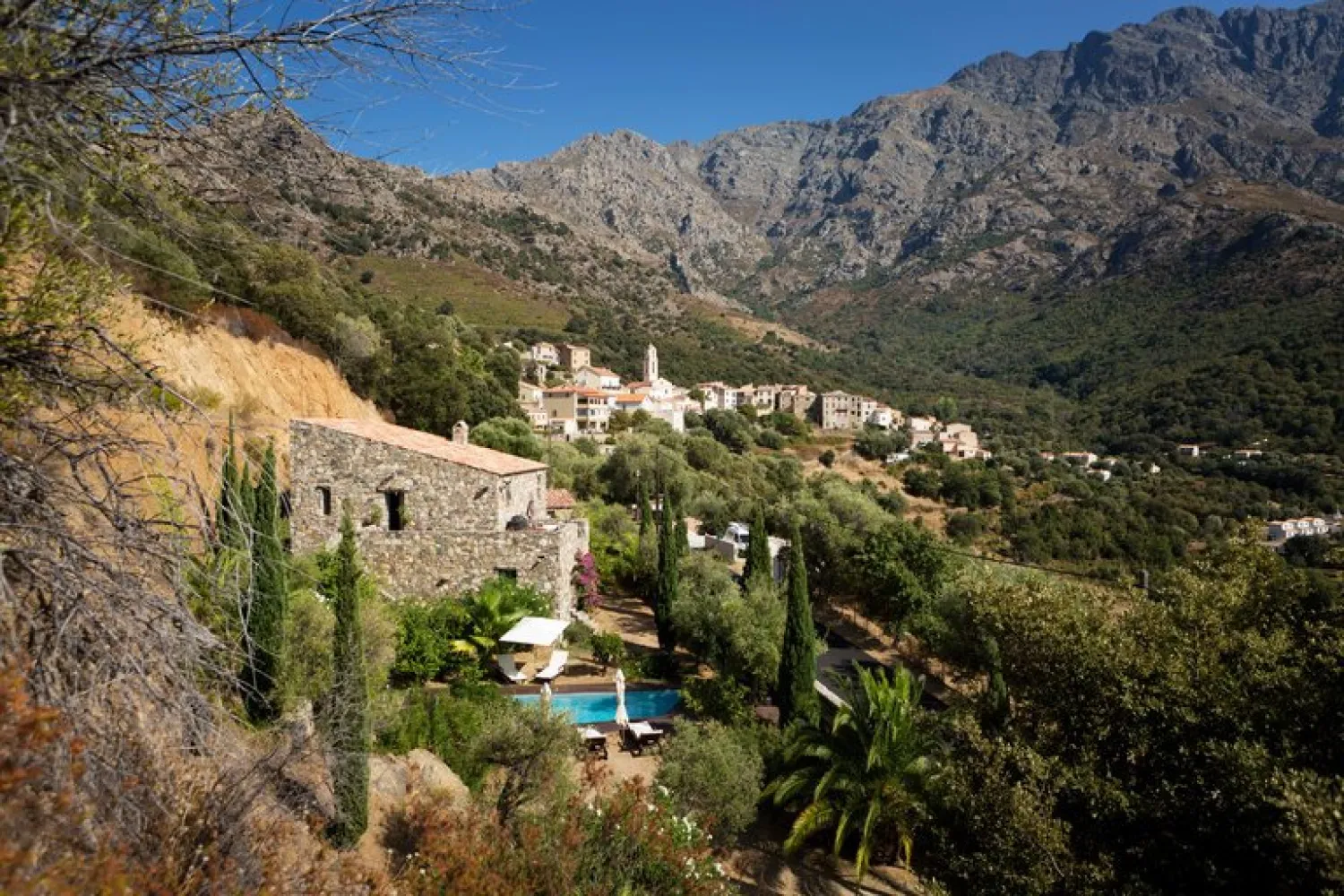
A two-story, three-bedroom stone villa that blends into the mountains in Zilia, Corsica, is on the market for $1.76 million. Credit Rebecca Marshall for The New York Times
TT

Sluggish Housing Market Draws Buyers to Corsica

A two-story, three-bedroom stone villa that blends into the mountains in Zilia, Corsica, is on the market for $1.76 million. Credit Rebecca Marshall for The New York Times

Corsica- This two-story stone villa with a roof terrace sits in the rocky hills of northern Corsica, a French island. The 2,152-square-foot home was constructed in 2008 on a lot of more than half an acre and has three bedrooms and three bathrooms. The property includes a swimming pool with a wooden deck, along with a 323-square-foot stone building used for storage that could be converted to a master suite, said Frédéric Olivieri, the listing agent with Sotheby’s International Realty.

The home — which was designed by Marc Held, a French architect, with his son Mathias, the homeowner — was inspired by vernacular Corsican architecture. Made of local stone, it has an austere look, with a sloped roof and small, traditional Corsican windows with interior shutters; inside, the ceilings are high, with painted wooden beams. All three airy bedrooms are off the ground-floor entrance, each with painted wood floors and its own en-suite bathroom. A wooden staircase ascends to the second floor, which has a large living room with a wood-burning fireplace and an open kitchen with an island and oak cabinets. A large roof terrace, reached by an exterior staircase, offers views of Monte Grosso. The villa is air-conditioned and has parking, but no garage.

The property is in Zilia, a village of about 300 with vineyards and a mineral spring. Landscaped with palm, citrus and olive trees, the villa is about 15 minutes from Algajola beach and less than half an hour from the coastal city of Calvi, which has about 5,400 residents and an international airport. Ajaccio, the capital of Corsica, has a population of more than 68,000 and is about three hours away.

Market Overview
Corsica, a Mediterranean island with about 330,000 residents, is known for its stunning beaches and is essentially divided into two housing markets, in the north and south, said Lionel Thomas, the founder and real estate director of the brokerage and advisory agency Mr. & Mrs. Thomas Private Office.

“The pricing is more expensive on the south side of the island, where there are more celebrities, and it’s more fashionable than the north,” Mr. Thomas said, whereas the northern side has “less construction, more historic buildings” and is “a bit more windy and colder in the winter.”

The price of waterfront properties in both areas has increased dramatically over the past decade, but the general housing market has faced challenges following events like the global financial crisis of 2008 and, more recently, Brexit and the French presidential election, brokers said.

“Corsica, and the whole of the French market, has been a tough one for the last few years,” said Alexandra Connolly, director of Alexandra Lloyd Properties, a real estate agency based in Nice that specializes in properties on the French coast and Corsica.

But while the housing market may be sluggish, prices significantly lower than those of comparable homes on the French Riviera may draw some buyers, agents said. “We recently sold a 300-square-meter waterfront home near Porto-Vecchio, with its own beach, for 5 million euros,” Mr. Olivieri said. “A similar offer on the Riviera would be hard to find and would at least cost double the price.”

Average prices in Corsica’s population centers are wide ranging, said Claudia Mura, a director with Barnes International Realty Corsica. In Bastia, in the north, the average is roughly 2,400 euros a square meter, or $265 a square foot, she noted, while in Lecci, to the south, the average is about 4,900 euros a square meter, or $542 a square foot. And waterfront properties in cities like Lecci, Bonifacio and Porto-Vecchio in the south can be more than 20,000 euros a square meter, or $2,211 a square foot, Ms. Mura said.

Who Buys in Corsica
The housing market is mostly fueled by French buyers, including many expatriates, brokers said. But the number of foreign buyers is growing, many of them from Belgium, Switzerland, Britain, Italy, Germany, the United States, Holland and the Scandinavian countries.

Buying Basics
There are no restrictions on foreign buyers in Corsica, which is an administrative region of France. As in mainland France, a notary typically conducts the sale and a lawyer is not necessary, brokers said.

Buyers pay about 7 percent of the sale price in fees, which include the notary fee and any government taxes, Ms. Connolly said.

Mortgages are available to foreign buyers, though depending on circumstances, they may have to put down 35 to 40 percent rather than the 25 percent required of local buyers, Mr. Thomas said.

Languages and Currency
French, Corsican; euro (1 euro = $1.19)

Taxes and Fees
The annual property taxes on this home are about 4,000 euros, or $4,760.

The New York Times


War Weighs on Egypt’s Private Sector as PMI Hits Near Two-Year Low in March

People walk past a closed cinema as shops close early under a government-ordered curfew aimed at reducing energy costs in downtown Cairo on April 2, 2026. (AFP)
TT

War Weighs on Egypt’s Private Sector as PMI Hits Near Two-Year Low in March

People walk past a closed cinema as shops close early under a government-ordered curfew aimed at reducing energy costs in downtown Cairo on April 2, 2026. (AFP)

Egypt's non-oil private ‌sector deteriorated at its sharpest pace in almost two years in March, as the Middle East war drove up costs and dampened client demand, a closely watched business survey showed on Sunday.

The headline S&P Global Egypt Purchasing Managers' Index fell for a fourth consecutive month, dropping to 48.0 in March from 48.9 in February — its lowest reading since April 2024.

The ‌figure remained below ‌the 50.0 threshold that ‌separates growth ⁠from contraction, though ⁠it was broadly in line with the survey's long-run average of 48.2.

Output and new orders were the chief drags on the index, with both measures also hitting their lowest levels for nearly two years. Firms frequently blamed ⁠the Middle East conflict for dampening client ‌demand, partly through ‌intensifying price pressures.

In a first, business expectations for the ‌coming 12 months slipped into negative territory, with ‌companies citing uncertainty over the war as a key reason for pessimism, though the degree of gloom was described as mild.

David Owen, senior economist at ‌S&P Global Market Intelligence, nevertheless noted that "the latest figure of 48.0 still relates ⁠to ⁠annual GDP growth of around 4.3%," adding that "recent data suggests the domestic non-oil sector is on a solid underlying growth path."

Cost pressures remained a serious concern, however. Input prices surged at their joint-sharpest pace in one-and-a-half years, as firms cited fuel costs and other war-related commodity price increases, compounded by a stronger US dollar.

In response, companies raised their selling prices at the fastest rate in 10 months, though the increase remained modest overall.


Middle East War Presents ‘Serious Risk’ for Africa, Warns Report

Festus Mwirotsi, 34, scouts for pests and diseases in roses meant for export at Isinya Roses farm in Kajiado, Kenya, March 24, 2026, as Kenya's flower industry is losing up to $1.4 million a week as the Iran war cuts demand and disrupts shipping. (AP)
TT

Middle East War Presents ‘Serious Risk’ for Africa, Warns Report

Festus Mwirotsi, 34, scouts for pests and diseases in roses meant for export at Isinya Roses farm in Kajiado, Kenya, March 24, 2026, as Kenya's flower industry is losing up to $1.4 million a week as the Iran war cuts demand and disrupts shipping. (AP)

The Middle East war "presents a serious risk to Africa", the African Union and the African Development Bank (AfDB) said in a report seen by AFP Saturday.

The conflict threatens to increase the cost of living and curtail growth on the continent, the report warned.

The Middle East accounts for 15.8 percent of Africa's imports and 10.9 percent of its exports, the report noted.

"The conflict, which already has triggered a trade shock, could quickly turn into a cost-of-living crisis across Africa through higher fuel and food prices, rising shipping and insurance costs, exchange rate pressures, and tighter fiscal conditions," it added.

The growth rate of most African countries continues to be slower than before the Covid pandemic, it noted.

"A loss in output growth of 0.2 percentage points on Africa's GDP is projected for 2026 if it (the conflict) exceeds six months," it said.

"The longer the conflict lasts and the more severe the disruption to shipping routes and energy and fertilizer supplies, the greater the risk of a significant growth slowdown across the continent."

Reduced deliveries of liquefied natural gas (LNG) from the Gulf will impact fertilizer production, limiting its availability during the crucial planting period up to May, it added.

- Currencies hit -

The report was compiled by the UN Development Program (UNDP) and the United Nations Economic Commission for Africa (UNECA).

According to recent data from the AfDB, the currencies of 29 African countries have already depreciated, increasing the cost of servicing external debt, making imports more expensive and reducing foreign exchange reserves,

Some countries could see some short-term gains, such as Nigeria for its oil exports or Mozambique for its LNG.

The rerouting of ships around Cape of Good Hope could benefit ports in Mozambique, South Africa, Namibia and Mauritius.

Kenya is establishing itself as a logistics hub in East Africa, while Ethiopian Airlines, the leading carrier in Africa, is serving as an "emergency air bridge" between the continent, Asia, and Europe, the report noted.

But these gains are likely to be uneven and will not offset the consequences for inflation, budgets, and food security in Africa, they warned.

Above all, the current crisis could hit the costs of humanitarian aid and divert donor funds towards other priorities.


Taiwan Says It Has Assurances over LNG Supplies from 'Major' Country

The Taipei 101 skyscraper is seen lit up before the Earth Hour in Taipei, Taiwan, Saturday, March 28, 2026. (AP Photo/ Chiang Ying-ying)
TT

Taiwan Says It Has Assurances over LNG Supplies from 'Major' Country

The Taipei 101 skyscraper is seen lit up before the Earth Hour in Taipei, Taiwan, Saturday, March 28, 2026. (AP Photo/ Chiang Ying-ying)

Taiwan has received ‌supply assurances from the energy minister of a "major" liquefied natural gas-producing country, the island's economy minister said on Saturday, speaking about the Iran war's impact on Middle East energy imports.

Taiwan, a major semiconductor producer, had relied on Qatar for around a third of its LNG before the conflict, and has said it has secured alternate supplies for the months ahead from countries including Australia and the United States, said Reuters.

Speaking to ‌reporters in Taipei, ‌Economy Minister Kung Ming-hsin said that ‌because ⁠Taiwan has good ⁠relationships with its crude oil and natural gas suppliers, neither adjusting shipment origins nor purchasing additional spot cargoes would be a problem.

Kung said that about two weeks ago the energy minister of a certain "major energy-producing country" proactively contacted him.

The person "explained to us that they ⁠would fully support our natural gas needs. ‌If we have any ‌demand, we can let them know," he added.

"Another country even ‌said that some countries have released strategic petroleum ‌reserves, and they could also help coordinate matters if Taiwan needs assistance," Kung said.

"This shows that Taiwan has in fact earned considerable goodwill internationally through the long-term trust ‌it has built over the years," he said.

He declined to name the countries involved.

Angela ⁠Lin, ⁠spokesperson for state-owned refiner CPC, said at the same news conference that crude oil inventories were being maintained at pre-conflict levels and overall petrochemical feedstock supplies have remained stable.

CPC Chairman Fang Jeng-zen said that to reduce dependence on the Middle East, a new contract with the US will see 1.2 million metric tons of LNG supplied annually, with even more to come in the future, including eventually from Alaska.

However, Taiwan is not considering importing crude or LNG from Russia, he added.
