

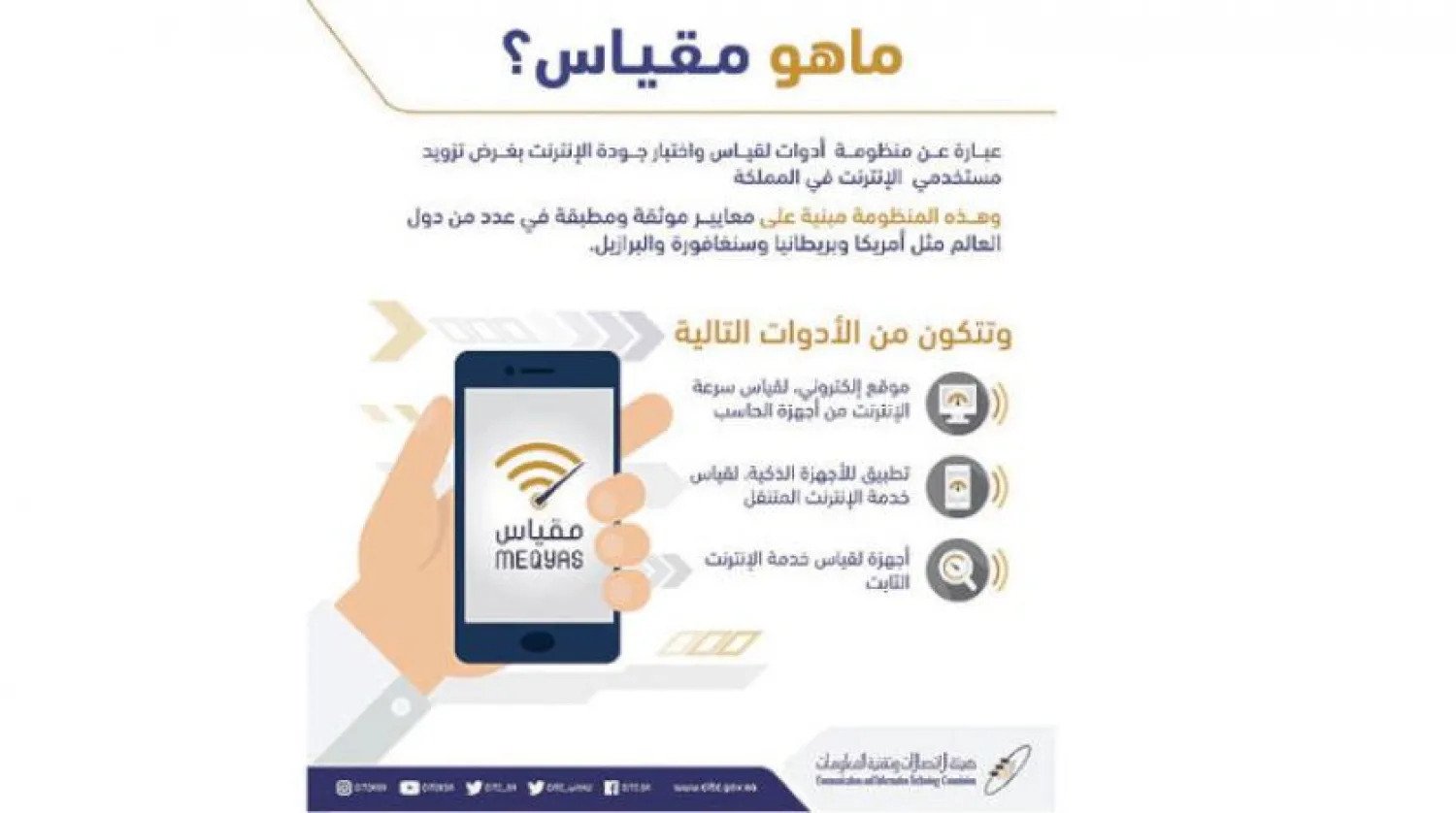

Saudi Arabia Launches Internet Quality Measurement Platform ‘Meqyas’

Meqyas instructions flowchart, Asharq Al-Awsat
TT

Saudi Arabia Launches Internet Quality Measurement Platform ‘Meqyas’

Meqyas instructions flowchart, Asharq Al-Awsat

In a move to increase the efficiency of Saudi internet services, the Saudi Communications and Information Technology Commission announced on Tuesday the launch of a measurement platform, ‘Meqyas.’

Meqyas is an initiative by The Communications and Information Technology Commission (CITC) to establish Internet Quality of Experience Measurement Platform in order to provide internet users in Saudi Arabia with reliable and accurate data concerning broadband and mobile internet services.

The Communications and Information Technology Commission (CITC) has partnered with SamKnows to implement and operate the measurement platform using world-class technologies and tools.

The CITC said that the aim of the initiative is to provide users with information pertaining to the quality of the Internet experience provided to them in a transparent manner, and to increase competition between service providers to improve quality.

These developments come at a time when Internet services in Saudi Arabia are the biggest driver of the telecom sector in the country. Local telecom operators are focusing on improving the quality of their services in this vital sector.

The CITC explained that the Internet measurement platform is influenced by several factors, such as the efficiency of the service provider's network tower, the distance from the supplying modem, the router's internal settings, and the number of users and devices tapping into the same point simultaneously.

It is noteworthy that ‘Meqyas’ is a different system of tools for users measure the quality of the internet provided them, and enables to follow the levels of quality at different time periods on a weekly basis, monthly, annually and according to international standards.

Meqyas aims to provide internet subscribers in Saudi Arabia with reliable and accurate data concerning broadband and mobile internet performance across the country.

More so, the CITC recently announced the number of mobile subscriptions in the country has reached 43.6 million, according to the latest statistics.

On the other hand, the communications commission had launched its electronic bulletin on monitoring the latest developments in the ICT sector in the Kingdom by the end of the second quarter of 2017.

The bulletin included the number of subscriptions to telecommunications services, which reached about 43.6 million-- 3.75 million lines represent the number of fixed line lines, while subscriptions to broadband services through mobile networks with a total definition amounted to about 25.2 million subscriptions.

The number of subscriptions to broadband services over fixed telecommunication networks reached 3.2 million, including DSL, fixed wireless connections, fiber optics and other wired lines.

As for the number of Internet users in the Kingdom, CITC said in its bulletin that the number of Internet users in the country reached 24 million users.

Saudi telecoms listed on the local capital market posted a remarkable growth in profits for the first half of 2017, with earnings growth of about 13 per cent compared to the first half of last year.



Saudi FM Stresses Ongoing Support for UN Efforts to Promote Values of Dialogue, Tolerance

The Saudi Foreign Minister chaired the opening of the 11th UNAOC Global Forum in Riyadh. SPA
TT

Saudi FM Stresses Ongoing Support for UN Efforts to Promote Values of Dialogue, Tolerance

The Saudi Foreign Minister chaired the opening of the 11th UNAOC Global Forum in Riyadh. SPA

Saudi Minister of Foreign Affairs Prince Faisal bin Farhan bin Abdullah chaired on Sunday the opening session of the 11th Global Forum of the United Nations Alliance of Civilizations (UNAOC), hosted by Riyadh, under the theme “Two Decades of Dialogue for Humanity: Advancing a New Era of Mutual Respect and Understanding in a Multipolar World."

The forum was attended by UN Secretary-General Antonio Guterres, High Representative for the United Nations Alliance of Civilizations Miguel Angel Moratinos, a number of foreign ministers from different countries, political and religious leaders, heads of international organizations, and representatives of civil society.

In his address at the opening session, the Saudi Foreign Minister affirmed that the Kingdom’s hosting of the forum reflects its continued support for United Nations efforts to promote the values of dialogue, tolerance, and peaceful coexistence among civilizations and cultures.

He underscored that Saudi Vision 2030 embodies a national approach grounded in moderation and openness to other civilizations, as well as in confronting hate speech and extremism.

Prince Faisal highlighted that the convening of the 11th session of the United Nations Alliance of Civilizations serves to review past efforts and to exchange views and ideas on how to manage diversity and differences by building bridges of communication and dialogue among various civilizations and religions.

Prince Faisal stressed that youth are the true embodiment of hope, stating: “They are the leaders of the future and messengers of peace. In this context, I cannot help but express my great pleasure at seeing such a large number of young people in this hall.”

“A youth forum is being held on the sidelines of this forum, and this venue will host the graduation of the eighth cohort of the Young Leaders Qualification Program of the (Salam) Project for Civilizational Communication. Accordingly, it can be said that this United Nations Alliance of Civilizations forum is a forum for youth,” he added.

The forum aims to review the achievements of two decades of global dialogue, discuss current challenges, and envision the future of joint action to enhance mutual understanding among peoples and build bridges of communication that support international peace and stability.


Libya’s Unity Gov. Urges Stronger Partnership with Saudi Arabia on Development Projects

Abdul Hamid Dbeibah during his meeting with members of the Saudi delegation (Dbeibah's Office)
TT

Libya’s Unity Gov. Urges Stronger Partnership with Saudi Arabia on Development Projects

Abdul Hamid Dbeibah during his meeting with members of the Saudi delegation (Dbeibah's Office)

Libya’s Government of National Unity has called for strengthening partnerships with Saudi Arabia in development projects.

The appeal came during a meeting on Thursday between Prime Minister Abdul Hamid Dbeibah and a high-level delegation from Saudi Arabia’s Amiantit Group.

The group is one of the world's leading companies in the manufacturing of pipes and tanks, offering innovative solutions for water management and infrastructure.

The meeting was also attended by a representative of Technical Link Services for Communications (TLS), a subsidiary of Etihad Salam Telecommunications, which specializes in communications and information technology solutions.

Discussions centered on strengthening Libyan-Saudi cooperation to advance infrastructure projects, stimulate investment in the industrial and agricultural sectors, and expand prospects for collaboration.

The meeting followed agreements with Libya’s Ministry of Housing and Construction on water infrastructure, specialized factories, and advanced water treatment solutions.

The agreements also included deals that aim to upgrade Libya’s communications infrastructure and modernize its IT and telecom services.

In January, on the sidelines of the World Economic Forum in Davos, Dbeibah had outlined Libya’s vision to strengthen cooperation with Gulf countries, particularly Saudi Arabia to attract international investment across various economic and development sectors.

He discussed with several Saudi officials ways to reinforce bilateral partnerships in oil, gas, and renewable energy, highlighting Saudi Arabia as a key partner in developing Libya’s oil infrastructure.


Saudi-Emirati Team in Aden to Restore Calm in Eastern Yemen

A view of Yemen's interim capital Aden. (Reuters file)
TT

Saudi-Emirati Team in Aden to Restore Calm in Eastern Yemen

A view of Yemen's interim capital Aden. (Reuters file)

A Saudi-Emirati team arrived in Yemen’s interim capital Aden on an urgent mission to put in place executive mechanisms for the withdrawal of the Southern Transitional Council (STC) forces from the Hadhramaut and al-Mahra provinces and returning them under the control of previous forces under the direct supervision of the Saudi-led Arab coalition.

The team will discuss arrangements related to the handover of positions to the National Shield Forces to ensure that the situation returns to the way it was before the escalation.

The step is in line with Saudi Arabia’s intense efforts to end the escalation in eastern Yemen, in rejection of any unilateral measures taken by the STC in Hadhramaut, which the coalition viewed as an attempt to impose a new status quo or drag the province into internal strife that threatens peace and stability.

Sources told Asharq Al-Awsat that the arrival of the team consolidates Riyadh’s rejection of activities that may create mistrust or deepen the divisions inside Yemen’s legitimate institutions.