



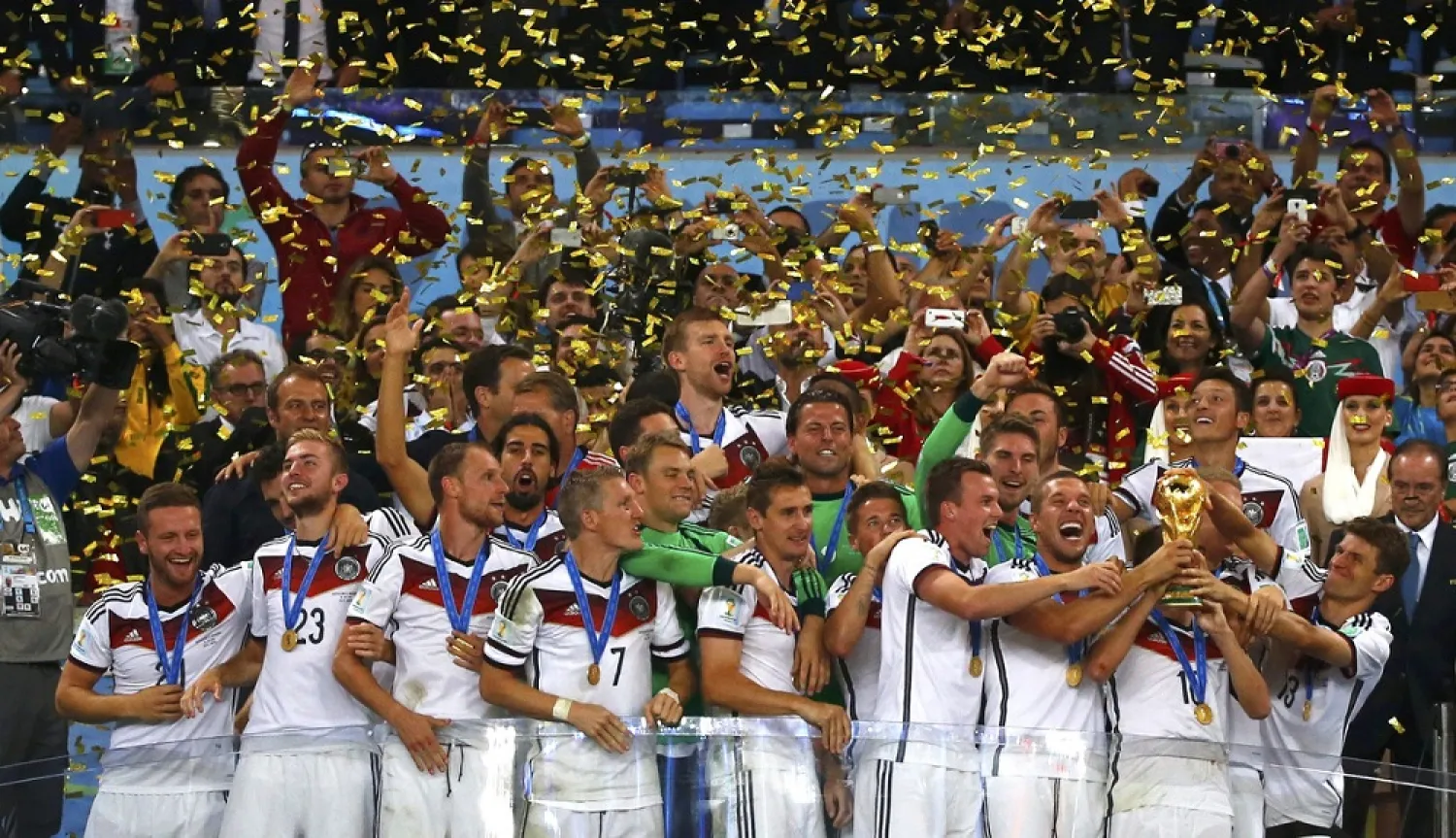

Twenty-three nations have booked their places for the World Cup in Russia, with the holders and Brazil looking in good shape, but we rank England in 13th place, below Iceland:
1) Germany
If the world champions were frustrated by their failure to win continental honors at Euro 2016 they have certainly taken it out on everyone else since. Germany won 10 qualifying games out of 10 and, even if San Marino’s presence in Group C needs taking into account, a record 43 goals scored suggests things are back in their old working order. So too did their Confederations Cup title in July, achieved with an experimental squad. Joachim Löw can select from an unrivaled depth of talent and, while winning back-to-back World Cups remains a huge task, none of next summer’s contenders has an equivalent selection of tools with which to tackle the different challenges they will face.
2) Brazil
Brazil look revitalized under Tite and the light work they made of the fiendish Conmebol qualifying procedure was deeply impressive. The manager has openly stated they should be listed among the leading contenders next summer; it is hard to disagree and it is worth listening to Dani Alves when he says Tite’s human touch makes him “very distant from all Brazilian coaches”. Neymar, Gabriel Jesus, Casemiro, Philippe Coutinho and an energized Paulinho are among those benefiting from the transformation and perhaps a sequence of failing to lift the trophy since 2002 will be ended in Russia.
3) Spain
Will it aid Spain that, certainly unlike most of their European rivals, they have already had to dispose of another World Cup contender in the qualifiers? Italy may well make it through the play-offs and, in fairness the rest of Group G was not up to much, but that 3-0 win at the Bernabéu last month was ominous and La Roja’s new generation appear ready to challenge seriously next summer. Álvaro Morata is developing into a genuinely world-class striker; Marco Asensio has a glittering career ahead at just 21; and the in-form Isco, who scored twice against the Italians, has been given room to express himself by Julen Lopetegui. Spain have emerged from their rough period to look a major force once again.
4) France
Qualifying was not without the odd hiccup – but for the frame of the goal that home draw with Luxembourg could have become something far more humiliating – but France did well in one of the more awkward groups and the potential of Antoine Griezmann, Paul Pogba, Ousmane Dembélé and Kylian Mbappé trumps that of virtually any side that will be playing in Russia. Can Didier Deschamps get the best out of them all? If he can then France, who have few obvious weaknesses on paper, will deserve to be ranked among the favorites next summer.
5) Belgium
Belgium put on one of Europe’s better qualifying campaigns, negating any real threat from two potentially tricky rivals in Bosnia-Herzegovina and Greece. Perhaps the unlikely combination of the Spaniard Roberto Martínez and the Frenchman Thierry Henry can deliver where Marc Wilmots failed and produce a run of convincing tournament performances. Romelu Lukaku’s form for club and country makes Christian Benteke’s struggles all the less troublesome, while Dries Mertens is in the form of his life for Napoli. None of their other mainstays need too much introduction and there remains the tantalizing prospect that, should everything be harnessed correctly, Belgium can do something special.
6) Portugal
They only scraped into the automatic qualification place although, save for a post-Euro 2016 hangover defeat in Switzerland, there was not too much wrong with Portugal’s campaign. Now the question is whether Fernando Santos can get players such as Bernardo Silva and André Silva to perform on the highest stage, and whether Cristiano Ronaldo – who will be 33 when Russia 2018 comes around – can handle a game every three or four days for, potentially, a month. Should Santos succeed then Portugal ought to be more fluid than the team that did not win too many friends in taking the European title.
7) Argentina
The bones will be picked out of a qualifying campaign that flirted with disaster and required saving by a Lionel Messi masterclass in Ecuador, but Argentina have made it and will automatically be installed as one of the favorites. It is worth pointing out that everyone bar Brazil came close to missing out in an extraordinary Conmebol qualifying group; it will also be a big concern, though, that the gap between Jorge Sampaoli’s team and their bitterest rivals – whom they did defeat in a summer friendly – was so big. They certainly have the individual talent to bridge it in Russia – and, in what will probably be his last World Cup, Messi has the incentive to deliver more magic.
8) Poland
There is a strut to Poland under Adam Nawalka and they fit neatly into any “dark horse” assessment – not least because the world’s sixth-ranked side will be one of the eight seeded teams in Russia. That is almost entirely down to their outstanding form during qualifying, marred only by a puzzling 4-0 defeat in Denmark; goals are not usually a problem and especially not for Robert Lewandowski, who scored 16 of their 28 in Group E. They are fast and assertive at their best. The worry would be that, as seemed to be the case at Euro 2016, Lewandowski may try to do too much and blunt his own effectiveness in the penalty area.
9) Mexico
The urbane Juan Carlos Osorio may not be universally popular in Mexico but his team barely had to break sweat in a poor qualifying group, an irrelevant (to them) late defeat away to Honduras notwithstanding. The Colombian Osorio has been criticized for his rotation of players, among other things but El Tri play with clarity and, with Carlos Vela and Javier Hernández both in their prime, carry a serious threat. It is still hard to see them mustering a performance that can overthrow one or more of the favorites, though.
10) Nigeria
Nigeria have started to get their house in order and there is distinct optimism around a generation of players that looks their best hope of a last-eight spot in some years. Victor Moses, Wilfred Ndidi, Kelechi Iheanacho and Alex Iwobi add Premier League quality. The coach, the German Gernot Rohr, has molded a balanced and organized side that can be lethal on the counterattack and maybe, after a series of nondescript World Cup appearances, Nigeria are now equipped for something more.
11) Uruguay
The one guarantee with Uruguay is that they will always hang in there and second place in the South American qualifiers was a pleasant tonic after a run of three consecutive defeats either side of Christmas. Luis Suárez and Edinson Cavani always give you a decent chance and they have an exceptional midfield talent coming through behind them in Federico Valverde. They finished up in good form with a 4-2 win over Bolivia although, with 20 goals conceded, Óscar Tabárez may be concerned that some of their time-honored solidity needs recapturing.
12) Iceland
The Iceland manager, Heimir Hallgrimsson, believes his side should turn up in Russia with the same hope of winning as anyone else. Nobody would dare laugh nowadays: Iceland kept their heads to win a fiendish Group I after Croatia folded with the finishing line in sight, and the question now is whether they can at least emulate their last-eight finish of Euro 2016. They can be such a difficult team to analyze, sometimes lacking an obvious pattern of play, but they benefit from an exceptional knowledge of one another and unswervable self-belief. Those two factors, added to the match-winning excellence of Gylfi Sigurdsson, could leave them perfectly equipped for another eye-catching campaign.
13) England
England were barely dealt a single problem in the most sterile of qualifying groups. Performances in the last two major tournaments speak rather less favorably of their prospects and they are left in a curious position where, after years in which their potential was often grossly overstated, expectations will perhaps move a little exaggeratedly in the other direction. Gareth Southgate’s team are competent enough and have an outstanding striker in Harry Kane; the problem is that nothing about what goes on behind him seems at all intuitive. There has been plenty of talk about lessons being learned in the team’s wider approach to tournament football; that may be so but the smart money is still on England pulling through the group stage comfortably enough before floundering against bolder opponents.
14) Egypt
What a story Egypt’s World Cup qualification, their first since 1990, provided and the good news might not stop there. Héctor Cúper’s team showed at the Africa Cup of Nations, where they finished runners-up to Cameroon, that they know their way around a major tournament and in Mohammed Salah they have a talisman who can decide tight games against anyone. They have an experienced spine, plenty of momentum and an immediate target – the Argentinian Cúper has already asked them to make the last 16 and, if they can take the initiative against sides that drop deep, it should not be beyond them.
15) Colombia
Colombia spluttered over the line and will need to be better if their quarter-final finish of 2014 is to be emulated. It is almost certainly a final chance on this stage for Radamel Falcao, who so cruelly missed out four years ago, while a repeat of last time around from James Rodríguez – generally disappointing since then – will probably be in order too. José Pekerman was relieved his team secured qualification by drawing with Peru and the resilience the Argentina-born coach showed in the critical draw in Peru will be required in spades eight months from now.
16) Serbia
It has been quite a turnaround for Serbia since, almost exactly three years ago, they underwent the shame of that fateful Euro 2016 qualifier against Albania and the picture looks altogether brighter now after they came top of a hard Group D. Nemanja Matic is the linchpin of a team with a pleasing blend of youth and experience. Slavoljub Muslin probably lacks the goalscoring power for a deep run next summer, but Serbia have been under-performing for some time and should, as a minimum, provide larger countries with an awkward moment or two.
17) Iran
“Team Melli” have never been past the group stage at a World Cup and, while they topped Group A in Asia’s third qualifying round by seven points, it would appear difficult for the Portuguese Carlos Queiroz to inspire something better next summer. Iran found it much harder to put teams away than their position suggested, although they were hardly averse to grinding out a result – five away games brought just two goals in total, both in 1-0 victories. They have a solid defense and a forward of great talent in Sardar Azmoun, but may struggle against stronger sides.
18) Costa Rica
Costa Rica continue to punch above their weight and their record in qualifying against the USA – inflicting two grievous blows in winning 4-0 and 2-0 – was eye-catching. They have a world-class goalkeeper in Keylor Navas although the squad as a whole is aging somewhat. It is a stretch to imagine they have the potential to reach the quarter-finals again, although only a fool would dismiss them out of hand. Their last meeting with a European side, a narrow defeat to Spain two years ago, suggests they should compete.
19) Japan
Vahid Halilhodzic looked to be on borrowed time before Japan, in beating Australia 2-0 six weeks ago, secured their progress to a sixth successive World Cup. The chances of bettering their two last-16 finishes seem fairly remote, although the Bosnian Halilhodzic took Algeria through the group stage in 2014 and, in a funny way, looks a better fit for the final tournament than for the qualifiers. Japan have plenty of European experience these days but, like Algeria, will still need to show signs of over-performing to move up these rankings.
20) Russia
Rarely has the buildup to a World Cup brought such little local enthusiasm for the home team, although Qatar may run Russia close in four years’ time. At the Confederations Cup it was Cristiano Ronaldo, rather than Stanislav Cherchesov’s stodgy side, that brought the crowds out in their droves and there is little obvious reason for that to change. Friendly results, including a win achieved in a slightly eccentric assignment against Dinamo Moscow, have been decent enough but it would currently take an optimistic soul to look beyond a last-16 exit at best.
21) Saudi Arabia
Saudi Arabia thanked Bert van Marwijk for taking them to a first World Cup in 12 years and promptly parted company with the Dutchman, negotiations for a new contract breaking down amid suggestions that he was not spending enough time in the country. It means they have lost the services of a 2010 World Cup finalist – with Holland – for next year’s tournament and the Argentinian Edgardo Bauza, who had been coaching their qualifying group B rivals the United Arab Emirates, will lead them to Russia instead. They did well to pip Australia to automatic qualification and look forward to players such as the prolific Mohammed al-Sahlawi to step up and have an impact.
22) South Korea
An unconvincing set of qualifiers was compounded by friendly defeats to Russia and Morocco – 4-2 and 3-2 respectively – this month and optimism is distinctly lacking. South Korea have not won a game since March, when they beat Syria 1-0, and bar the admirable Son Heung-min they possess few names to make opponents sit up. Shin Tae-yong, appointed in July, has a battle on his hands – not least to win round South Korea’s fans, who still hold out hope of a glorious return to the fold for Guus Hiddink.
23) Panama
Barely known to most without a keen interest in the Concacaf qualifying tournament, Panama are a welcome new face and will be ready to bloody a nose or two. If we are being harsh, their form in a group low on quality was essentially middling – and they had a decisive slice of luck against Costa Rica on Tuesday when their equalizer was given despite not crossing the line – but nobody in the country will care. They disrupted the USA, among others, with some strong-arm tactics on the road to Russia – perhaps recalling Honduras’s performance at Brazil 2014.
The Guardian Sport


