

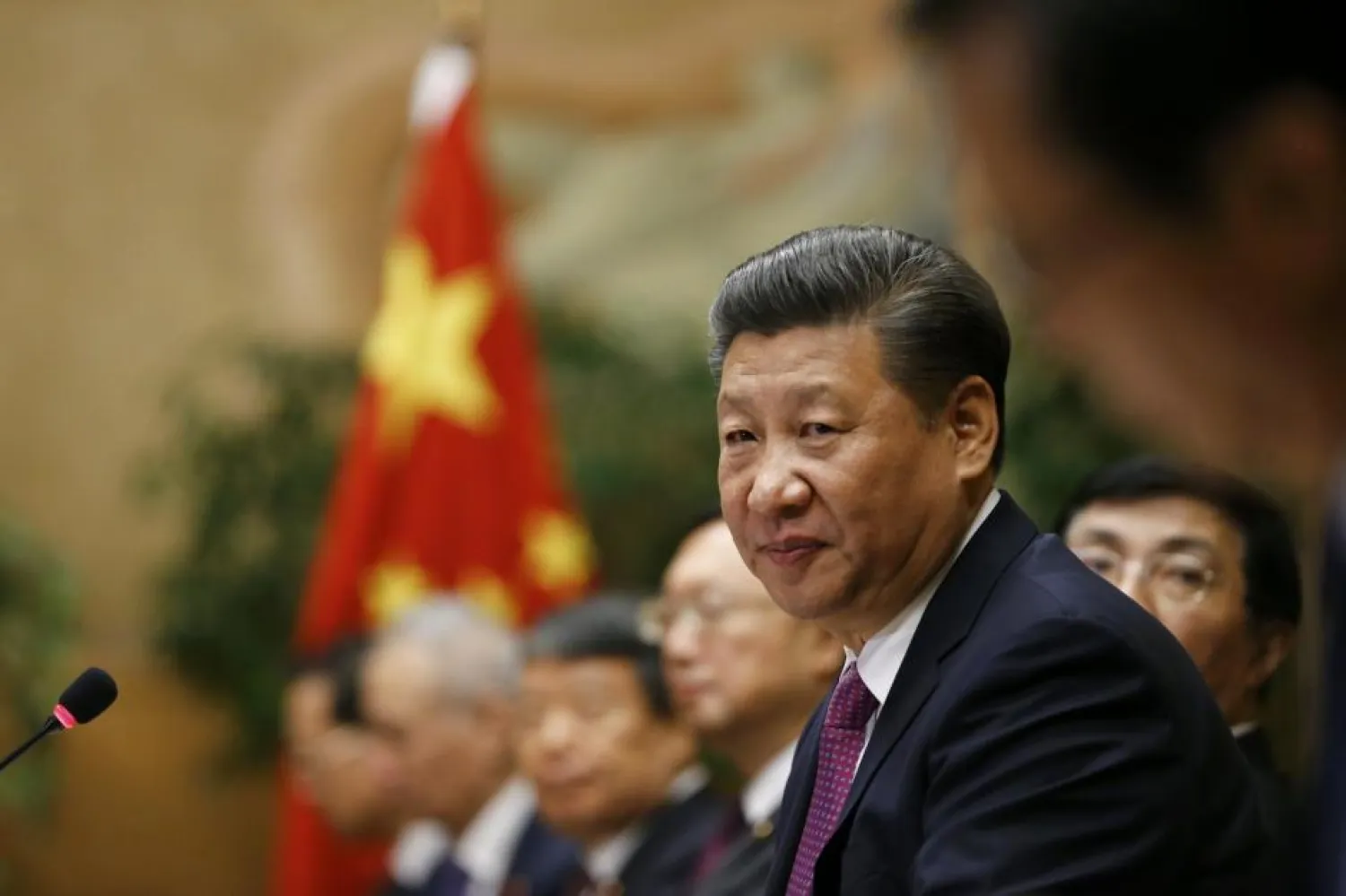

China Gears up for National Congress as Xi Seeks to Consolidate Power

Chinese President Xi Jinping. (Reuters)
TT

China Gears up for National Congress as Xi Seeks to Consolidate Power

Chinese President Xi Jinping. (Reuters)

China’s ruling Communist Party is preparing to hold its national congress on Wednesday where President Xi Jinping is expected to consolidate his power and head on a second five-year term in office.

Amid the stability he has achieved in China during his term in office, beyond the borders, the situation is not so calm.

There, he is at the mercy of two unpredictable men, US President Donald Trump and North Korean strongman Kim Jong Un - a predicament that points to the limits of China's bid to project soft power, said an Agence France Presse report.

Some analysts say Kim could try to cause a stir by testing another missile or nuclear bomb in the middle of China's most important political event, which is held every five years.

A new test could trigger another 140-character salvo by Trump, who has alternated between prodding and praising Xi's response to North Korea.

Trump's mercurial Twitter diplomacy has contrasted with Xi's unemotional style. The US leader has also pointedly left Xi hanging over whether he will hit China with tariffs over trade grievances.

Despite the mixed messages, Xi has professed his friendship with Trump, confirming an invitation for the US president to come to Beijing next month, when they will discuss trade and North Korea face-to-face.

His relationship with Kim is also complicated.

The North Korean leader has already interfered with two international summits that the Chinese president has hosted this year, by staging headline-grabbing provocations.

In May, as Xi prepared to address world leaders gathered in Beijing on his signature Belt and Road initiative - a Chinese-led trade infrastructure program - the North successfully launched a new ballistic missile.

Then in September, it conducted its most powerful nuclear test to date, hours before Xi took the stage for a speech before leaders of the developing world at the annual BRICS summit.

The timing was seen as a slight towards Xi and an attempt by Kim to strongarm his Chinese neighbor into convincing Trump to sit down for talks.

A new nuclear test during the party congress "would be more than a loss of face. It will harm the ruling party of China," said Cheng Xiaohe, an associate professor of international relations at Renmin University in Beijing. "It will harm Xi Jinping at this crucial moment."

On Wednesday, Xi will address the nation to lay out his political and economic vision for the world's second-largest economy over the next five years.

Villages will broadcast news of the congress over loudspeakers, a security crackdown has been extended and monitoring of dissidents strengthened.

Xi, who is expected to get a second five-year term as party leader at the gathering, will kick off events with an address indicating whether his personal political theory will be entered into the party constitution alongside those of predecessors such as Mao Zedong and Deng Xiaoping.

Xi's speech is also expected to recommit the party to achieving the goals of a "moderately well-off society" by 2021 — the 100th anniversary of the party's founding — and even greater national power and prosperity by 2049 — the centenary of the founding of the Communist state.

Those achievements will depend on continued economic growth and the lifting of millions out of poverty, alongside the continued rapid expansion of Chinese military and political power, including its growing ability to dominate the Asia-Pacific region.

While the nation's presidency is limited to two five-year terms, the office of party general secretary is bound by no such restrictions. Xi, 64, could step aside for a younger leader while maintaining ultimate control from behind the scenes.

Whatever the outcome, most analysts say Xi has largely completed the task of sidelining his competitors in other cliques, including those surrounding his immediate predecessor, Hu Jintao, and former leader Jiang Zemin.

"Xi has been extremely successful in purging political rivals," said Feng Chongyi, an expert on Chinese politics at Sydney's University of Technology. "There will be only one faction left after the 19th congress."

The 2,287 carefully hand-picked delegates to the congress are drawn from 40 constituencies, including the 31 provincial-level administrative districts, the government, the military, state industries and grass-roots organizations representing most of the party's 89 million members.



Russia's Lavrov Warns against Any New US Strike on Iran

FILE PHOTO: Russia's Foreign Minister Sergei Lavrov speaks during an annual press conference in Moscow, Russia, January 14, 2025. REUTERS/Evgenia Novozhenina/File Photo
TT

Russia's Lavrov Warns against Any New US Strike on Iran

FILE PHOTO: Russia's Foreign Minister Sergei Lavrov speaks during an annual press conference in Moscow, Russia, January 14, 2025. REUTERS/Evgenia Novozhenina/File Photo

Russian Foreign Minister Sergei Lavrov, in ‌an interview made public on Wednesday, said that any new US strike on Iran would have serious consequences and called for restraint to find a solution to enable Iran to pursue a peaceful nuclear program.

Lavrov's interview with Saudi Arabia's Al-Arabiya television was aired a day after US and Iranian negotiators held indirect talks in Geneva to head off a new mounting crisis between Washington and Tehran, Reuters said.

"The consequences are not good. There have already been strikes on Iran on ‌nuclear sites ‌under the control of the International Atomic ‌Energy ⁠Agency. From what ⁠we can judge there were real risks of a nuclear incident," Lavrov said in the interview, which was posted on his ministry's website.

"I am carefully watching reactions in the region from Arab countries, Gulf monarchies. No one wants an increase in tension. Everyone understands this is playing with fire."

Boosting ⁠tensions, he said, could undo the ‌positive steps of recent years, including ‌improved relations between Iran and nearby countries, notably Saudi Arabia.

A senior ‌US official told Reuters on Wednesday that Iran was ‌expected to submit a written proposal on how to resolve its standoff with the United States after the talks in Geneva.

US national security advisers met in the White House on Wednesday and ‌were told all US military forces deployed to the region should be in place ⁠by mid-March, ⁠the official said.

The United States wants Iran to give up its nuclear program, and Iran has adamantly refused and denied it is trying to develop an atomic weapon.

Lavrov said Arab countries were sending signals to Washington "clearly calling for restraint and a search for an agreement that will not infringe on Iran's lawful rights and ... guarantee that Iran has a purely peaceful nuclear enrichment program".

Russia, he said, remained in close, regular contact with Iran's leaders "and we have no reason to doubt that Iran sincerely wants to resolve this problem on the basis of observing the Nuclear Non-Proliferation Treaty".


AI Cannot Be Left to 'Whims of a Few Billionaires', UN Chief Says

India's Prime Minister Narendra Modi speaks with United Nations Secretary-General Antonio Guterres during a welcoming ceremony at AI Impact Summit, in New Delhi, India, February 18, 2026. India's Press Information Bureau/Handout via REUTERS
TT

AI Cannot Be Left to 'Whims of a Few Billionaires', UN Chief Says

India's Prime Minister Narendra Modi speaks with United Nations Secretary-General Antonio Guterres during a welcoming ceremony at AI Impact Summit, in New Delhi, India, February 18, 2026. India's Press Information Bureau/Handout via REUTERS

UN chief Antonio Guterres warned technology leaders Thursday of the risks of artificial intelligence, saying its future cannot be left to "the whims of a few billionaires".

Speaking at a global AI summit in India, the UN chief called on tech tycoons to support a $3 billion global fund to ensure open access to the fast-advancing technology for all.

"AI must belong to everyone," he said.

"The future of AI cannot be decided by a handful of countries -- or left to the whims of a few billionaires," he added, warning the world risked deepening inequality unless urgent steps were taken.

"Done right, AI can... accelerate breakthroughs in medicine, expand learning opportunities, strengthen food security, bolster climate action and disaster preparedness and improve access to vital public services," he said.

"But it can also deepen inequality, amplify bias and fuel harm."

The UN has set up an AI scientific advisory body to help countries make decisions about the revolutionary technology.

Guterres warned that people must be protected from exploitation, and that "no child should be a test subject for unregulated AI".

He pressed for global guardrails to ensure oversight and accountability, and the creation of "Global Fund on AI" to build basic capacity.

"Our target is $3 billion," he told the conference, which includes national leaders as well as tech CEOs, including Sam Altman of OpenAI and Google's Sundar Pichai.

"That's less than one percent of the annual revenue of a single tech company. A small price for AI diffusion that benefits all, including the businesses building AI."

Without investment, "many countries will be logged out of the AI age", exacerbating global divides, he said.

He also cautioned that as AI's energy and water demands soar, data centers must switch to clean power, rather than "shift costs to vulnerable communities".


US Military Tells Trump It's ‘Ready’ to Strike Iran as Soon as Saturday

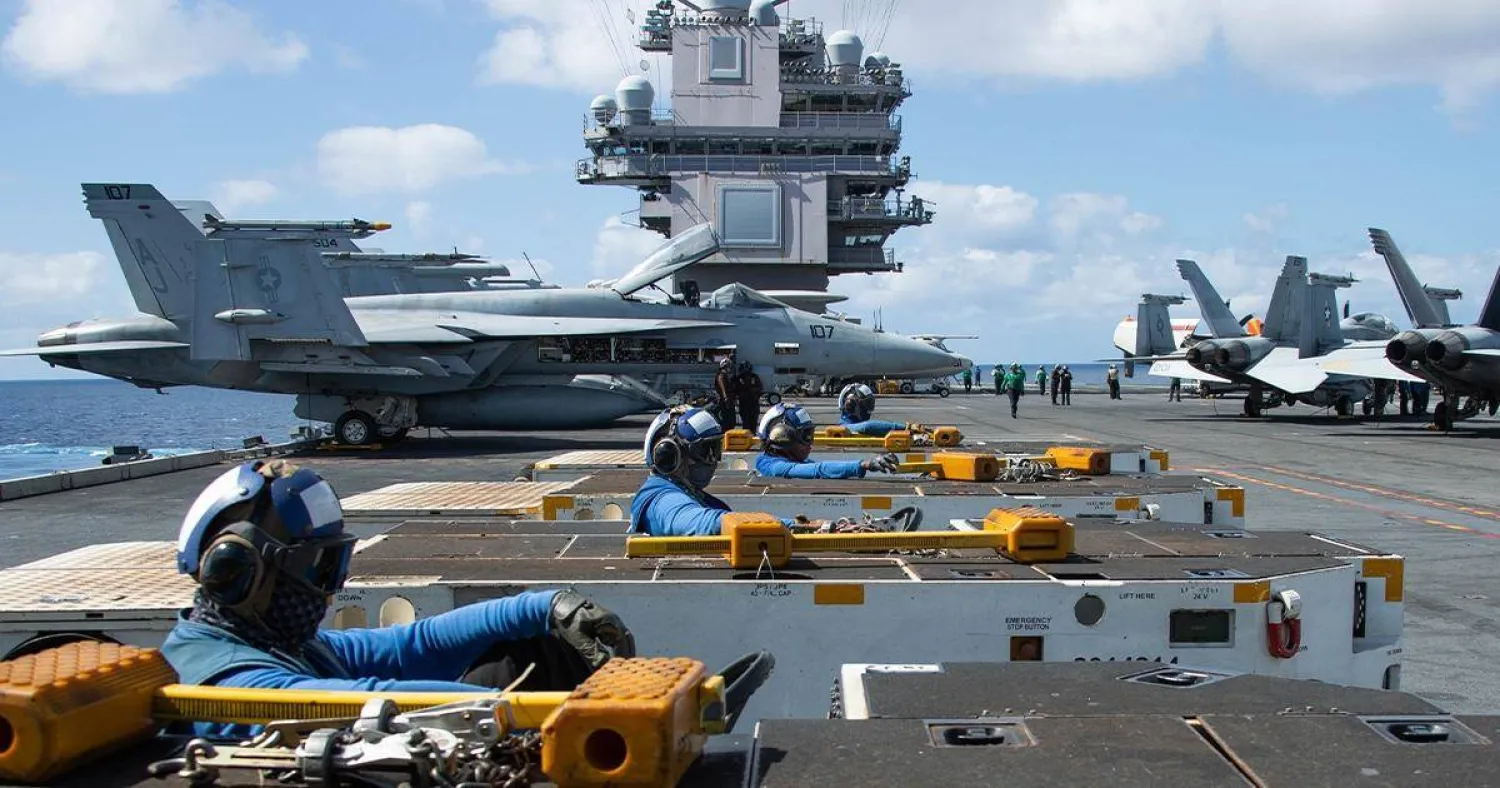
A shot showing personnel preparations aboard the US aircraft carrier "Gerald Ford" (US Navy)
TT

US Military Tells Trump It's ‘Ready’ to Strike Iran as Soon as Saturday

A shot showing personnel preparations aboard the US aircraft carrier "Gerald Ford" (US Navy)

Top national security officials have told US President Donald Trump the military is ready for potential strikes on Iran as soon as Saturday, but the timeline for any action is likely to extend beyond this weekend, sources familiar with the discussions told CBS News.

Trump has not yet made a final decision about whether to strike, said the officials, who spoke under condition of anonymity to discuss sensitive national matters.

The conversations have been described as fluid and ongoing, as the White House weighs the risks of escalation and the political and military consequences of restraint, added CBS.

Over the next three days, the Pentagon is moving some personnel temporarily out of the Middle East region — primarily to Europe or back to the United States — ahead of potential action or counterattacks by Iran if the US were to move ahead with its operation, according to multiple officials.

It's standard practice for the Pentagon to shift assets and personnel ahead of a potential US military activity and doesn't necessarily signal an attack on Iran is imminent, one of the sources told CBS.

Contacted by CBS News on Wednesday afternoon, a Pentagon spokesperson said they had no information to provide.

Iran was discussed in the White House Situation Room on Wednesday, a US official and a senior military official told CBS News. All military forces deployed to the region are expected to be in place by mid-March.

Axios had also said that a war between the United States and Iran is looming — and there are several factors suggesting President Trump might push the button soon.

On Wednesday, Iran's top diplomat Abbas Araghchi said that Tehran was "drafting" a framework for future talks with the United States, as the US energy secretary said Washington would stop Iran's nuclear ambitions "one way or another".